010-6097 4119Book a Demo


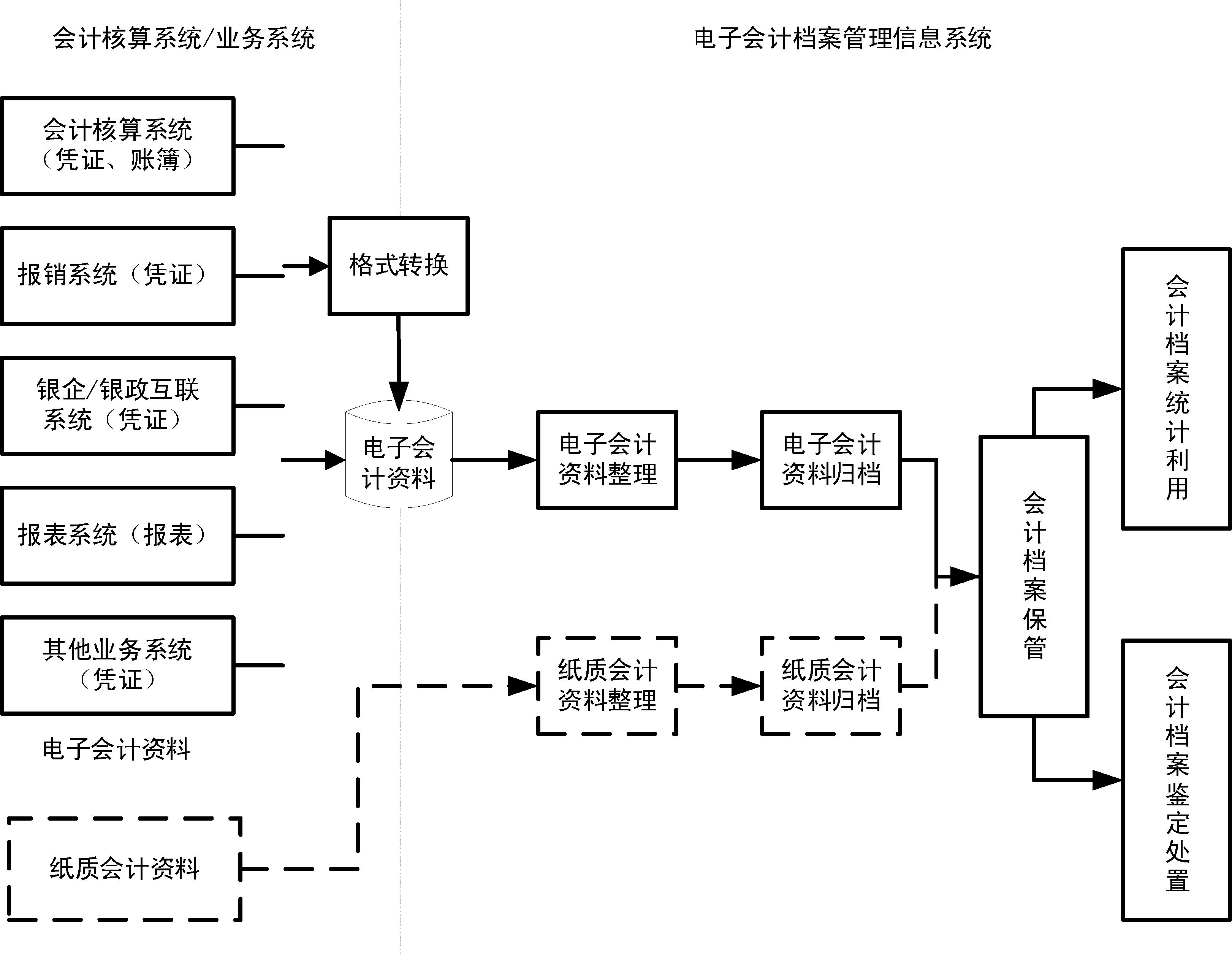
Full text! Electronic Accounting Archives Management Specification (DA/T 94—2022)Published: 2024-01-03 11:11 The Specifications for Electronic Accounting Archives Management sets out the requirements for the formation, collection, arrangement and archiving of electronic accounting materials, as well as the preservation, statistics, utilization, appraisal and disposal of electronic accounting archives, and applies to government agencies, organizations, enterprises, public institutions and other organizations carrying out electronic accounting archives management activities. Electronic Accounting Archives Management Standards DA/T 94—2022 1 Scope This document specifies the requirements for the formation, collection, organization, and archiving of electronic accounting materials, as well as the custody, statistics, utilization, appraisal, and disposal of electronic accounting archives. This document applies to government agencies, organizations, enterprises and institutions, and other organizations (hereinafter referred to as "units") carrying out electronic accounting archive management activities. 2 Normative references The contents of the following documents constitute indispensable provisions of this document through normative references in the text. Among them, for dated reference documents, only the version corresponding to that date applies to this document; for undated reference documents, the latest version (including all amendments) applies to this document. DA/T15 Specifications for the Management and Protection of Magnetic Carrier Archives DA/T38 Technical Requirements and Application Specifications for Archival-Grade Recordable Optical Discs CD-R, DVD-R, DVD+R DA/T39 Accounting Archive File Format DA/T70 General Requirements for the Inspection of Documentary Electronic Archives 3 Terms and definitions The following terms and definitions apply to this document. 3.1 electronic accounting document Various accounting information records in electronic form that record and reflect an entity's economic business matters, formed, transmitted, and stored through computers and other electronic devices during the entity's accounting process. Note: Electronic accounting materials include accounting vouchers, accounting books, financial accounting reports, and other accounting materials that exist in electronic form. Among these, financial accounting reports include enterprise financial accounting reports, financial reports and final accounts reports of government accounting entities, financial accounting reports of private non-profit organizations, and financial accounting reports of other accounting entities. 3.2 electronic accounting archive Electronic accounting materials directly formed or received, transmitted, stored, and archived by electronic computers in accounting work, recording and reflecting a unit's economic business matters, and having evidentiary, reference, and preservation value. 3.3 accounting system Computer software, software systems, or software functional modules used by an entity for accounting purposes to directly collect data, process accounting business, generate accounting vouchers, accounting books, financial accounting reports, and other accounting materials, and to convert, output, analyze, and utilize accounting materials. 3.4 business system Besides accounting systems, other computer information systems that generate electronic accounting vouchers, such as office automation systems, reimbursement systems, contract management systems and enterprise resource planning systems. 3.5 electronic accounting archives management information system Electronic archive management information systems or software functional modules used by an entity for the collection, organization, and archiving of electronic accounting materials, as well as the custody, statistics, utilization, appraisal, and disposal of electronic accounting archives. 4 Management principles and requirements 4.1 Units shall strengthen the management of electronic accounting archives, establish and improve management systems for the formation, collection, organization, archiving of electronic accounting materials and the custody, statistics, utilization, appraisal, and disposal of electronic accounting archives, and adopt reliable security protection technologies and measures to ensure the authenticity, integrity, usability, and security of electronic accounting archives during transmission and storage. 4.2 Units shall incorporate electronic accounting archive management into the job responsibilities and performance assessments of accounting personnel, archive personnel, and relevant business personnel. 4.3 The accounting institution of a unit or the institution to which accounting personnel belong (hereinafter collectively referred to as the unit accounting management institution) is responsible for the collection, organization, and archiving of electronic accounting materials that should be archived, and regularly transfers them to the unit archive management institution or the institution to which archive staff belong (hereinafter collectively referred to as the unit archive management institution). 4.4 The unit archive management institution is responsible for the custody, statistics, utilization, appraisal, and disposal of electronic accounting archives, and guides and supervises the collection, organization, and archiving of electronic accounting materials. Units may also entrust institutions with archive management conditions to manage electronic accounting archives on their behalf. 4.5 The information technology institution of a unit shall implement electronic accounting material archiving requirements during the planning, analysis, design, implementation, and operation and maintenance of relevant accounting systems and business systems, realize the electronic accounting material archiving requirements in accounting systems and business systems, provide information technology support, and be responsible for the operation and maintenance of the electronic accounting archive management information system. 4.6 Units shall strengthen the security and confidentiality management of electronic accounting archives. Confidential electronic accounting materials and electronic accounting archives shall be managed in accordance with relevant national regulations. 4.7 Electronic accounting materials formed (or received) in compliance with relevant national regulations and managed in accordance with this document may be archived and preserved in electronic form only. 5 Electronic accounting archives management process Electronic accounting archive management is handled by accounting personnel and archive personnel according to division of responsibilities, involving information systems such as accounting systems, business systems, and electronic accounting archive management information systems. The management process includes the formation, collection, organization, and archiving of electronic accounting materials, as well as the preservation, counting, utilization, appraisal, and disposal of electronic accounting archives. The management process is shown in Figure 1.
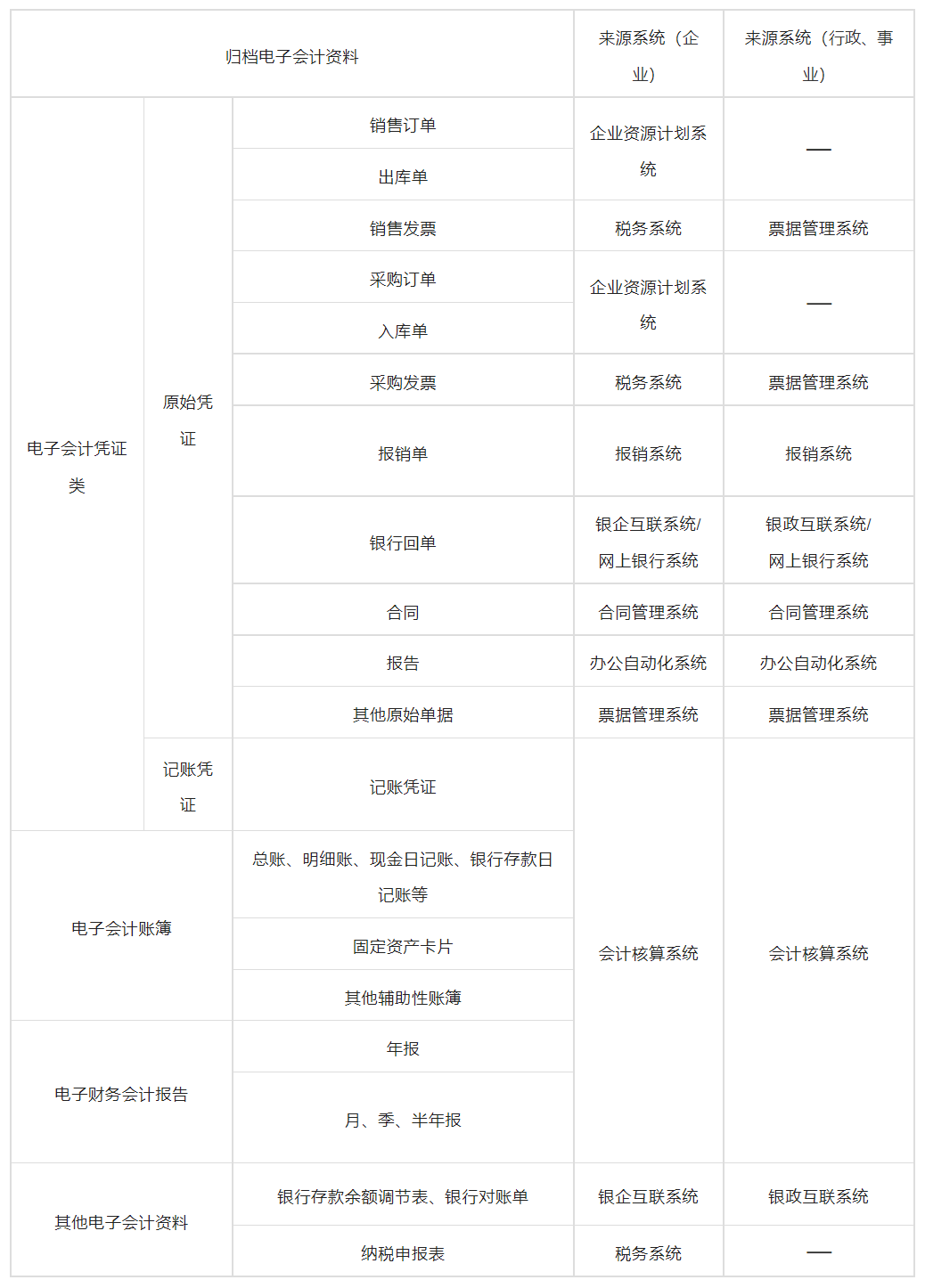
6 Formation of electronic accounting materials 6.1 Internally generated electronic accounting materials shall undergo necessary review and approval procedures such as handling, review, and approval, and the content and metadata shall be complete. For the structure and content of metadata, see Appendix A. 6.2 Electronic accounting materials shall be formed into independent electronic files in corresponding formats for archiving. 6.3 Internally generated electronic accounting materials shall be output and archived as electronic accounting materials according to a certain time and unit. The file size shall be convenient for management and use. The output time and format of various electronic accounting materials shall meet the following requirements. a) Internally generated electronic accounting vouchers should be output as archived electronic accounting vouchers after completion, and the output information should reflect the association relationships between related electronic accounting vouchers. Externally received electronic accounting vouchers are generally archived in their original format. If the original format does not meet archiving requirements, the dedicated software should be archived together, or the original format should be converted to a format that meets archiving requirements, and the electronic accounting materials in both the original format and the format meeting archiving requirements should be archived together. b) Electronic accounting books may be regularly output and archived by month, quarter, year, or other periods, and the output period may be determined according to the amount of data. c) Electronic financial accounting reports can be output and archived by accounting period. 6.4 For archiving fixed-layout electronic accounting materials, OFD format is recommended. Units that do not have the conditions to apply OFD format may use PDF format or other fixed-layout formats that meet long-term preservation requirements. To facilitate parsing and statistics, XML-like description files may be output simultaneously for archiving. 7 Collection of electronic accounting materials 7.1 The scope of electronic accounting material archiving is shown in Appendix B. Each unit may refer to, but is not limited to, Appendix B to determine the scope of electronic accounting material archiving for its own unit. 7.2 Electronic accounting materials within the archiving scope and their metadata shall be transmitted from the accounting system and business systems to the electronic accounting archives management information system, and the transmission process shall be safe and controllable. The electronic accounting archives metadata scheme is shown in Appendix A. 7.3 The collection of electronic accounting materials is generally carried out automatically online through interfaces. The interface scheme is shown in Appendix C. 7.4 When collecting electronic accounting materials, the sources of electronic accounting materials should be sorted out. The correspondence between archived electronic accounting materials and source systems may refer to Table 1.
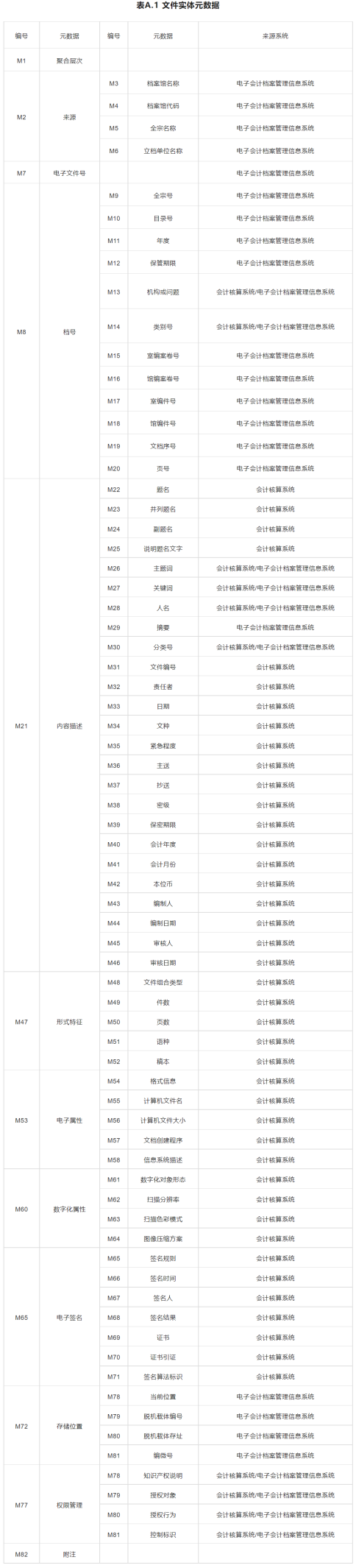
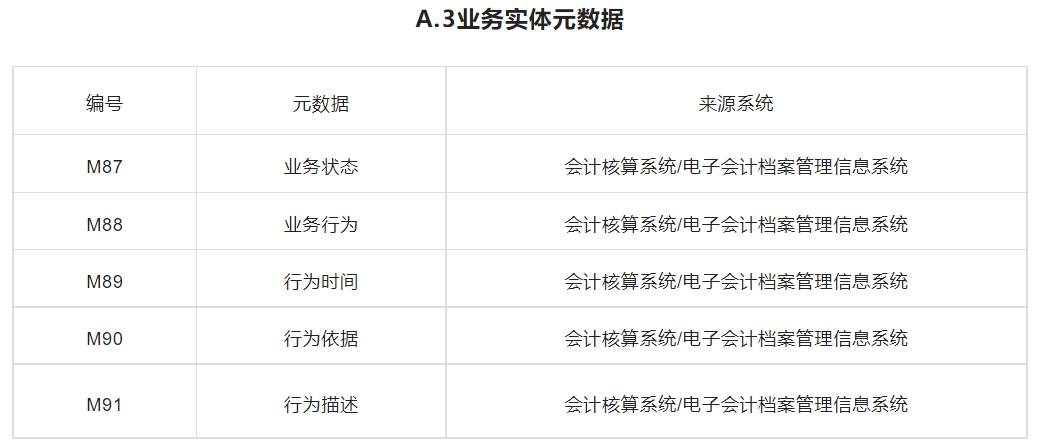
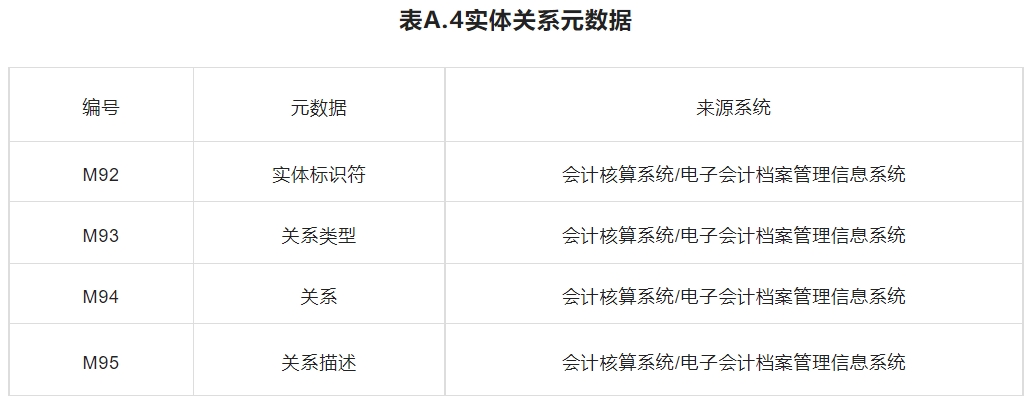
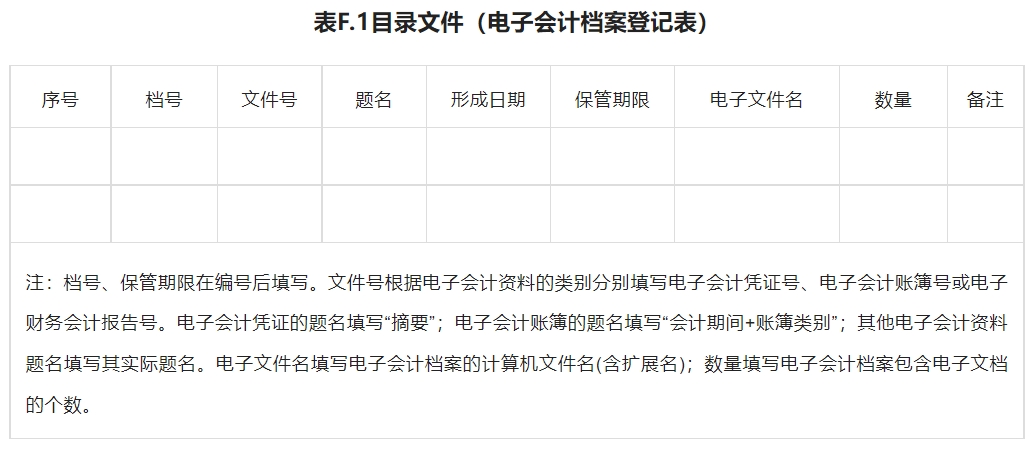
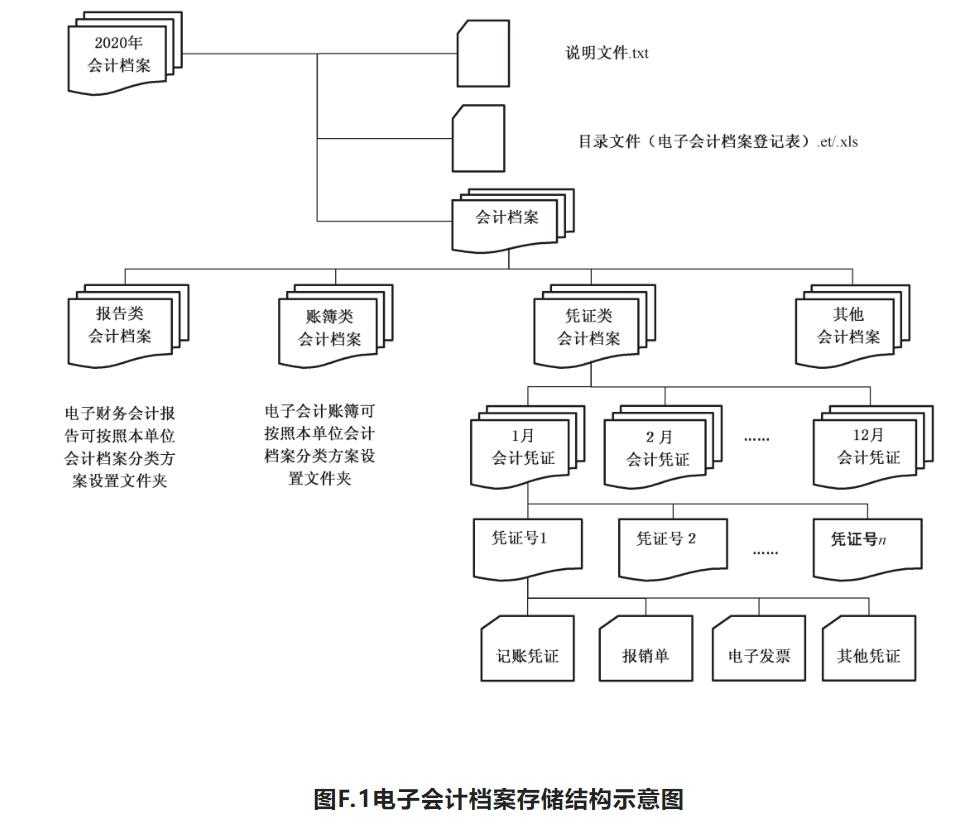
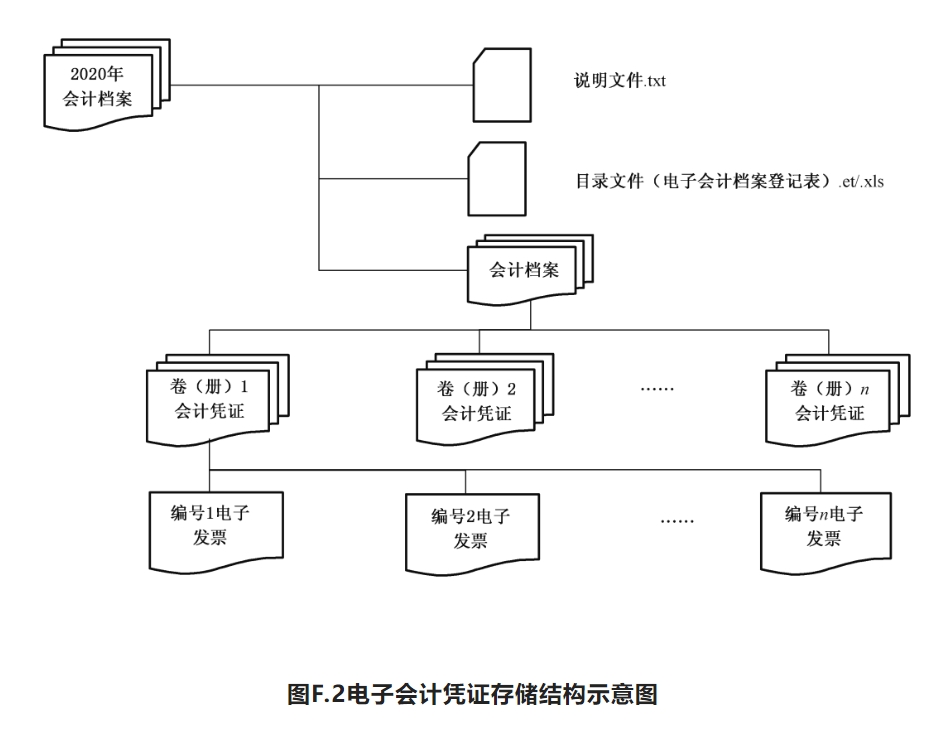
7.5 When collecting electronic accounting materials, authenticity, integrity, usability and security testing should be carried out in accordance with the relevant requirements of DA/T70. Only electronic accounting materials that pass the testing may be registered into the electronic accounting archives management information system. Those that fail the testing should be re-collected and registered into the electronic accounting archives information system after passing the testing. 7.6 Electronic accounting materials that pass the testing should have their retention periods determined in accordance with Appendix B. The retention periods of electronic accounting archives are divided into permanent and regular; regular is generally 10 years and 30 years, counted from the first day after the end of the accounting year. The retention periods of electronic accounting archives in Appendix B are the minimum retention periods; each unit may choose a longer retention period according to work needs. 7.7 If the specific names of electronic accounting archives of each unit are inconsistent with the names listed in Appendix B, they should be handled by referring to the retention periods of similar archives. 8 Organization of electronic accounting materials 8. 1 Organizing TimeAfter collection of electronic accounting materials is completed, they should be organized promptly. Among them, electronic accounting vouchers, electronic accounting books, electronic fixed asset cards, electronic financial accounting reports, and other electronic accounting materials should be organized within 1 month after the end of the accounting year, within 1 month after accounting final accounts, within 1 year after fixed asset retirement, within 1 month after generation of electronic financial accounting reports, and within 3 months after the end of the accounting year, respectively. 8. 2 PrinciplesOrganizing electronic accounting materials should follow their natural formation patterns and inherent characteristics, maintain the organic connections between electronic accounting materials, distinguish different preservation values, and facilitate preservation and utilization. For units that produce a relatively small quantity of electronic accounting materials, the electronic accounting materials may be organized by piece after classification according to 8.3. 8. 3 Classification8. 3.1 Formulate a classification planWhen organizing electronic accounting materials, they should be classified according to the electronic accounting archive classification scheme. The electronic accounting archive classification scheme shall be prepared with reference to 8.3.3 and embedded in the electronic accounting archive management information system. 8. 3.2 Classification principles for electronic accounting archivesThe classification principles for electronic accounting archives are as follows. a) Classification by form of accounting materials: that is, classification by the content form of accounting materials. Generally divided into 4 categories: accounting vouchers, accounting books, financial accounting reports, and other accounting materials. b) Classification by accounting year: that is, classification by the accounting year to which the accounting archives pertain. c) Classification by retention period: i.e., classification by the retention period of accounting archives. d) Classification by organizational structure: i.e., classification by the organizational structure that formed the accounting archives. Generally used for accounting archive classification of general budget accounting units. e) Classification by accounting type: i.e., classification by the accounting type reflected in the accounting archives. Generally used for accounting archive classification of tax authorities. 8. 3.3 Classification methodsThe recommended classification methods and their applicability are as follows. a) Classification method by accounting material form · accounting year · retention period, see D.1 in Appendix D for details, applicable to medium and small units, i.e., units with a small annual volume of accounting archives, and also the method currently adopted by most units. b) Accounting year · form of accounting materials · retention period classification method, see D.2 for details, applicable to budget units. c) Accounting year · organizational unit · form of accounting materials · retention period classification method, see D.3 for details, applicable to units where multiple departments generate accounting archives and general budget units at all levels. d) Accounting year · accounting type · accounting material form · retention period classification method; see D.4 for details, applicable to tax authorities at all levels with strong professional requirements. 8. 3.4 Classification number settingsThe category numbers of electronic accounting archives should be set scientifically and concisely, and can be expanded according to actual needs. The fiscal year uses 4 Arabic numerals; categories such as the form of accounting materials, retention period, organizational structure, and accounting type are generally compiled using uppercase Chinese pinyin letters, Arabic numerals, or a combination of both, and duplicate numbers should not be used. Upper- and lower-level category numbers are separated by "·". 8. 4 Components, filing, and arrangement of electronic accounting vouchers8.4.1 Electronic accounting vouchers are assembled by bookkeeping voucher number; a bookkeeping voucher and its attached original vouchers, other attachments, etc. form one item. Within the item, they are arranged in the order of bookkeeping voucher, original vouchers, and other attachments. 8.4.2 Electronic accounting vouchers are generally filed by time, that is, electronic accounting vouchers are filed according to an appropriate time period, and the electronic accounting vouchers within the file are arranged in the order of voucher numbers. Where electronic accounting vouchers are classified, they are filed by type combined with time; electronic accounting vouchers of different types should not form one file. 8.4.3 Electronic accounting voucher files are arranged in chronological order. Where electronic accounting vouchers are classified, electronic accounting voucher files are arranged by type combined with time order. 8.4.4 When accounting vouchers with the same bookkeeping voucher number exist in different record forms, they may be organized separately according to different record forms, and their association relationship recorded by means of metadata. For example, when the bookkeeping voucher is in electronic form and the original voucher is in paper form, the bookkeeping voucher is organized in electronic archive form, becoming one electronic archive; the original voucher is organized in paper archive form, becoming one paper archive. At the same time, the corresponding original voucher number is noted in the corresponding metadata of the bookkeeping voucher, and the corresponding bookkeeping voucher number is noted in an appropriate position on the original voucher. 8. 5 Components, filing, and arrangement of electronic accounting books8.5.1 Electronic accounting books are assembled according to 6.3 by account, accounting period, and combined with the amount of data that a single electronic file can store. Among them, electronic fixed asset cards are assembled by fixed asset number; electronic fixed asset cards with the same fixed asset number form one item. 8.5.2 Electronic accounting books should be filed regularly by type within one accounting year. The electronic accounting books within the file are arranged in the order of formation time. 8.5.3 Electronic accounting books of different types are arranged in the order of general ledger, subsidiary ledger, bank deposit journal, cash journal, fixed asset cards, and other auxiliary books; electronic accounting books of the same type are arranged in time order. 8.6 Assembly, filing and arrangement of electronic financial accounting reports and other electronic accounting materials 8.6.1 Electronic financial accounting reports are assembled by type combined with period. Reports of different types and different periods should not form one item. 8.6.2 Electronic financial accounting reports shall be filed separately by monthly, quarterly, semi-annual, and annual reports. Electronic financial accounting reports within a file shall be arranged in chronological order of formation. 8.6.3 Electronic financial accounting report files shall be arranged in the order of monthly, quarterly, semi-annual, and annual reports; files of the same type of electronic financial accounting report shall be arranged in chronological order. 8.6.4 Other electronic accounting materials besides the foregoing shall be organized and filed by category combined with time; electronic accounting materials of different categories and retention periods shall not be combined into one file. Electronic accounting materials within a file shall be arranged in chronological order of formation. 8. 7 NumberingArranged electronic accounting materials should be assigned archive numbers, with the format "[fonds number-]category number-file number-item number(sequence number within file)." The category number is given by the classification scheme; the file number and item number (sequence number within file) are identified by 4 Arabic numerals, and if fewer than 4 digits, they are padded in front with "0." 9 Archiving of electronic accounting materials 9.1 After the end of the accounting year, organized electronic accounting materials may be temporarily kept by the unit's accounting management institution for 1 year, and then transferred to the unit's archives management institution for custody. If transfer must indeed be delayed due to work needs, it shall be approved by the unit's archives management institution, but for no more than 3 years. During temporary custody, the custody of electronic accounting archives shall comply with relevant national archives management regulations, and cashiers shall not concurrently manage electronic accounting archives. 9.2 When receiving electronic accounting archives, the unit's archives management institution shall conduct testing in accordance with the relevant requirements of DA/T70, and may only receive them after passing the test. 9.3 When transferring and receiving electronic accounting archives, both parties shall promptly complete handover procedures online or offline. 10 Storage of electronic accounting archives 10. 1 Regular AssessmentAn entity's archive management institution shall annually assess the readability of electronic accounting archives and form an assessment report; if there is a risk that electronic accounting archives cannot be read due to system software or hardware or other technological upgrades or updates, the electronic accounting archives shall be migrated. 10. 2 Migration assessmentBefore migrating electronic accounting archives, a migration feasibility assessment should be conducted, including assessment of the sustainability, security, and cost-effectiveness of the target carrier, system, and format, and ensuring that electronic accounting archives remain authentic and complete during migration with a controllable process, preventing loss or illegal tampering of electronic accounting archive information during migration. 10. 3 Storage10.3.1 Electronic accounting archives should implement online and offline storage. Online storage is implemented according to the operating requirements of the electronic accounting archive management system. Offline storage media should have good durability, in priority order: write-once optical discs, magnetic tapes, hard disks, etc. 10.3.2 Important electronic accounting archives should be stored offline in triplicate. The three sets of offline storage media should preferably be kept separately, and units with conditions should conduct off-site backup. 10.3.3 Offline storage media management shall be carried out in accordance with the requirements given in DA/T15 and DA/T38. 10.3.4 Offline storage should organize information according to the custodian unit and storage media capacity. It should support the formation of handover credentials after import. For the requirements of handover credentials, see the Measures for the Transfer and Receipt of Electronic Archives. The information organization method of operational backups cannot be used for offline storage, and system backup files cannot be used to replace offline storage files. 10.3.5 For offline storage of electronic accounting archives, magnetic media should undergo sampling machine-readable inspection every 2 years, and optical discs every 4 years, with a sampling rate of no less than 10%. If problems are found, measures should be taken promptly. 10.3.6 Electronic archives on magnetic media should be transferred to new media every 4 years. The original media should be retained for no less than 4 years. 11 Statistics of electronic accounting archives Entities shall conduct statistics on electronic accounting archives in accordance with national archive statistics requirements and their own actual needs. 12 Utilization of electronic accounting archives 12.1 Units should formulate permission rules for the utilization of electronic accounting archives. Permission settings should be scientific and reasonable, and should be implemented in the electronic accounting archive management information system. When archives are utilized beyond permission, approval should be carried out. 12.2 Units should ensure that electronic accounting archives are not tampered with during utilization. 12.3 Electronic accounting archives may be provided for online or offline utilization according to authorization. The utilization process should be recorded through logs or other means, and the recorded information includes the user, time of use, method of use, name of the electronic accounting archive utilized, archive number, etc. Utilization process information should be stored as metadata of the electronic accounting archive. 13 Periodic appraisal and disposal of electronic accounting archives 13.1 Units shall periodically appraise electronic accounting archives that have reached their retention period and form an appraisal opinion. 13.2 The appraisal of electronic accounting archives shall be led by the unit's archives management institution, which shall organize the unit's accounting, information technology, auditing, discipline inspection and supervision institutions or personnel to conduct it jointly. 13.3 After appraisal, electronic accounting archives that still need to be retained shall have their retention period redetermined; electronic accounting archives that may be destroyed after appraisal shall be destroyed according to the following procedures. a) The archival management institution of the unit shall output the electronic accounting archive destruction register, listing the name, number of volumes, starting and ending years, archive number, retention period, retained period, and scheduled destruction time of the electronic accounting archives to be destroyed. b) The person in charge of the unit, the person in charge of the archival management institution, and the handler of the archival management institution shall sign opinions on the electronic accounting archive destruction register. c) The archival management institution of the unit is responsible for organizing the destruction of electronic accounting archives, and shall send personnel together with the accounting management institution to supervise the destruction. After destruction is completed, the supervisor shall sign the destruction list. The destruction of electronic accounting archives shall be carried out by physical deletion and shall undergo irrecoverability verification. The destruction register and records should be output as paper documents for permanent preservation. 13.4 Electronic accounting archives whose retention period has expired but whose creditor's rights and debts have not been settled or which involve other unfinished matters shall not be destroyed, and shall be separately extracted and filed or transferred for storage until the unfinished matters are concluded. Electronic accounting archives separately extracted and filed or transferred for storage shall be listed in the electronic accounting archive appraisal opinion, the electronic accounting archive destruction register and the electronic accounting archive retention register. 13.5 Units shall, in accordance with relevant national regulations, promptly transfer electronic archives due for transfer to the archives repository, together with their metadata. For transfer methods, see the Measures for the Transfer and Receipt of Electronic Archives. 14 Metadata management 14.1 During the archiving of electronic accounting materials and the management of electronic accounting archives, metadata shall be captured, archived and managed simultaneously. 14.2 During system development, metadata capture points shall be planned, specifying the metadata items to be captured by the accounting system, business systems and electronic accounting archive management information system and their capture methods, as detailed in Appendix A. 14.3 The metadata of electronic accounting archives shall be improved, as detailed in Appendix A, to ensure that the metadata can standardly, objectively and accurately describe the subject content and formal characteristics of electronic accounting archives. The background, structure and management process metadata of electronic accounting archives shall not be modified. 15 Construction of accounting systems, business systems and electronic accounting archive management information systems 15.1 Construction requirements for units' accounting systems and business systems When building accounting systems and business systems, entities should fully consider the following archiving requirements for electronic accounting materials. a) Select an appropriate storage format for electronic accounting materials to facilitate conversion to the electronic accounting archive storage format. To ensure the smooth archiving of electronic accounting materials, the system implementation should, as far as possible, adopt data structures and file storage formats that meet archiving requirements as the file storage formats during system operation. If formats that meet archiving requirements truly cannot be adopted, a convertibility assessment of the data structures and file formats used shall be conducted during system implementation, and business systems assessed as non-convertible or high-risk should be used with caution. b) Plan the metadata capture nodes and elements of electronic accounting materials in accounting systems and business systems, and fully form and capture all electronic accounting material metadata that should be captured by accounting systems and business systems. For relevant requirements, see Appendix A. c) Select a feasible output method for electronic accounting materials based on the system technical architecture; see Appendix C for details. d) Determine the data package format for archiving electronic accounting materials generated by the accounting system and business systems. 15. 2 Functions of the electronic accounting archives management information systemThe functions of the electronic accounting archive management information system shall comply with the provisions of Appendix E. 15.3 Connection between accounting systems, business systems and electronic accounting archive management information systems Archiving of electronic accounting materials and management of electronic accounting archives are generally realized through an electronic accounting archive management information system, or by designing archiving of electronic accounting materials and electronic accounting archive management functions in accounting systems and business systems, or by designing the corresponding functions separately in accounting systems, business systems, and electronic accounting archive management information systems. 16 Preservation methods for electronic accounting archives of units that have not implemented an electronic accounting archive management information system 16.1 Preservation methods for electronic accounting archives of units that conduct accounting through an accounting system To implement the requirement in the Notice of the Ministry of Finance and the National Archives Administration on Regulating the Reimbursement, Posting, and Archiving of Electronic Accounting Vouchers that "IV. Where a unit uses a paper printout of an electronic accounting voucher as the basis for reimbursement, posting, and archiving, it must simultaneously preserve the electronic accounting voucher from which the paper printout was made," for units that have not implemented an electronic accounting archives management information system but conduct accounting through an accounting system, electronic accounting archives shall be preserved by accounting personnel according to the following methods. a) Download electronic accounting materials from the accounting system, fill in the electronic accounting archives registration form according to Table F.1 in Appendix F, and register the electronic accounting materials. b) Conduct authenticity, integrity, usability, and security detection on downloaded electronic accounting materials, and only accept them after passing the detection. c) Assemble electronic accounting materials into items. Copy electronic accounting vouchers with the same voucher number into the same folder, and arrange them within the folder in the order of accounting vouchers, reimbursement forms, invoices, and other attachments. One folder is regarded as one item; electronic accounting books are assembled by subject and accounting period, combined with the amount of data that a single electronic file can store, with each accounting period as one item; electronic financial accounting reports are assembled by accounting period, with one accounting period as one item. The storage format shall comply with the requirements of Section 6 of this standard. d) Define the retention period. e) Arrange electronic accounting materials. According to the classification scheme and the sequence of electronic accounting material numbers, arrange the electronic accounting materials one by one in units of items, compile archive numbers, and fill in information such as archive numbers and retention periods into the electronic accounting archive registration form. f) Compile explanatory documents, including the content of electronic accounting archives (accounting period + accounting document form), quantity of electronic accounting archives, transferor, and other circumstances requiring explanation (such as explanations of non-general format files). For example: electronic accounting vouchers from January to December 2020, 555 items in total, transferred by Zhang San. g) The storage of electronic accounting materials, catalogs (electronic accounting material registration forms), and explanatory documents is shown in Figure F.1. h) Output the catalog (electronic accounting material registration form) as a paper document. i) Transfer the electronic accounting materials, catalogs (electronic accounting material registration forms) and their paper documents, explanatory documents, and other paper archives to archive personnel within the prescribed time limit. j) Adopt methods such as multiple backups and regular detection to ensure that electronic accounting archives remain authentic, complete, secure, and usable within the retention period. 16.2 Preservation methods for electronic accounting vouchers of units that do not conduct accounting through an accounting system To implement the requirement in the Notice of the Ministry of Finance and the National Archives Administration on Regulating the Reimbursement, Posting, and Archiving of Electronic Accounting Vouchers that "IV. Where a unit uses a paper printout of an electronic accounting voucher as the basis for reimbursement, posting, and archiving, it must simultaneously preserve the electronic accounting voucher from which the paper printout was made," for units that have not implemented an electronic accounting archives management information system and do not conduct accounting through an accounting system, whose accounting materials are mainly paper-based, electronic accounting vouchers received from external sources shall be preserved by accounting personnel according to the following methods. a) Receive electronic accounting vouchers, fill in the electronic accounting materials registration form, and register the electronic accounting materials. b) Conduct authenticity, integrity, usability, and security detection on received electronic accounting vouchers, and only accept them after passing the detection. c) Based on the file (or volume) number of the corresponding paper-based accounting voucher, create a volume (or book) folder in the storage medium, and copy the electronic accounting voucher to the corresponding volume (or book) folder. d) Based on the file (or volume) number of the corresponding paper-based accounting voucher, fill in information such as the archive number and retention period into the electronic accounting archive registration form. e) Compile explanatory documents, including accounting period, names and quantities of electronic accounting vouchers, transferor, and other circumstances requiring explanation (such as explanations of non-general format files). For example: electronic invoices from January to December 2020, 555 items in total, transferred by Zhang San. f) The storage of electronic accounting vouchers, catalogs (electronic accounting archive registration forms), and explanatory documents is shown in Figure F.2. g) Output the catalog (electronic accounting archive registration form) as a paper document. h) Transfer the organized electronic accounting vouchers, catalogs (electronic accounting archive registration forms) and their paper documents, explanatory documents, and other paper archives to archive personnel within the prescribed time limit. i) Adopt methods such as multiple backups and regular detection to ensure that electronic accounting archives remain authentic, complete, secure, and usable within the retention period. Appendix A (normative) Metadata Scheme for Electronic Accounting Archive Management This solution is developed with reference to DA/T46, combined with the current practice of electronic accounting material archiving and electronic accounting archive management. Table A.1 provides file entity metadata items, Table A.2 provides organization and personnel entity metadata items, Table A.3 provides business entity metadata items, and Table A.4 provides entity relationship metadata items.
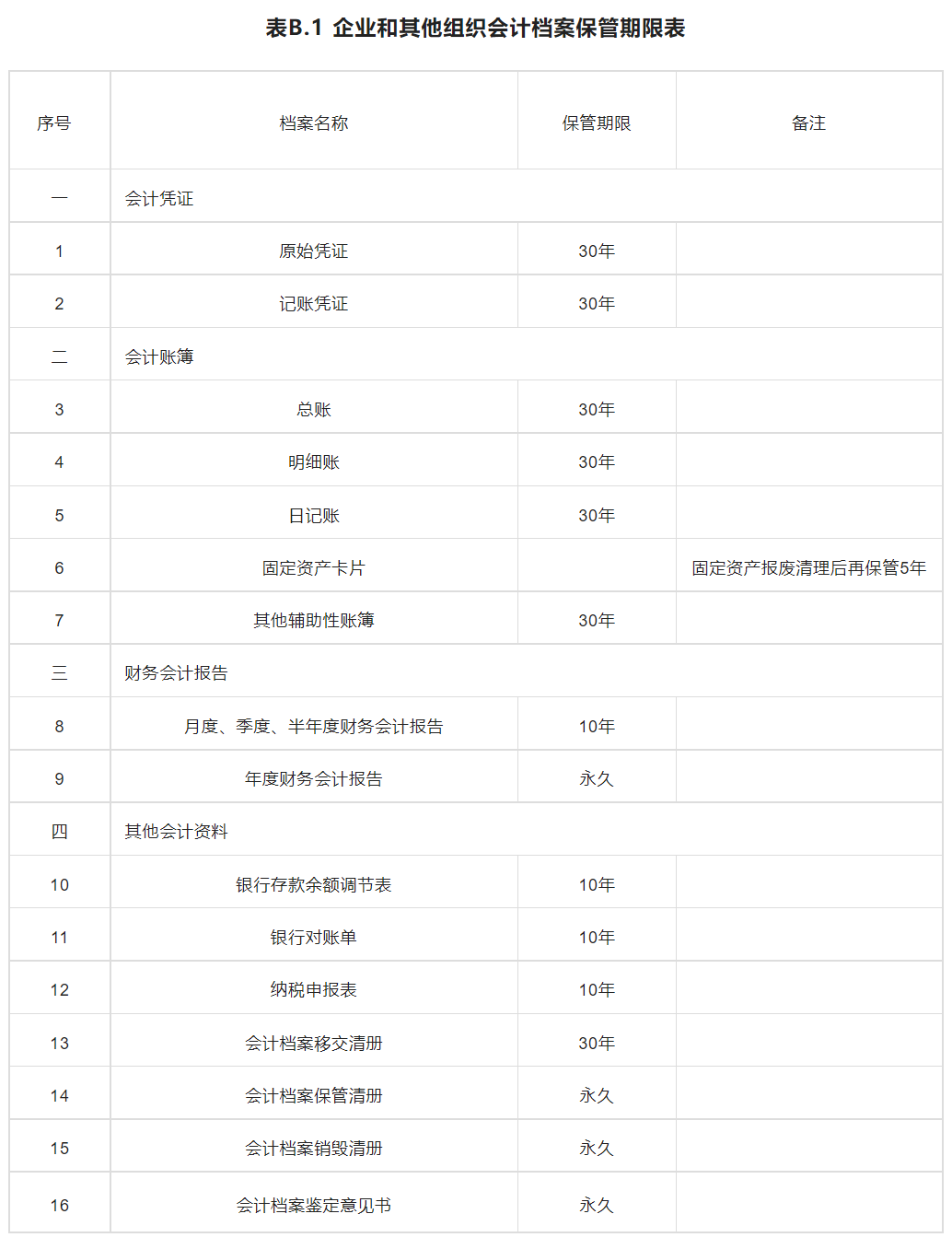
Appendix B (normative) Accounting Archive Filing Scope and Retention Period Table Table B.1 specifies the retention periods for accounting archives of enterprises and other organizations, and Table B.2 specifies the retention periods for accounting archives of general fiscal budgets, administrative units, public institutions, and tax accounting. The retention period for tax authorities' tax fund accounting archives shall be handled in accordance with the retention period provisions for administrative unit accounting archives.
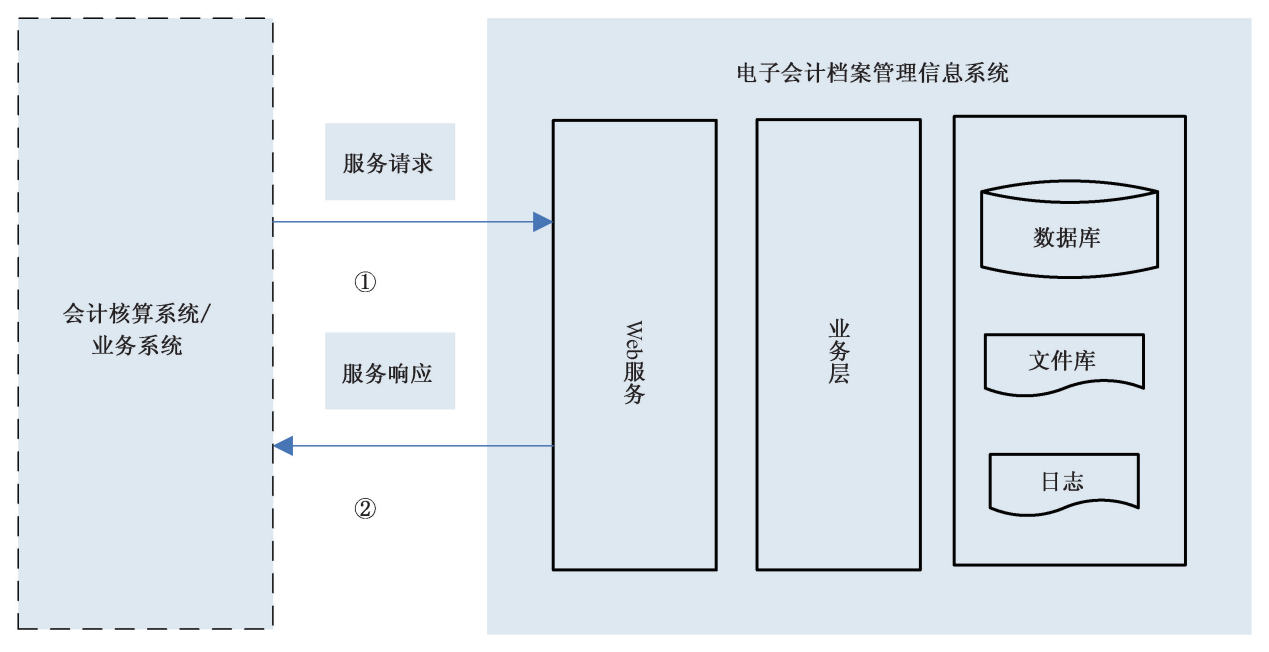
Appendix C (informative) Interface solution for accounting systems, business systems, and electronic accounting archive management information systems C.1 Interface methods C.1.1 Web Service service invocation method The archiving interface schematic based on Web Service service invocation is shown in Figure C.1.
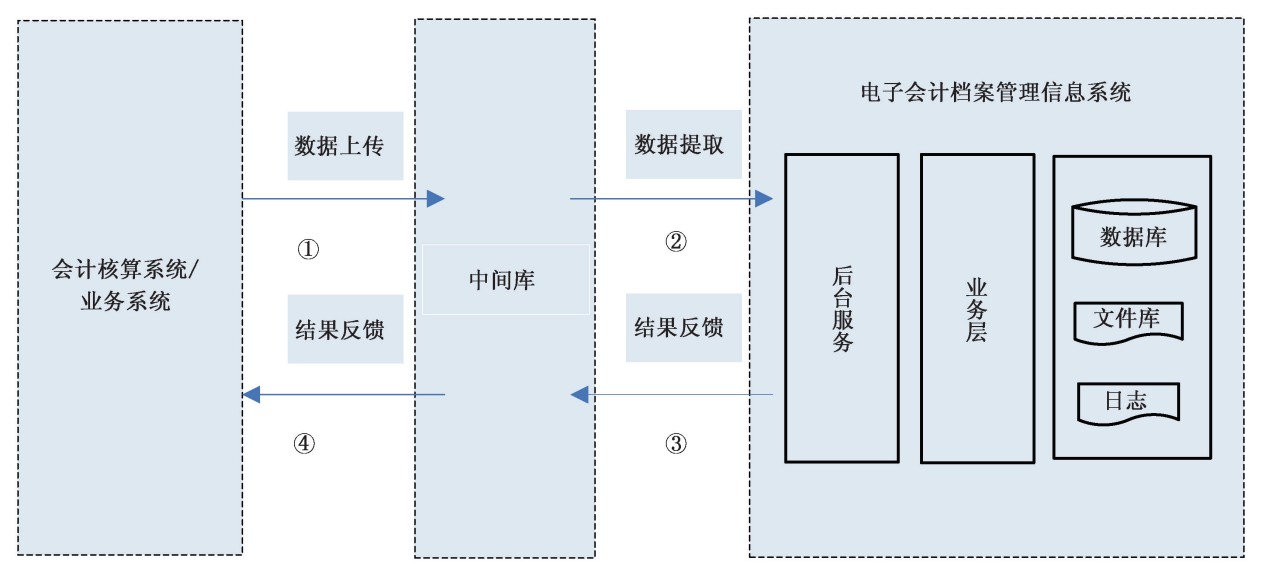
Data flow description: ① Service request: the accounting system and business system initiate a service request; ② Service response: the electronic accounting archive management information system receives service requests, returns results after processing is completed, and feeds them back to the accounting system and business system. C.1.2 Intermediate database method The archiving interface schematic based on the intermediate database is shown in Figure C.2.
Data flow description: ① Data upload: the accounting system and business system transmit data to be archived to the intermediate database; ② Data extraction: the electronic accounting archive management information system extracts data to be archived from the intermediate database; ③ Result feedback: After the electronic accounting archives management information system completes the extraction and processing of data to be archived, it feeds the processing results back to the intermediate database; ④ Result feedback: The accounting system and business system extract processing results from the intermediate database. C.2 Interface functions C.2.1 Interface functions of accounting systems and business systems The interface functions of accounting systems and business systems shall refer to the following requirements: a) Before archiving, encapsulate the electronic accounting materials to be archived and their metadata into an archival information package in the recommended format; b) Transmit the archival information package to the designated location (or call the counterparty's interface), ensuring that the information in the archival information package is not lost or illegally altered during transmission; c) Receive feedback messages from the recipient of the archival information package, including archival success or failure messages, failure fault codes, etc.; d) Mark successfully archived electronic accounting materials as archived to prevent duplicate archiving, and be able to cancel the mark and re-archive under manual intervention; e) Record the type, archiving time, and archiving status of archived electronic accounting materials, and be able to perform combined queries by type, archiving time, and archiving status of archived electronic accounting materials. C.2.2 Interface functions of the electronic accounting archives management information system The interface functions of the electronic accounting archive management information system shall refer to the following requirements: a) Receive data packages transmitted from accounting systems and business systems (or extract data from designated locations), and parse them correctly; b) Conduct detection on the authenticity, integrity, usability, and security of electronic accounting materials and their metadata submitted for archiving by accounting systems and business systems, and refuse to accept those that fail the detection; c) Store the parsed electronic accounting materials and their metadata in databases and file repositories, and save process logs; d) Send success or failure messages for electronic accounting material archiving, as well as failure fault codes, to the accounting system and business systems; e) During the processes of receiving, parsing, and data storage of the archival information package, information shall not be lost or illegally altered; f) Record the type, archiving time, and archiving status of archived electronic accounting materials, and be able to perform combined queries by type, archiving time, and archiving status of archived electronic accounting materials. C.3 Interface construction management requirements Interface construction management shall refer to the following requirements: a) The archiving interface shall be designed, developed, tested, and implemented together with the accounting system and business systems. Accounting systems and business systems for which no archiving interface has been developed at the time of implementation shall promptly realize it through secondary development; b) To ensure the authenticity, integrity, usability, and security of electronic accounting materials, detection functions should be embedded in the archiving interface to reduce manual intervention; c) During the development of the archiving interface, sufficient testing shall be conducted and expert review shall be carried out to confirm that the functional requirements meet the design objectives; d) After the archiving interface is put into operation, dedicated personnel shall be arranged to continuously track the interface operation and handle problems promptly; e) For existing accounting systems and business systems, contact the original developers of the accounting systems and business systems or organize in-house resources to develop the interface; f) For newly developed accounting systems and business systems, the archive department shall be included in the implementation team at the early stage of development, requirements for the archiving function of electronic accounting materials in the accounting systems and business systems shall be proposed, and the archiving function shall be tested and confirmed; g) Updates to accounting systems, business systems, and electronic accounting archive management information systems shall fully demonstrate the impact on archiving interface functions to ensure the archiving interface operates normally; h) Establish an emergency mechanism to immediately initiate emergency response when the accounting system, business systems, and electronic accounting archive management information system are affected in interface functions due to upgrades, system failures, virus infections, etc. Appendix D (normative) Classification scheme for electronic accounting archives D.1 Classification method by accounting material form · fiscal year · retention period The specific classification method is as follows: 1 Accounting Voucher 2009 30 years (receipt vouchers, payment vouchers, transfer vouchers) 2010 30 years (receipt vouchers, payment vouchers, transfer vouchers) 2 Accounting books 2009 1. 30 years (general ledger, subsidiary ledger, bank deposit journal, cash journal, other auxiliary books) 2. 30 years or 5 years after fixed asset scrapping (fixed asset cards) 2010 1. 30 years (general ledger, subsidiary ledger, bank deposit journal, cash journal, other auxiliary books) 2. 30 years or 5 years after fixed asset scrapping (fixed asset cards) 3 Financial accounting reports 2009 1. Permanent (annual financial accounting report <final accounts>)2. 10 years (monthly financial accounting reports, quarterly financial accounting reports, semi-annual financial accounting reports) 2010 1. Permanent (annual financial accounting report <final accounts>)2. 10 years (monthly financial accounting reports, quarterly financial accounting reports, semi-annual financial accounting reports) 4 Other accounting materials 2009 1. Permanent (annual internal control evaluation report, annual internal control audit report, accounting archive retention register, accounting archive destruction register) 2. 30 years (accounting archive transfer inventory)3. 10 years (bank reconciliation statements, bank statements)2010 …… This classification method applies to most medium and small units, i.e., units with a small annual volume of accounting archives. It is also the method currently adopted by most units. D.2 Classification method by fiscal year · accounting material form · retention period The specific classification method is as follows: 2009 1 Accounting Voucher 30 years (receipt vouchers, payment vouchers, transfer vouchers) 2 Accounting books 1. 30 years (general ledger, subsidiary ledger, bank deposit journal, cash journal, other auxiliary books) 2. 30 years or 5 years after fixed asset scrapping (fixed asset cards) 3 Financial accounting reports 1. Permanent (annual financial accounting report <final accounts>)2. 10 years (monthly financial accounting reports, quarterly financial accounting reports, semi-annual financial accounting reports) 4 Other accounting materials 1. Permanent (annual internal control evaluation report, annual internal control audit report, accounting archive retention register, accounting archive destruction register) 2. 30 years (accounting archive transfer inventory)3. 10 years (bank reconciliation statements, bank statements)2010 1 Accounting Voucher 30 years (receipt vouchers, payment vouchers, transfer vouchers) 2 Accounting books 1. 30 years (general ledger, subsidiary ledger, bank deposit journal, cash journal, other auxiliary books) 2. 30 years or 5 years after fixed asset scrapping (fixed asset cards) 3 Financial accounting reports 1. Permanent (annual financial accounting report <final accounts>)2. 10 years (monthly financial accounting reports, quarterly financial accounting reports, semi-annual financial accounting reports) 4 Other accounting materials 1. Permanent (annual internal control evaluation report, annual internal control audit report, accounting archive retention register, accounting archive destruction register) 2. 30 years (accounting archive transfer inventory)3. 10 years (bank reconciliation statements, bank statements)This classification method applies to budget unit accounting. D.3 Classification method by fiscal year · organizational structure · accounting material form · retention period The specific classification method is as follows: 2009 1 Treasury Division 1. Accounting vouchers (30 years)2. Accounting Books (30 years)a) 30 years (general ledger, subsidiary ledger, bank deposit journal, cash journal, other auxiliary books) b) 30 years or 5 years after fixed asset retirement (fixed asset cards) 3. Financial accounting reportsa) Permanent (annual financial accounting report <final accounts>) b) 10 years (monthly financial accounting reports, quarterly financial accounting reports, semi-annual financial accounting reports) 4. Other accounting materialsa) Permanent (annual internal control evaluation report, annual internal control audit report, accounting archive custody register, accounting archive destruction register) b) 30 years (accounting archive transfer register) c) 10 years (bank reconciliation statements, bank statements) 2 Budget office a) 30 years (general ledger, subsidiary ledger, bank deposit journal, cash journal, other auxiliary books) b) 30 years or 5 years after fixed asset retirement (fixed asset cards) 3 Accounting Office 1. Financial accounting reports…… 2. Other accounting materials…… 2010 …… This classification method applies to units where multiple departments generate accounting archives, as well as accounting at general budget units at all levels. D.4 Classification method by fiscal year · accounting type · accounting material form · retention period The specific classification method is as follows: 2009 1 Tax Accounting 1. Accounting vouchers2. Accounting Books3. Financial accounting reportsa) Permanent (annual report) b) 10 years (quarterly reports, monthly reports) 4. Other accounting materials2 Fund accounting 1. Accounting vouchers2. Accounting Books3. Financial accounting reportsa) Permanent (annual report) b) 10 years (quarterly reports, monthly reports) 4. Other accounting materials2010 …… This classification method applies to the accounting archives of tax authorities at all levels with strong professional specialization. Appendix E (normative) Functional Requirements of the Electronic Accounting Archive Management Information System E.1 Collection Functions E.1.1 Manual Registration of Electronic Accounting Materials Manual registration of electronic accounting materials shall refer to the following requirements: a) It should support manual input of electronic accounting material metadata and upload of electronic accounting materials with assignment of a unique number; b) It shall support increasing or decreasing the entered metadata items as needed, provided that they meet relevant national standards; c) It shall support metadata validation functions, and may perform operations such as modification, deletion, and retrieval of metadata according to permissions. E.1.2 Online Receipt For online receipt, refer to the following requirements. a) It should support integration with business systems, be able to receive electronic accounting materials and their metadata from accounting business systems such as reimbursement systems, accounting systems, reporting systems, and tax systems, and assign a unique number to the received electronic accounting materials. b) It shall support receiving electronic accounting materials transferred by archival units that comply with relevant standards of the National Archives Administration and the Ministry of Finance, including but not limited to: 1) Text files; 2) Layout files; 3) Data files; 4) Image files; 5) Audio and video files. c) It shall support the function of format conversion for the full text of received electronic accounting materials, generating electronic file formats that comply with relevant national and industry standards. If files in formats such as EXCEL involve issues such as cross-page problems after conversion to fixed-layout files and cannot be read completely, it is advisable to support online viewing in the original format. d) Support synchronous receipt of electronic accounting material metadata and paper-based accounting materials, and support automatic establishment of associations between electronic accounting material metadata and the full text of accounting materials. e) Support unlimited receipt of electronic accounting archives, and support statistics and queries on the received quantity and unqualified return quantity of electronic accounting archives. f) It is advisable to support identification of duplicate received or captured electronic accounting archives at the time of receipt or capture, and the system shall issue a warning. g) Be able to generate an electronic archive receipt corresponding to the transfer list, automatically assign the responsible person, time, and related information, and provide output functions. E.1.3 Offline Receipt of Electronic Accounting Materials and Electronic Accounting Archives Offline receipt of electronic accounting materials and electronic accounting archives shall refer to the following requirements: a) It shall support offline batch import of electronic accounting materials and electronic accounting archive data, support the import and receipt of common file formats such as EXCEL, DBF, MDB, XML, TXT, and ET, and realize automatic association of metadata and electronic full text; b) It shall support data validation during the import receipt process, such as whether it is unique, whether it can be empty, and whether the date format is correct; c) It shall support providing a report explanation if partial data import fails; if an interruption occurs (such as power outage, network disconnection, or system crash), it shall support breakpoint resume when importing again; d) Support the formation of handover credentials after import; for requirements of handover credentials, see the "Measures for the Transfer and Receipt of Electronic Archives". E.1.4 Receipt Inspection Receipt detection refers to the following requirements: a) It should support testing the authenticity, integrity, usability, and security of electronic accounting materials received for archiving in accordance with DA/T70; b) It shall support displaying detailed detection results and problem descriptions after detection; c) It shall support forming detection business entity metadata by item after detection is completed, and saving it in the metadata; d) Support format conversion of the full text of received electronic accounting materials, including per-item conversion and batch conversion. E.2 Archival Document Arrangement Functions E.2.1 Determine Retention Period It should support the designation of retention periods for archived electronic accounting materials according to the electronic accounting archives retention schedule. E.2.2 Assembly Components refer to the following requirements: a) It should support forming archived electronic accounting materials from the same business system or different business systems into items in accordance with the requirements given in 8.4, 8.5, and 8.6, and maintain the organic connections between accounting matter documents; b) It shall support sorting the sub-items of electronic accounting materials within an item; c) It shall support undoing assembly and reassembling after assembly, etc. E.2.3 Classification It should support the classification of electronic accounting materials according to the set accounting archives classification scheme and assign category numbers. E.2.4 Form Retention Units The constituent custody unit refers to the following requirements. a) It should support automatically or with manual intervention forming volumes or boxes for archived electronic accounting materials in accordance with DA/T39 rules, and be able to sort and locate the electronic accounting materials within volumes (boxes) according to the rules, including but not limited to: 1) Should support the automatic generation of metadata and archive indexing information for electronic accounting materials; 2) It should support the automatic generation function of electronic accounting materials catalogs. b) It shall support adjusting the volume (box) to which archived accounting materials belong and reordering and repositioning them under manual intervention. E.2.5 Numbering It should support the formation of archive numbers according to archive number compilation rules, and the formed archive numbers should be unique, reasonable, stable, expandable, and simple. E.2.6 Cataloging Catalog according to the following requirements: a) It should support the provision of standardized accounting archive catalog templates, capable of printing out, in accordance with DA/T39, file covers, intra-volume catalogs or archived document catalogs, full reference catalogs, examination and preparation sheets, volume (box) covers and spines, etc.; b) It shall support catalog template creation, allowing adjustment of fonts, print content, sorting methods, etc. in the template; c) It shall support print preview functions, and it is advisable to support batch generation and printing with multiple templates; d) Support forming corresponding catalogs for selected archived electronic accounting materials or electronic accounting archives based on templates; e) It should support the export of general format files in accordance with the DA/T39 format, such as file covers, intra-volume catalogs, archived document catalogs or full reference catalogs, file catalogs, and examination and preparation sheets; f) Support audit trail logs for the cataloging operation process of accounting archives, which can be tracked, audited, and reviewed. E.2.7 Establishment of Associations Establish related relationships according to the following requirements. a) It should support the function of establishing association relationships between the same accounting archive and its sub-items, including but not limited to: 1) Should support establishing an association between electronic bookkeeping vouchers and electronic original vouchers; 2) It should support the association relationship between the main document and attachments of archived electronic accounting materials; 3) Should support establishing associations between the full text of electronic accounting materials and metadata; 4) It should support the establishment of associations between electronic accounting archives of the same accounting unit. b) It shall support automatic and timely updating of electronic accounting archive metadata after archive movement, modification, or disposal, ensuring the correctness of association relationships. c) It shall support automatic and timely updating of association relationships between electronic accounting archives after archive movement, modification, or disposal, ensuring the correctness of associations. d) Operations of associated functions shall have audit trail logs, which can be tracked, audited, and reviewed. e) It is advisable to support maintaining the association between paper-based accounting archives and electronic accounting archives when paper-based accounting archives exist. E.3 Electronic Archive Storage Functions Electronic archive storage functions refer to the following requirements: a) It shall support storage methods for electronic accounting archives such as centralized storage, distributed storage, centralized + distributed storage, fully online storage, and partial online storage + partial offline storage; b) It shall support organizing information according to the capacity of offline storage carriers, storing the organized accounting archives on the corresponding offline storage carriers. For information organization requirements, see the Measures for the Transfer and Receipt of Electronic Archives; c) It shall support separation of file storage from data storage, and shall not allow file bytecode to be stored in the database. E.4 Electronic Archive Custody Functions E.4.1 Long-term Preservation of Electronic Archives Long-term preservation of electronic archives shall refer to the following requirements: a) It shall support conversion of electronic archive storage formats, converting electronic archives stored in the system into storage formats that meet long-term preservation requirements; b) It shall support checking the authenticity, integrity, security, and usability of electronic accounting archives and their metadata converted to long-term preservation in accordance with DA/T70; c) It shall support log records for long-term preserved electronic accounting archives, enabling tracking, auditing, and review; d) The system shall support organizing information according to the capacity of offline storage media, storing the organized archives onto the corresponding offline storage media; for information organization requirements, see the "Measures for the Transfer and Receipt of Electronic Archives"; e) Support the use of migration, emulation, encapsulation, detection, and other methods to ensure long-term preservation of digital archive information; be able to identify in the system the original software and hardware required for reading electronic archives in non-general formats; f) Support recording key business entity metadata into the metadata of electronic accounting archives for long-term preservation. E.4.2 Electronic Archive Storage Format Conversion and Information Organization Electronic archive storage format conversion and information organization refer to the following requirements: a) It shall support format conversion functions for electronic accounting materials and archives, such as batch format conversion, single conversion, manual custom conversion, or conversion through external solutions, and generate electronic accounting archives that comply with relevant national and industry standards for utilization and long-term preservation; b) It shall support storing electronic accounting archives whose format conversion has been completed individually or in batches to storage carriers; c) It shall support prompting or issuing warnings for problems or errors occurring during format conversion, and recording relevant information on unsuccessful conversions; d) Provide detection functions for the authenticity, integrity, and usability of electronic accounting archives before and after format conversion; e) Support adding information that can record the original state of electronic archives during format conversion. E.4.3 Backup Backup should refer to the following requirements: a) It should support full, incremental, and differential backup functions for the metadata and full-text data of electronic accounting archives; b) It shall support restoring the full-text data and metadata of electronic accounting archives after a system failure; c) It shall have the function of configuring and maintaining backup and recovery strategies; d) Register, detect, and manage backed-up data, media, and information; e) Record log information of backup and recovery business processes. E.4.4 Periodic Appraisal Periodic appraisal refers to the following requirements: a) It should support the definition, configuration, and implementation functions of appraisal and disposal of electronic accounting archives, and establish and configure appraisal and disposal conditions, strategies, and processes in accordance with the disposal rules of electronic accounting archives; b) It shall support the function of automatic reminders when the retention period of accounting archives expires; c) It shall support functions such as adjusting the retention period and confidentiality level of electronic accounting archives according to appraisal opinions; d) The system shall preserve process information of appraisal and disposal, such as recording appraisal status, responsible personnel, opinions, and time, and support statistical queries; e) Appraisal actions shall be logged, and key operation information shall be recorded in the electronic accounting archive metadata and be traceable and reviewable. E.4.5 Destruction Management Destruction management refers to the following requirements: a) It should support process customization such as destruction application and approval for accounting archives that need to be destroyed; b) It shall support completely deleting destroyed electronic accounting archives from online storage devices and remote disaster recovery backup systems, while retaining the metadata information of destroyed electronic accounting archives, and automatically recording appraisal and destruction activities in management process metadata and logs; c) It is advisable to separately establish a database for the relevant records of destroyed archives for secure preservation, managing them separately from currently valid electronic accounting archives; d) Support the compilation of destruction lists for destroyed electronic accounting archives, recording information such as file names, quantities, and destruction reasons. E.4.6 Transfer Transfer according to the following requirements: a) It shall support the function of reminding about the expiration of electronic accounting archives for transfer; b) It shall support process settings such as online application and approval for the transfer of electronic accounting archives; c) It shall support detection of the authenticity, integrity, usability, and security of electronic accounting archives before transfer and receipt; d) Support the transfer of complete accounting archive information packages for electronic accounting archives that meet transfer requirements; key business information generated during the transfer process shall be recorded in the archive metadata; e) Support the formation of accounting archive transfer lists after archive transfer and receipt; f) Support logging of business operation records during the transfer process, which can be tracked and reviewed. E.4.7 Media Management Medium management shall refer to the following requirements: a) It should support unified management of storage media for storing electronic accounting archives; system administrators can set corresponding storage media for accounting archives according to the actual needs of media custody; b) It should support media warning functions, notifying the system administrator when situations such as unstable storage media or insufficient storage space occur. E.5 Statistics and Reports Statistics and reports shall refer to the following requirements: a) It should support statistics on the quantity and capacity of electronic accounting archives, which can be counted by dimensions such as accounting classification, file format, and time; b) It shall support the function of statistics on key business work such as receipt, arrangement, preservation, appraisal, and utilization of electronic accounting archives within a certain time period; c) It shall support output and printing of statistical results; d) It is advisable to support built-in common electronic archive work statistical report templates, and to be able to generate statistical results based on templates according to input conditions; e) It is advisable to support report creation tools and support user-defined statistical reports. E.6 Utilization Functions E.6.1 Search and Query Retrieval and query refer to the following requirements: a) It should support retrieval of archives by accounting classification, with multiple retrieval methods such as fuzzy retrieval, combined retrieval, filtered retrieval, and associated retrieval; b) It shall support access permission control for retrieval of accounting archive metadata and full-text data. E.6.2 Browsing Browse with reference to the following requirements: a) It should support browsing of electronic accounting archive information in common formats, such as metadata browsing and full-text browsing; b) It shall support access permission control for browsing electronic accounting archives; c) It shall support operations such as online browsing, downloading, and printing within the authorized scope; d) It is advisable to support adding protection measures such as anti-theft watermarks when browsing electronic accounting archives. E.6.3 Borrowing Borrowing refers to the following requirements: a) It should support the functions of borrowing application, approval, reminder for return, and return of electronic accounting archives; b) It shall support operations such as online borrowing applications, approvals, and process customization for electronic accounting archives, and support automatic authorization functions; c) It shall support borrowing approval processes that comply with the accounting archive management and utilization system; d) Support operations such as online reading, downloading, and printing within the authorized scope; e) Support usage control of permissions for the original text of downloaded electronic accounting archives, which may include but is not limited to: 1) Full-text online browsing control; 2) Full-text online printing control; 3) Control of the number of full-text downloads and time; 4) Full-text anti-copy, anti-diffusion, and anti-tampering. E.7 System Management Functions E.7.1 Log Management Log management refers to the following requirements: a) It shall support log recording functions, recording user operation information, system startup and shutdown information, user login and other behaviors and information; b) It shall support the function of auditing and tracking matters such as operational behaviors in key business processes of electronic accounting archive management and unauthorized system access, and recording discovered problems; c) It shall support the function of automatic log generation and implement classified management. System logs shall include categories such as system operation logs, user operation logs, and electronic accounting archive data processing logs; d) Support user behavior monitoring and early warning tools, notifying system security officers via system messages, emails, SMS, etc.; e) It is advisable to support log retrieval and query functions, displaying log retrieval results through a visual interface. E.7.2 System Settings System settings refer to the following requirements. a) It should support process-based management of electronic accounting archives, be able to set corresponding management processes according to the management requirements of different electronic accounting archive categories, and be able to track and trace processes. b) It shall support the function of defining and maintaining the metadata structure of electronic accounting archives, specifying the hierarchical levels and association relationships of electronic accounting archive classification. Specific functions may include but are not limited to: 1) Use the functions provided by the system to define the classification system level by level; 2) Import the classification system from an external interface file; 3) Automatically import the classification system from external systems; 4) After the system is put into use, modifications and adjustments to the accounting classification directory structure shall be made only after approval, and secure and reliable methods shall be adopted to ensure that electronic accounting archives are not modified. c) It shall support the setting and maintenance of code tables, such as accounting year codes, confidentiality level codes, retention period codes, and other information; it shall support the setting and maintenance of metadata and their association relationships, and may define attribute information such as metadata name, type, whether it can be empty, whether it is unique, string length limit, default value, maximum value, minimum value, combined fields, and association relationships. d) Support the setting and maintenance of the "four-property detection", allowing configuration of detection rules, detection metadata items, etc. E.7.3 User Management User management refers to the following requirements: a) It shall support direct entry of user information, or synchronization of user information from other systems through interfaces; b) It shall support the security control function of separation of the three roles: system administrator, system security and confidentiality officer, and system security auditor; c) It shall support management of user information, allowing operations such as viewing, adding, modifying, deleting, enabling, disabling, grouping, and classifying user information. Deletion, enabling, and disabling of user information may support batch operations; d) Support user password strength management, allowing setting and adjusting user password strength policies; for user account information that fails login verification multiple times, support user lockout processing; e) It is advisable to have functions such as user identity security authentication services or binding user information to fixed IP addresses and MAC addresses, to control user login and ensure information security. E.7.4 Organization Management Organization management refers to the following requirements: a) It shall support direct entry of organizational information, or synchronization of organizational information from other systems through interfaces; b) It shall support multi-level management functions for organizations; c) It shall support management of organizational information, allowing operations such as viewing, adding, modifying, and deleting organizational information, and enabling mapping between users and organizations. E.7.5 Permission Management Permission management refers to the following requirements: a) It shall support permission management for electronic accounting archives, ensuring that authorized users can perform lawful operations within the scope of their permissions; b) It shall support fine-grained permission control, such as authorizing specified users, roles, positions, and units to access and use archive records; c) It shall support setting the validity period of permissions, and the system shall automatically cancel permissions upon expiration; d) Support authorization by function and data according to different responsibilities and positions. Appendix F (informative) Forms (charts) for electronic accounting archives preservation Table F.1 provides the format of the catalog file (electronic accounting archive registration form) used when preserving electronic accounting archives, Figure F.1 provides an illustration of the storage structure of electronic accounting archives, and Figure F.1 provides an illustration of the storage structure of electronic accounting vouchers.
References [1] Guidelines for Enterprise Electronic File Archiving and Electronic Archives Management. Dang Ban Fa [2015] No. 4. [2] Accounting Archives Management Measures. Ministry of Finance of the People's Republic of China and National Archives Administration Order No. 79. [3] Notice on Standardizing Reimbursement, Bookkeeping, and Archiving of Electronic Accounting Vouchers. Cai Kuai [2020] No. 6. [4] Measures for Transfer and Receipt of Electronic Archives. Dang Fa [2012] No. 7. [5] DA/T46—2009 Metadata Scheme for Documentary Electronic Files Source:National Archives Administration official website Beijing Kailing Technology Co., Ltd.——an enterprise business-finance-tax digitalization solution service provider. Kailing Technology provides solutions for sales management systems, procurement management systems, output invoicing systems, input invoice collection systems, imaging management systems, financial posting systems, electronic accounting archives and other businesses according to enterprise needs, professionally and efficiently helping enterprises transform and upgrade their business-finance-tax digital management. If you have any business-finance-tax digital transformation needs, welcome to contact us. Beijing Kailing Technology will serve you wholeheartedly.
|