One-stop Tax Management Solution

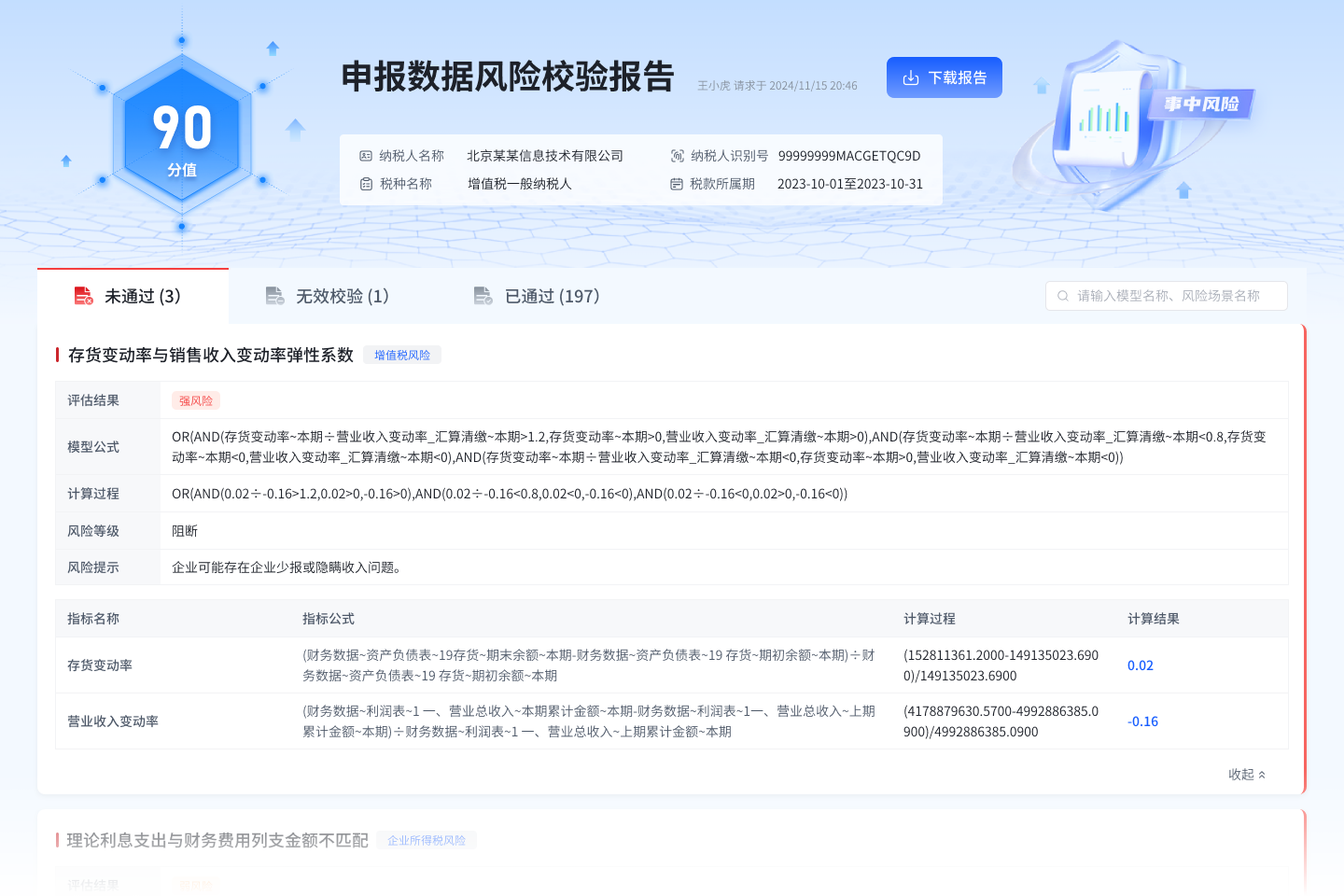
Filing data risk verification report

Wang Xiaohu requested on 2024/11/15 20:46

Download report

Figure Taxpayer name Beijing XX Information Technology Co., Ltd.

Country Tax Type Name

VAT general taxpayer

Example Taxpayer Identification Number

99999999MACGETQC9D

Tax period

2023-10-01 to 2023-10-31

Not passed (3)

Unit invalid verification (1)

Passed (197)

Q Please enter the model name or risk scenario name

1 inventory change rate and sales revenue change

Work integration

Station-based stock selection collection ×

Company Name

Initial data collection

Initialize Guojii scheduled task

Determination of supplementary tax types and deep collection ratio timing

White tax fee Ning... fixed collection

8 Tax-agriculture preference management

Period summary intermediate settings

Day Tax Source Management

Fen Mo Chan Yue Yuan Yuan

Yunzuo Land Use Yue

Platform management w

88 Order Center

Q Search applications

Menu name moved

Daily Heart Selection chunsa•

Meat Product Name

Batch push Tax Guide 2

Property name

Real estate title certificate number.

Company Name

Kuo Huan sits on the potato and details the cave; she plans and operates.

Bangbang Youqing Building.

In-depth pain point analysis · Core troubles of tax personnel and CFOs

Group 37.png

Group 38.png

Tax Officer
Overtime is inevitable at the end of each monthly filing period, relying on manual filling and verification, often completing filing right at the deadline.
With intensive introduction of new policies (such as VAT incentives and adjustments to R&D expense super-deductions), it is difficult to quickly determine "whether the enterprise is eligible," making it easy to miss benefits or cross compliance red lines.
Tax authority audits and risk inquiries are frequent. Without a systematic risk control mechanism, the cost of passive response is high.
Subordinates submit tax data with logical contradictions (such as tax burden rate not matching revenue changes), making it hard to support decisions;Rigid labor costs: employees complain of high work pressure, but there is no additional headcount, and there is no lever for efficiency improvement.
Enterprises have "tax cost reduction" targets, but find it difficult to accurately identify preferential policies they can enjoy, or do not know how to reduce tax burden through business optimization.
Have ideas for tax management optimization (such as connecting business-finance-tax data) but lack the technical capability to implement digitalization.
Filing data adjustments leave no traces, making it impossible to trace the source during subsequent tax bureau inspections; multiple systems are scattered (financial ERP, invoicing system, electronic tax bureau), and checking data requires switching across platforms, often causing confusion under urgent needs.
Temporary reporting needs are frequent (such as tax bureau risk response reports and group tax burden statistics), requiring manual data integration, which is time-consuming and error-prone.
collection period
Anxiety
collection period
Anxiety
collection period
Anxiety
collection period
Anxiety
collection period
Anxiety
Policy
Blind spots
Data
Fault
Reports
Pressure
Stuck in "repetitive inefficiency" and "passive response"
Stuck in the contradiction between "inaccurate data" and "compliant cost reduction"
CFO
Build path · Five-stage progression to build a tax digitalization system

Scenario analysis, data governance, full-tax filing, risk management, decision analysis

Tax digitalization is not achieved overnight; it requires following a five-stage path of "scenario sorting → data governance → all-tax filing → risk management → decision analysis," solving problems progressively layer by layer:
Clarify requirement boundaries
Assist in breaking down enterprise tax business processes, identifying core pain points, and determining functional scenarios and business scenarios.
Based on data governance results, achieve automatic tax calculation and tax return generation, support one-click submission to the electronic tax bureau, and connect the closed loop of "tax calculation → tax filing → payment → tax payment certificate acquisition," reducing manual intervention.
Establish an all-tax-type risk monitoring system, support dynamic tax risk monitoring, generate risk reports and suggest response plans, transforming "passive response" into "proactive prevention and control."
Relying on data governance capabilities + BI report designer + AI capabilities, it flexibly defines multi-dimensional analysis tables and intelligently generates various reports to support management's tax decisions.
Break data silos
Achieve process automation
Dynamically monitor risks
Unlock data value
Solutions · Five modules precisely addressing pain points

Group 43.png

Title 1.png

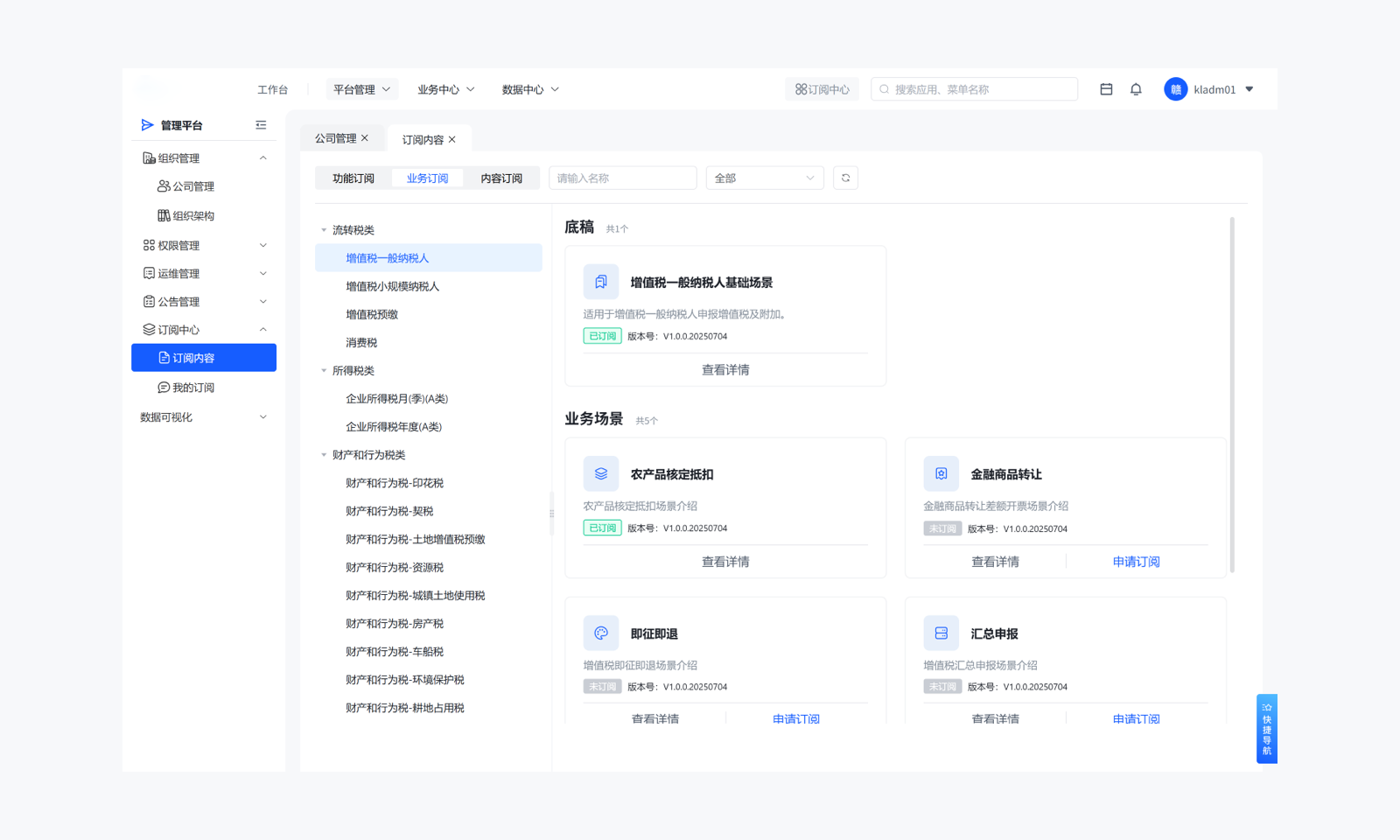
> Management Platform, Organization Management, 2 Company Management, Organization Structure, 8? Permission Management, Operations Management, Announcement Management, Subscription Center, Subscription Content, My Subscriptions, Data Visualization, Workbench, Platform Management<, Business Center<, Data Center<, 3, Company Management ×, Subscription Content ×, Feature Subscription, Business Subscription, Content Subscription, • Turnover Tax Category, VAT General Taxpayer, VAT Small-Scale Taxpayer, VAT Prepayment, Consumption Tax, • Income Tax Category, Corporate Income Tax Monthly (Quarterly) (Class A), Corporate Income Tax Annual (Class A), • Property and Behavior Tax Category, Property and
Button 1.png
Button 1.png
Button 1.png
Group 41.png
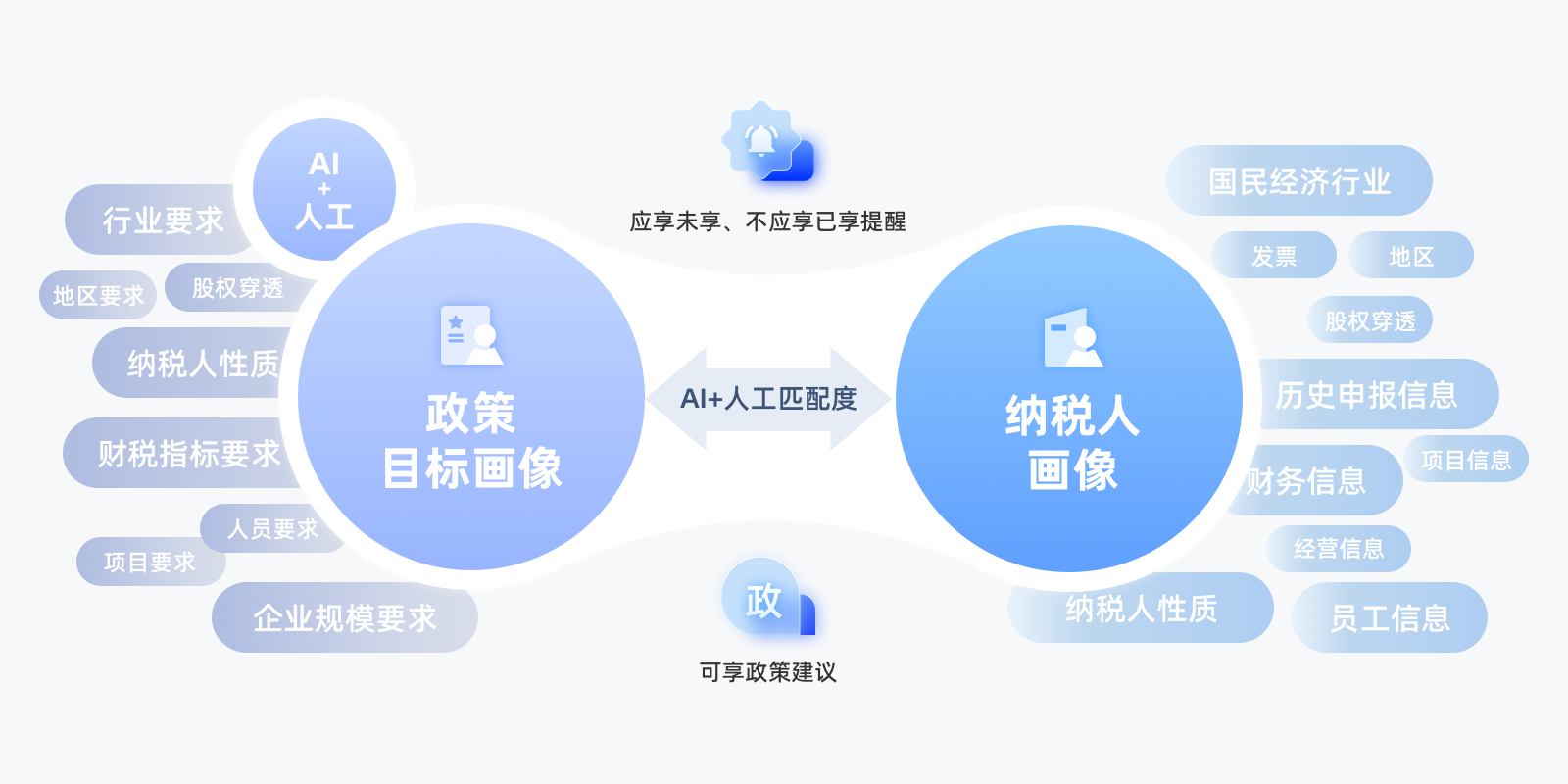
AI, manual, regional requirements, industry requirements, equity penetration, taxpayer nature, business-finance-tax indicator requirements, personnel requirements, project requirements, enterprise scale requirements, policy, target profile, reminders for unclaimed benefits and improperly claimed benefits, AI + manual match degree, policy, applicable policy recommendations, national economic industry, invoice, taxpayer, profile, taxpayer nature, region, equity penetration, historical filing information, project information, financial information, operational information, employee information
Make "policy interpretation" go from "difficult" to "easy"
Automatically matches policies, saying goodbye to "interpretation difficulties"
Build a knowledge graph of policies and regulations
Precisely matching preferences to enhance "tax-saving benefits"
Select tax types and scenarios based on the business, automatically match tax policies, and solve policy interpretation issues.
Deeply embedded with pre-built, cross-industry, full-tax-type standard business resources, supporting on-demand subscription and enabling solutions to be assembled like building blocks, achieving rapid project implementation and precisely addressing diverse business scenarios and policy differences.
Through the blood relationship among policies and regulations, preferential policies and corresponding interpretations, related cases, and FAQs, establish a knowledge graph, form a tax policy and regulation library, and link it with the business scenario library and the entitlement mechanism, easily achieving policy interpretation and application.
Solve the problem of matching preferential policies. Through precise matching of "taxpayer profiles" and "policy adaptation profiles," achieve multi-dimensional intelligent reminders for unclaimed benefits, improperly claimed benefits, and claimable tax preferential policies, helping enterprises fully utilize tax policies under compliance premises and improve tax-saving returns.
Business scenario library
Tax policy and regulation database
Full entitlement mechanism

Group 43.png

Title 2.png

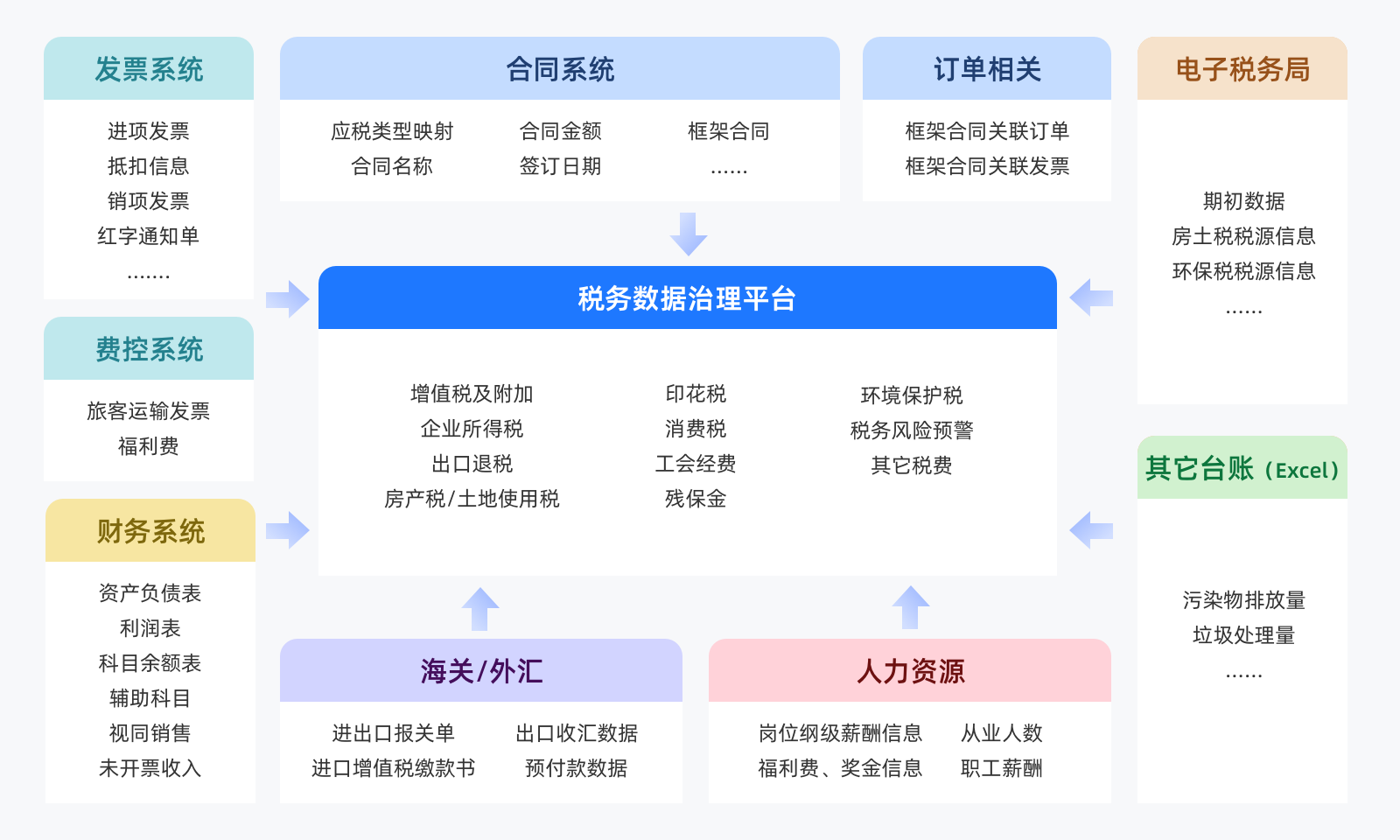
Invoice system, input VAT invoice, deduction information, output VAT invoice, red-letter notice, expense control system, passenger transport invoice, welfare expenses, taxable type mapping, contract name, contract system, contract amount, signing date, framework contract, order-related, framework contract associated orders, framework contract associated invoices, VAT and surcharges, corporate income tax, export tax rebates, property tax/land use tax, tax data governance platform, stamp tax, consumption tax, union funds, disability employment security fund, environmental protection tax, tax risk warning, other taxes and fees, financial system, balance sheet, income statement, subsidiary ledger of accounts, auxiliary accounts, deemed sales,
Button 1.png
Button 1.png
Button 1.png
Panel 2.png
Integrated pc-02.png
Group 48.png
Make "data acquisition" go from "chaotic" to "smooth"
Connect multiple systems with zero development
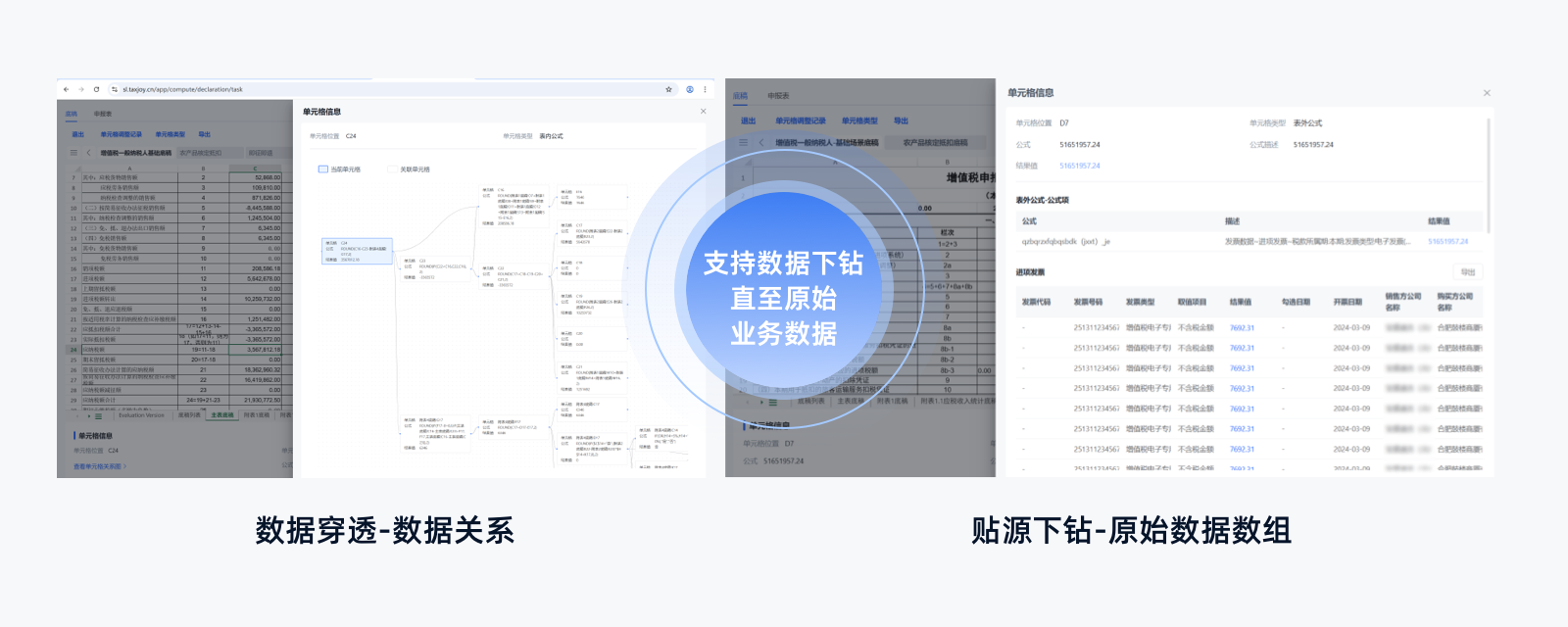
One-click drill-down from reports to source data
Release data value downstream
Self-developed visual, zero-development data integration tools seamlessly adapt to enterprises' existing business systems, tax authority ports, and Excel spreadsheets, solving the large amount of manual data transfer and secondary processing caused by data silos, easily breaking down business-finance-tax data barriers, and enabling rapid integration and deployment of multi-source heterogeneous systems. At the same time, based on intelligent, full-chain data governance capabilities, it automatically completes the cleaning and validation of tax-related data, building an enterprise-level "tax data governance platform."
Based on a complete and visualized data lineage network, achieve highly traceable data all the way to source data. A full-scenario data relationship graph displayed without crossing pages, suitable for showing relationships between tables; data composition drill-down, suitable for referencing original data arrays. It can efficiently respond to internal and external inspections and provide high-quality data support for enterprise strategic decisions.
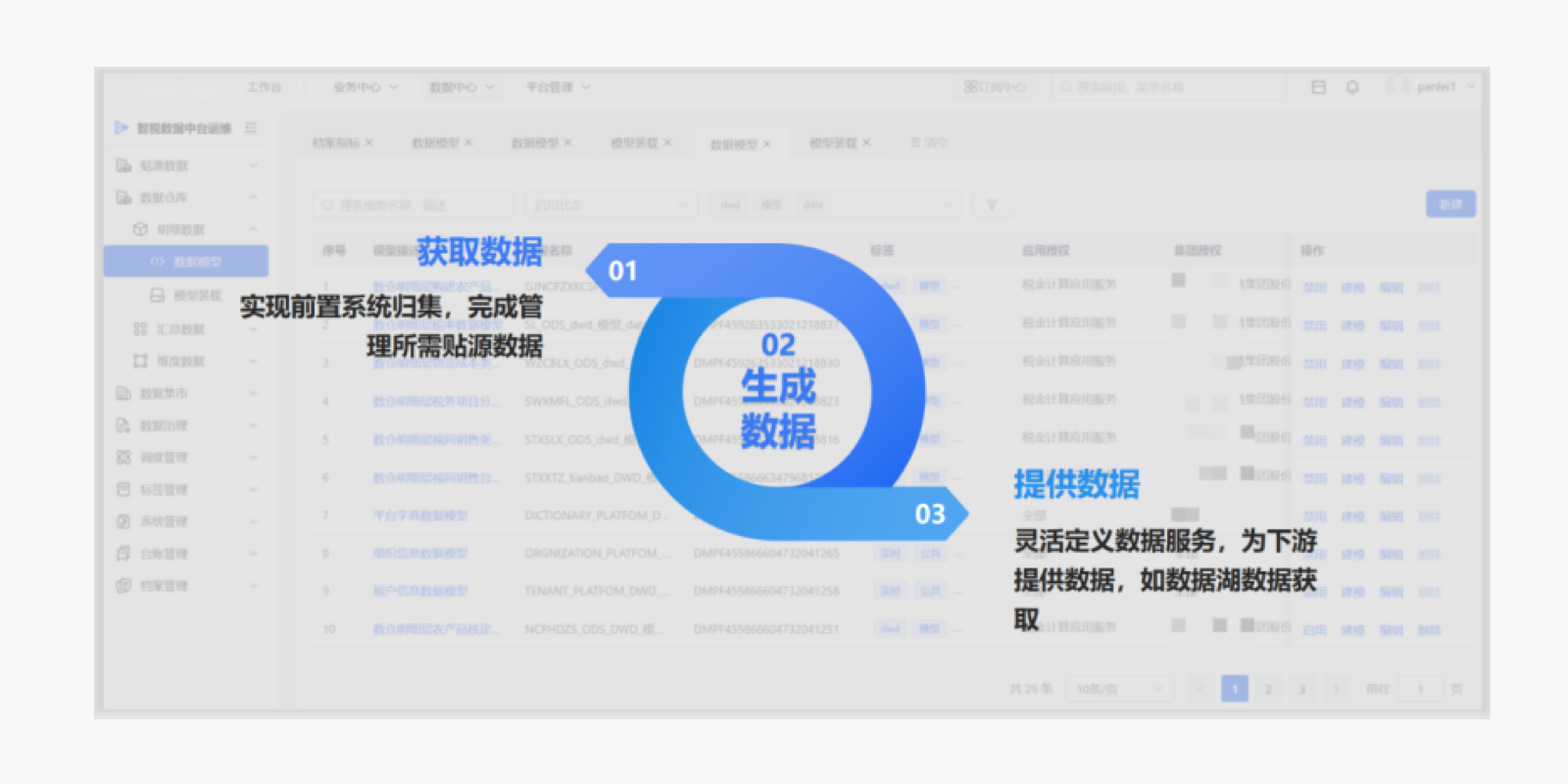
Based on self-developed visual, zero-development data integration tools, provide data service capabilities, accurately push data generated by the system to downstream demand sides, avoid "the tax system becoming a new data island," further unlock data value, and help enterprises achieve data-driven value creation.
Standardized data integration
Highly traceable data
Data services

Group 43.png

Title 3.png

Integrated pc-03.png
Button 1.png
rectangle.png
Group 56.png
Integrated pc-04.png
Make "filing processes" go from "complex" to "simple"
Solidify the foundation for automatic tax calculation
Farewell to overtime
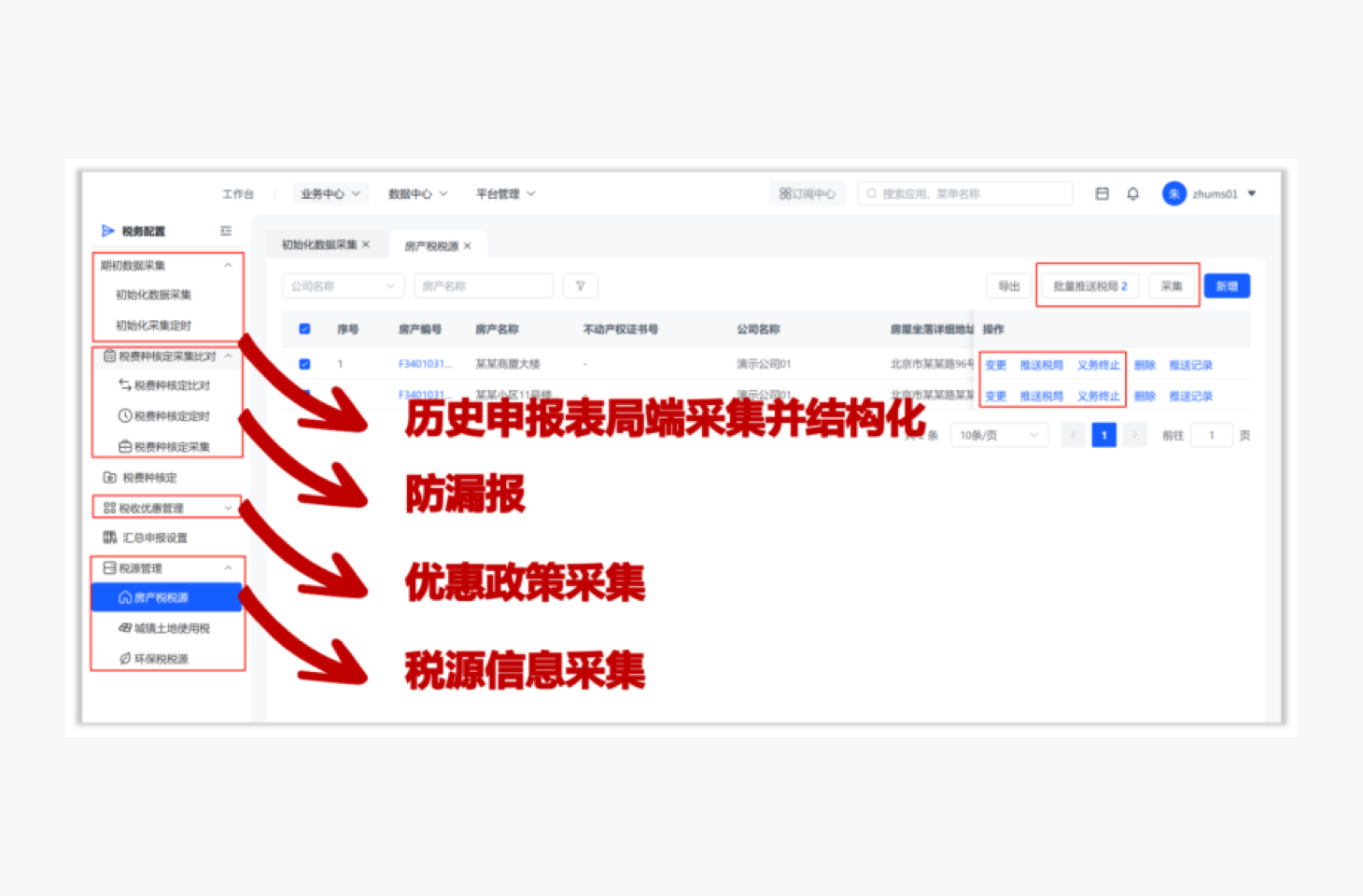
Tax and fee type verification: automatically collects enterprise tax and fee type verification information from the tax bureau, automatically compares tax and fee type verification differences by levy period, ensuring data from the same source and frequency throughout the tax accounting and filing process while preventing missed filing risks.
Tax incentive management: provides a full-volume, all-tax-type preferential policy library, supports enterprises in binding applicable preferential policies to ensure accurate enjoyment of preferential policies during filing, and also supports maintenance of information such as "record-filing/approval document number" and "record-filing/approval document" to meet enterprise needs for tax reduction and exemption preferential policy information management and record-filing.
Opening data collection: aimed at collecting and managing historical data of bureau-side tax filing forms, enabling initial data entry, supporting both scheduled and real-time collection methods, and improving the tax calculation data pool.
Tax source collection/synchronization: supports three major functions—real-time collection of tax source information from the tax bureau, manual maintenance of tax source information, and cross-region tax source management—covering taxes such as property tax, urban land use tax, and environmental protection tax. Most importantly, the system supports pushing locally maintained tax source information to the tax bureau, avoiding duplicate maintenance by enterprises.
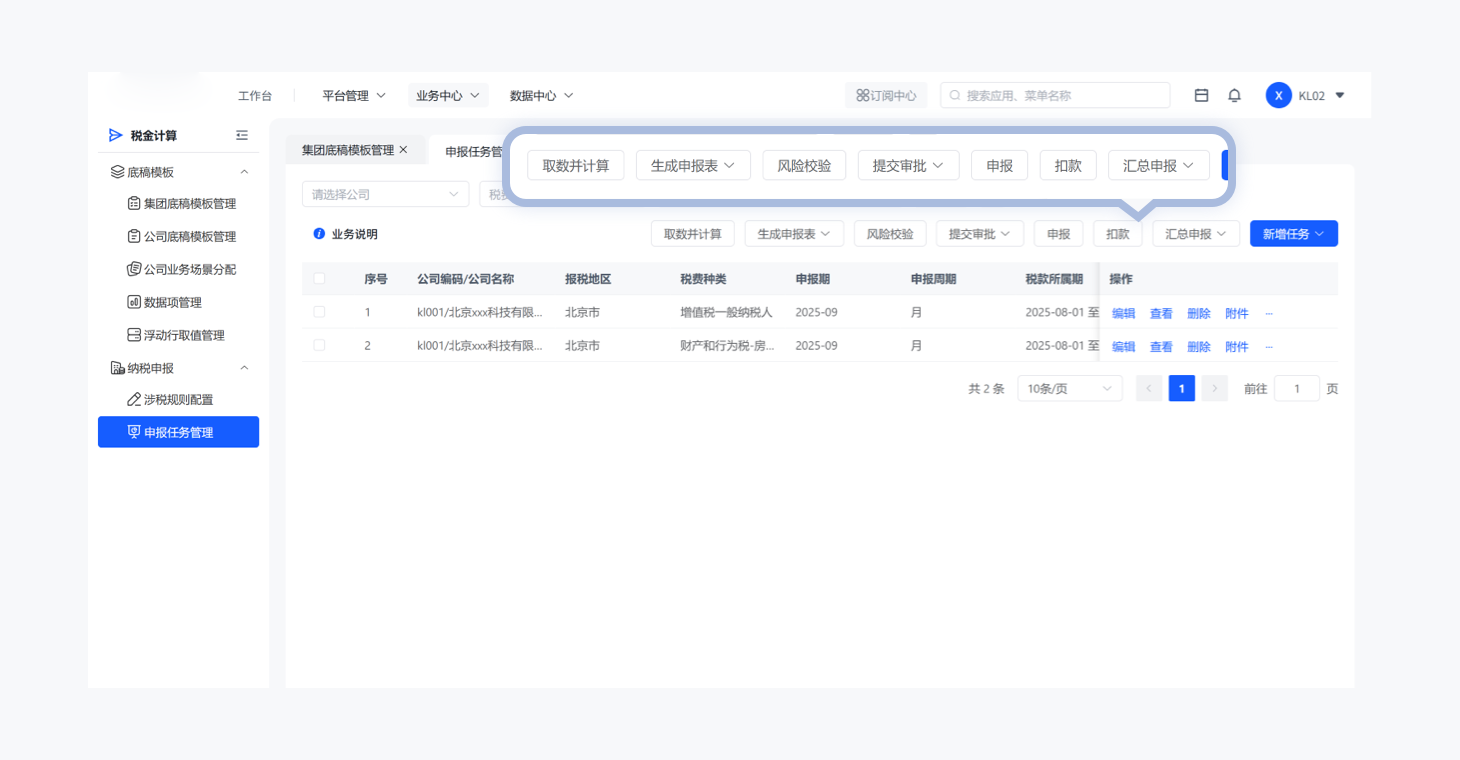
Tax calculation and one-click filing easily solve overtime issues. The system automatically generates filing tasks for each tax type in batches based on company working paper template configuration, tax and fee type verification information, and consolidated filing settings, and generates filing forms through working paper calculation, realizing automated tax calculation, one-click batch filing and payment, tax payment certificate acquisition, and other related functions.
Automatic acquisition of tax configuration
Automatic tax calculation + one-click filing

Group 43.png

Group 58.png

Title 4.png

Group 36.png
Button 1.png
Button 1.png
Button 1.png
Make "risk control" go from "passive" to "proactive"
Covers all-tax-type risks
Improve response efficiency
Precisely locate the source
Based on the tax administration's risk indicators plus industry experience, build a risk indicator system covering 200+ all-tax categories, supporting real-time/near-real-time scanning:
During-the-event risk: generally used in conjunction with tax calculation, aiming to promptly trigger risk warning prompts during the tax calculation process to achieve during-the-event risk prevention. After tax calculation is completed, the corresponding during-the-event risk report can be generated with one click and viewed along with the approval flow, enabling automated compliance review;
Post-event risk: Generally refers to risk control checks on tax calculation result items, with the step set after the tax return is generated and before formal filing, forming the "last line of defense" before filing. Through multi-dimensional risk control checks on tax calculation result items, potential tax risk points can be investigated to the greatest extent, effectively preventing risk spillover and ensuring the compliance and accuracy of the final filing work.
Risk sharing mechanism: collect practical cases from various enterprises, extract front-end risk indicators, and feed them back into the risk control model to improve warning accuracy;
Based on the lineage network of the data governance platform, risk indicators can be traced across the entire chain: for example, for the "abnormal input VAT deduction" risk, it can drill down to specific invoices (invoice code, issuer) and business contracts, quickly determine the cause of the risk (such as false business corresponding to the invoice), and provide a basis for responding to the tax authority.
Authoritative risk indicator model
Rapid risk tracing

Group 43.png

Title 5.png

Group 66.png
Button 1.png
rectangle.png
Path 27.png
Group 60.png
Make "report output" go from "slow" to "fast"
Meet both standardized and personalized needs
Conversational data retrieval
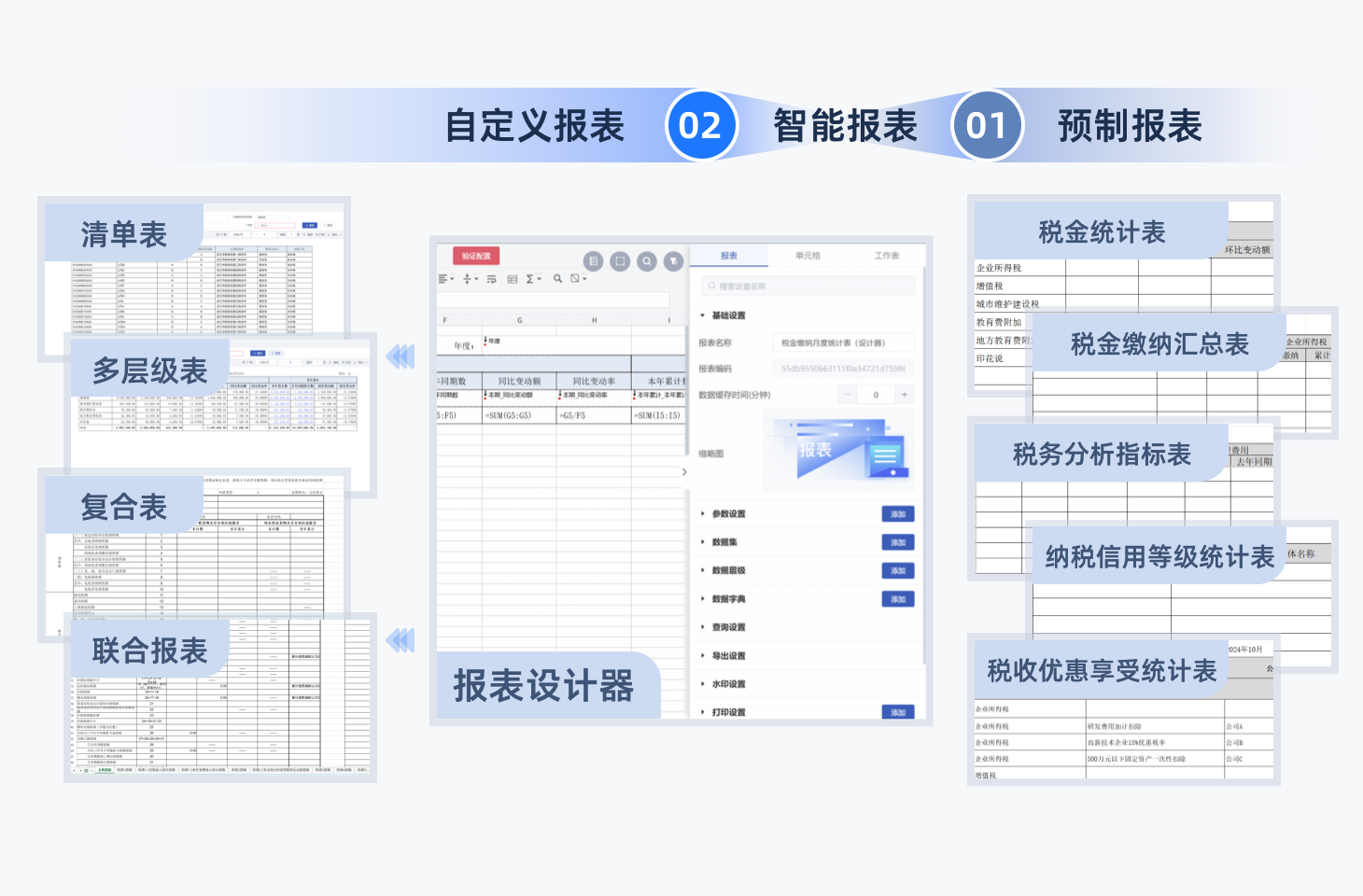
Prebuilt templates: cover high-frequency scenarios (tax statistics, preferential treatment utilization, tax credit rating, fiscal contribution), data updates automatically, and support one-click export (Excel/PDF);
Custom reports: built-in drag-and-drop report designer, enabling personalized reports without code (such as a "tax burden analysis report for a certain product line"), and supports setting automatic push (such as pushing a group tax burden report to the CFO every Monday).
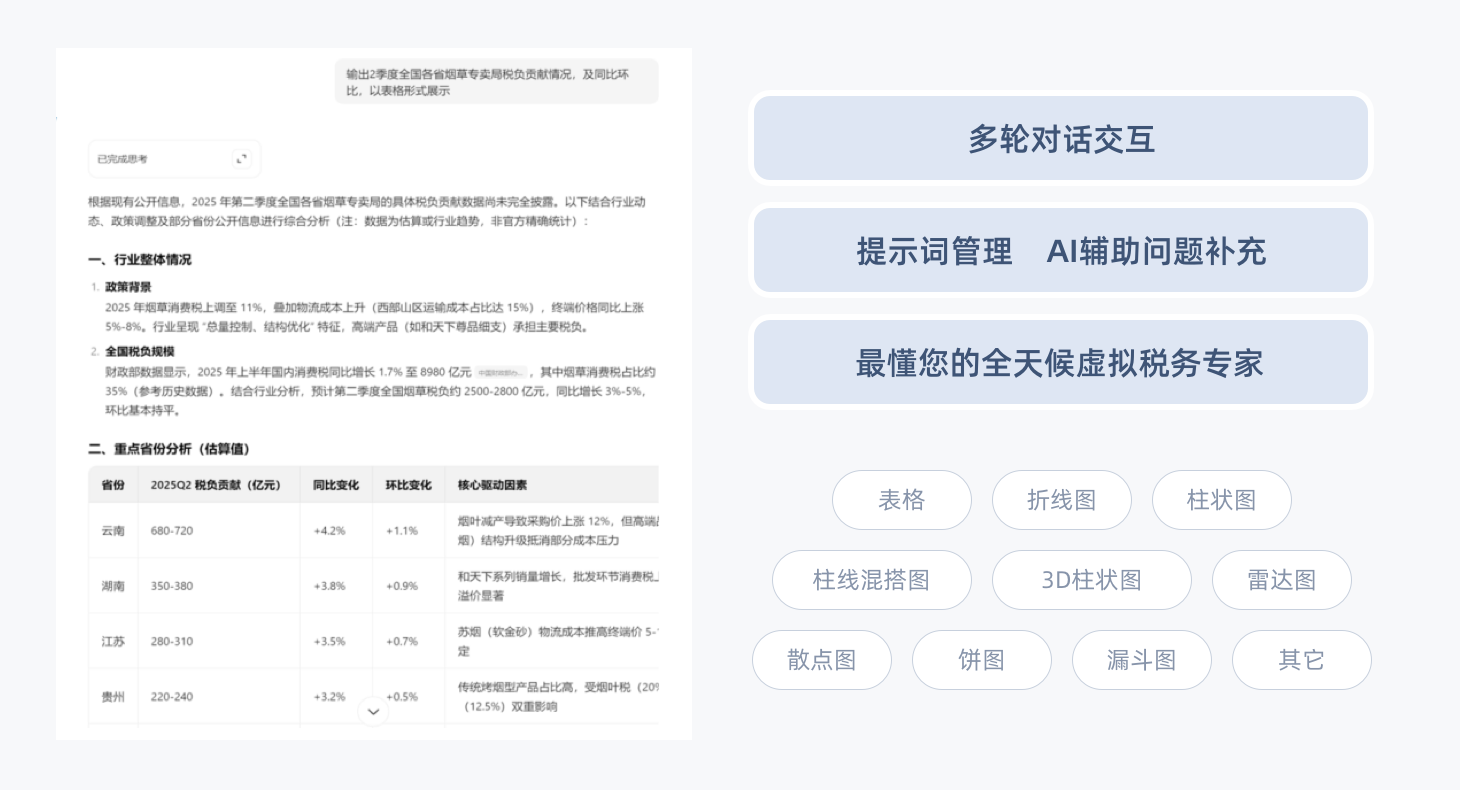
To precisely respond to the need for flexible access to data and tables in work scenarios, we rely on the underlying support of the tax data governance platform and the core computing power of the AI engine to build a natural language interactive query system. Users can complete in-depth analysis of multi-dimensional indicators and precise data retrieval in real time through intuitive Q&A, truly driving AI's upgrade from an auxiliary tool to an enterprise's all-weather online "senior business partner," injecting new momentum into decision-making efficiency and the release of data value.
Intelligent reports (pre-built + custom)
AI reports

Group 17.png

Group 18.png

Group 14.png

Group 68.png

Group 15.png

Tax operation automation
Dynamic Tax Risk Control
Efficiency improvement
Cost optimization
Risk Control
Decision support
Tax planning and decision support
Tax Information Standardization
Covers the full process of automatic input VAT invoice matching, centralized output VAT invoicing, intelligent tax calculation, and one-click tax filing, reducing manual intervention and improving efficiency by over 90%
Based on a 200+ risk indicator system, real-time monitoring of risks across all tax types including VAT and income tax, combined with industry threshold alerts, to avoid audit risks in advance.
Automation rate
85%
70%
50%
95%
60%
Filing cycle shortened
Reduce dedicated positions at branches and lower labor costs
Risk identification accuracy
Compliance Cost Reduction
Provides multi-dimensional tax burden analysis and industry benchmarking reports
Support strategic planning
Use big data analysis to optimize the tax burden from dimensions such as business model and organizational structure, link with tax incentive policies, and provide management with a basis for strategic decision-making.
Establish unified tax-accounting rules and data standards, connect business-finance-tax systems, and achieve group-level data interconnection.
Value validation · Let data speak, see efficiency improvement
Through tax digitalization solutions, enterprises can achieve value improvement in four dimensions: "efficiency, cost, compliance, and decision-making":
Contact Us

Contact: 010-60974119

VIP Dedicated Consultant: 185-1389-5936

Address: Room 410, 4th Floor, Jianjin Center, No. Jia 1 Yongtaiyuan, Qinghe, Haidian District, Beijing
Scan to add customer service on WeChat
Industry Websites
Scan to follow our WeChat official account
Scan to view our video account
Scan to follow our Douyin account