010-6097 4119Book a Demo


What exactly can Kailing Technology's AI digital employee do? Overview of five position scenario categories: general, review, monitoring, reporting, and data linkingPublished: 2026-07-02 16:02 What exactly can Kailing Technology's AI digital employee do? One-sentence answer: it can do those tasks in enterprises that are "high-frequency, repetitive, cross-system, and require some judgment," and all are covered by Kailing's five major categories—General category (daily Q&A and knowledge lookup), review category (contract comparison and compliance review), monitoring category (equipment and indicator monitoring), reporting category (automatic data retrieval for daily and weekly reports), data linking category (cross-system data synchronization and master data verification). No matter which position you want AI to take over, it will ultimately fall into one of these five categories. The following review provides a panoramic overview of enterprise position scenarios across these five categories, and teaches you to use the "Four-Keyword Rule" to pick the first scenario to implement within a category.
First distinguish: digital employees and "AI that only chats" are not the same thingMany people equate digital employees with chatbots installed in a workbench; this is the biggest misunderstanding. Chatbots are good at "telling you how to do it," while AI digital employees are good at "getting this done for you." The paradigm difference is: in the past it was "people finding systems" — you log in to one system after another, manually retrieve data, and manually enter it; in the future it will be "AI invoking systems for people" — digital employees, like real colleagues, drive progress across multiple systems and finally deliver a complete deliverable. Can get things done:Not just giving suggestions, but actually issuing invoices, reconciling accounts, and producing reports, completing tasks in a closed loop. Can judge:Includes judgment steps of "yes / no", such as whether contract terms are compliant and whether reimbursement exceeds standards; it is not mechanical handling. Cross-system:It can transfer data between two or more systems such as ERP, contracts, OA, and finance, rather than being trapped in a single dialog box. Produce complete deliverables:The result is a reconciliation statement, an invoice, or an analysis report that can directly enter business circulation, rather than a text reply.
Panoramic inventory of five major categories: any AI digital employee must fall into one of themKailing categorizes all enterprise job scenarios into five major types. The significance of this classification is that it covers almost every position in an enterprise that can be taken over by AI, and any digital employee will ultimately belong to one of these categories. First look at an overview map, then break down each category to explain what it manages, typical position examples, and which types of enterprises it suits.
General category: first make AI the entry point for "on-demand answers" The general category handles high-frequency but lightweight work such as daily Q&A, knowledge lookup, and meeting booking. A typical role is the "policy inquiry AI digital employee": when an employee wants to know the travel reimbursement limit, there is no need to search policy documents or chase administration; they simply ask the AI, which finds the accurate answer from the policy library. This suits enterprises with many policy documents and frequent employee questions, and is the easiest category to start with and the fastest for all employees to perceive value from. Review type: turn experience-based judgments into standard actions Review-type employees handle contract comparison, reimbursement verification, and compliance review—the common point is that all involve "yes/no" judgments. A typical role is "contract risk review employee": after uploading a contract, AI automatically compares it with enterprise templates and the regulations database, marks risk clauses in red item by item, and compresses review of a contract from 40 minutes to 5 minutes. It suits enterprises with large contract/reimbursement volumes and strict compliance requirements, especially scenarios where legal and finance teams are short-staffed and afraid of missing reviews. Monitoring category: 7×24 sleepless watching Monitoring category manages equipment status alarms and environmental indicator monitoring. The value lies in "people cannot watch everything, and not a moment can be missed." A typical position is "wind turbine operation monitoring employee": watching equipment operation data 24×7, and once an abnormality occurs, automatically sending text messages or calling the duty officer. It is suitable for manufacturing, energy, and park-type enterprises with large numbers of equipment, production lines, or environmental indicators that require continuous monitoring. Report category: before work starts every day, the data is already on your phone The report category manages automatic data retrieval and generates daily and weekly reports—this is the most typical "high-frequency + repetitive" work. A typical role is the "production daily report auto-generation employee": reports are automatically completed before 9:00 every morning, and managers receive them directly in DingTalk / WeCom / Feishu, with no need to chase people for numbers or manually assemble tables. It is suitable for almost all enterprises that need to regularly produce business / production / operations reports. Data link category: The "data bridge" that breaks down system silos Data link category manages cross-system data synchronization and master data validation, solving the long-standing problem of "the same data not matching across multiple systems." A typical role is the "ERP and finance bridge employee": when master data changes in ERP, it automatically synchronizes to finance, procurement, contract, and other systems, avoiding manual duplicate entry and data conflicts. It is suitable for group enterprises with numerous systems and data that needs to flow frequently between multiple systems. The four-keyword rule: how to pick the first scenario to launch within a categoryNow that you know the five major categories, the next step is choosing scenarios. Kailing's experience is to score candidate scenarios with four keywords: the more hits and the greater the value, the higher the priority for adoption.
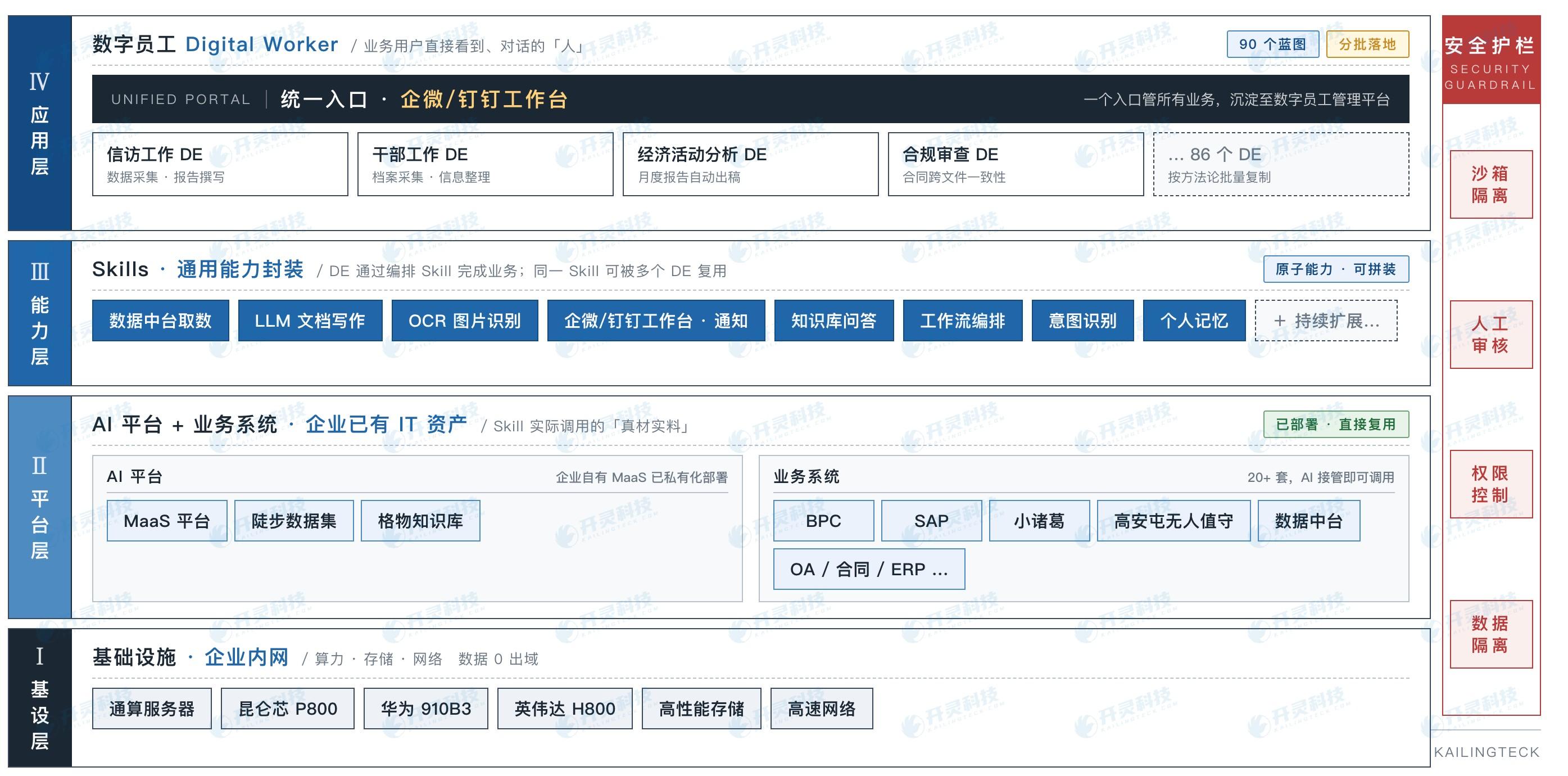
The method is simple: in the category you want to take over, list several candidate positions and check each against "high frequency, repetitive, cross-system, requires judgment." The more items a scenario hits, the higher its return on investment and the more it should be the first to be implemented. For example, in the reporting category, an operations daily report that is "needed every day, has a fixed process, requires data from multiple systems, and still needs judgment on definitions" is a natural first choice. Being able to handle so much work, what architecture does it rely on?A digital employee is not an isolated robot, but is built on a four-layer technical architecture. The key premise of this architecture is "data zero egress"—pure private deployment, reusing the enterprise's existing IT assets, without sending data outside the enterprise intranet.
Simply put: the infrastructure and AI platform layers are assets the enterprise already has, and Kailing does not duplicate investment; the capability layer turns data retrieval, writing, recognition, notification, and more into reusable atomic capabilities; the application layer assembles these capabilities into "digital employees," which employees can subscribe to and use in the WeCom/DingTalk workbench without secondary IT configuration. Security guardrails (sandbox isolation/manual review/permission control/data isolation) run through the entire architecture, and key approval nodes always retain a "human in the loop." Want to know which type of AI digital employee your enterprise should implement first? Welcome to contact Beijing Kailing Technology for scenario diagnosis: www.kailingteck.com .
Solutions for businesses including sales contract management system, procurement contract management system, fully digitalized Leqi interface project, output automatic invoicing system, reverse invoicing system, invoice issuance for individuals system, employee expense control and reimbursement system, input VAT invoice management system, supply chain collaborative reconciliation system, image OCR recognition system, automatic financial bookkeeping system, and electronic accounting archives system, comprehensively driving the digitalization process across various fields. If you have any business-finance-tax digital transformation needs, welcome to contact us. Beijing Kailing Technology will serve you wholeheartedly.
Keywords:AI digital employee, enterprise digital employee, five major categories of digital employees, general category, review category, monitoring category, reporting category, data connection category, four-keyword rule, contract risk review, automatic production daily report generation, ERP data synchronization, private deployment, zero data egress, Kailing Technology |