The AI Era
Building the marketing lead acquisition system

There is just one thing to solve:Let customers in need find you precisely。From how the team works and where content is published, to where customers come from, who takes leads, and what to adjust next round, the five things connect into a closed loop that can run on its own.

  • Make them find you——Before customers contact you, they first search and ask AI Q&A; you need to be there
  • Make them trust you——Official website, encyclopedia, media reports, and qualifications must be solid enough for AI to be willing to mention you
  • Make leads retainable——Official website leads, phone calls, and WeChat unified into one pool; who follows up and how long it takes to respond are determined in advance
  • Make the next round more accurate——Which word and which piece of content actually brought customers is clearly shown on the dashboard
Customer acquisition loop · Five steps run on their own
Continuous iteration
1
Teach the methodTwo-day course, the team walks through all eight rings together
Course
2
Build the positionWebsite found by search, cited by AI, and able to retain visitors
SEO/GEO
3
Lead entry into poolWebsite leads automatically enter CRM and are assigned to sales by rules
CRM
4
Data ReturnWhere customers come from and what they care about is registered on the spot during reception
Dashboard
5
Adjust upon returnWhich words to add, what content to write, which page to modify
Next round
Return to step 2, and each round makes the position strongerLess effort the more it runs
8 rings
The eight systems of the marketing flywheel
If one link fails, the whole chain breaks.
2 days
Team training together
Generate the enterprise's own solution on the spot
RMB 5
Course · Official Website · CRM
Opportunity distribution · Data dashboard
100 days
Marketing system building roadmap
Know the first step as soon as you return to the role

How to let customers in need find you precisely

First look at how customers actually find suppliers, then look at where most enterprises get stuck, and then our approach and what can be seen after implementation.

Customers search and ask AI Q&A before contacting the company How customers find you
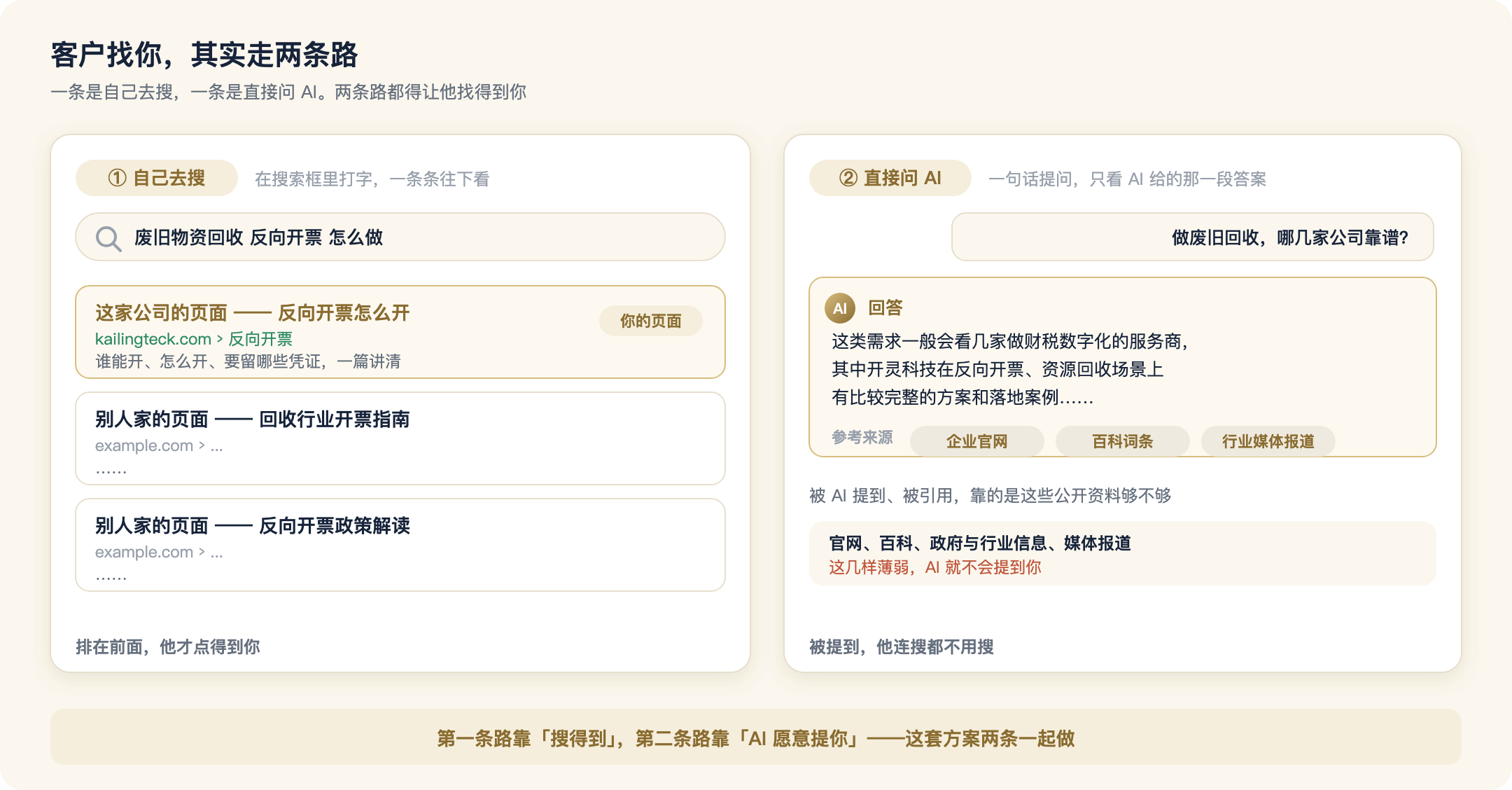
He first searches by himself, then asks AI.
Before contacting you, customers have already compared several vendors in searches and AI answers. Only if you appear there can anything follow.
Everyone writes their own content, and customers can't find this company when searching Where do most enterprises get stuck
Everyone writes their own content, and customers can't find you
Those writing articles do not know what customers are searching for, those shooting videos do not know where to direct traffic, and sales do not know what the other party viewed before reaching out
Two-day course, marketing and sales teams build the customer acquisition system together How to do it
The eight stages are opened up in sequence, with the team working together
Go through the eight stages one by one, using the enterprise's own business for practice throughout, producing a diagnostic checklist, keyword library, and 100-day roadmap on the spot
Marketing data dashboard, letting management see at a glance which keywords actually brought in customers After it is done
Which keywords actually brought customers, see clearly on one screen
Website performance, content citations, lead sources and follow-up status converge into one dashboard, providing a basis for what to adjust next
For customers to find you accurately, in between there is Eight stages: Who does it, what customers search for, what content to write, whether the official website can capture leads, who follows up on leads...
Our approach is to first go through these eight links and see which ones are broken,First connect the one or two links that are blocking the entire chain, not tear down and rebuild all eight links.

The eight rings of the marketing flywheel: eight questions to answer in sequence along one chain

The eight things are actually eight questions to be answered in sequence along one chain: who is assigned to handle the market matter → how to build the brand moat → how customers with needs find suppliers → how to get them to actively search for you → how to get them to remember you after watching the video → whether key people can be contacted after finding you → who takes over after contact is made → how the results of taking over feed back into the market. If one link in the middle breaks, all previous efforts will leak out from there.

Marketing flywheel
Eight rings
After it starts running
Each lap is less effort than the last
1Who handles the marketHow to build the marketing organization and staffing system
2Brand MoatHow to build an enterprise brand moat
3How customers find youHow customers in need find suppliers
4Article found via searchHow do you get people in need to find you on their own?
5Video rememberedHow do you make them remember you after watching the video?
6Leave the key contactAfter finding you, can the key person be reached?
7Who follows upAfter contact is made, who will take over and follow up
8Feed back into the next roundHow do the undertaken results feed back into the market?

1 · How to build a market organization personnel system?

How marketing positions are divided and assessed. Provide the operator profile, how to write recruitment job descriptions, trial draft questions, and scoring dimensions; after team expansion, the responsibilities and monthly output baselines for the three roles of copywriter, video, and lead.

2 · How is an enterprise brand moat built?

Before customers contact you, they first search and ask AI. AI answers come from official websites, encyclopedias, government and industry information, and media reports, and enterprises with weak materials in these areas will not be cited. This section explains how to supplement them in order.

3 · How do customers in need find suppliers?

Industry terms, product terms, and question terms have different value, and priorities must be validated with data from the specific industry. Keyword sources include Baidu, WeChat, Douyin, keyword tools, competitor websites, the actual words of sales and customer service, and AI Q&A, ultimately building a keyword library with search volume, competition level, intent, and priority.

4 · How to let people in need actively find you?

Topics come from keywords, high-frequency sales questions, and customer cases; industry news and holiday greetings are not customer acquisition content. Articles follow a four-part structure: introduce the problem, break down the causes, provide methods, and guide the next step. People handle topic selection and facts, while AI handles the first draft and rewriting.

5 · How do you make them remember you after watching the video?

Whether the boss or employees appear on camera, and how to agree in advance on account and material ownership. Spoken scripts, basic shooting setup, and batch shooting schedules—aim to shoot a batch of continuously editable materials in half a day.

6 · After finding you, can we reach the key person?

The three responsibilities of a website are to be found, to be trusted, and to capture leads. Four criteria determine whether to optimize locally or rebuild entirely; SEO looks at crawling, structure, and content updates, while GEO looks at AI citation sources, structured data, and excerpt-friendly writing.

7 · After contact is made, who takes over and follows up?

Where to place lead capture hooks and how many form fields convert best; unify form, phone, WeChat, direct message, and offline entry points into one pool, and define who notifies, how fast to respond, and what the first sentence should be.

8 · How do the results undertaken feed back into the market?

Lead status and win/loss reasons must be filled back, with marketing and sales aligning once a week. Managers focus on a few core indicators, combining the official website, search terms, customer management records, and sales feedback into one demand map.

Five modules, linked into one closed loop

For customers to find you accurately, knowing the method is not enough; you also need a system that can catch it. The course solves "the team knows how to do it," and the following four blocks solve "after doing it, it can be caught"—only taking the course without implementing the system makes it hard to sustain after returning to the job; only implementing the system without taking the course leaves the team not knowing how to use the data.
Marketing system course Two days · The team works together

Go through all eight links of the marketing flywheel, with exercises throughout based on the enterprise's own business, not just listening to concepts. On site, select three peers for comparison, use the enterprise's own products to mine keywords and build a library, use real cases to break down article structures, and draft job responsibilities and assessment proposals on the spot. Everything produced in class can be taken back and used directly by the enterprise.
View the full two-day outline →
What is delivered
  • Two days of offline instruction and on-site exercises
  • Full set of courseware, instruction templates, and practice scripts
  • Enterprise status diagnosis and improvement priority list
  • 100-day market system construction roadmap

SEO / GEO official website Customer acquisition channels

A website must do two things at once: be found in search engines and be mentioned in AI Q&A. The "found" half addresses: whether search engines can smoothly crawl your pages, whether the page structure is easy to understand, and whether content is continuously updated—specifically covering crawl rule files, sitemaps, page titles and descriptions, heading hierarchy, and URL structure; the "mentioned by AI" half addresses why AI would cite you—completing citation sources such as your website, encyclopedias, industry and media, adding machine-readable markup to pages and a site description file written specifically for AI, and writing content in a form AI can easily excerpt, with Q&A pages being the most effective format.
Diagnose first, then act: four criteria to judge whether it is local optimization or a complete redo. For most enterprises, local optimization is enough.
What is delivered
  • Official website SEO / GEO current status diagnostic report
  • Technical Item Rectification: Crawling Rules, Machine-Readable Markup, Sitemap
  • Keyword landing page and Q&A page development
  • Lead capture entry points and conversion hook design
Two paths for customers to find you: searching on their own, and asking AI directly
← Swipe left or right to view the full image →

CRM system Leads have a place to be stored

Equip a Kailing AI CRM: 360° customer profiling, opportunity funnel management, contract and payment milestone tracking, and AI daily business summaries. After leads come in, the entire process from follow-up, quotation, signing to payment collection is fully documented—who is following up, what stage they are at, and why it was lost are always visible to managers. The functions are consistent with the AI CRM product on the Kailing official website; the only difference is that this solution connects it with the official website and marketing actions.
Learn about Kailing AI CRM →
What is delivered
  • Kailing AI CRM Activation and Initial Configuration
  • Full-process archiving of customers, opportunities, contracts, and collections
  • Sales team usage training
  • AI daily business summary

Automatic dispatch of official website opportunities Connect the official website with CRM

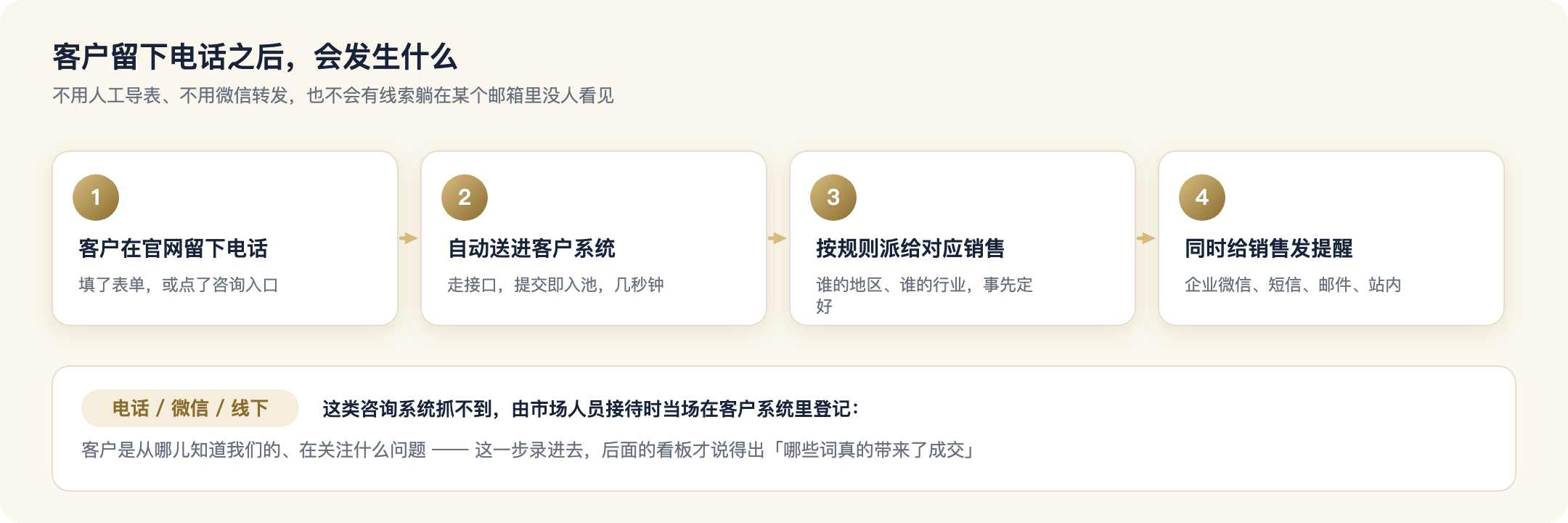
This is the pipe between the previous two parts. Every lead form a customer fills out on the official website and every consultation entry point clicked goes through the integration interface provided by CRM Directly enters the CRM lead pool, and assign them to the corresponding salesperson according to pre-defined rules, while triggering notifications. No manual table export, no back-and-forth forwarding, and no leads sitting unseen in someone's inbox.
Inquiries from phone, WeChat, and offline channels that such systems cannot capture are registered on the spot in the CRM by marketing staff when receiving them, with source and customer concerns recorded together — this step is the prerequisite for whether the later data dashboard can speak.
What is delivered
  • Integration and joint debugging of website forms with CRM
  • Configuration of lead pooling rules and assignment rules
  • Response time limit and timeout reminder settings
  • Marketing staff registration standards and first-touch scripts
Leads automatically enter the pool: what happens after a customer leaves a phone number
← Swipe left or right to view the full image →

Marketing data dashboard and optimization notifications Tell you what to adjust in the next round

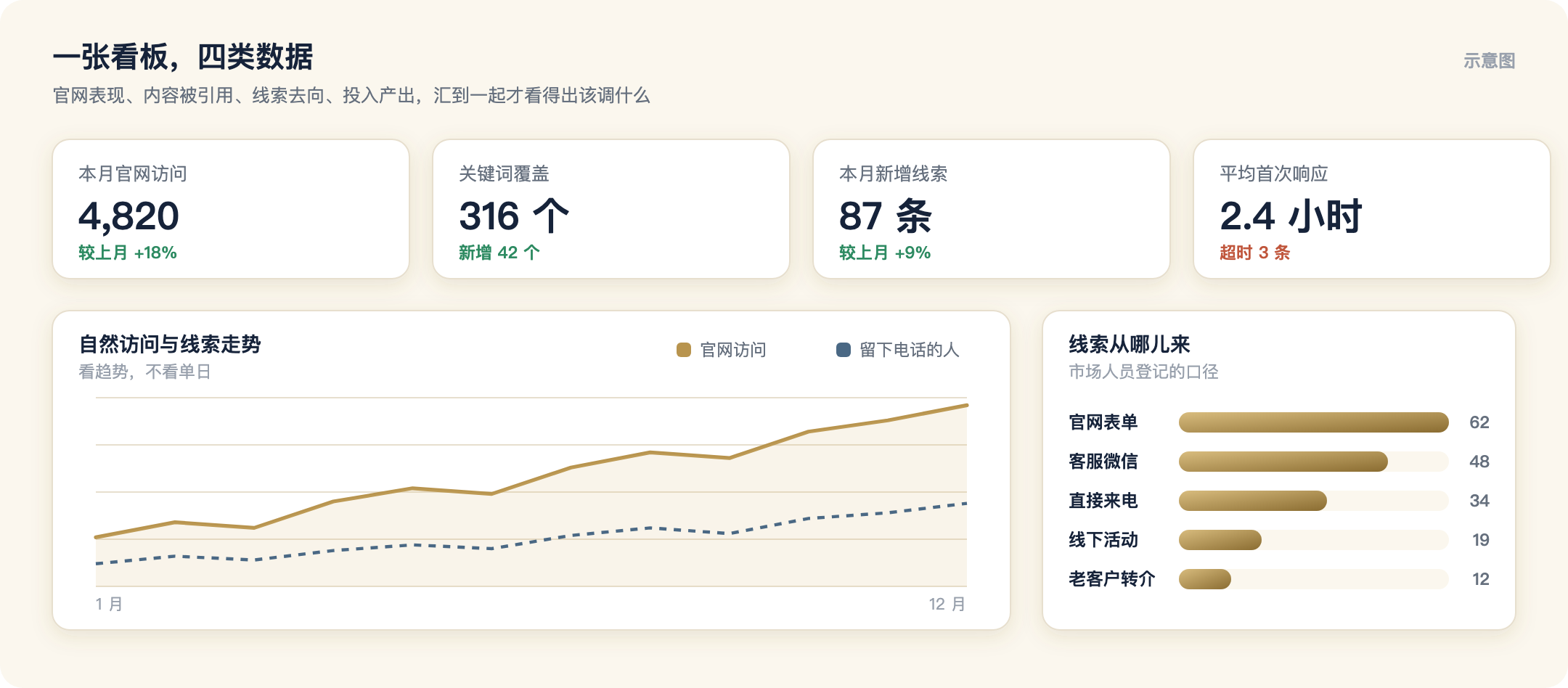
The dashboard consolidates data scattered everywhere into one chart: organic visits to the official website and performance of key pages, content indexing and AI citation status, which channel leads come from, how far sales follow-up has progressed, and the reasons for wins and losses.Among them, the item "how customers found us and what they are paying attention to" is asked clearly on the spot by marketing personnel when receiving inquiries and entered into the system— Customers who come via phone and WeChat cannot be captured by the system; only people can find out by asking, and this is precisely the key to determining which keywords truly bring in deals.
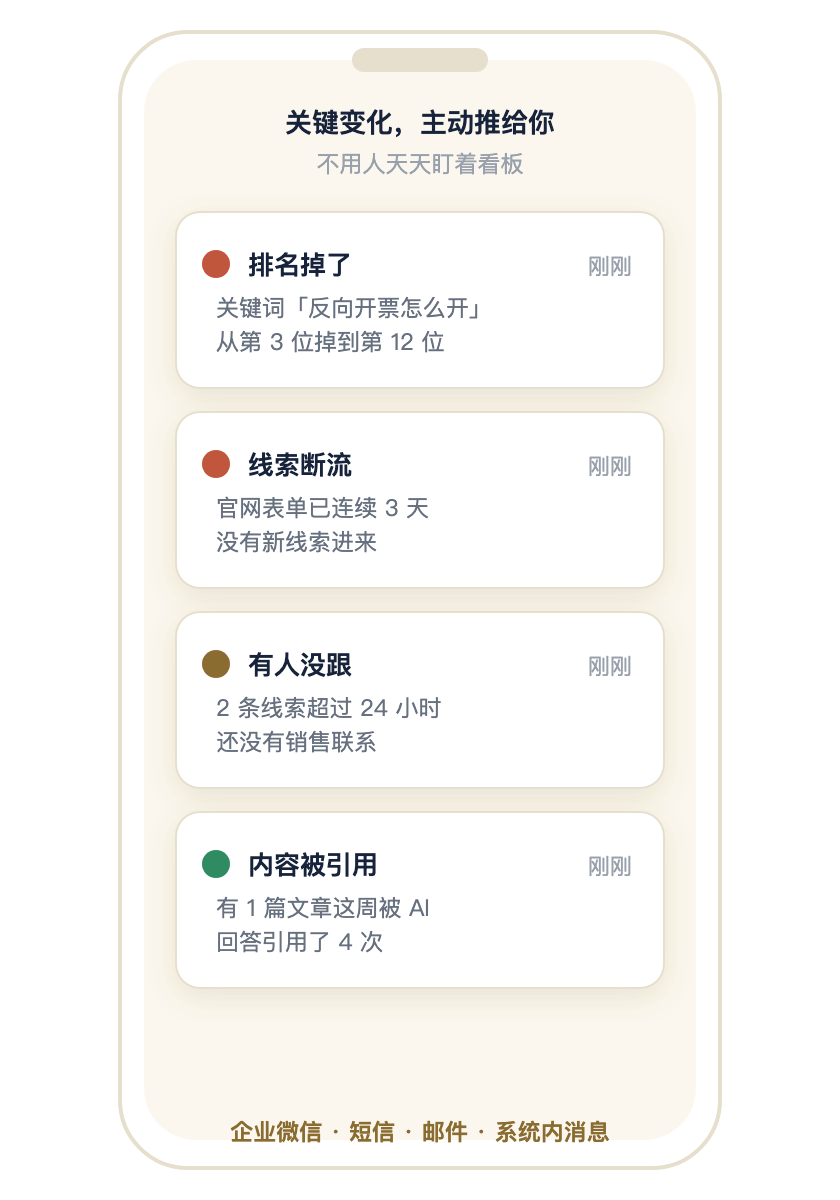
Key changes don't need to be watched daily by a person: if a keyword's ranking drops, a channel's leads suddenly drop to zero, or a lead goes overtime with no follow-up, the system proactively pushes a message alert.
What is delivered
  • Marketing lead acquisition data dashboard configuration
  • Rules for notifying abnormal changes in key indicators
  • Four-channel push via WeCom / SMS / Email / In-site
  • Weekly marketing and sales alignment mechanism
Marketing data dashboard illustration: website performance, content citations, lead destinations, return on investment
← Swipe left or right to view the full image →

Complete two-day course outline

Nine modules, corresponding to the eight stages of the market flywheel plus one overall framework. Each segment is paired with the enterprise's own business for on-site practice, and what is produced in class can be used back on the job.
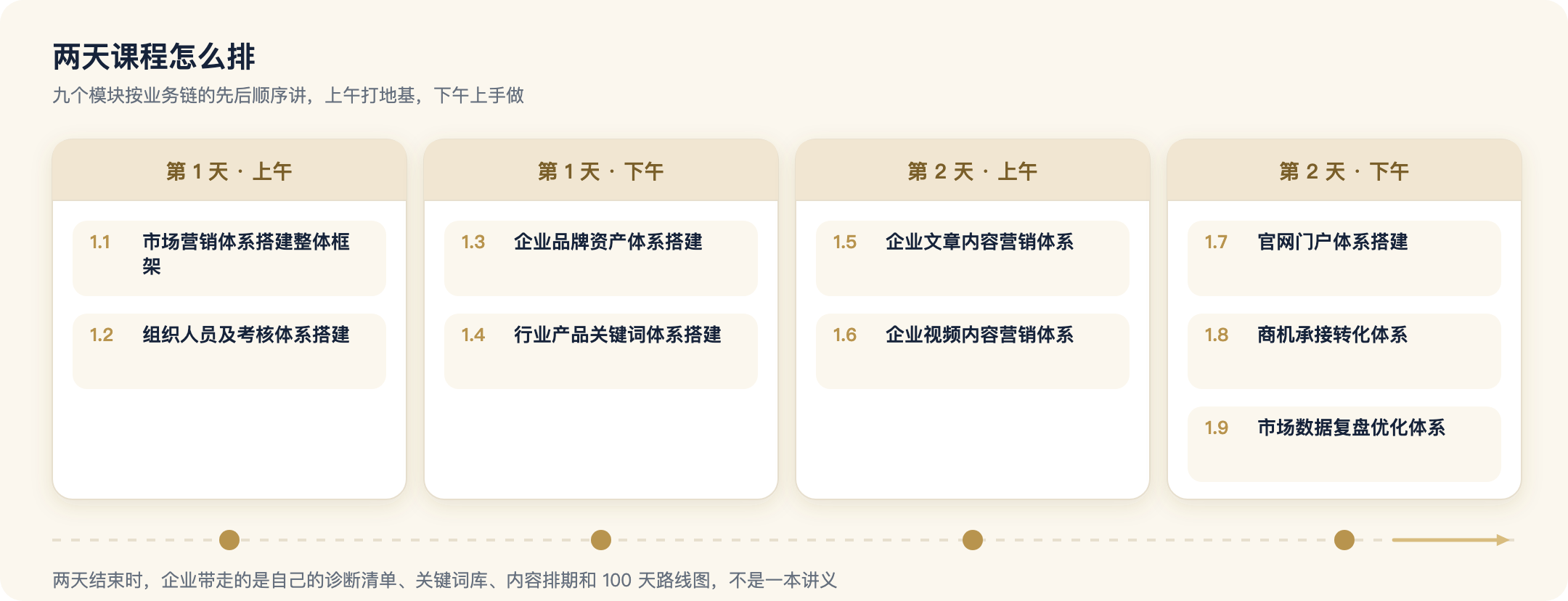
Two-day course schedule: nine modules arranged in business chain order
← Swipe left or right to view the full image →
ArrangeTopicCore Content
Day 1 Morning 1.1 Build the overall framework of the marketing system
1.2 Build the organizational personnel and assessment system

Marketing investment is substantial yet stable output is hard to achieve. Common causes are unclear responsibilities, scattered actions, and disconnected lead handover. Start with The eight-ring marketing flywheel model Review the current situation and determine which links should be prioritized. The eight things are eight questions to be answered in sequence along one chain: who handles the market work → how to build the brand moat → how customers with needs find suppliers → how to get them to actively search for you → how to make them remember you after watching the video → whether key people can be contacted after finding you → who takes over after contact → how the results feed back into the market.

Provide Trader profile, how to write recruitment job descriptions, trial draft questions and scoring dimensions, improving the discernment of recruitment and selection; after team expansion, clarifying the responsibilities and monthly output baselines of three roles: copywriting, video, and lead.

Designed for the two common problems of only assessing deal completion and only assessing document output volume,Three-level indicators: process, intermediate, and result: Discuss the combination of salary and performance, as well as which basic tasks can be assisted by AI and which judgments still need to be made by people.

Day 1 Afternoon 1.3 Build the enterprise brand asset system
1.4 Building an industry product keyword system

Before contacting an enterprise, customers usually first learn about it through search and AI Q&A.Select three peers on site, observe search results and AI answers respectively, and compare their respective brand information, content foundation, and citation sources.

Break down the common information sources for AI answers: corporate websites, encyclopedia materials, government and industry information, media reports, and professional content. When materials are weak, it is harder to build trust and harder to be cited. Based on this, sort out media content, encyclopedia materials, and qualification information Build sequence

Distinguish the different value of industry terms, product terms, and question terms, and validate priorities with data from your own industry; demonstrate keyword mining sources such as Baidu, WeChat, Douyin, keyword tools, competitor websites, actual words from sales and customer service, and AI Q&A; establish a system including Search volume, competition level, intent, content format, and priority lexicon and convert it into a first draft of the content schedule.

Day 2 Morning 1.5 Building an enterprise article content marketing system
1.6 Building an enterprise video content marketing system

Clarify the division of labor among different positions in the content matrix: which content is responsible for being found, which for building trust, and which for spreading, and choose the content positions to prioritize in the initial stage based on the enterprise's current goals.

Topics come from keywords, high-frequency sales questions, and customer cases; industry news, holiday greetings, and internal activities usually Not used as customer acquisition content.'s priority direction. Practice the four-paragraph structure of the article: introduce the problem → break down the causes → provide methods → guide the next step, and use real cases for paragraph-by-paragraph analysis. Clarify Humans are responsible for topic selection and facts, while AI assists with drafts and rewriting, supporting writing instructions, methods to remove AI flavor, and fact-checking steps.

Choose whether the boss or an employee appears on camera based on the enterprise's situation, and design in advance the ownership and handover methods of accounts, content, and materials; practice the spoken script, basic shooting configuration, and batch shooting schedule, aiming to complete a batch of materials that can be continuously edited within half a day; break down content forms such as enterprise short dramas, product demonstrations, customer testimonials, and on-site shooting, as well as their use in sales follow-up.

Day 2 Afternoon 1.7 Building an official website SEO/GEO portal system
1.8 Building a lead conversion system
1.9 Market data analysis, review, and optimization system

The three core responsibilities of a website are Be found, be trusted, leave leads. Use four criteria to judge whether to optimize locally or redo entirely, and choose the investment approach based on the current situation. The check items here are: whether search engines can smoothly crawl your pages, whether the page structure is easy to understand, and whether the content is continuously updated, specifically covering the crawl rules file, sitemap, page titles and descriptions, hierarchical headings in the body text, and URL structure.

Getting AI to willingly cite you is an incremental direction worth watching: Analyze the information sources commonly used by AI, add machine-readable annotations to pages, place a site description file written specifically for AI, and write content in a form that is easy to excerpt and cite; Q&A pages are the most common and effective form.

Compare the impact of common lead capture methods, entry positions, and number of form fields on conversion, and design lead capture hooks that match the design and content; sort out entry points such as forms, phone, WeChat, direct messages, and offline, and design Lead pooling, notification triggers, response time limits, and first-contact scripts

Establish backfill rules for lead status and win/loss reasons to form a weekly marketing-sales alignment mechanism; use sales communication materials within the scope approved by the enterprise, with AI assisting in extracting customer concerns, objections, competitors, and price sensitivity, then feed back into the lexicon and topic selection; finally, select the core metrics that managers need to continuously observe, and consolidate the official website, search terms, customer management records, and sales feedback into One requirements diagram

Outputs are produced during the course, and can be advanced immediately back on the job

It is not about listening for two days and taking away a handout. The course must produce six things specific to the enterprise on the same day, and upon returning to the position, there are four things that can be immediately started.

Results formed within the classroom

At the end of two days, enterprises take away their own materials, not templates
  1. A diagnosis of the current state of enterprise market customer acquisition and a prioritized improvement checklist
  2. A draft set of marketing role division, collaboration methods, and assessment mechanisms
  3. A keyword library and topic directions organized in combination with the enterprise's business
  4. A set of instruction templates and classroom exercise drafts for AI writing articles and scripts
  5. A basic official website diagnosis and remediation priority checklist
  6. A first draft of a 100-day market system development roadmap

Can be prioritized after returning to the role

The four things have a sequence; following this order is the least effort
  1. Clarify market role responsibilities and monthly output baselines, and submit for internal enterprise review
  2. Complete the first version of the keyword library and convert it into a content scheduling table
  3. Advance basic optimization such as official website indexing, title descriptions, and lead capture entry points
  4. Gradually unify the lead entry point, status definitions, notification methods, and response mechanisms

Once it is running, look at these five things

These five items are all on the same dashboard. Managers do not need to stare at it; key changes will be proactively pushed to them.
Website performance Natural traffic, keyword coverage, visits and lead generation for key pages
Content cited The number of content pieces indexed by search engines, and the situations in which they are cited in AI answers
Lead quality Lead sources, follow-up status, win/loss reasons, and sales response efficiency
Monthly Dashboard Monthly comparison of marketing investment, content output, lead volume, and sales feedback
Iteration Efficiency How long does it take to complete one cycle between keywords, content, and sales feedback?
Proactive alerts for key changes
A certain keyword's ranking drops, leads from a certain channel suddenly drop to zero, or a lead is not followed up within the agreed time limit—these do not need people to discover them; the system pushes them once detected. All four channels are supported, choose according to team habits:
WeComSMSEmailCRM in-site message
Reminder examples: ranking dropped, lead flow cut off, someone did not follow up, content was cited

How is it implemented, and who follows up?

The three lines of course, official website, and system each have their own contact person, so there will be no situation where "after the course ends, no one is in charge."

Diagnose first, then define the solution

Before Starting, First Look at the Company's Current Website, Content Foundation, Team Setup and Lead Handling Methods, Produce a Status Assessment, Then Decide Which of the Five Modules to Launch First and in What Order. It's Not About Pushing the Whole Package from the Start.

Team training together

The course recommends that marketing, sales, and the boss attend together. Half of the eight links involve cross-departmental matters; if only the marketing colleague listens, they won't be able to push it forward after returning.

Data stays in the enterprise's own hands

The keyword library, content schedule, customer profiles, and lead records all reside in the enterprise's own CRM; staff turnover does not affect the accumulation, and a replacement can pick up where the predecessor left off.

Review and adjust quarterly

A system is not something you build once and leave alone. Review it once a quarter based on dashboard data: which keywords to add, which content directions to cut, which landing pages to revise, and feed the conclusions into the next quarter's schedule.

Common Questions

The six questions salespeople are asked most often, with all the answers written here, so you don't have to ask again.

Is this a training course, or a system?

You get both, and they are connected in series. The two-day course solves "the team knows what to do"; the SEO/GEO official website, AI CRM, automatic opportunity dispatch, and data dashboard solve "once you start, there is a system to support it." Taking only the course without implementing the system makes it hard to sustain after returning to the job; implementing only the system without the course leaves the team not knowing how to use the data in the system.

We already have an official website. Do we still need to rebuild it?

Not necessarily. The course has a set of four criteria for judging whether it is local optimization or a complete rebuild: whether it can be crawled by search engines, whether the page structure is easy to understand, whether the content is continuously updated, and whether there is an entry point to capture leads. For most enterprises, local optimization of the official website is enough; a rebuild is a minority case. Diagnostic conclusions will be given on the spot in class.

What is GEO, and how is it different from SEO?

SEO makes a company searchable in search engines, while GEO makes a company mentioned and cited in AI Q&A. More and more customers now ask AI "which company in this industry is reliable" before contacting a company. AI answers come from public materials such as company official websites, encyclopedias, government and industry information, and media reports; companies with weak materials will not be cited. What GEO does is fill in these citation sources and write content in a form that AI can easily excerpt.

How do leads enter the CRM?

Lead capture forms and inquiry entry points on the official website are connected to CRM through interfaces. Once a customer submits, they automatically enter the CRM lead pool and are assigned to the corresponding salesperson according to rules, with no manual transfer needed. For inquiries that the system cannot capture, such as phone, WeChat, and offline, marketing staff register the source and customer concerns in CRM on the spot when receiving them.

What can the data dashboard show?

Organic website traffic and key page performance, whether content is indexed by search engines and cited in AI answers, lead sources and follow-up status, win/loss reasons, sales response efficiency, and a monthly comparison of marketing investment versus opportunity output. Key changes are proactively alerted via WeCom, SMS, email, and in-CRM messages, so no one has to watch it daily.

How long until results are visible?

On the day of the course, the enterprise's own current-state diagnosis, a draft keyword library, and a 100-day roadmap will be produced. Basic official website optimization and unified lead entry points can usually be implemented within one month, with visible changes in indexing and lead sources. Metrics such as keyword coverage and AI citations are continuous accumulations, generally observed by quarterly trends.

First conduct a diagnosis of the current market customer acquisition situation

Leave your contact information and a senior consultant will provide a current-state assessment and priority improvement suggestions based on your industry


Get the solution and quote
Leave your contact information and a senior consultant will provide a free one-on-one market customer acquisition system plan
National unified service hotline:
010-60974119
Customer service WeChat QR code
Scan to add customer service on WeChat
Get a solution quote in real time