010-6097 4119Book a Demo


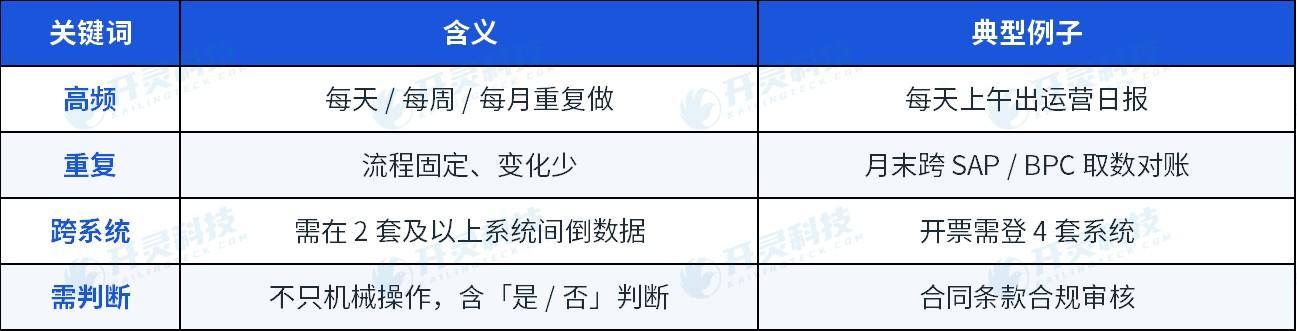
Enterprises want to build AI digital employees but do not know which to build first? Kailing Technology's AI digital employee five-category scenario map helps you understand selection and implementation from 0 to 1 in one articlePublished: 2026-06-23 17:07 I. First step in selection: four keywords to judge whether a scenario is worth handing over to an AI digital employeeMany enterprises get stuck at the first step: the large model has been privately deployed, there are dozens of business systems, and needs are everywhere, but once it is time to act, they do not know which one to build first. In fact, there is no need to struggle. To judge whether a scenario is worth handing over to a digital employee, just look at four keywords — high frequency, repetitive, cross-system, and requiring judgment. The more keywords it satisfies, the greater the value of handing this matter over to an AI digital employee.
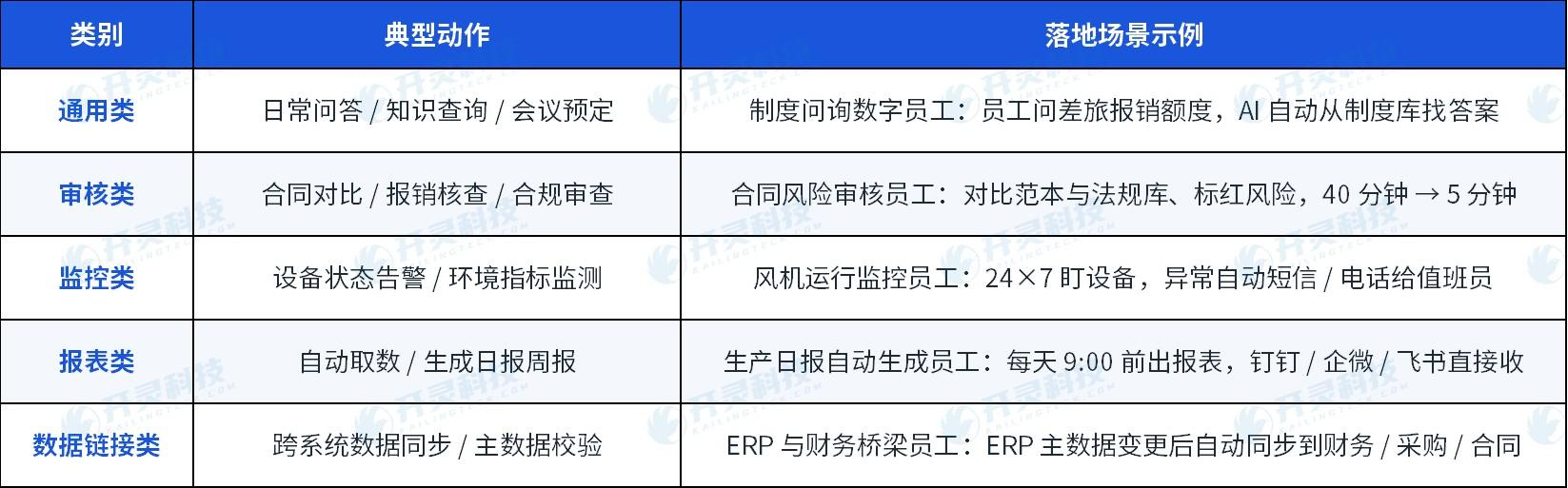
One-sentence standard: if something is high-frequency, repetitive, requires moving data back and forth among multiple systems, and still needs a person to judge "compliant or not / abnormal or not," it is almost born to be handed to a digital employee. A scenario that hits all four keywords is your best starting point. II. Map of five major scenario categories: any AI digital employee must fall into one of themSelection is not about picking by feel from countless possibilities, but about checking against a map. Kailing categorizes enterprise position scenarios into five major categories, which can cover all enterprise positions, and any AI digital employee must fall into one of them. First confirm which category your pain point belongs to, then pick the most painful scenario within that category, and selection has its coordinates.
1. General category — turn policies and knowledge into on-demand answersThe general category handles high-frequency small tasks such as daily Q&A, knowledge lookup, and meeting booking. A typical example is the "policy inquiry AI digital employee": an employee asks about the travel reimbursement limit, and the AI automatically finds the answer from the policy library and replies, without needing to search documents or ask HR. High-frequency but single-point, it is the lightest starting option. 2. Review category—humans only judge anomalies, mechanical checks are left to AI Review-type work focuses on tasks requiring judgment, such as contract comparison, reimbursement verification, and compliance review. A typical example is "contract risk review employee": after uploading a contract, AI compares it with templates and the regulations database, marks risk points in red item by item, and compresses manual review that originally took 40 minutes to 5 minutes. High-frequency, repetitive, and judgment-based, it has very high value density. 3. Monitoring category - watches on your behalf 24/7, and only disturbs people when there is an anomaly The monitoring category is responsible for equipment status alarms and environmental indicator monitoring. A typical example is "wind turbine operation monitoring employee": watching equipment operation 24×7, and once an abnormality occurs, automatically notifying the duty officer by text message or phone. Hand over "continuous watching," something people are least good at, to AI, and people only intervene when there is an abnormality. 4. Reports — before 9 a.m. every day, reports appear in the work group on their own The report category handles automatic data retrieval and generates daily and weekly reports. A typical example is the "production daily report auto-generation employee": reports are automatically produced before 9:00 every day, and managers receive them directly in DingTalk / WeCom / Feishu, with no need to chase numbers or assemble tables. High-frequency and repetitive, this is the category most likely to deliver a tangible "time-saving" experience. 5. Data link category — master data changed in one place, automatically synchronized across multiple systems The data link category solves cross-system data synchronization and master data validation. A typical example is the "ERP and finance bridge employee": when ERP master data changes, it automatically synchronizes to finance, procurement, contract, and other systems, eliminating data conflicts across systems. It has the strongest cross-system attributes, and the more systems a group has, the more indispensable it becomes.
III. From 0 to 1: Which should be the first AI digital employee?Overlay the four-keyword rule with the five-category map, and the selection answer becomes clear: the first AI digital employee should be the one with "high frequency + repetition + cross-system + major pain point + quantifiable results." High frequency and repetition ensure it creates value every day; cross-system reflects the unique value of AI operating systems on people's behalf; a major pain point makes business departments buy in; quantifiability (such as minutes, days, or manpower) makes results obvious at a glance—such scenarios are the easiest to run through and the easiest to establish a reputation for internally. What is more important is that the first step carries almost zero risk.Kailing's pilot breakthrough phase takes only 2-3 weeks and is free of charge: based on the enterprise's existing AI foundation, it runs through the entire process and removes blockers. After it runs through, the enterprise receives 1 truly usable digital employee that belongs to the enterprise, plus a Scenario Definition Document and an implementation assessment report. Let one real result speak first, then decide whether to proceed.
IV. From 1 to 90: Pilot → Scaled replication → Group-wide coverageGetting the first AI digital employee running is only the starting point. Kailing provides a clear "9 months, 90 employees" path: from a zero-cost validation pilot, to replicating 10 within 2 months and consolidating the methodology, to covering all group positions that can be standardized within 6 months and building 90 AI digital employees and a group-specific capability asset library. Each stage has a clear cycle and verifiable deliverables.
Common Questions FAQQ: What scenario should the first AI digital employee be built for? A: Choose scenarios that hit more of the four keywords "high-frequency, repetitive, cross-system, requiring judgment," and that have large pain points and quantifiable effects. Such scenarios are easiest to run through and easiest for business departments to see value in. Q: How do the five major categories map to our positions? A: First classify your pain point into one of five categories: general, review, monitoring, reporting, or data linking—any digital employee must fall into one of them. Then choose the most painful scenario within that category. For example, contract / reimbursement compliance falls under review, daily and weekly reports fall under reporting, and cross-system reconciliation falls under data linking. Q: If unsure, can we first validate on a small scale? A: Yes. The pilot breakthrough period is 2-3 weeks, free of charge, and runs one complete scenario based on the enterprise's existing AI foundation. After it runs successfully, you get 1 truly usable digital employee owned by the enterprise, plus a Scenario Definition Document and an implementation assessment report. You then decide whether to expand after successful validation. Q: How long does it take to scale from 1 to dozens? A: Follow the "90 in 9 months" path: produce 1 pilot in 2-3 weeks, scale replication to 10 within 2 months and accumulate methodology and a Skill library, and within 6 months expand the group's standardizable positions to 90, achieving full coverage. No need to agonize over selection: start with a zero-cost pilot in a high-frequency, high-pain-point scenario—Kailing accompanies you from 0 to 1, and then to 90:www.kailingteck.com 。
Kailing TechnologyAs a comprehensive business-finance-tax digitalization solution service provider, we provide business-finance-tax management digital transformation products and operational services for various government agencies, institutions, and large, medium, and small enterprises. The product line includes: Sales contract management system, procurement contract management system, fully digitalized Leqi interface project, output automatic invoicing system,Reverse invoicing system,Solutions for the invoice issuance for individuals system, employee expense control and reimbursement system, input VAT invoice management system, supply chain collaborative reconciliation system, image AI OCR recognition system, automated financial bookkeeping system, electronic accounting archives system, and other businesses, comprehensively advancing the digitalization process across various fields. If you have any business-finance-tax digital transformation needs, welcome to contact us. Beijing KailingKailing TechnologyWe will serve you wholeheartedly.
Keywords:AI digital employee selection, five major categories, application scenarios, implementation path, pilot, high-frequency repetitive cross-system requiring judgment, AI digital employee |