010-6097 4119Book a Demo


Still can't do without people after deploying RPA? Kailing Technology AI digital employees have "judgment" beyond RPA, making cross-system processes truly unattendedPublished: 2026-06-24 15:03 I. RPA's ceiling: it can click a mouse, but it cannot judgeThe essence of RPA (Robotic Process Automation) is to follow pre-written fixed rules and "click the mouse and type on the keyboard" for people on system interfaces. When processes are fixed enough and change little enough, it is indeed efficient—freeing people from repetitive copy-paste. But this is exactly where RPA's capability boundary lies: it executes scripts, not judgments. Once a "yes/no" judgment, an exception branch, or the need to understand business semantics across systems appears in the process, RPA can no longer proceed—it cannot determine whether the terms of this contract are compliant, whether this reimbursement is anomalous, or whether this milestone has truly been reached, and can only hand the work back to people as-is. Thus a common feeling shared by many enterprises emerged: "After adopting RPA, we still can't do without people." People still have to stand at the exception exit, waiting to take over the steps that machines cannot understand and dare not decide. In other words, RPA automated the "hands" but did not automate the "brain." What truly blocks unattended operation is never how cumbersome the clicking actions are, but the nodes in the process that require understanding and judgment. II. What AI digital employees have beyond RPAKailing AI Digital Employee and RPA both target 'high-frequency, repetitive, cross-system' scenarios, but add a key fourth keyword — 'requires judgment.' It is not just mechanical operation, but brings understanding and judgment into execution: it can understand business processes, knows which large model in the enterprise to 'think' with, and knows where it must stop for human confirmation. The table below lays out the differences between the two.
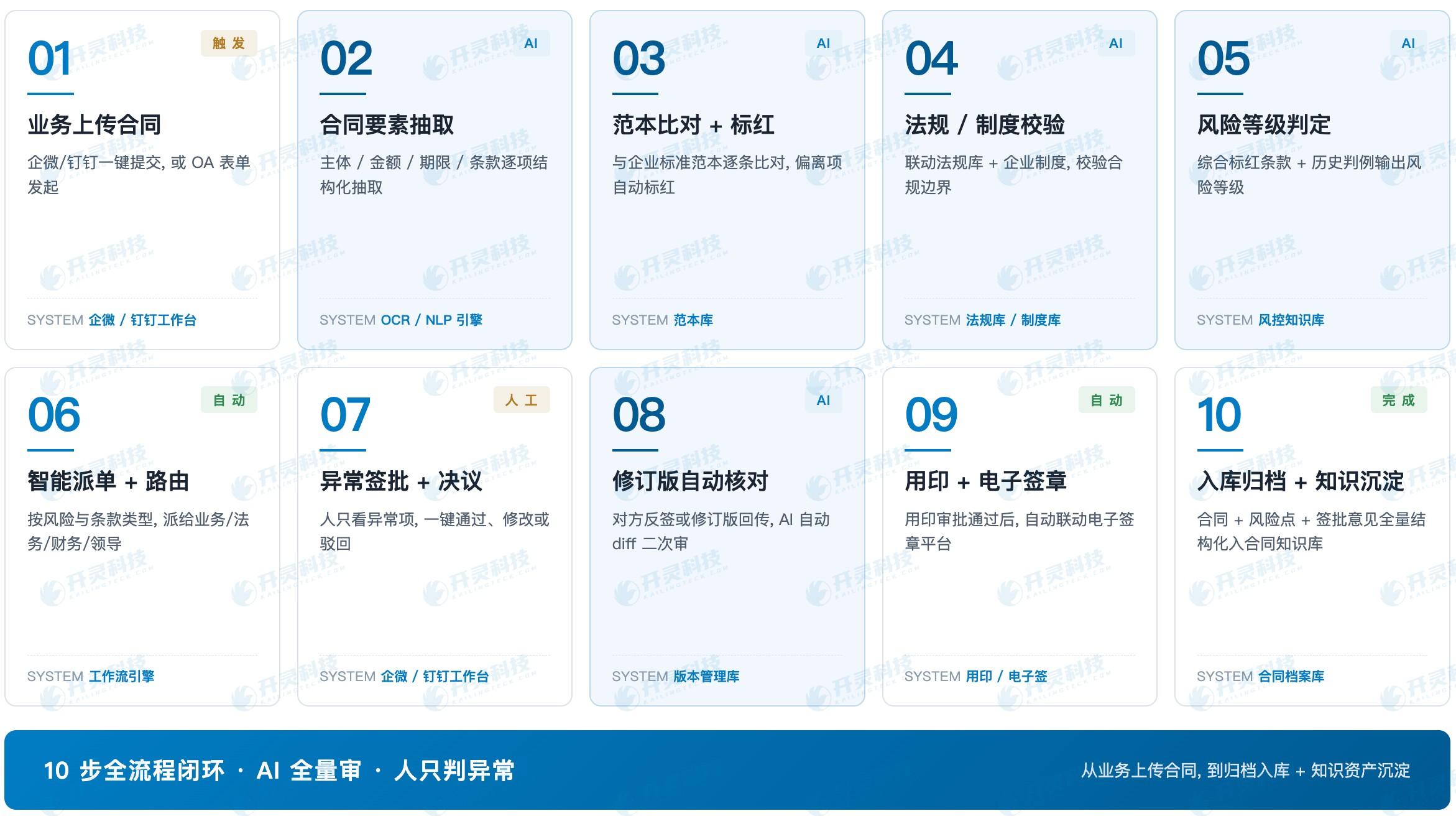
III. What "Can judge" looks like"Can judge" is not a slogan, but a capability embodied in specific actions. Take intelligent contract approval as an example: after the AI digital employee uploads a contract, it performs clause-level comparison based on the template library and the regulation library, automatically determines the risk level, and marks each risk point in red — this process of "clause comparison + risk determination + item-by-item red marking" compresses the original 40-minute manual review to 5 minutes, which is exactly the judgment that RPA cannot achieve. The same applies to reimbursement review: AI financial reviewers check every transaction 24/7 in full, automatically identifying anomalies, and humans only need to look at the few anomalous transactions instead of flipping through every document. In the automatic invoicing scenario, after completing milestone identification, AI compares contract clauses on its own and only proceeds to invoicing after confirming there are no issues—these are real steps of "judge first, then act," not mindless execution of preset scripts.
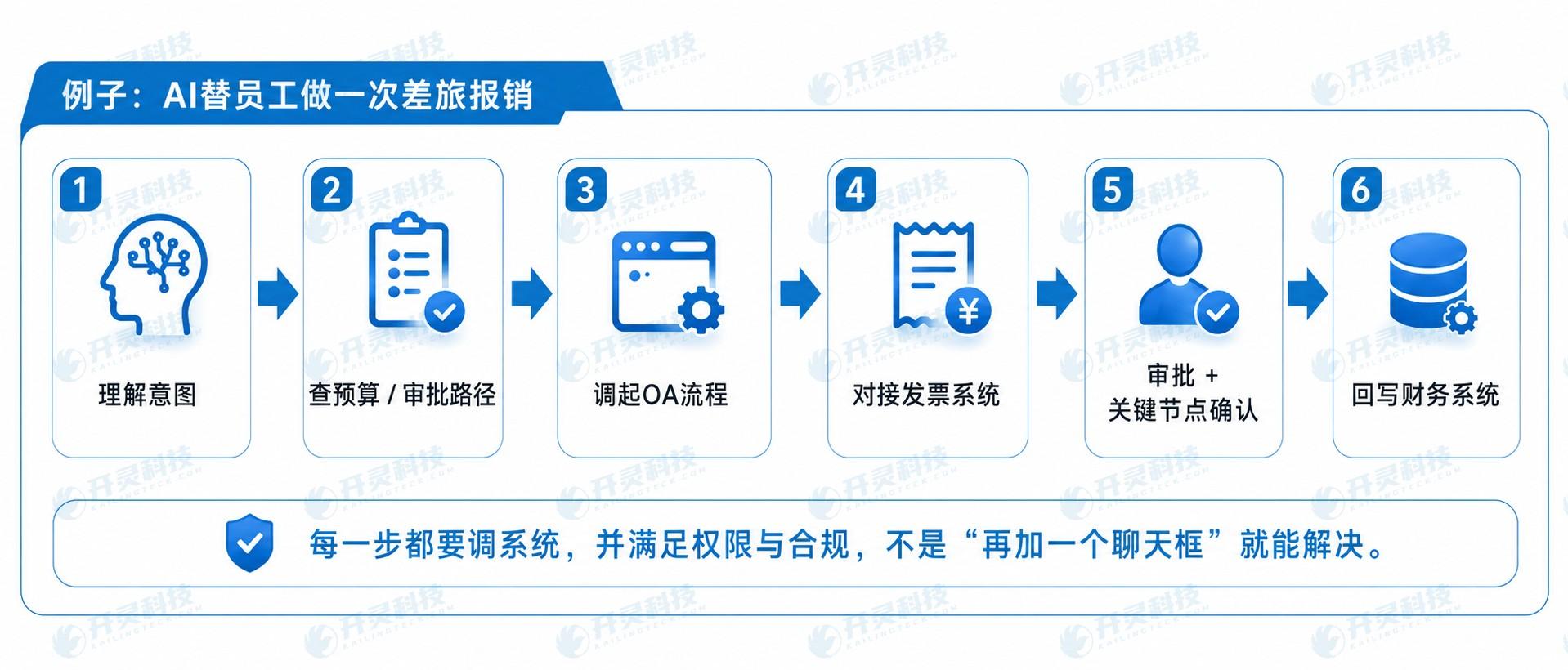
IV. Truly unattended: AI operates systems on behalf of people, and people only confirm at key nodesThe paradigm shift advocated by Kailing is moving from the past 'people finding systems' to 'AI adjusting systems for people'. The key to unattended operation is not adding another chat box for people to ask, but letting AI itself complete the work across multiple systems. Taking automatic invoicing as an example: the digital employee completes as many as 6 things for you, from scanning the sales contract ledger in the morning, identifying projects that have reached milestones, pushing to project managers via WeCom, to completing contract clause comparison, logging in to the electronic tax bureau to issue invoices, and then writing the results back to the project management system and shared platform - the entire chain advances autonomously across multiple systems, completing everything, with people only needing to click to confirm at 2 key nodes. The effect is that where 3 accountants previously watched 50 invoices each month, now 1 person only needs to review 5 anomalies. Travel reimbursement follows the same logic: AI completes the steps across systems, and people only pick out anomalies. Daring to hand over unattended operation relies on fallback mechanisms: every AI digital employee must run 100 times in a sandbox before going live, and only after reaching a 99% pass rate is it allowed to go live; the error rate is written into the SLA. Key approval nodes are marked as "human-in-the-loop," confirmed by people rather than decided by machines, holding both unattended operation and controllability at the same time.
V. Don't overturn RPA: reuse existing enterprise IT assetsChoosing a digital employee does not mean overturning the RPA you have already invested in. Kailing digital employees sit at the enterprise's "AI entry layer" and follow the principles of "business processes unchanged / systems not switched / processes not interrupted": do not change business processes, do not switch systems, and do not interrupt existing links. In the four-layer technology architecture, it directly reuses the MaaS already deployed at the enterprise AI platform layer and existing business systems such as SAP, BPC, OA, contracts, and ERP—these are all existing IT assets of the enterprise. Existing automation capabilities such as RPA and various interfaces can all be scheduled by AI digital employees at the underlying level, achieving zero reinvestment and making IT assets "come alive." In other words, AI digital employees are not rivals coming to replace RPA, but commanders standing above RPA and completing the "judgment-capable" layer. Common Questions FAQQ: With RPA, are AI digital employees still needed? A: Yes. RPA is good at executing mechanical clicks according to fixed rules, but when encountering judgment, exceptions, and cross-system semantics, it must transfer to manual handling. The AI digital employee adds the layer of "understanding + judgment + cross-system self-driving," enabling links that originally had to be manually taken over to also be completed automatically, thereby truly pushing the process toward unattended operation. Q: Will AI digital employees replace RPA? A: No, it's more like scheduling on top of RPA. Kailing insists on "business processes unchanged / systems not switched / processes unbroken"; existing RPA and interfaces can both be reused for scheduling, without overturning or duplicating investment. Q: What does "can judge" rely on to be achieved? A: It relies on reusing the large models already deployed by the enterprise (MaaS). Digital employees connect to the enterprise's existing large models and agents to handle the "thinking" part, and then combine business rules such as the template library and regulation library for clause-level comparison and risk determination, so they can complete work requiring judgment such as contract compliance and reimbursement anomaly identification. Q: Will unattended operation get out of control? A: There is a fallback. Before go-live, it must run 100 times in a sandbox and achieve a 99% pass rate before launch, and the error rate is written into the SLA; key approval nodes are marked "human-in-the-loop," confirmed by people rather than decided by machines, mainly assistive and not replacing human decisions. Let AI not only click the mouse but also make judgments — Kailing digital employees bring cross-system processes into true unattended operation:www.kailingteck.com 。 Kailing TechnologyAs a comprehensive business-finance-tax digitalization solution service provider, we provide business-finance-tax management digital transformation products and operational services for various government agencies, institutions, and large, medium, and small enterprises. The product line includes: Sales contract management system, procurement contract management system, fully digitalized Leqi interface project, output automatic invoicing system,Reverse invoicing system,Solutions for the invoice issuance for individuals system, employee expense control and reimbursement system, input VAT invoice management system, supply chain collaborative reconciliation system, image AI OCR recognition system, automated financial bookkeeping system, electronic accounting archives system, and other businesses, comprehensively advancing the digitalization process across various fields. If you have any business-finance-tax digital transformation needs, welcome to contact us. Beijing KailingKailing TechnologyWe will serve you wholeheartedly.
Keywords:Digital employee、RPA, intelligent automation, judgment-capable, unattended, human-in-the-loop, cross-system, AI digital employee |