010-6097 4119Book a Demo


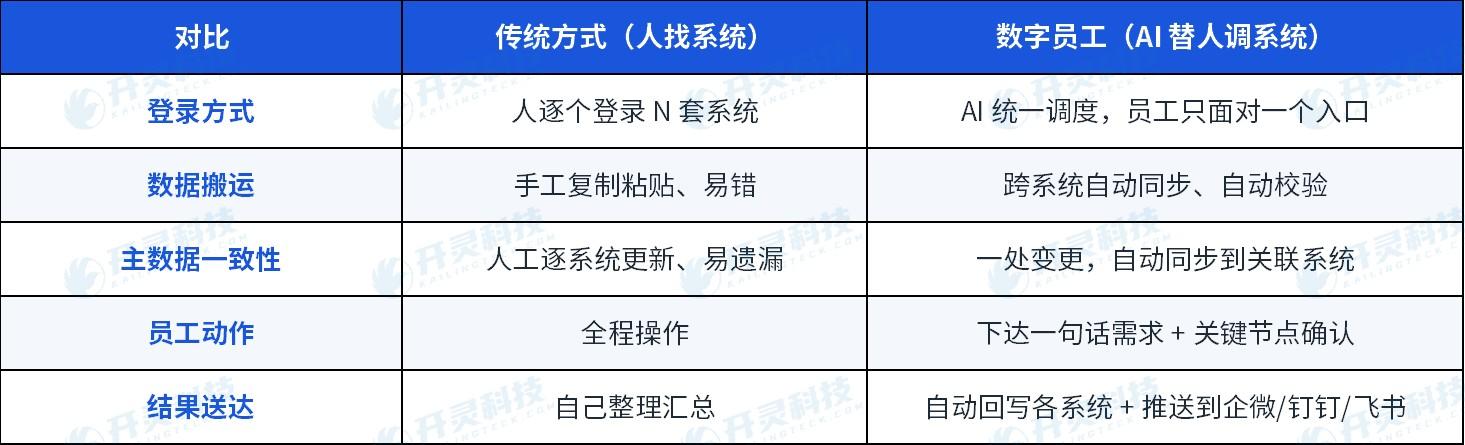
Fragmented multiple systems in the group and business processes relying on manual data transfer? Kailing Technology's AI digital employees automatically handle tasks across systems, making AI a unified business entry pointPublished: 2026-06-16 16:50 I. The real pain points of group enterprises: plenty of systems, but even more "human middleware"Large groups often have dozens of business systems: ERP, SAP, BPC, finance, procurement, contracts, shared platforms... Each system operates efficiently in its own domain, but the "gaps" between systems must be filled by people. A seemingly simple business task may involve employees repeatedly logging in, copying, pasting, and checking across 4 systems. Invoicing requires logging in to 4 systems, retrieving data one by one, and checking item by item; At month-end, pulling data across SAP / BPC for reconciliation is a fixed process yet time-consuming and labor-intensive; When ERP master data changes, finance, procurement, and contracts must be updated manually one by one, which is highly prone to omissions and errors.
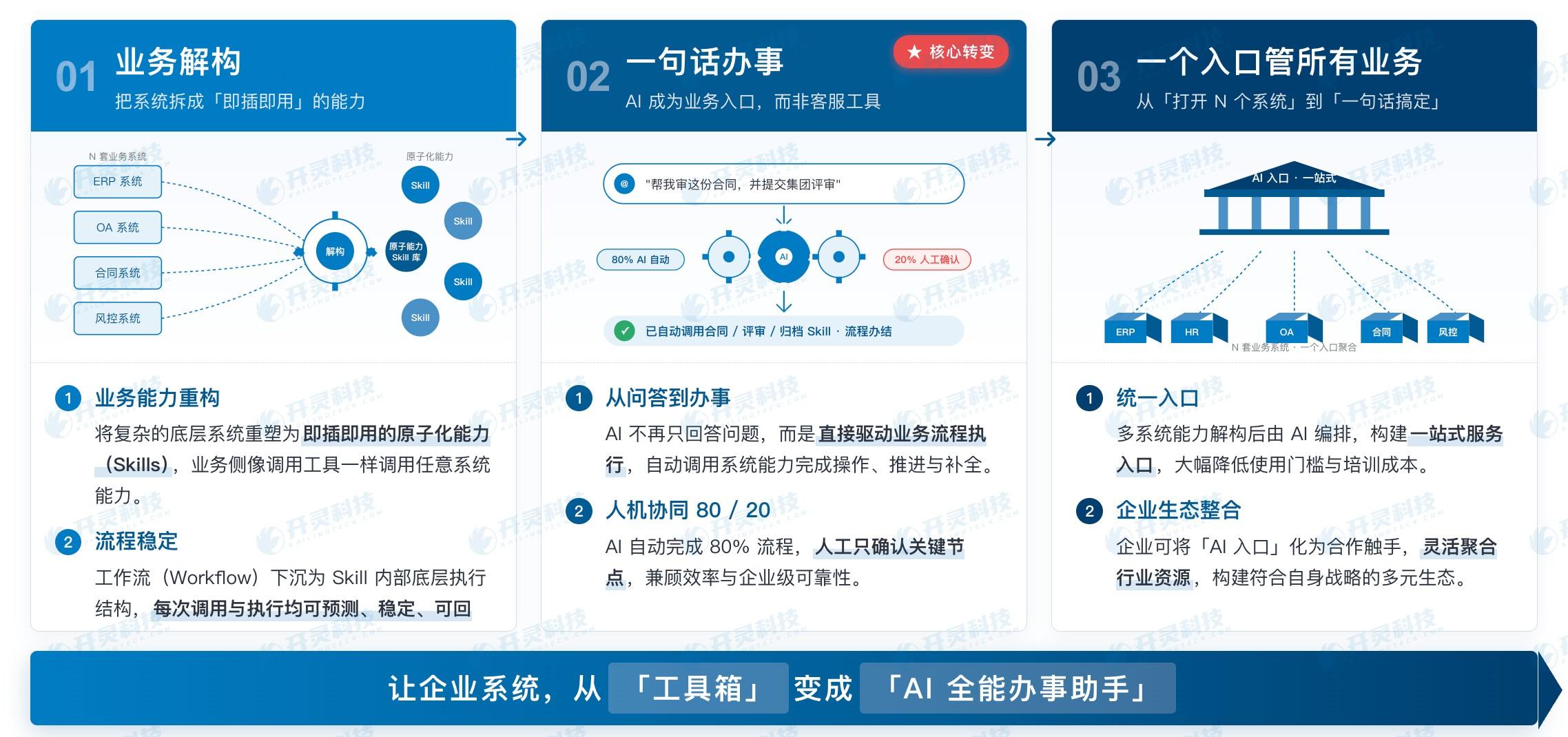
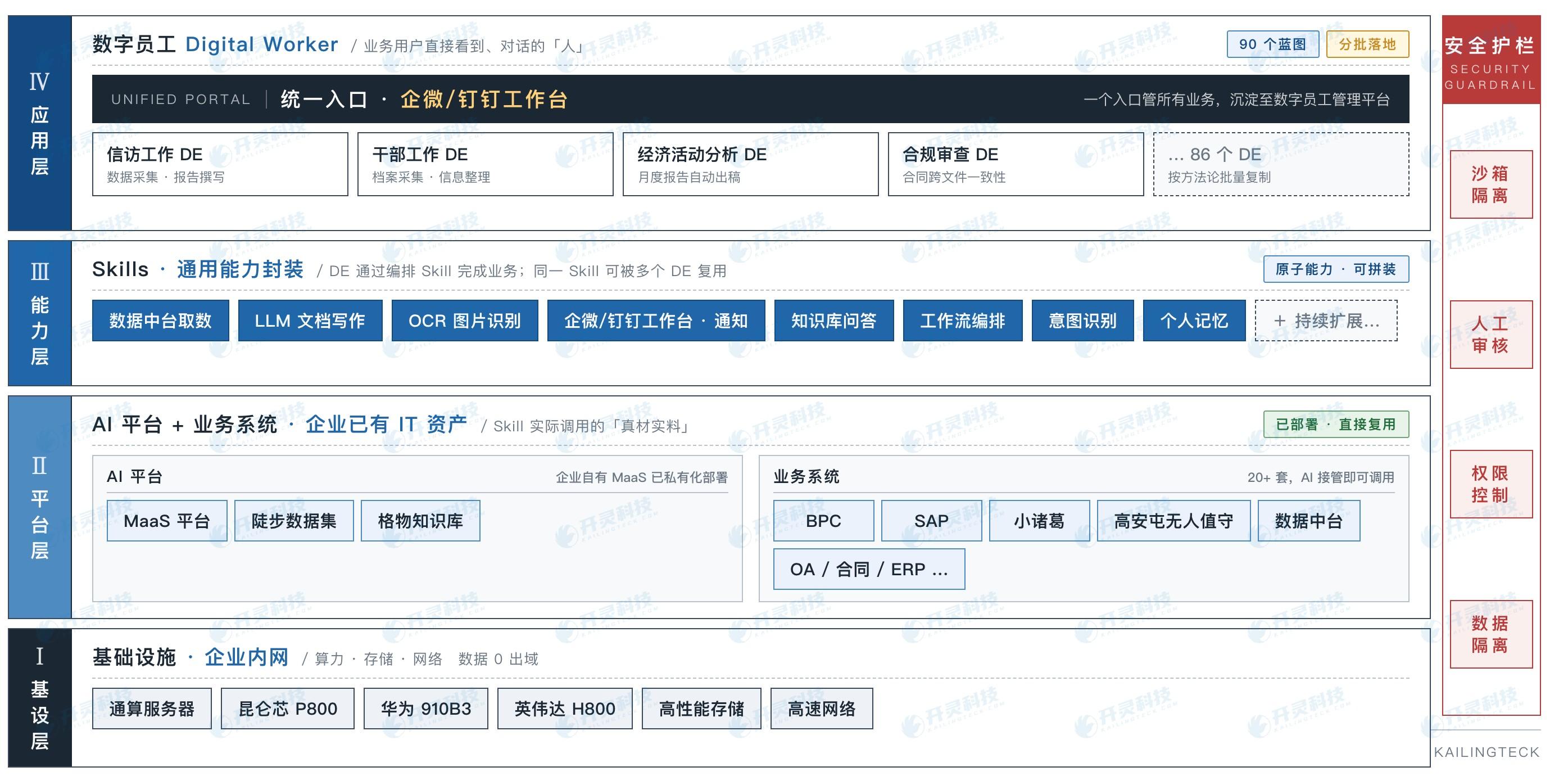
II. Solution: Make AI the unified business entry point (AI entry layer)Kailing Technology's core idea is not to add another new system, but to build an "AI entry layer" on top of existing systems—enterprises are not short of AI platforms, systems, or needs; what they lack is exactly the entry layer that connects these three. AI digital employees sit at this layer, receiving employees' natural language needs from above and calling various business systems below, completing cross-system full-process operations on behalf of people.
III. Data link digital employees: The main force for cross-system automated operationsAtAIAmong the five major categories of AI digital employees, the "data connection category" specifically solves the problem of system fragmentation, with typical actions being cross-system data synchronization and master data validation. Typical scenario: ERP and finance bridge employee After ERP master data changes, the AI digital employee automatically syncs the changes to finance, procurement, contracts, and other systems, with no need for manual updates one by one, eliminating from the source the most common and most hidden source of errors: inconsistent data across systems. Scalable similar scenarios Automatic write-off of procurement orders:Material receipt completed → AI comparison → automatic write-off and payment; Automated accounts payable reconciliation:Bank statements → automatic matching → exception push; Automatic archiving of contract changes:Electronic signature and sealing → automatic archiving → linked contract ledger; Month-end cross-system data retrieval and reconciliation:Automatically retrieve data from SAP / BPC, automatically reconcile differences and flag anomalies.
IV. How does it achieve "cross-system"? A four-step engineering method① Let AI understand business processes Screen recording of business staff, with the large model parsing each cross-system operation step, turning the manual experience of "first log in to System A to retrieve data, then log in to System B to compare" into an AI-executable process. ② Let AI know whom to ask For stages requiring understanding and reasoning, directly connect to the enterprise's existing large models and agents, reuse the enterprise's own AI assets, and avoid reinventing the wheel. ③ Let AI know where it must stop Mark "human-in-the-loop" nodes on cross-system operations involving funds and compliance, and key steps continue only after a person confirms with one click, ensuring cross-system automation always remains controllable. ④ Let AI test itself Run the sandbox 100 times and only go live with a 99% pass rate, with the error rate written into the SLA—for the most error-prone step, such as transferring data across systems, engineering quality provides the backstop.
V. Why is "more systems" actually an advantage?In traditional digitalization, the more systems there are, the harder they are to manage; but in the logic of digital employees, the more systems and the richer the scenarios, the more manpower AI can save by handling affairs across systems, and the greater the value. This is also why group enterprises with all three conditions—"AI platform readiness + numerous systems + clear needs"—are called the best soil for digital employees.
Common Questions FAQQ: OnAIDo AI digital employees require modifying or replacing existing systems? A: No. Digital employees are set up as an "AI entry layer" above existing systems, following the principles of "no system switching / no process changes / no business interruption," reusing rather than replacing existing systems. Q: How is accuracy ensured when data is automatically transferred across systems? A: Through triple assurance: screen recording and analysis of business processes to restore real operations, "human-in-the-loop" confirmation at key nodes, and 100 sandbox runs before launch with a 99% pass rate, with the error rate written into the SLA. Q: Master data is inconsistent across multiple systems; can this be solved? A: Yes. Data-linking digital employees automatically synchronize a change in one place to associated systems and automatically verify it, eliminating master data inconsistency at the source. Q: Do employees still need to log in to each system? A: Basically none. Employees only need to issue requests through unified entry points such as DingTalk/WeCom/Feishu, and the AI calls systems on their behalf to complete the full process and write back and push the results. Let AI become a unified business entry point and free employees from being "movers between systems" — this is exactly KailingTechnology AIThe value of AI digital employees:www.kailingteck.com 。 Kailing TechnologyAs a comprehensive business-finance-tax digitalization solution service provider, we provide business-finance-tax management digital transformation products and operational services for various government agencies, institutions, and large, medium, and small enterprises. The product line includes: Sales contract management system, procurement contract management system, fully digitalized Leqi interface project, output automatic invoicing system,Reverse invoicing system,Solutions for the invoice issuance for individuals system, employee expense control and reimbursement system, input VAT invoice management system, supply chain collaborative reconciliation system, image AI OCR recognition system, automated financial bookkeeping system, electronic accounting archives system, and other businesses, comprehensively advancing the digitalization process across various fields. If you have any business-finance-tax digital transformation needs, welcome to contact us. Beijing KailingKailing TechnologyWe will serve you wholeheartedly.
Keywords:AI digital employee· Multi-system fragmentation · Cross-system data synchronization · Manual data transfer · Unified business entry · AI entry layer · Master data validation · SAP · BPC · ERP |