010-6097 4119Book a Demo


Important notice: The Electronic Tax Bureau upgrades the limit on the number of identity switches; taxpayers handling tax matters for multiple enterprises should pay close attentionPublished: 2026-02-03 16:13 According to the work arrangements of the State Taxation Administration, the national electronic tax bureau completed a system upgrade on January 30, and the identity switching frequency limit function has officially gone live. This adjustment is uniformly deployed by the State Taxation Administration, with the core purpose of improving system security and operational standardization. It will directly affect high-frequency users and enterprises' tax handling processes. Tax handlers and tax-related service agencies that have not yet adapted to the new rules need to familiarize themselves with the rules and adjust their operating methods as soon as possible. I. Core upgrade rule: identity switching has a "quota"; once exceeded, it is suspended(1) Restriction dimension This upgrade clarifies two major restriction dimensions, with dual controls on switching behavior: 1. Upper limit of switches per hour2. Daily (0:00–24:00) total switch count limit (II) Operational Scope Counted Toward the Number of Times The following four types of operations will all be recorded by the system as switch counts, and require special attention: 1. Role switching within the enterprise (such as switching between tax handler and invoicer, etc.) 2. Switch between different enterprises in the account⚠️ For example:Switching from enterprise A to enterprise B, then switching back to enterprise A, will be counted as2 times ⚠️ 3. Switching between different taxpayer identities4. Identity switching between natural persons and enterprises
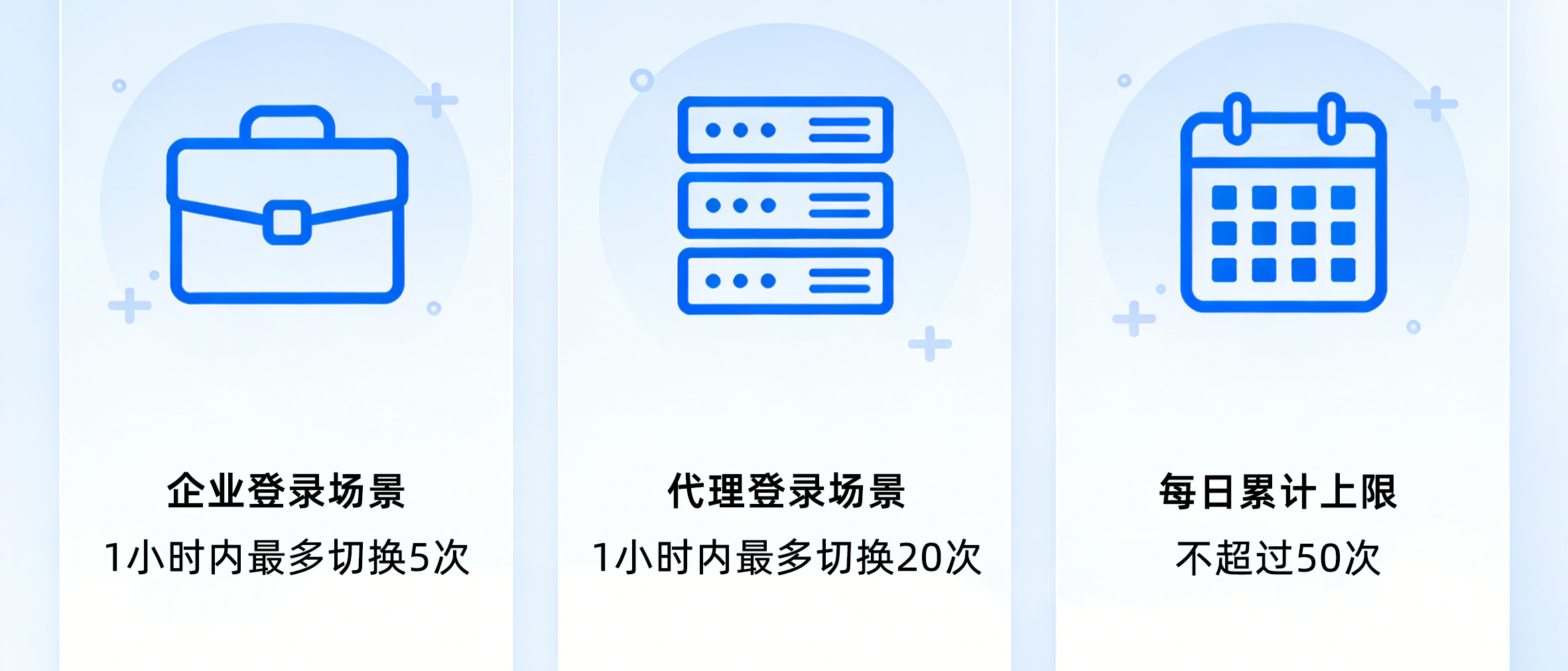
(3) Specific quota standards 1. Enterprise login scenario: up to 5 switches per hour2. Agent login scenario: up to 20 switches per hour3. Daily cumulative limit: no more than 50 timesThe above quotas are initial settings, and tax authorities may dynamically adjust them based on actual operation.。
(4) Consequences of restrictions After the number of switches reaches the upper limit of any dimension, the system will suspend the relevant switching function until the counting cycle resets. During this period, tax-related business requiring identity switching cannot continue to be handled, such as tax filing, invoicing, input VAT invoice selection, and invoice updates and generation。 ⚠️ Temporary remedial measures:On the electronic tax bureau enterprise login interface, directly log in to the enterprise where operations are needed, exit after completion, and log in to the next enterprise again. II. Key affected groups(1) Tax handlers managing multiple enterprises Such people could previously freely jump between the account center to handle business for multiple enterprises. After the upgrade, if they frequently switch identities, they may be locked out by the system midway through the day, causing tax matters of subsequently associated enterprises to be unable to be handled in time and affecting business progress. Special note:UseLingshuitong Systemwhen, logging into the electronic tax bureau in the background and frequently switching identities will also trigger this restriction! (II) Tax-Related Agency Institutions Tax-related agency institutions need to handle filing, invoicing, invoice selection, and other business in batches for dozens or even hundreds of enterprises daily, relying heavily on identity switching operations. Once the switching quota is exhausted, the entire batch of business will be forced to interrupt, which not only affects work efficiency but may also delay the timeliness of customer business delivery. III. Practical response recommendations to avoid business interruption(1) Centralized handling of single-household business When handling tax-related business, it is recommended to log in and fully complete all matters for one enterprise (such as invoicing, invoice retrieval, input VAT selection, filing, etc.) before switching to the next entity or next identity, reducing unnecessary frequent switching and avoiding quota waste. (2) Reasonably plan the tax handling sequence Sort by the urgency and complexity of enterprise business, prioritize high-frequency enterprises or urgent business, ensure key matters are completed during periods with sufficient quota, and reduce the risk of business delays caused by quota exhaustion. (3) Pressure from decentralized tax handling authority If a single person manages many enterprises (such as more than 10), it is recommended to reasonably allocate tax officer quotas, with multiple personnel sharing tax handling tasks and identity switching pressure, reducing the probability of a single account triggering the upper limit. (4) Attention to dynamic rule adjustments Pay close attention to official notices from the Electronic Tax Bureau and updates to quota rules, while also followingLingshuitong's optimization progress, and adjust tax handling processes in a timely manner to adapt to new regulations. This upgrade is not intended to restrict reasonable tax handling needs, but to improve system security through standardized operations. Tax handlers only need to adapt to the rules in advance and plan operations reasonably to ensure the smooth progress of tax-related business. It is recommended that relevant tax handlers promptly forward and inform colleagues so they can prepare in advance and avoid business disruptions caused by unfamiliarity with the new rules. Kailing TechnologyAs a comprehensive business-finance-tax digitalization solution service provider, we provide business-finance-tax management digital transformation products and operational services for various government agencies, institutions, and large, medium, and small enterprises. The product line includes: Sales contract management system, procurement contract management system, fully digitalized Leqi interface project, output automatic invoicing system,Reverse invoicing system,The invoice issuance for individuals system, employee expense control and reimbursement system, input VAT invoice management system, supply chain collaborative reconciliation system, image AI OCR recognition system, automated financial bookkeeping system, electronic accounting archives system, and other business solutions comprehensively advance digitalization across various fields. If you have any business-finance-tax digital transformation needs, welcome to contact us. Beijing KailingKailing TechnologyWe will serve you wholeheartedly.
|