010-6097 4119Book a Demo


In-house development VS service provider: comprehensive cost-benefit analysis of Kailing Technology's Leqi Direct Connection accessPublished: 2025-11-20 17:54 Against the backdrop of the comprehensive implementation of China Golden Tax Phase IV and the adoption of fully digitalized e-invoices, Leqi Direct Connection, as a core solution for tax digitalization, has become a key path for group enterprises and scale enterprises to achieve "business-finance-tax integration." When connecting to Leqi, enterprises face two major choices: self-developed integration or commissioning a professional service provider (such as Kailing Technology) for implementation. This article comprehensively compares the core differences between the two models from dimensions such as cost input, benefit output, and practical implementation, providing reference for enterprise decision-making.
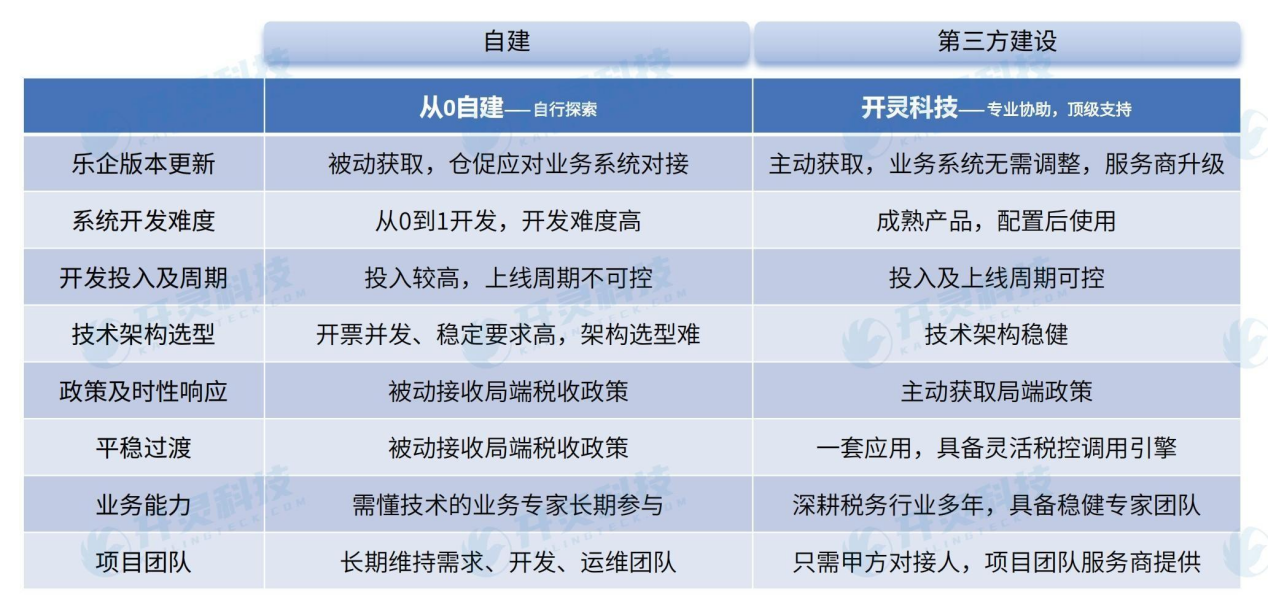
I. Core value and core access requirements of Leqi Direct ConnectionLeqi Direct Connection is a direct connection service between tax systems and enterprises' own information systems launched by the State Taxation Administration. Through open standardized interfaces, it enables 365*24-hour offline invoicing, facial recognition-free authentication, and businessAdvantagesand other core values while avoiding data security and policy risks. Its core access requirements include: directly connected units must meet tax credit grade A/B, total annual revenue of more than RMB 50 million, and annual invoice issuance/receipt volume of ≥50,000 invoices or amount ≥RMB 500 million(Some regions have lowered the requirement toAnnual invoicing and receiving volume ≥1ten thousand copies or amount ≥1100 million yuan), and requires professional informatization construction and data security assurance capabilities. II. In-house development VS Kailing Technology service provider: in-depth cost comparison(1) Independent R&D model: high investment, long cycle, and prominent hidden costs 1. Direct R&D costs:According to Kailing Technology research data, enterprises developing in-house need to invest substantial manpower in output VAT adaptation and input VAT adaptation. Calculated at the industry average labor cost, adaptation development alone costs millions of yuan, and this does not include related costs for subsequent version upgrades and compatibility. 2. Time cost:In-house development requires independently advancing the entire process from process design, interface development, and sandbox testing to official launch, usually taking more than 6 months, and after launch requires continuous manpower investment to respond to tax policy updates and system iterations. 3. Hidden costs:Includes communication and coordination costs between finance and IT teams, retesting costs after sandbox test failures, compliance rectification costs caused by policy interpretation deviations, etc. Actual investment often exceeds expectations by more than 30%. (II) Kailing Technology service provider model: low cost, short cycle, controllable investment 1. Direct service costs:No need for enterprises to bear R&D personnel salaries and equipment investment; only standardized service fees are required, at about 1/3 to 1/2 the cost of the self-developed model, with transparent fees and no hidden expenses. 2. Time cost:Relying on mature products and rich implementation experience, Kailing Technology can complete go-live within 2~3 months, with a sandbox test pass rate of over 98%, greatly shortening the implementation cycle. 3. Extremely low hidden costs:Kailing TechnologyCanProvides full-process on-site delivery, real-time policy interpretation, and automatic system upgrade services; the enterprise only needs to assign a contact person, with no additional manpower investment for operations and maintenance. III. In-house development VS Kailing Technology service provider: comprehensive benefit comparison(1) Efficiency and Benefits: Service Provider Model Achieves "Plug and Play" 1. Self-developed mode:Must independently design core modules such as invoicing processes, validation logic, and layout file synthesis. Red invoice issuance alone requires the development of 142 rules and blue invoices 52 rules. After development, repeated testing and optimization are required, and post-launch operational efficiency depends on the internal team's capabilities. 2. Kailing Technology model:The system has preset full-process nodes and adaptation solutions for more than 20 invoice types, supporting batch invoicing, automatic delivery (PDF/OFD/XML formats), intelligent write-off, and other functions. Invoicing efficiency increases by more than 80%, and finance personnel do not need to manually enter data. (2) Risk control benefits: the service provider model builds a solid compliance defense 1. Self-developed mode:They face three major risks — invoicing failure caused by incorrect API call order, tax risks caused by incomplete parameter validation, and system failure caused by untimely policy updates; moreover, sandbox testing must complete full testing within 72 hours, and after failure the application must be resubmitted. 2. Kailing Technology model:Data security is guaranteed through the national cryptographic SM4 encryption algorithm. The system has built-in 1,000+ compliance verification rules, synchronizes tax policy updates in real time, provides full-process technical support through sandbox testing, and delivers the full source code to ensure enterprise autonomy and control, complying with the tax requirement of "no third-party hosting." (3) Long-term operational benefits: the service provider model reduces operations and maintenance pressure 1. Self-developed mode:Demand, development, and operations teams need to be maintained long-term to address issues such as tax system upgrades and new invoice types,Annual O&M cost is approximately 20% to 30% of the initial development cost. 2. Kailing Technology model:Provide 7*24-hour responsive operations and maintenance services, with issues responded to within 10 minutes and resolved the same day, and compatibility updates for new invoice types completed within no more than 5 working days, so enterprises do not need dedicated operations and maintenance staff.
V. Key considerations for enterprise selection1. Enterprise scale and IT capabilities:Small and medium-sized enterprises meeting application requirements, IT team sizeLimited's enterprises, choosing the service provider model is more cost-effective; large groups with mature IT teams and long-term customization needs may consider a hybrid model of partial module self-development plus service provider support. 2. Compliance and security needs:Industries with extremely high data security and compliance requirements, such as finance and healthcare, prioritize vendors such as Kailing Technology that possessCompliance Securityqualified service providers, ensuring compliance with industry regulatory requirements. 3. Cost budget and implementation cycle:If the budget is limited or go-live must be completed before a tax policy deadline, the service provider model is the best choice; if the enterprise has long-term technical accumulation needs and sufficient budget, it can plan for self-development, but it is recommended to first achieve rapid go-live through the service provider model and then gradually iterate and optimize. Based on comprehensive cost and benefit analysis, for the vast majority of enterprises, choosing a professional service provider such as Kailing Technology to access Leqi Direct Connection is the choice with "optimal cost, lowest risk, and highest efficiency." Its core advantages lie in: mature products reducing implementation risks, independent controllability, and a professional team providing long-term operation and maintenance support. It not only complies with the tax authorities' "no hosting" requirement, but also allows enterprises to focus on core business and achieve a "lightweight" tax digital transformation. For enterprises with access needs, it is recommended to prioritize the model of "service provider rapid implementation + on-demand customization," with Kailing Technology providing a standardized product foundation and personalized configuration according to the enterprise's special business scenarios. This avoids the high investment risk of self-development while meeting differentiated needs. Consult Kailing Technology to obtain an industry-customized solution:https://www.kailingteck.com/h-col-123.html 。 As a comprehensive business-finance-tax digitalization solution service provider, Kailing Technology provides business-finance-tax management digital transformation products and operational services for various government agencies, institutions, and large, medium, and small enterprises. The product line includes: Solutions for sales contract management system, procurement contract management system, fully digitalized Leqi interface project, automatic output VAT invoicing system, invoice issuance for individuals system, employee expense control and reimbursement system, input VAT invoice management system, supply chain collaborative reconciliation system, imaging OCR recognition system, automatic financial bookkeeping system, electronic accounting archives system and other businesses, comprehensively advancing the digitalization process across various fields. If you have any business-finance-tax digital transformation needs, welcome to contact us. Beijing Kailing Technology will serve you wholeheartedly.
|