010-6097 4119Book a Demo


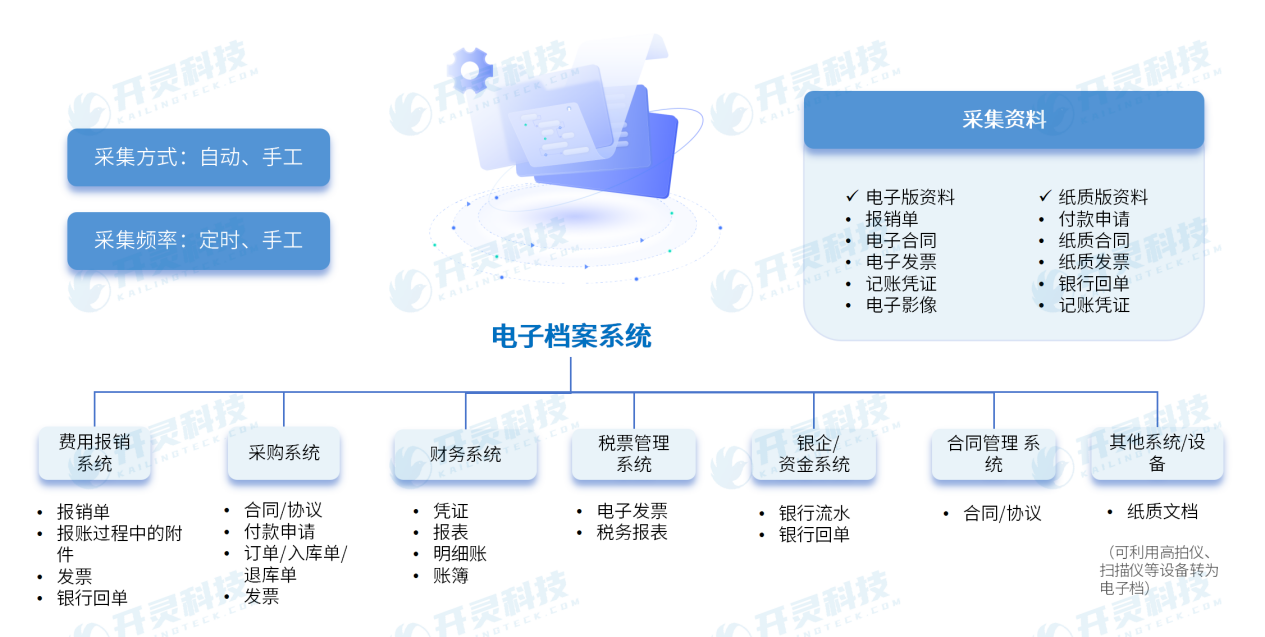
How is paperless archiving achieved? A full-process implementation guide for Kailing Technology electronic accounting archives systemPublished: 2025-07-18 20:46 Against the backdrop of the comprehensive advancement of China Golden Tax Phase IV and the widespread application of fully digitalized e-invoices, electronic accounting archives have become a core link in enterprises' business-finance-tax digital transformation. From policy compliance to efficiency improvement, electronic accounting archives management is reconstructing enterprise financial management models. This article combines the latest policy requirements, technical implementation paths, and practical cases to comprehensively analyze the implementation logic and value of electronic accounting archives. I. Policy Interpretation: Compliance Framework and Development Trends of Electronic Accounting ArchivesPolicy promotion is the core driving force for the popularization of electronic accounting archives. In recent years, multiple laws and regulations have been intensively issued at the national level, providing clear guidance for the legalization and standardization of electronic accounting archives: ▪ China Golden Tax Phase IV and the fully digitalized e-invoice reform: tax supervision has achieved cloud-based integration of "all tax data, all business, and all processes," and enterprises need to respond to stricter digital supervision requirements. The comprehensive promotion of fully digitalized e-invoices,PromptEnterprises achieve full-process electronic processing of invoice receipt, reimbursement, booking, and archiving. ▪ "Measures for the Management of Accounting Archives" (Order No. 79): clarifies that electronic accounting archives and paper archives have equal legal effect, allowing eligible electronic accounting materials to be archived only in electronic form. Internally generated accounting vouchers, account books, etc., if they meet conditions such as authentic sources, compliant systems, and tamper resistance, need no longer be printed in paper form. ▪ Ministry of Finance "14th Five-Year" Accounting Informatization Plan: requires that by 2025, 50% of central enterprises apply underlying accounting data standards, 80% of bank confirmations be digitalized, and the widespread application of electronic voucher accounting data standards be promoted, laying the foundation for the standardization of electronic accounting archives. ▪ Cai Kuai [2020] No. 6: emphasizes the electronic reimbursement, booking, and archiving requirements for electronic accounting vouchers (such as electronic invoices and bank receipts), and clarifies that when paper printouts are used as the basis, the electronic originals must also be preserved, eliminating the compliance risk of "dual preservation." II. Core functions: the technical support system of Kailing Technology's electronic accounting archives systemKailingThe electronic accounting archive management system achieves full-process digitalization through technological innovation, with core functions covering the full lifecycle of data collection, processing, storage, and utilization: 1. Intelligent collection and multi-source integration▪ Omnichannel data access: connect with financial systems (Yonyou, Kingdee, etc.), tax systems (input/output VAT invoices), business systems (procurement and sales documents), and imaging systems to automatically capture structured and unstructured data such as accounting vouchers, bank receipts, and contracts.
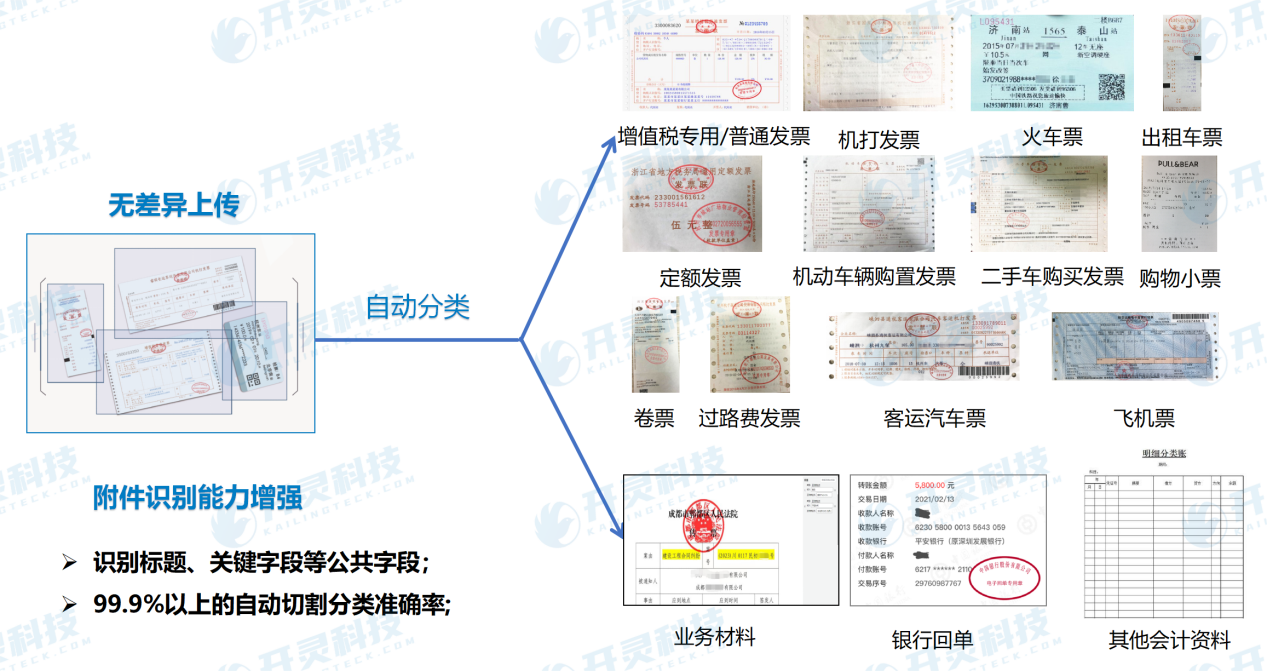
▪ OCR private deployment: Through AI recognition technology, it enables automatic scanning, classification, and information extraction of paper invoices and documents, supports 99.9% accurate recognition of 30+ bill types such as ID cards, train tickets, and motor vehicle invoices, and ensures information security through localized data processing.
2. Lead association and visual management▪ Star Chain Graph data drill-through: centered on business documents, it uses key fields such as contract numbers and voucher numbers to establish full-chain data associations among purchase orders, invoices, payment applications, bank receipts, and more, supporting drill-through viewing of related archives from any node to achieve "one transaction, one view." ▪ Four-property detection mechanism: Automatically verifies the authenticity, integrity, usability, and security of electronic archives to ensure compliance with archiving standards.
3. Full-process automated processing▪ Intelligent archiving: the system automatically completes archive classification, numbering, and packaging, supports filing by year, voucher type, and other dimensions, and achieves 100% accuracy in one-click assembly of completion archives. ▪ Electronic seal and evidence preservation: Integrates an electronic seal system to enable electronic signing and approval in approval workflows, with native electronic documents directly sealed, avoiding the inefficiency of paper printing and manual signing. ▪ Cloud storage and backup: adopts a distributed cloud storage architecture, supports off-site backup and encrypted storage of archive data, with disaster resistance and data security far exceeding traditional paper archive warehouses.
III. Implementation Guide: The Full Process of Implementing Kailing Technology Electronic Accounting ArchivesThe successful implementation of electronic accounting archives requires following "sorting-Build-The gradual path of "optimization" can be specifically divided into six key steps: 1. Archiving content organizationAccording to the "Measures for the Management of Accounting Archives", clarify the scope of accounting materials that need to be archived: ▪ Internal materials: accounting vouchers, general ledger, subsidiary ledger, financial reports, reimbursement forms, etc., requiring authentic sources and system traceability. ▪ External materials: e-invoices, bank receipts, customs payment statements, etc., must be verified for legitimacy through tax bureau interfaces, and metadata must be retained. 2. System Integration and Data InterconnectionKailing Electronic Accounting Archives SystemConnect the enterprise's existing information systems to achieve seamless data flow: ▪ Connect to the financial system to obtain voucher and ledger data; ▪ Connect to the tax system to automatically synchronize input/output VAT invoices; ▪ Integrate OA and business systems to obtain approval forms, contracts, and other business documents; ▪ Connected to the imaging system to enable electronic capture of paper documents. 3. Intelligent collection and verification▪ Electronic files are automatically collected directly through system interfaces; ▪ Paper documents are scanned via a document camera and converted into structured data after OCR recognition; ▪ The system automatically performs the four-property test, with real-time warnings for abnormal data and triggering of manual intervention. 4. Lead association and compilationKailing Electronic Accounting Archives SystemAutomatically match associated materials based on key fields to form a complete archive chain: ▪ For example: in procurement business, automatically associate purchase orders, input VAT invoices, acceptance sheets, and payment vouchers into a volume; ▪ Achieve corresponding retrieval between electronic archives and paper archives through barcode technology, ensuring bidirectional traceability. 5. Archive storage and management▪ Electronic archives by "year-Category-Tiered storage by "retention period", supporting online access and version management; ▪ Paper archives (if retention is required) are managed via location codes, enabling intelligent shelving, inventory counting, and borrowing tracking. 6. Archive utilization and destruction▪ The full-text search function supports multi-condition combined queries, with response time ≤1000ms for billion-level data; ▪ Electronic approval for the borrowing process, with watermark and permission controls configurable to prevent information leakage; ▪ Expired archives automatically trigger the appraisal process, and those meeting destruction conditions are electronically destroyed according to prescribed procedures. IV. Practical case: value validation of electronic accounting archivesCase 1: An integrated circuit enterprise ▪ Requirements: achieve full electronification of reimbursement and procurement vouchers for a workforce of tens of thousands, connect with mainstream ERP systems and OA platforms, and meet the compliance requirements of the precision manufacturing industry. ▪ Solution: Deploy an AI OCR intelligent recognition platform and electronic accounting archives system to support automatic recognition and verification of multiple types of domestic and international invoices, synchronize data with business systems in real time through interfaces, and achieve full-process automation of archives from collection to archiving. ▪ Results: reimbursement process efficiency improved by 60%, archive query time shortened from 3 days to 5 minutes, annual savings of over 500,000 yuan in paper and storage costs, and successfully passed multiple external audits through digital archive management. Case 2: A multinational manufacturing enterprise ▪ Pain points: Paper voucher storage occupies hundreds of square meters of warehouse space, archive retrieval for cross-border business requires cross-regional collaboration, manual operations are inefficient and error-prone, and the company faces multi-region compliance supervision pressure. ▪ Implementation results: through the electronic accounting archives system, full-process paperless management is achieved, archive storage costs are reduced by 70%, cross-border audit response speed is increased by 80%, standardized management of electronic archives meets regulatory requirements in different regions, and manual intervention is reduced by 90%. V. The Core Value and Future Trends of Electronic Accounting ArchivesElectronic accounting archives are not merely an "electronic replacement for paper archives" but also an important carrier for enterprise data assetization: ▪ Compliance value: meet the requirements of China Golden Tax Phase IV and archives management regulations, reducing tax and audit risks; ▪ Efficiency improvement: Full-process automated processing, reducing manual operations by 80%, and compressing key business approval time from 3 days to 2 hours; ▪ Cost optimization: save 90% of physical storage space and reduce hidden costs such as paper, printing, and warehousing; ▪ Data value: structured archive data supports multi-dimensional analysis, provides data support for management decisions, and realizes the transformation from "dormant archives" to "active assets." In the future, with the deepening application of AI technology and accounting data standards, electronic accounting archives will further evolve toward intelligence, becoming the "data hub" of enterprise business-finance-tax digitalization. ConsultationKailing Technology, let electronic accounting archives become the accelerator of enterprise business-finance-tax digitalization, improve efficiency in compliance, innovate in security, let every piece of data release its due power, and jointly move toward a new future of intelligent management:https://www.kailingteck.com/h-col-110.html 。 As a comprehensive business-finance-tax digitalization solution service provider, Kailing Technology provides business-finance-tax management digital transformation products and operational services for various government agencies, institutions, and large, medium, and small enterprises. The product line includes: Solutions for sales contract management system, procurement contract management system, fully digitalized Leqi interface project, automatic output VAT invoicing system, invoice issuance for individuals system, employee expense control and reimbursement system, input VAT invoice management system, supply chain collaborative reconciliation system, imaging OCR recognition system, automatic financial bookkeeping system, electronic accounting archives system and other businesses, comprehensively advancing the digitalization process across various fields. If you have any business-finance-tax digital transformation needs, welcome to contact us. Beijing Kailing Technology will serve you wholeheartedly.
|