010-6097 4119Book a Demo


Kailing Technology Electronic Accounting Archives: Ushering in a new era of intelligent and efficient archive managementPublished: 2025-03-28 14:56 Today, as the digital wave sweeps across all industries, accounting archive management has also ushered in an intelligent transformation. Kailing electronic accounting archives management system, with its outstanding functions and intelligent features, provides enterprises with an efficient, secure, and compliant accounting archive management solution, making work more efficient, more intelligent, and more convenient. I. Automated data processing: core function, multiplying efficiencyThe automated data processing function of the Kailing electronic accounting archives management system is the core of its intelligence and brings a qualitative leap to accounting work.
(1) Data Entry and Organization 1. OCR technology:The system is equipped with advanced optical character recognition (OCR) technology that accurately recognizes text information on paper documents. Whether invoices, receipts, or contracts, simply scanning or photographing paper documents allows the system to automatically recognize and enter data, greatly reducing manual input workload, avoiding errors and omissions caused by manual entry, and ensuring data accuracy and completeness. For example, when finance staff process large volumes of reimbursement documents, they previously had to manually enter each invoice's information one by one, which was time-consuming and error-prone. The Kailing system, through OCR technology, can quickly extract and enter key information such as amounts, dates, and invoice numbers, saving substantial labor costs and freeing finance staff from tedious data entry to focus on more valuable financial analysis and decision support. 2. Template matching:The system has built-in rich and diverse accounting document templates that can intelligently recognize different types of documents and classify and organize them according to preset templates. Whether it is general ledgers, subsidiary ledgers, or vouchers and other accounting materials, the system can automatically categorize them, ensuring data standardization and structuring, and laying a solid foundation for subsequent data analysis and report generation. (II) Data verification and review 1. Automatic verification:Based on preset financial rules and data validation logic, the system performs comprehensive automatic validation of entered data. Once errors or anomalies are found in the data, the system immediately issues a warning, prompting financial personnel to correct them promptly, effectively ensuring the accuracy and reliability of the data. For example, when entering an expense reimbursement form, the system automatically checks whether the expense account is correct and whether the amount exceeds the budget, ensuring the compliance and reasonableness of each expense. 2. Intelligent review:With big data analysis and machine learning technology, the system can learn from historical review data and review rules to achieve intelligent review. For routine business that complies with established rules, the system can automatically complete the review process without manual intervention, greatly reducing the workload and time cost of manual review, improving review efficiency, and also ensuring consistency in review standards and reducing review risks. (3) Data export and report generation 1. Multi-format export:Considering the diverse data format needs of different departments and personnel within the enterprise, Kailing's electronic accounting archives management system supports exporting data in multiple common formats such as Excel, PDF, and Word. Whether for further data analysis, report creation, or external submission of financial materials, it can easily meet the needs, conveniently and quickly obtaining data files in the required format, improving work efficiency and collaborative capabilities. 2. Automatically generate reports:The system has built-in rich financial statement templates, such as balance sheets, income statements, and cash flow statements. Based on preset rules and data relationships, the system can automatically summarize and organize relevant data to quickly generate various financial statements. In the past, producing a complete set of financial statements might take finance personnel hours or even days, but now with the Kailing system, just a few mouse clicks can generate accurate and standardized financial statements in a short time, not only saving time but also avoiding calculation errors and data omissions that may occur during manual report preparation, providing timely and reliable basis for enterprise financial decisions. II. Intelligent search and retrieval: precise positioning, fast accessQuickly finding the required information in massive accounting archive data is key to improving work efficiency. The intelligent search and retrieval function of Kailing's electronic accounting archives management system makes finding archives effortless.
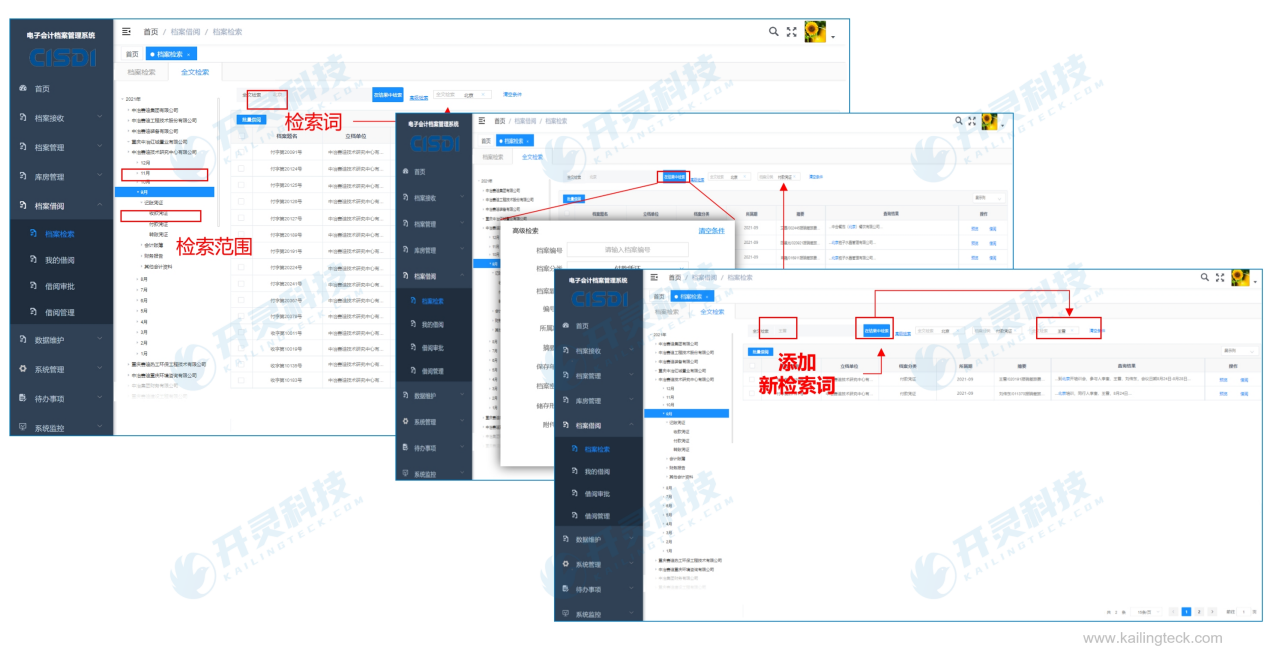
(1) Full-text search 1. Keyword search:Users only need to enter keywords in the search box, such as a specific transaction date, customer name, or expense item, and the system instantly retrieves all relevant files and data containing that keyword from massive accounting archives. Whether it is file titles, content, or related remarks, comprehensive search is possible, ensuring no potentially matching content is missed. For example, if a finance staff member needs to find a specific customer's sales records, they only need to enter the customer name, and the system quickly locates the relevant sales invoices, contracts, and corresponding accounting records, greatly shortening search time and improving work efficiency. 2. Fuzzy search:Considering that in actual work it may be impossible to accurately remember the complete information of a file, the system supports fuzzy search. Users can search by entering partial information, and the system will automatically match all similar or related content, further improving the flexibility and accuracy of searches. For example, if you only remember that a certain transaction occurred roughly in a specific time period, or the approximate amount range of a certain expense item, fuzzy search can quickly find the relevant archive records. (2) Classified search 1. Multi-dimensional classification:The system supports classified retrieval by time, category, amount, department, and other dimensions. Users can flexibly choose different classification methods for filtering based on actual needs to quickly locate the required accounting archives. For example, finding all expenditure records within a certain period by month, or calculating the total cost of a project by expense category, can all be easily achieved, providing powerful data support for financial analysis and decision-making. 2. Tag management:To further improve search efficiency, users can add custom tags to accounting archives. These tags can be any identifier that helps distinguish and identify archives, such as business nature, project name, or urgency level. Through tag management, users can quickly filter out archives with specific tags, achieving refined management and rapid retrieval of archives. For example, by adding an "Important Contract" tag to important contract archives, when they need to be consulted, simply clicking that tag quickly retrieves all related contract files without having to filter through a large number of archives one by one. (3) Intelligent recommendations 1. Related recommendations:Based on users' search history and behavior patterns, the system can intelligently analyze users' common operations and areas of interest, and proactively recommend related accounting archives and data. For example, if a user has recently frequently searched for archives related to the cost of a certain project, the system will automatically recommend other archives related to that project's budget, expense reimbursement, capital expenditure, etc., helping users understand the project's financial situation more comprehensively, improving work efficiency, and reducing repetitive search operations. 2. Automatic completion:When users enter search keywords, the system automatically completes keywords based on existing data and common search terms, guiding users to enter search content more accurately, helping users find the information they need faster, and further improving the search experience and search efficiency. III. Security and compliance management: solid assurance, peace of mind in useAccounting archives involve an enterprise's core financial information, and security and compliance are crucial. The Kailing Electronic Accounting Archives Management System has adopted comprehensive safeguard measures in data security and compliance, giving enterprises peace of mind. (1) Data Encryption and Backup 1. Data encryption:The system adopts internationally advanced encryption technology to comprehensively encrypt data in storage and transmission. Whether data is stored on servers or transmitted over networks, it undergoes strict encryption processing to ensure data confidentiality and integrity, preventing data theft or tampering. Even if data is intercepted during transmission, without the correct decryption key, no information can be obtained, effectively protecting enterprise financial secrets. 2. Automatic backup:To prevent data loss caused by unexpected situations, the system has an automatic backup function. At preset time intervals, the system automatically backs up all accounting archive data regularly and stores the backup data on secure off-site servers or cloud storage. Once data loss occurs due to data corruption, system failure, or other force majeure, enterprises can quickly restore from the backup data, ensuring continuous data availability and business continuity. (II) Permission management 1. Multi-level permission control:The system supports a multi-level permission management mechanism, and enterprises can assign corresponding permissions to different positions and personnel according to their responsibilities. For example, ordinary finance personnel can only view and operate the accounting data they are responsible for, department managers can view their department's financial statements and related data, while the finance director has higher permissions and can comprehensively control the entire enterprise's financial status. Through this fine-grained permission division, data security and confidentiality are ensured, preventing unauthorized access and operations. 2. Log recording:The system records every user operation log in detail, including login time, operation content, and modification records. These log information not only facilitates internal audit and traceability for enterprises, but also helps promptly detect abnormal operation behavior and take timely measures to prevent risks. For example, if a user is found to frequently access or modify important financial data outside working hours, administrators can promptly detect and investigate through log records, ensuring the safe and stable operation of the system. (3) Compliance check 1. Policy updates:The Kailing electronic accounting archives management system closely monitors changes in national finance, tax, and other relevant policies and regulations, and the system can automatically update and follow the latest policy requirements. Whether it is revisions to accounting standards, adjustments to tax policies, or updates to archive management standards, the system can adapt in a timely manner, ensuring that enterprises' accounting archive management and operations always comply with laws and regulations and avoiding compliance risks caused by policy nonconformity. 2. Compliance audit:The system has a built-in automated compliance audit function that regularly conducts comprehensive checks on accounting archive data and operational processes. By comparing preset compliance rules with actual data and operations, the system can promptly identify potential compliance issues and generate detailed audit reports. Enterprises can make timely rectifications based on these reports, ensuring compliance in accounting archive management and reducing legal and financial risks. IV. Real-time update and synchronization: fresh data, efficient collaborationIn modern corporate financial management, real-time access to the latest financial data is crucial for decision-making. The real-time update and synchronization function of the Kailing electronic accounting archives management system keeps corporate financial data always up to date, while supporting multi-person collaboration and improving team collaboration efficiency. (1) Real-Time Data Updates 1. Automatic synchronization:The system can synchronize data across different devices and platforms in real time. Whether finance personnel operate on a computer in the office or enter and modify data via mobile phone or tablet while traveling, data on all devices remains consistent in real time. Once data on one device is updated, other devices immediately sync to obtain the latest data, ensuring real-time accuracy and avoiding information lag or decision-making errors caused by data desynchronization. 2. Instant notification:When data is updated, the system immediately notifies relevant users through message push, email reminders, and other methods. For example, when a new expense reimbursement form is submitted for review, the reviewer will immediately receive a notification and can promptly proceed with the review; when financial reports are generated or updated, management can also obtain the latest financial information at the first opportunity, providing strong support for rapid enterprise decision-making. (II) Multi-device support 1. Cross-platform compatibility:The Kailing electronic accounting archives management system supports multiple operating systems and devices, including Windows, Mac, iOS, Android, and more. Whether users use desktop computers, laptops, smartphones, or tablets, they can access the system anytime and anywhere through a browser or dedicated client to query, enter, review, and otherwise operate accounting archives. This cross-platform compatibility frees finance personnel from time and location constraints, enabling them to work more flexibly and efficiently and improving work efficiency. 2. Data synchronization:No matter what device the user operates on, the system can synchronize data in real time, ensuring consistency and completeness of data across different devices. Users can start processing a business matter on an office computer, continue viewing and supplementing information via mobile phone on the way home, and then complete the final review on a tablet after arriving home. The entire process has seamless data connection and smooth, natural operation, greatly improving work continuity and convenience. (3) Collaborative work 1. Multi-person collaboration:The system supports simultaneous online collaboration by multiple users, and finance personnel in different positions can view and edit the same accounting archive in real time. For example, when preparing financial statements, the general ledger accountant is responsible for data entry, the reporting accountant is responsible for reviewing and adjusting formats, and management can view the preparation progress and content of the statements in real time. All parties can collaborate in real time, avoiding communication costs and time waste caused by file transfer and version desynchronization under traditional models, and improving work efficiency and team collaboration capability. 2. Version control:For the same accounting archive, the system can automatically record and manage the change history of different versions. Users can conveniently view historical versions, compare differences between versions, and even roll back to a previous version for restoration. This function is especially important in scenarios such as complex accounting adjustments and report modifications, ensuring data traceability and accuracy and avoiding work errors caused by version confusion.
V. Cost savings: reduce costs and increase efficiency to help enterprises growThrough intelligent functional applications, the Kailing electronic accounting archives management system not only improves work efficiency but also brings significant cost savings to enterprises, becoming a powerful tool for enterprises to reduce costs and increase efficiency. (1) Reduce labor costs 1. Automated operation:The system's automated data processing and intelligent search and retrieval functions greatly reduce manual workload. Tasks that previously required multiple finance staff several days to complete, such as account organization, data entry, and report generation, can now be completed with just a small number of staff performing simple operations and monitoring through the Kailing system. For example, a mid-sized enterprise previously needed 3 finance staff and 5 days each month for accounting processing and report preparation; after adopting the Kailing system, only 1 finance staff member is needed to complete it within 2 days, greatly reducing labor costs. At the same time, the freed-up human resources can be invested in more valuable work such as financial analysis and budget planning, improving the enterprise's overall financial management level. 2. Intelligent review:The intelligent review function can automatically complete part of the review work, reducing the burden of manual review. The system makes intelligent judgments based on preset rules and historical data, automatically approving compliant business, and requiring manual intervention only for complex or abnormal situations. This not only improves review efficiency but also reduces errors and risks caused by manual review oversight, further saving labor costs. (II) Reducing Paper Costs 1. Paperless office:The Kailing electronic accounting archives management system realizes comprehensive electronic management of accounting archives, greatly reducing the use of paper documents. Enterprises no longer need to purchase large amounts of paper archive storage equipment such as filing cabinets and archive boxes, nor do they need to expend large amounts of manpower and material resources on organizing, filing, and storing paper archives, reducing paper costs and storage costs. At the same time, electronic archives occupy very little storage space. Compared with paper archives, they save a large amount of office space, creating a cleaner and more efficient working environment for enterprises. 2. Electronic signature:The system supports electronic signature functionality, replacing traditional paper-based signing. In business processes such as document approval and contract signing, relevant personnel only need to sign via electronic devices to complete the approval process, without printing paper documents for signatures, further reducing paper usage, meeting environmental requirements, and improving the efficiency and convenience of business processing. (3) Improve work efficiency 1. Shorten working time:Through intelligent functional applications, Kailing's electronic accounting archives management system significantly shortens the processing time of accounting work. From data entry and organization to report generation and data analysis, the system can complete each link quickly and efficiently, enabling finance staff to provide accurate financial information more promptly and providing strong support for enterprise decision-making. For example, during monthly financial closing, account reconciliation and report preparation that previously took several days can now be completed within one day through the system, greatly shortening the work cycle and improving enterprise operating efficiency. 2. Optimize resource allocation:The system can comprehensively analyze an enterprise's financial data and operational processes, helping enterprises optimize resource allocation. Through in-depth data mining and analysis, enterprises can more clearly understand the financial status and resource utilization of each department and project, thereby reasonably adjusting the allocation of personnel, funds, and other resources, improving resource utilization efficiency, and further enhancing the enterprise's economic benefits and competitiveness. Kailing Electronic Accounting Archives Management SystemWith its intelligent advantages, it provides enterprises with a comprehensive and efficient accounting archive management solution in areas such as automated data processing, intelligent search and retrieval, security and compliance management, real-time updates and synchronization, and cost savings. We sincerely recommend that enterprises fully consider their own business needs and development plans when choosing an electronic accounting archives management system, choose the Kailing electronic accounting archives management system, open a new chapter in intelligent accounting archive management, improve the efficiency and level of enterprise financial management, and inject strong momentum into the sustainable development of the enterprise. More details:https://www.kailingteck.com/h-col-110.html。 As a comprehensive business-finance-tax digitalization solution service provider, Kailing Technology provides business-finance-tax management digital transformation products and operational services for various government agencies, institutions, and large, medium, and small enterprises. The product line includes: Solutions for sales contract management system, procurement contract management system, fully digitalized Leqi interface project, automatic output VAT invoicing system, invoice issuance for individuals system, employee expense control and reimbursement system, input VAT invoice management system, supply chain collaborative reconciliation system, imaging OCR recognition system, automatic financial bookkeeping system, electronic accounting archives system and other businesses, comprehensively advancing the digitalization process across various fields. If you have any business-finance-tax digital transformation needs, welcome to contact us. Beijing Kailing Technology will serve you wholeheartedly.
|