010-6097 4119Book a Demo


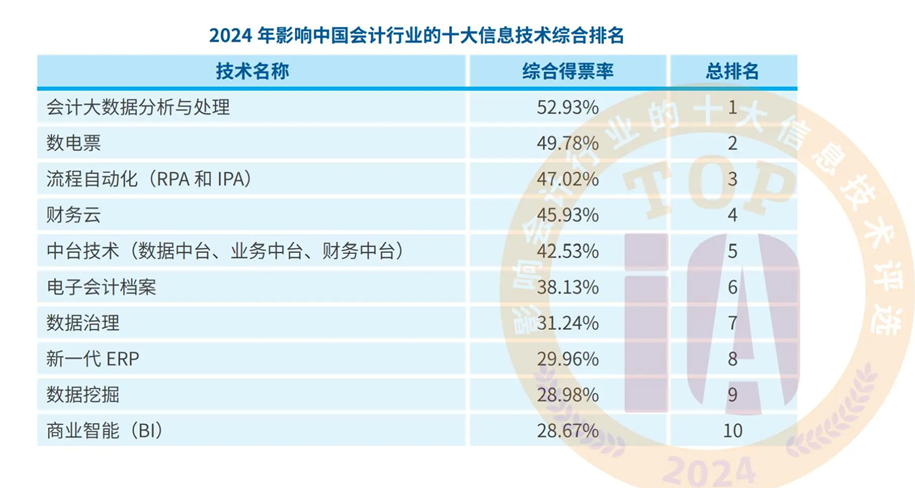
2024 Top Ten Information Technologies Affecting the Accounting Industry: fully digitalized e-invoices, electronic accounting archives, process automation, and others includedPublished: 2024-07-19 16:20 The results of the 2024 Top Ten Information Technologies Affecting China's Accounting Industry have been announced. Fully digitalized e-invoices, process automation, and electronic accounting archives were selected among the top ten information technologies with vote rates of 49.78%, 47.02%, and 38.13%, respectively.
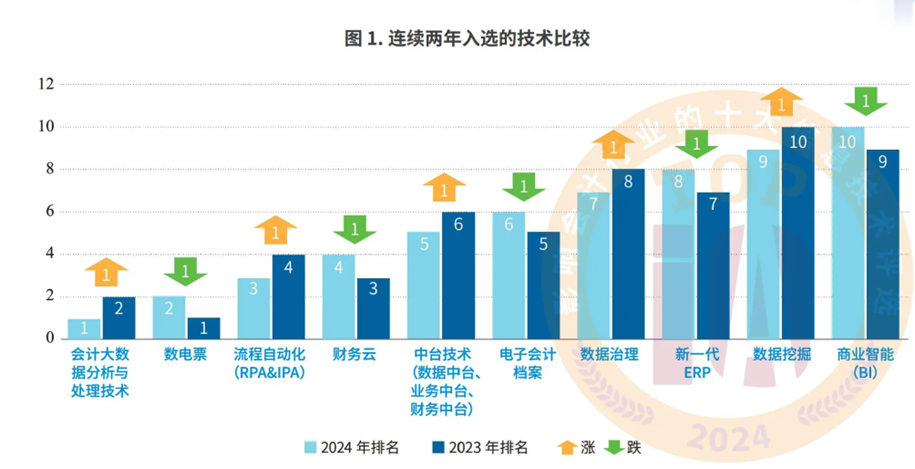
JuneBottom, in collaboration with Shanghai National Accounting InstituteSeveral domestic technology giants jointly released the top ten information technologies affecting China's accounting industry in 2024. After collecting over 5,000 survey questionnaires and review by more than 200 industry experts, ten technologies were selected: accounting big data analysis and processing, fully digitalized e-invoices, process automation, financial cloud, middle platform technology, electronic accounting archives, data governance, next-generation ERP, data mining, and business intelligence. Among them, although fully digitalized e-invoices ranked second, slightly down from last year, the vote share was nearly half.Process automation ranks third, second only to fully digitalized e-invoices.Electronic accounting archives rank sixth, with a vote share of nearly 40%.
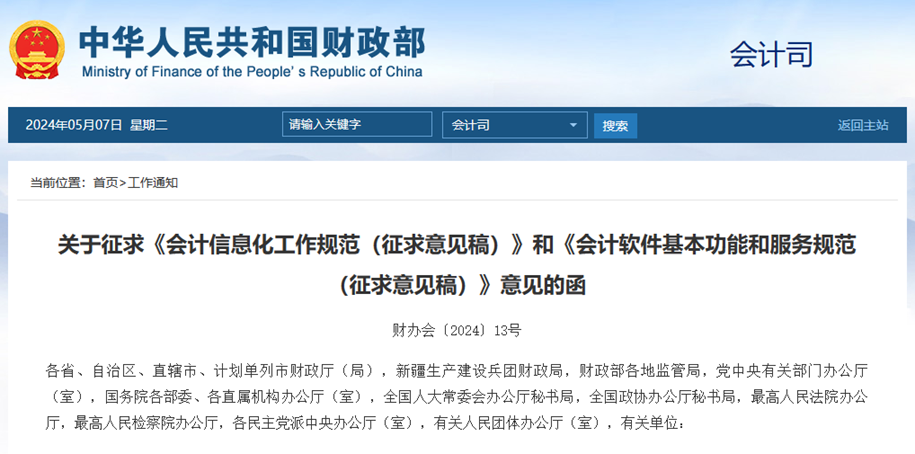
"Digital transformation"BecomeAs the core thread of global social, technological, and economic development, under the strong promotion and precise guidance of information technology and policies, elements such as invoices, documents, and archives involved in organizational expense management have gradually completed digital transformation, with a huge market demand scale. 01. The era of fully digitalized e-invoices in fullAspectArrives: one-stop invoice service, convenient and worry-free Fully digitalized e-invoices are invoices that exist in the form of data messages (XML data format), and their legal effect is equivalent to that of paper invoices. Fully digitalized e-invoices break free from the constraints of specific formats such as PDF and OFD, effectively curbing invoice forgery while making circulation more convenient,SignificantlyImproved the convenience of invoice management. (1) Progress of fully digitalized e-invoice policy: ① Nationwide coverage achieved for the fully digitalized e-invoice promotion pilot In 2023, in government announcements and document descriptions, the term "fully digitalized e-invoice" replaced the original "fully electronic invoice." Provinces and cities across the country successively issued pilot announcements for fully digitalized electronic invoices, and the pilot scope has now expanded nationwide. ② Sort out key management points for electronic invoices In March 2023, four departments—the State Taxation Administration, the National Archives Administration, the Ministry of Finance, and the Ministry of Commerce—jointly issued the "Guide to Full-Process Electronic Management of Electronic Invoices," systematically sorting out management points related to the issuance, receipt, reimbursement, booking, and archiving of electronic invoices. ③ Official guidance for Leqi services For large groups, especially multi-format, cross-regional groups, the number of invoices is huge and there are many enterprise organizations. Manual invoicing can no longer meet growing business needs. So how can online invoicing be achieved? To this end, tax authorities provide Leqi services to meet enterprises' needs for automated invoicing, prompting enterprises to connect their business systems with Leqi to achieve the goal of automated invoicing. In 2023, the Inner Mongolia Tax Service and the Guangdong Provincial Tax Service issued "Guidelines on the Specifications for Leqi Self-Use Direct Connection Services." Through Leqi services, building a tax-enterprise direct connection model is not only a basic service supporting enterprises' smart tax architecture and filing digitalization, but also realizes the system upgrade of "governing tax by data" tax supervision. ④ Reimbursement and archiving standards for fully digitalized e-invoices In May 2023, the Accounting Department of the Ministry of Finance issued the notice on the "Accounting Data Standards for Electronic Vouchers," further clarifying the preservation format for the reimbursement and archiving of fully digitalized e-invoices: Fully digitalized e-invoice XML requires no printing for archiving. It is only necessary to use the digitally signed XML file of the fully digitalized e-invoice for reimbursement, booking, and archiving; no paper preservation is required, and electronic archiving is sufficient. The XML original must be retained. If paper printouts of the PDF or OFD format files of fully digitalized e-invoices are used for reimbursement, bookkeeping, or archiving, the XML-format electronic file of the fully digitalized e-invoice with a digital signature must also be archived. (2) Advantages of fully digitalized e-invoices: Convenient invoicing flow:Invoicing requires no tax-control equipment and no processes such as invoice type verification, invoice collection, invoice inspection, or invoice express delivery. National unified management:Nationwide, each invoice is automatically assigned a unique code on a unified basis (enterprises do not need to manage blank invoices), and the total issuance amount limit is controlled based on the invoicer's credit status (to prevent arbitrary invoicing and false invoicing). Enterprise self-management:Supports specific classification of invoice functions, statuses, and purposes in the form of tags. At the same time, supports enterprise-defined elements such as contract number, order number, shipment number, voucher number, profit center, etc. Adding such information can better meet enterprises' internal needs for unified management of invoices, tax, finance, and business. 02. Electronic accounting archives: policies in the accounting archives field continue to advance New variables such as fully digitalized e-invoices are emerging, accelerating the digitalization of accounting vouchers. Organizations face new challenges in booking and archiving various electronic vouchers and in managing electronic accounting archives. (1) Timeline of policy advancement for electronic accounting archives construction: In recent years, the state has successively issued policies to gradually guide organizations in building electronic accounting archives management systems: December 2015 The Ministry of Finance and the National Archives Administration Order No. 79, the "Measures for the Management of Accounting Archives," was issued, establishing the concept and management requirements of electronic accounting archives and clarifying that accounting archives can be archived and preserved in electronic form only. April 2019 The National Archives Administration, the Ministry of Finance, and the State Taxation Administration issued the "Notice on Carrying Out Pilot Work on Electronic Reimbursement, Booking, and Archiving of Electronic Invoices," launching the first pilot for paperless reimbursement, booking, and archiving of electronic invoices, opening the "last mile" for electronic accounting voucher archiving. March 2020 Cai Kuai [2020] No. 6, the Notice on Standardizing the Reimbursement, Booking, and Archiving of Electronic Accounting Vouchers, clarifies that electronic accounting vouchers such as electronic invoices may not be printed; when electronic archiving is adopted, their effect is equivalent to paper vouchers. July 2022 The National Archives Administration issued DA/T94 "Specification for Electronic Accounting Archives Management," which stipulates requirements for the formation, collection, organization, and archiving of electronic accounting materials, as well as the custody, statistics, use, appraisal, and disposal of electronic accounting archives, strengthening industry standards for electronic accounting archives. May 2023 Cai Kuai [2023] No. 7 was issued, with nine ministries and commissions jointly carrying out the "Deepening Pilot of Accounting Data Standards for Electronic Vouchers," clarifying that the entire process of electronic vouchers from issuance to receipt, booking, and archiving can be paperless. These 9 categories of electronic vouchers include fully digitalized e-invoices, railway electronic tickets, air transport electronic ticket itineraries, VAT electronic ordinary/special invoices, fiscal electronic bills, electronic general payment books for non-tax revenue, bank electronic receipts/statements, and more. After enterprises receive fully digitalized e-invoices, they can directly parse and book XML-format fully digitalized e-invoices with digital signatures, and then directly push the XML files to the accounting archive system for paperless archiving. If an enterprise is temporarily unable to parse and book XML fully digitalized e-invoices, it can still print fully digitalized e-invoices like traditional electronic invoices for reimbursement and bookkeeping, but ultimately it still needs to collect and archive the XML fully digitalized e-invoice files. 2024 The Ministry of Finance revised the "Work Standards for Enterprise Accounting Informatization," the "Work Standards for Computerized Accounting," and the "Basic Function Standards for Accounting Software," forming the "Work Standards for Accounting Informatization (Draft for Comments)" and the "Basic Functions and Service Standards for Accounting Software (Draft for Comments)." Among them, "Article 31 (Accounting Data Archiving)" puts forward clear and explicit requirements for the construction of electronic accounting archives: “Entities shall, in accordance with national regulations on electronic accounting archive management, establish and improve management systems for the formation, collection, organization, and archiving of electronic accounting materials, as well as the custody, statistics, utilization, appraisal, and disposal of electronic accounting archives, apply reliable security protection technologies and measures, ensure the authenticity, integrity, usability, and security of electronic accounting archives during transmission and storage, and strengthen the archiving of electronic accounting materials and the management of electronic accounting archives.”
(2) Electronic accounting archives have become a necessary need for organizations: Personnel in different positions within the organization have generated new needs for accounting archives management. The construction of electronic accounting archives will bring new breakthroughs for organizational efficiency and compliance: • For archive management personnel: reduce mechanical and repetitive work and achieve automatic statistics; • For finance personnel: achieve compliant handover and access all related accounting archives; • For business personnel: efficiently retrieve massive archives and achieve one-click borrowing; • For external auditors: complete and comprehensive data and complete accounts facilitate audit work. 03. Business process automation (RPA): achieve financial automation, reduce pressure and burden for finance personnel Under the backdrop of China Golden Tax Phase IV, the modern tax collection and administration system has become more powerful, achieving "cloud-based" connectivity of all data, all business, and all processes for "taxes and fees." China Golden Tax Phase IV aims to achieve "governing tax by data." Enterprises not only need to build financial compliance, but also must achieve tax compliance, which places higher-level requirements on the efficiency and compliance of enterprise tax filing. The daily work of the finance department includes tax filing, fund management, expense reimbursement, budget management, and other content. The business operation process of each task is relatively complex, and usually urgent in time and heavy in tasks. Currently, through the business process automation platform RPA, organizations can connect financial processes. It has been widely applied in various financial scenarios, helping finance personnel complete work efficiently. RPA stands for Robotic Process Automation. RPA is a software automation technology that simulates human operations and combines AI to enhance interaction with computers, taking over manual operations in original business processes and replacing humans in highly repetitive, rule-based work. RPA effectively integrates the following technologies to enable user-defined, automatic completion of various tasks, reducing the workload of finance staff. (1) Automated process definition For operations performed by RPA, operation steps, execution conditions, task time limits, execution roles and next-step operations, all can be customized. (2) Advanced access technology RPA uses many advanced access technologies, such as screen element recognition and capture, and simulating human use of the keyboard and mouse, to simulate human operation of various software. (3) Artificial intelligence RPA uses AI algorithms in the robot task processing. For example, it automatically extracts key information from text in various software or websites and converts it into structured data for automatic analysis, classification, and organization. In the future, these algorithm technologies will also be able to automatically learn and optimize task processes, adapting to changes in software environments and data. (4)Execution strategy management RPA predefines execution strategies based on requirements to automatically schedule robots for execution. Strategy management covers strategy definition and unified task scheduling mechanisms. Kailing TechnologyAs a professional business-finance-tax digitalization solution service provider, possessingThe integrated business-finance-invoice-tax-archive solution enables full-process closed-loop management of the issuance, receipt, verification, reimbursement, accounting entry, filing, and electronic archiving of fully digitalized e-invoices, archiving all accounting materials such as "invoices," "documents," "vouchers," "ledgers," and "reports." At the same time, it launches an RPA-based automated financial tax filing solution for organizations, reducing the workload of finance personnel。 Kailing Technology provides enterprise business-finance-tax digital product lines according to enterprise needs: Solutions for businesses including sales contract management system, procurement contract management system, fully digitalized Leqi interface project, output automatic invoicing system, employee expense control and reimbursement system, input VAT invoice management system, supply chain collaborative reconciliation system, image OCR recognition system, automatic financial bookkeeping system, and electronic accounting archives system, professionally and efficiently supporting the transformation and upgrading of enterprise business-finance-tax digital management. If you have any business-finance-tax digital transformation needs, welcome to contact us. Beijing Kailing Technology will serve you wholeheartedly.
|