010-6097 4119Book a Demo


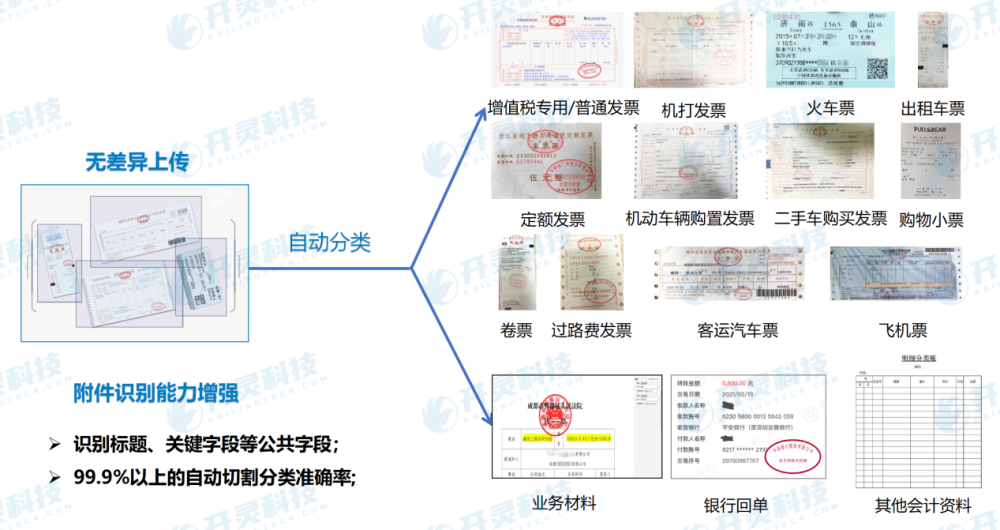
Kailing Technology's New Paradigm for Archive Management in the AI Era: OCR Intelligent Recognition for Front-End Collection + Electronic Accounting Archives for Back-End Archiving, with Zero Manual Intervention ThroughoutPublished: 2026-06-09 16:41 Against the backdrop of the full rollout of China Golden Tax Phase IV, the widespread application of electronic invoices, and the intensive issuance of electronic accounting archives management standards by the Ministry of Finance and the National Archives Administration, enterprise finance is facing an unprecedented compliance transformation. The traditional accounting archives management model of "printing, binding, archiving, and searching" is not only inefficient and costly, but also exposes obvious shortcomings in legal validity, audit response, and data security. Based on the deep integration of AI technology and business-finance-tax digitalization, Kailing Technology has built a new management paradigm with OCR intelligent recognition as the front-end lever and an electronic accounting archives system as the back-end hub, truly achieving a "zero manual intervention" closed loop from collection to archiving. I. Policy Pressure and Technology Drive: Archive Management Must ChangeCurrently, regulators have put forward rigid requirements for the authenticity, completeness, and traceability of business-finance-tax data. The Measures for the Management of Accounting Archives (Order No. 79) clearly stipulates that electronic accounting materials preserved only in electronic form must meet six conditions including reliable source, standardized procedures, and compliant elements; the Ministry of Finance Document No. 6 even directly points out that using paper printouts of electronic invoices as the sole archiving basis poses major risks, and electronic originals must be preserved simultaneously. At the same time, external accounting vouchers such as electronic invoices, bank electronic receipts, and fiscal electronic bills have become fully widespread. If enterprises still follow paper-based archiving logic, it is tantamount to "wearing digital shoes while walking a manual path." However, in reality, a large number of enterprises face a triple dilemma: first, front-end paper documents and electronic documents are mixed, and manual classification, scanning, and entry are extremely inefficient and error-prone; second, business systems, financial systems, and fund systems are separated from one another, making it difficult to automatically associate vouchers with source documents; third, archive queries after archiving rely on manual searching, and cross-period, cross-system business tracing is even more time-consuming and laborious. To break these dilemmas, AI capabilities must be introduced to reconstruct the entire archive management chain. II. Front-end AI OCR intelligent recognition: turning "unstructured" into "structured" in secondsThe front-end core of Kailing Technology Electronic Accounting Archives System is a privately deployed OCR-AI recognition platform. Unlike general OCR solutions, this platform is deeply optimized for business-finance-tax scenarios and has the following key capabilities: Automatic Classification and Splitting: After the system receives image files such as paper invoices, bank receipts, contracts, and reimbursement forms, no manual type specification is needed; the AI model can automatically determine document categories based on layout features, barcodes, QR codes, faces, and other elements, with classification accuracy exceeding 99.9%. Structured extraction of key fields: Support multiple methods such as fixed-position extraction, table cell extraction, and regular expression extraction to automatically extract core information such as invoice codes, amounts, dates, bank transaction numbers, and contract numbers into structured data, output in JSON format for direct use by downstream systems. Private deployment ensures data security: All recognition models run on the enterprise's internal network, and original images and extraction results are not transmitted externally, completely eliminating the risk of sensitive financial data leakage. At the same time, the platform supports enterprises in training custom recognition models based on their own document characteristics, for example precise adaptation for bank receipts or internally created vouchers in specific formats. Through front-end OCR, paper documents complete a "digital twin" the moment they enter the system—not only obtaining a searchable formatted file, but also possessing structured metadata that can be understood by machines. The entire process requires no manual intervention, laying a clean and reliable data foundation for subsequent automated archiving.
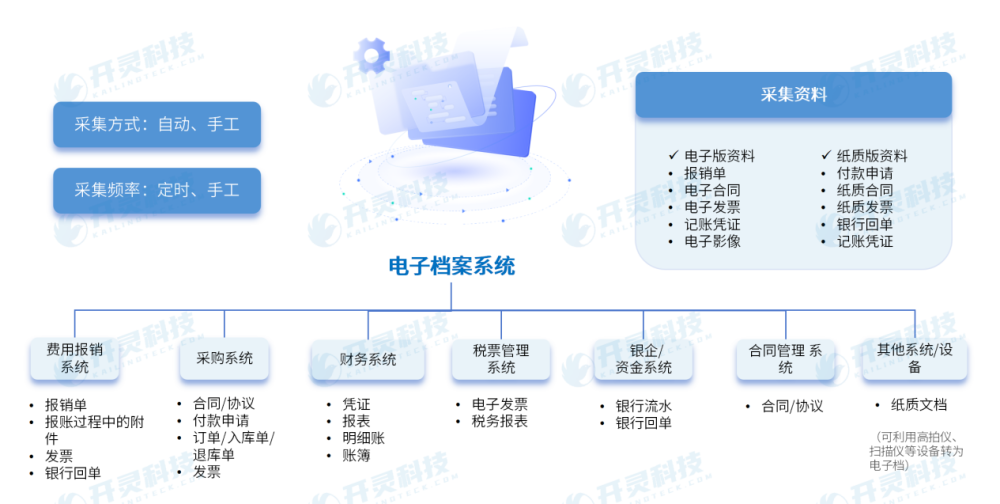
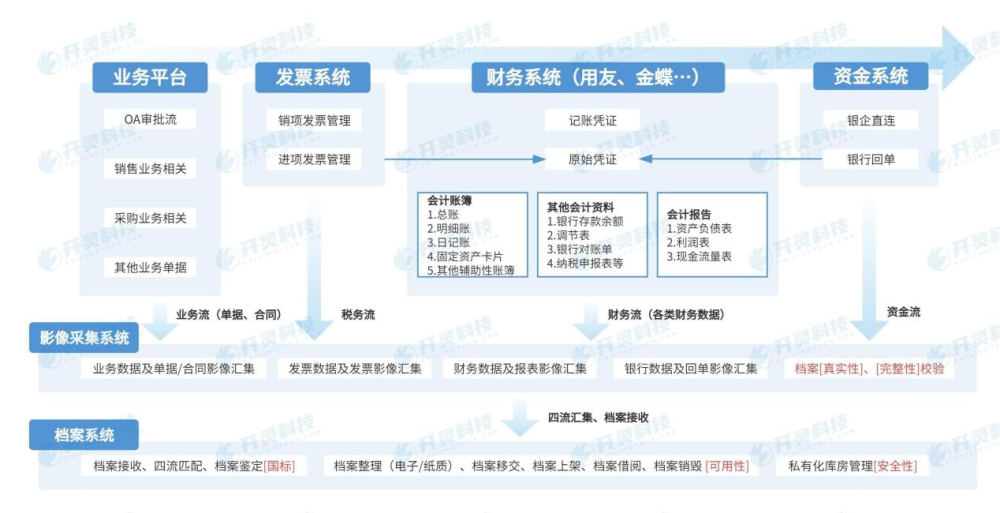
III. Back-end electronic accounting archives filing: automated binding and intelligent drill-throughStructured data and format files collected at the front end are uniformly fed into the electronic accounting archives management hub. The Kailing system connects via standard APIs with the enterprise's existing financial accounting system, reimbursement system, treasury system, and tax invoice system, automatically pulling accounting vouchers, reimbursement forms, bank receipts, and e-invoice source files (XML/OFD/PDF), and automatically completing the matching and binding of "vouchers-original documents" according to preset association rules (such as voucher number, reimbursement form number, contract number, and bank transaction number).
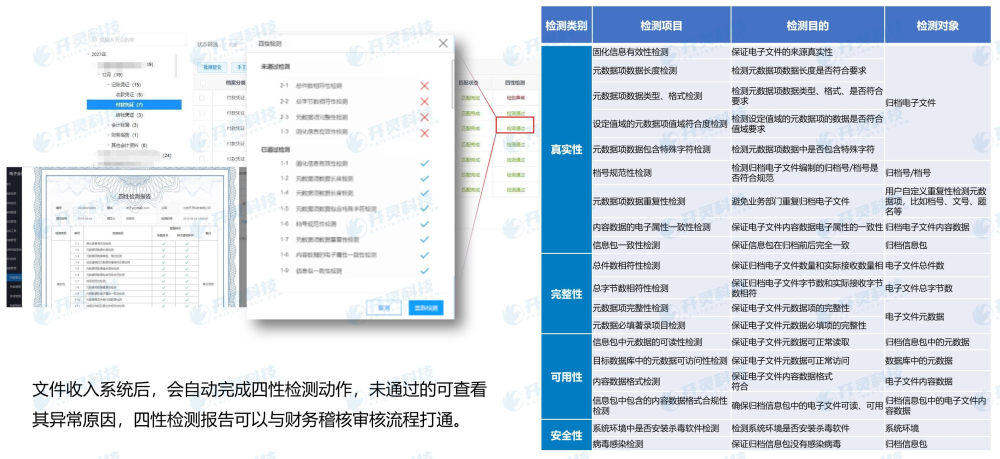
The core capabilities of this process are reflected in three aspects: 1. Automatic binding and completeness detectionThe system has a built-in "four-property verification" mechanism compliant with the National Archives Administration's DA/T 94—2022 standard, verifying the authenticity, integrity, usability, and security of each archive. For example, if an accounts payable voucher lacks an input VAT invoice or bank receipt, the system automatically marks it as "incomplete" and blocks archiving, while generating a missing-items report. Administrators can customize the types of source documents that each type of voucher must be linked to (e.g., receipt vouchers must be linked to bank receipts and collection notes), eliminating archiving loopholes at the institutional level.
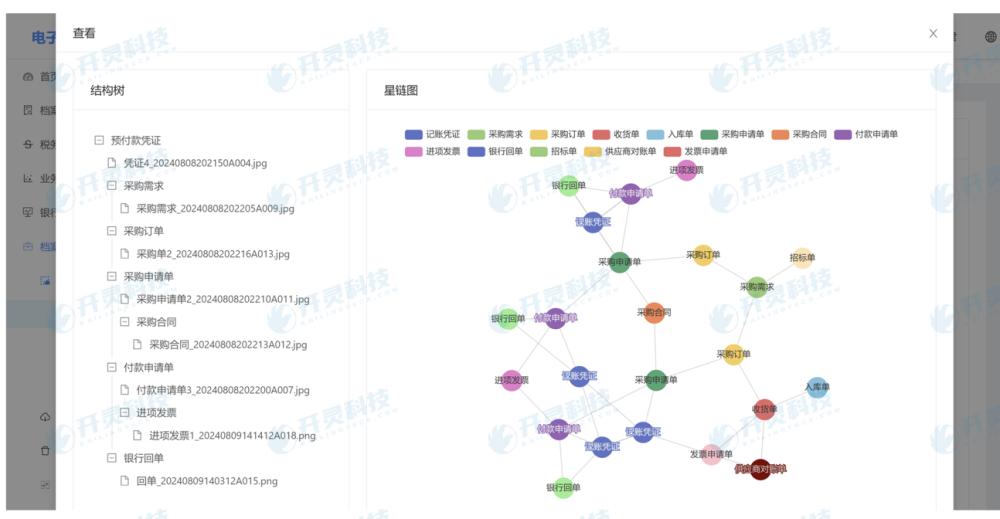
2. Starlink graph: Panoramic penetration across periods, systems, and ledgersTraditional archive queries are limited by accounting year, ledger system, and system boundaries. For a procurement contract paid in multiple installments, the corresponding vouchers are scattered across ledgers of different years, making manual retrieval extremely cumbersome. Kailing's original "Star Chain Graph" technology centers on any document (such as a contract, reimbursement form, or voucher) and automatically draws a dynamic relationship network of all related archives upstream and downstream. Users can click a node to penetrate and view the complete business chain, achieving a leap from "single-thread auditing" to "panoramic inspection," especially suitable for complex transaction tracing and listed company compliance review.
3. Confidentiality and audit authorization with controllable granularityThe system supports precise confidentiality permissions down to the original voucher level. Multiple original documents under the same bookkeeping voucher can have access permissions set separately according to sensitivity. During audits, audit packages can be generated separately, opening only specified original vouchers for external personnel to review, both meeting audit requirements and protecting sensitive information such as compensation and pricing. IV. Zero manual intervention throughout the process: an automated closed loop from collection to archivingThe "zero manual intervention" defined by Kailing Technology is not simply paperless, but an automated pipeline running through the entire chain of "collection → recognition → association → detection → binding → warehousing → utilization": Collection Automation: The system automatically captures accounting vouchers, reimbursement forms, bank receipts, etc. from various business systems at set frequencies; paper documents are batch-uploaded via document cameras or scanners, with OCR automatic recognition and no manual entry required. Link Automation: Based on the unique primary key in the metadata (such as reimbursement form number or serial number), the system automatically matches vouchers with attachments. Even without bank-enterprise direct connection, after the cashier uploads hundreds of pages of PDF receipts in batches, the system can automatically link them based on the serial number in the voucher summary. Archiving automation: The system automatically files by month/quarter/year, generates covers and spines, initiates four-property testing, and upon passing automatically stores them and generates location barcodes; electronic archives and physical archives correspond one-to-one via barcodes. Utilize automation: Support full-text search, multi-format preview (covering all common global layout files), online borrowing approval processes, and automatic reminders for return upon borrowing expiration. Throughout the entire process, finance personnel do not need to print, bind, manually link, or repeatedly verify. The only thing they need to do is set rules and monitor exception reports. Archive management transforms from "labor-intensive" to "rule-driven." V. Core value of the new paradigm: compliance, cost reduction, efficiency improvement, risk controlThis new AI-driven paradigm of archive management brings multiple and far-reaching values to enterprises: Compliance Without Concern: The system strictly follows Order No. 79, Document No. 6, and the DA/T 94 standard, with four-property testing, electronic signatures, and backup mechanisms all in place, calmly handling tax inspections and audit confirmations. Costs plummet: Say goodbye to paper printing, binding, warehouse leasing and manual sorting, and the archiving cost per voucher can be reduced by more than 70%. Efficiency leap: Cross-period voucher queries change from "rummaging through boxes" to "second-level drill-through," and the star-chain graph increases verification efficiency in complex audit scenarios by more than 5 times. Controllable risk: Completeness detection and missing-item reports leave no place for archive omissions to hide; private deployment OCR eliminates data leakage; fine-grained confidentiality permissions prevent information misuse.
With OCR intelligent recognition and the electronic accounting archives system at its core, Kailing Technology has built a fully zero-manual-intervention archive management paradigm that is implementable, scalable, and privately deployable. It is not intended to replace finance staff, but to fully free people from repetitive, inefficient, and error-prone paper archive processing, allowing finance teams to focus on data analysis, risk control, and business decisions. In the wave of comprehensive digitalization of business-finance-tax, whoever first completes the paradigm shift in archive management from "manual" to "intelligent" will gain a first-mover advantage in the competition for compliance and efficiency. To learn more about the electronic accounting archives system or to book a product demo, please consult Kailing Technology:https://www.kailingteck.com/h-col-110.html 。 As a comprehensive business-finance-tax digitalization solution service provider, Kailing Technology provides business-finance-tax management digital transformation products and operational services for various government agencies, institutions, and large, medium, and small enterprises. The product line includes: Solutions for businesses including sales contract management system, procurement contract management system, fully digitalized Leqi interface project, output automatic invoicing system, reverse invoicing system, natural-person invoicing system, employee expense control and reimbursement system, input VAT invoice management system, supply chain collaborative reconciliation system, image OCR recognition system, automatic financial bookkeeping system, and electronic accounting archives system, comprehensively driving the digitalization process across various fields. If you have any business-finance-tax digital transformation needs, welcome to contact us. Beijing Kailing Technology will serve you wholeheartedly.
#Electronic Accounting Archives System #Enterprise Compliance Management #Digital Business-Finance-Tax Transformation #Electronic Accounting Archives Solution # AI OCR Recognition #Financial Digitalization |