010-6097 4119Book a Demo


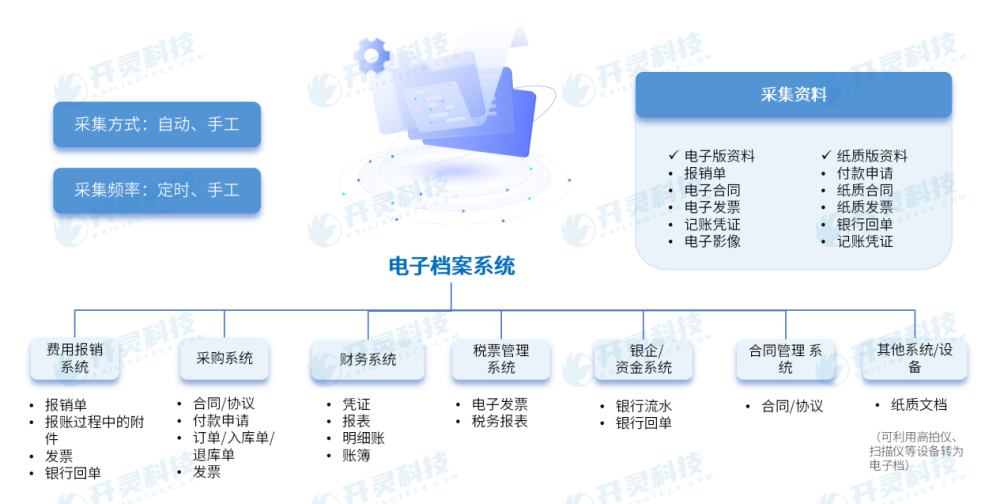
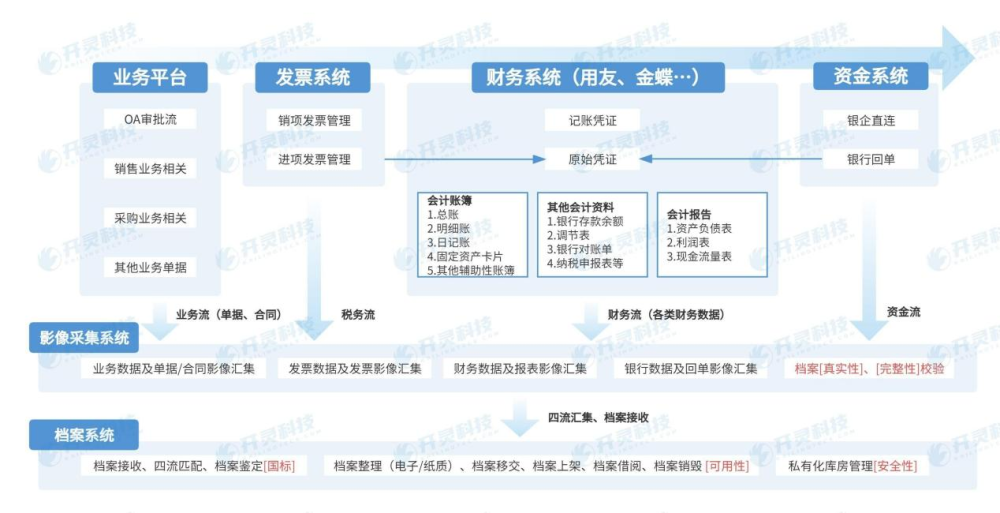
Group enterprises archive millions of vouchers every year, all relying on finance staff working overtime? Kailing Technology's AI-driven electronic accounting archives system automates the entire process from collection to destructionPublished: 2026-06-04 20:47 I. Why archiving always becomes finance's "overtime pit"For group enterprises, archive filing is never simple document organization, but a systematic project that runs throughout the year and involves multiple departments. With many subsidiaries, large business volume, and scattered document sources, accounting vouchers, reimbursement forms, invoice source files, bank receipts, approval flows, and contract scans can accumulate over a year to possibly millions of vouchers and millions of attachments. Under the traditional model, finance often can only rely on month-end centralized organization, printing, binding, numbering, and shelving to tough it out. With more people, the process slows down; when materials are scattered, associations become chaotic; and when audits and retrieval come, flipping through archives, finding attachments, and supplementing materials mean working overtime again. More critically, the policy has already changed. Ministry of Finance Document No. 6 clearly states that when electronic accounting vouchers are booked and archived, the electronic source files must be preserved at the same time, and paper printouts alone cannot be kept. In other words, enterprises can no longer treat "print one copy and bind it" as completing archiving. II. Kailing Technology's approach: not moving paper processes onto computers, but letting the system work on its ownMany enterprises still approach electronic archiving with the old way of thinking: manual classification before, now manually creating directories in the system; manual pasting before, now uploading attachments online. It looks digitized, but in essence finance is still moving files. The core logic of Kailing Technology's AI-driven Electronic Accounting Archive System is different:Automate the entire process of collection, recognition, association, detection, archiving, retrieval, and destruction. Finance no longer needs to do repetitive labor, but instead sets rules, reviews results, and manages exceptions. 1. Automatic collection: data actively converges without manual handlingThe system can connect with an enterprise's existing financial system, OA system, treasury system, tax system, and imaging system to automatically collect various archive materials. For example, accounting vouchers, reimbursement forms, payment slips, approval flows, fully digitalized e-invoice PDF/OFD/XML, and bank receipts can all be captured on schedule according to rules. The value of this step is straightforward: what used to require finance to export, download, upload, and organize item by item is now completed automatically by the system. For group enterprises, especially in multi-subsidiary, multi-ledger scenarios, it can significantly reduce repetitive manual operations.
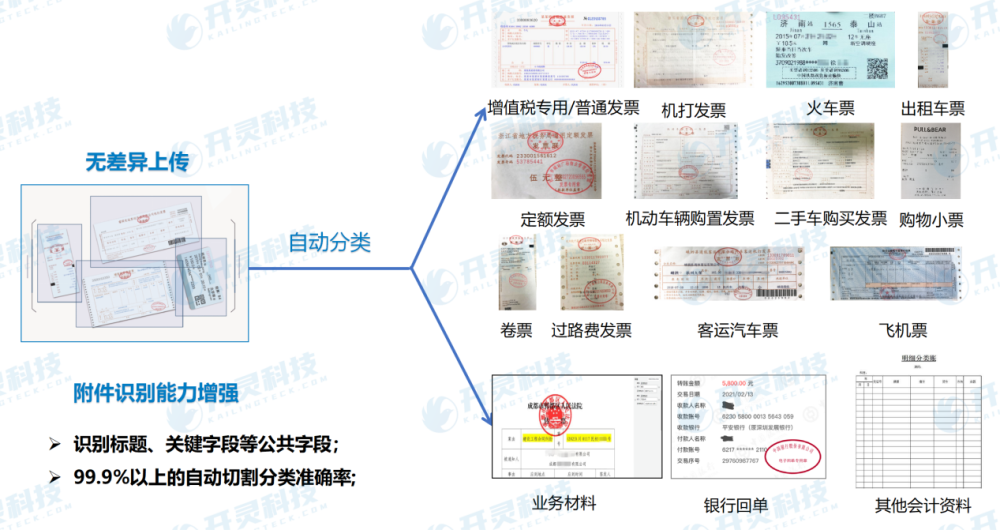
2. AI recognition: paper documents instantly become structured dataFor paper documents that still exist, the system has built-in OCR-AI recognition capability, supporting automatic recognition after batch upload via scanner or document camera. Invoices, receipts, reimbursement attachments and contract scans can all be automatically classified, with fields extracted and key information recognized. Mixed-pasted invoices can also be automatically cut and recognized, with no need for manual one-by-one separation and item-by-item entry. The "entry" step that finance dreads most is directly taken over by the system.
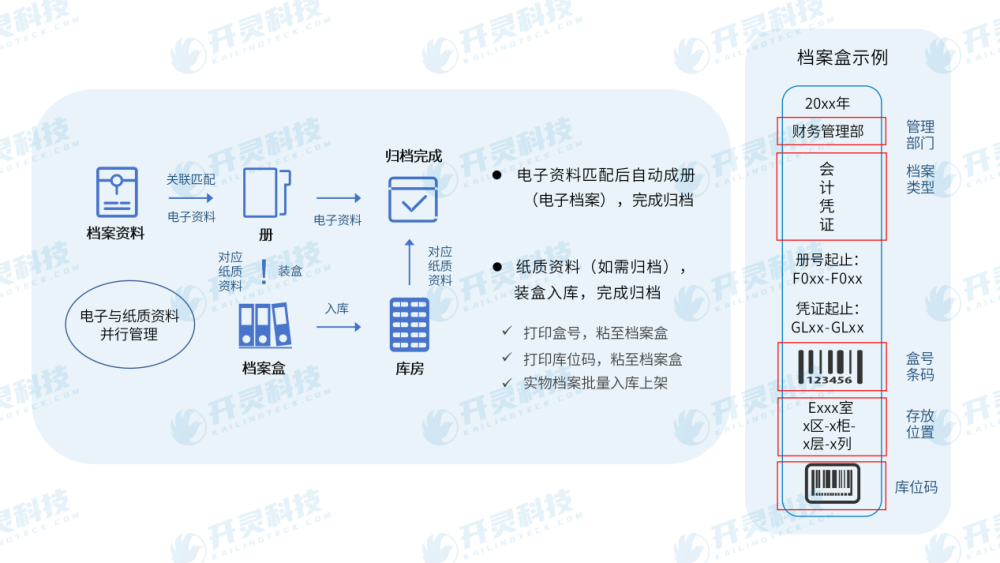
3. Automatic association: attachments of a voucher are automatically bound into a volumeThe core of electronic accounting archives is not "storage," but "association." Behind a single bookkeeping voucher, exactly which business documents, invoice source files, bank receipts, and approval flows correspond to it used to rely entirely on people to find, match, and verify. Kailing Technology's system, based on preset rules, automatically links all materials of the same business transaction: voucher numbers correspond to reimbursement forms, reimbursement forms correspond to invoice source files, payment orders correspond to bank receipts, and finally automatically assembles them into archives. For group enterprises, this means archives are no longer scattered across different systems, different folders, and different people's hands, but form a unified and traceable electronic archive chain.
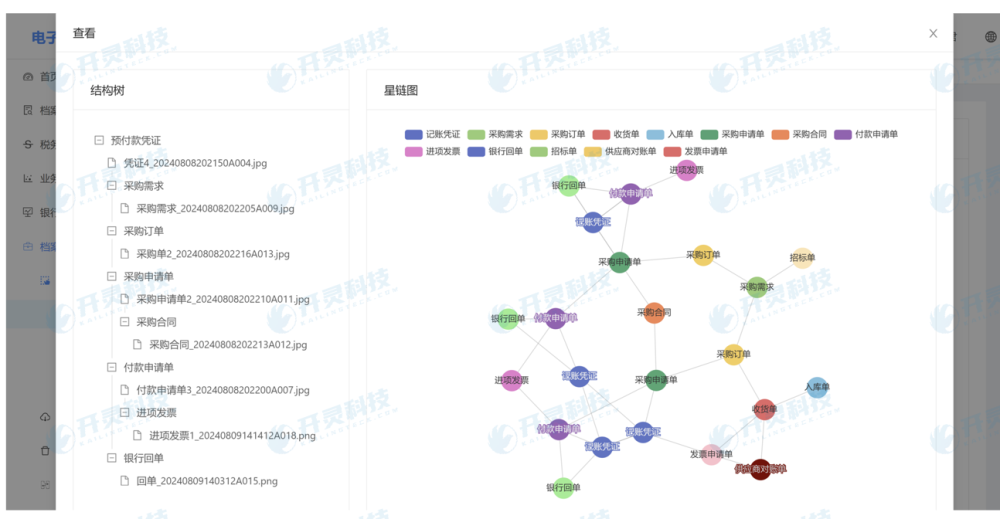
4. Starlink graph penetration: view the full chain of cross-period business with one clickA very common scenario for group enterprises is cross-year contract payments. For example, a contract is paid over several years, with vouchers scattered across different years. With the traditional annual archiving method, checking a single transaction often requires going through several ledgers. Kailing Technology's "star chain graph" can take any document as the center and string related vouchers, contracts, invoices, receipts, and approval flows into a network structure. Clicking a node allows you to see through the entire business chain. For auditing, internal control, and review, this capability is very practical.
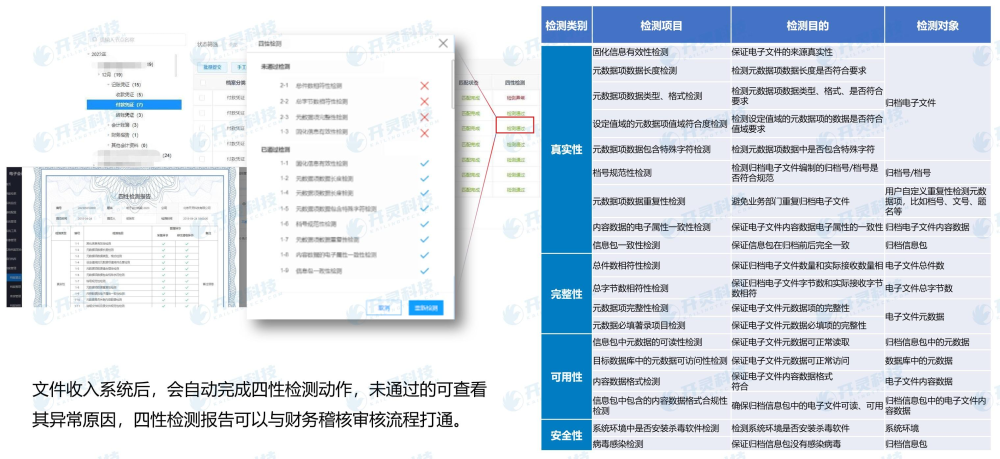
5. Four-property detection: automatic checks before archivingArchives are not simply done once uploaded; quality control must be performed before storage. The system automatically completes authenticity, integrity, usability, and security checks: Check whether files have been tampered with Check whether attachments are complete Check whether the format can be opened normally Check whether permissions and storage are compliant Archives with missing attachments, abnormal formats, or incomplete associations are automatically flagged and required to be completed before archiving. This blocks problems before archiving rather than exposing them only during audits.
6. Full lifecycle management: not just archiving, but also borrowing, retrieval, and destructionAfter archives are stored, the system continues to handle subsequent management. When consultation is needed, online retrieval is available; when borrowing is needed, approval can be initiated; after the retention period expires, the system can automatically remind for appraisal and destruction. This means electronic accounting archives are no longer just "stored away," but become manageable, traceable, and utilizable enterprise assets.
III. What This System Actually Solves for Group EnterprisesThe most direct benefit is cost reduction and efficiency improvement. Work that previously relied on finance staff working overtime, manual verification, and paper binding is now run automatically by the system, and finance only needs to do spot checks and management. What is more important is the compliance upgrade. Electronic source files are automatically saved, meeting Ministry of Finance requirements; four-property testing ensures archive quality; unified archiving rules keep subsidiaries and branches consistent. Looking further ahead, archive management for group enterprises is no longer "manual labor" but part of digital governance capability. Whoever manages archives well is better able to respond to audits, risk control, and management decisions. For group enterprises archiving millions of vouchers, overtime can no longer solve the fundamental problem. The truly effective approach is to systematize collection, recognition, association, detection, archiving, retrieval, and destruction entirely. What Kailing Technology's AI-driven Electronic Accounting Archive System does is turn the archive work that was previously the most labor-intensive, error-prone, and hardest to trace into an automated, standardized, and penetrable management system. To learn more about the electronic accounting archives system or to book a product demo, please consult Kailing Technology:https://www.kailingteck.com/h-col-110.html 。 As a comprehensive business-finance-tax digitalization solution service provider, Kailing Technology provides business-finance-tax management digital transformation products and operational services for various government agencies, institutions, and large, medium, and small enterprises. The product line includes: Solutions for businesses including sales contract management system, procurement contract management system, fully digitalized Leqi interface project, output automatic invoicing system, reverse invoicing system, natural-person invoicing system, employee expense control and reimbursement system, input VAT invoice management system, supply chain collaborative reconciliation system, image OCR recognition system, automatic financial bookkeeping system, and electronic accounting archives system, comprehensively driving the digitalization process across various fields. If you have any business-finance-tax digital transformation needs, welcome to contact us. Beijing Kailing Technology will serve you wholeheartedly.
#Electronic Accounting Archives System #Enterprise Compliance Management #Digital Business-Finance-Tax Transformation #Electronic Accounting Archives Solution # AI OCR Recognition #Financial Digitalization |