
Vegetable purchase prices often change on the same day; how do purchase prices and invoice amounts reconcile? The Kailing Technology agricultural product purchase reverse invoicing system links acceptance, pricing, and payment by farmer
Vegetable origin prices may differ between morning and evening, and the same truck may carry different grades and losses. If finance only receives a "daily average price table," it is hard to explain why a certain household's purchase invoice has that amount. The Kailing Technology agricultural product purchase reverse invoicing system groups the farmer, acceptance batch, pricing time, and payment result into the same transaction.
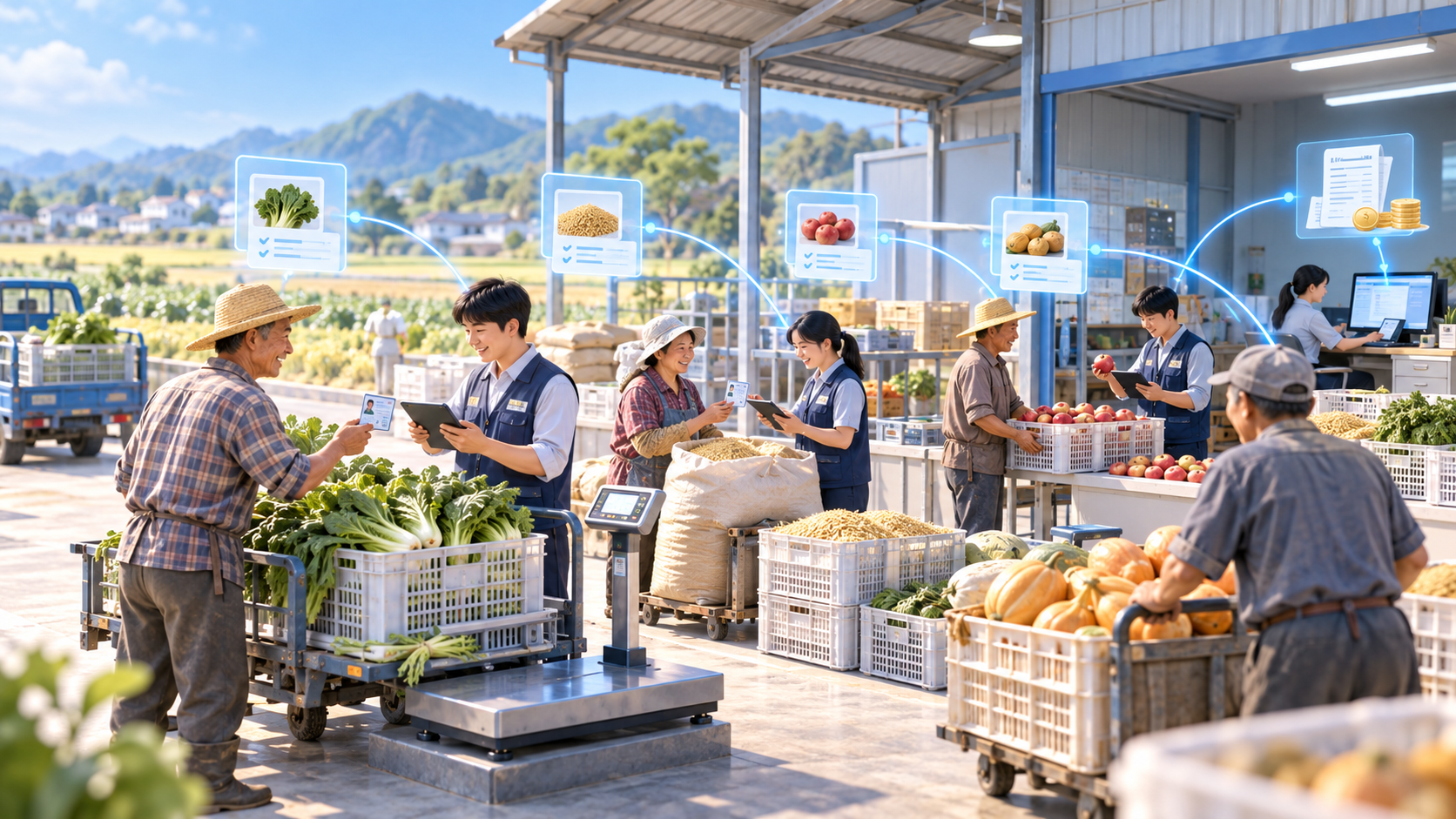
▍First confirm who sold which batch of vegetables
Purchase orders are established by farmer household, recording self-production attributes, variety, delivery time, number of vehicles or baskets, and acceptance location. When a cooperative transports on behalf, the actual selling farmer and the carrier should be identified separately; when one truck carries multiple households, the entire truck weight must not simply be recorded under the driver's name. On site, household-by-household weighing, basket labels, or handover lists can be used to establish attribution.
If the same household delivers vegetables in batches on the same day, batches must also be distinguished. Leafy vegetables are greatly affected by loss, and the field quantity, factory acceptance quantity, and actual priced quantity may differ; the system retains each record and difference explanation, rather than modifying the original delivery data afterward to make the payment match.
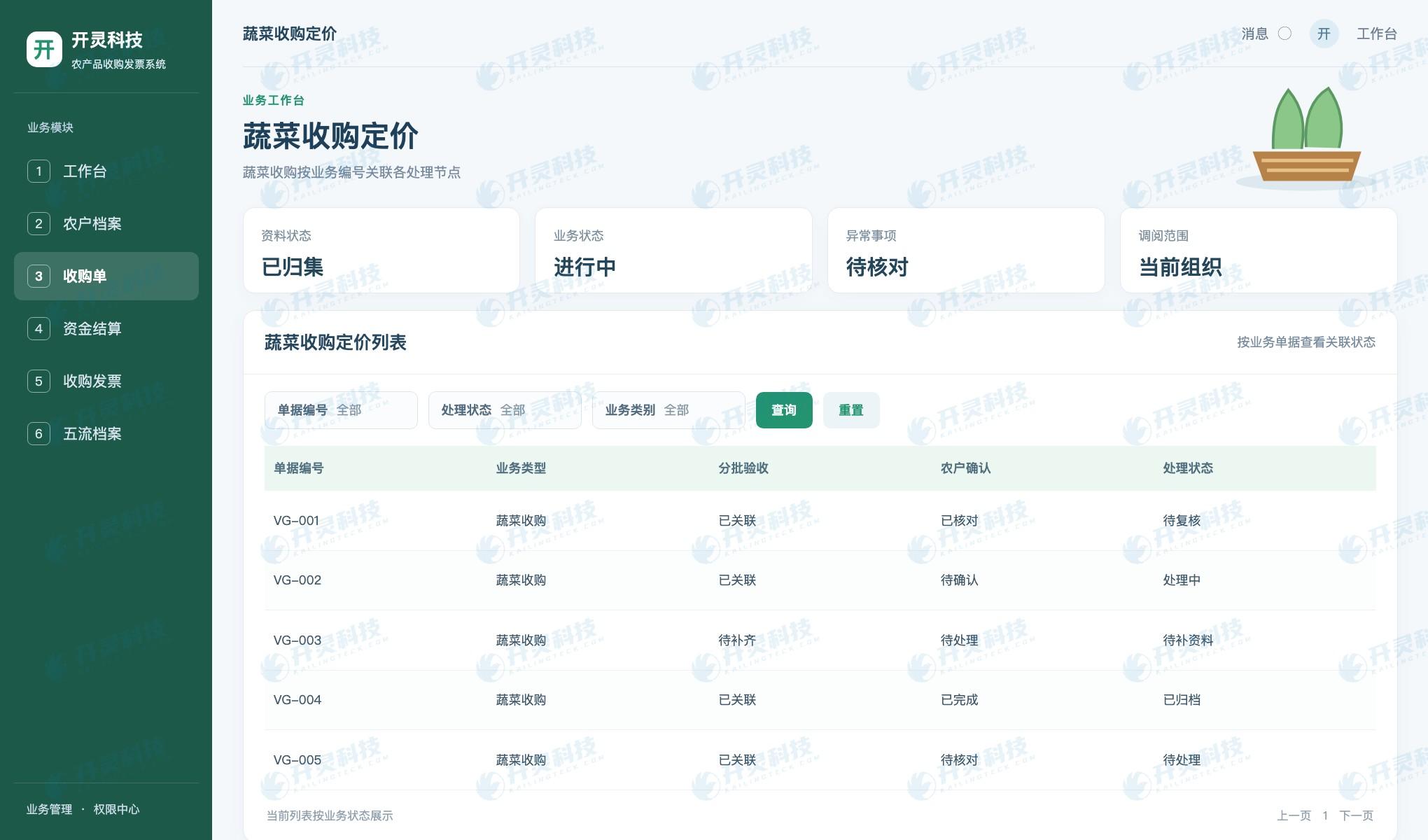
Vegetable purchase pricing business list
▍Price lists must have applicable times
When vegetable prices change, the variety, grade, unit of measure, applicable time, and confirmer should be retained. If morning and afternoon purchases apply different prices, the key is that each purchase order accurately references the price version at that time; for temporary negotiations, retain the negotiation and approval records. Do not overwrite only with the latest price version, otherwise old orders cannot be recalculated after a few days.
If downgrading, spoilage deductions, or partial rejection occur during acceptance, first fix the actual settleable quantity, then calculate the amount according to the applicable price. The total invoice amount is summarized from the details of each variety and grade, and finance can trace back from the amount to the process of quantity multiplied by unit price.
▍After farmer confirmation, connect payment and documents
The farmer confirms the variety, quantity, unit price, and amount on the purchase order, and the payment instruction is generated based on the confirmed result. After the bank returns the actual payment status, the system associates the bank receipt with the original order; if payment fails or is returned, it remains pending and "payment submitted" must not be recorded as "paid."
Issuing agricultural product purchase invoices also requires verifying the applicable scope of the purchasing enterprise, the facts of farmer self-production and sale, the information on the invoice face, and actual settlement. The Kailing Technology platform links invoices back to purchase orders and checks amounts and payment standards, reducing deviations caused by on-site and finance each using a different price list.
▍Start daily closing with discrepancy orders
On the same day, finance can filter exceptions by "missing price version," "acceptance unconfirmed," "payment returned," "paid without invoice," and "invoice amount inconsistent with settlement." First handle quantity and price disputes still verifiable on site, then recheck invoice and payment status; for cross-day supplementary entries, retain the original occurrence time and the supplementary entry time.
Once five-flow materials are linked with order numbers, finance no longer needs to search WeChat chats for the quotation at the time. Farmers, acceptance, contracts or confirmations, funds, and invoices each have clear nodes, facilitating both daily closing and later retrieval.
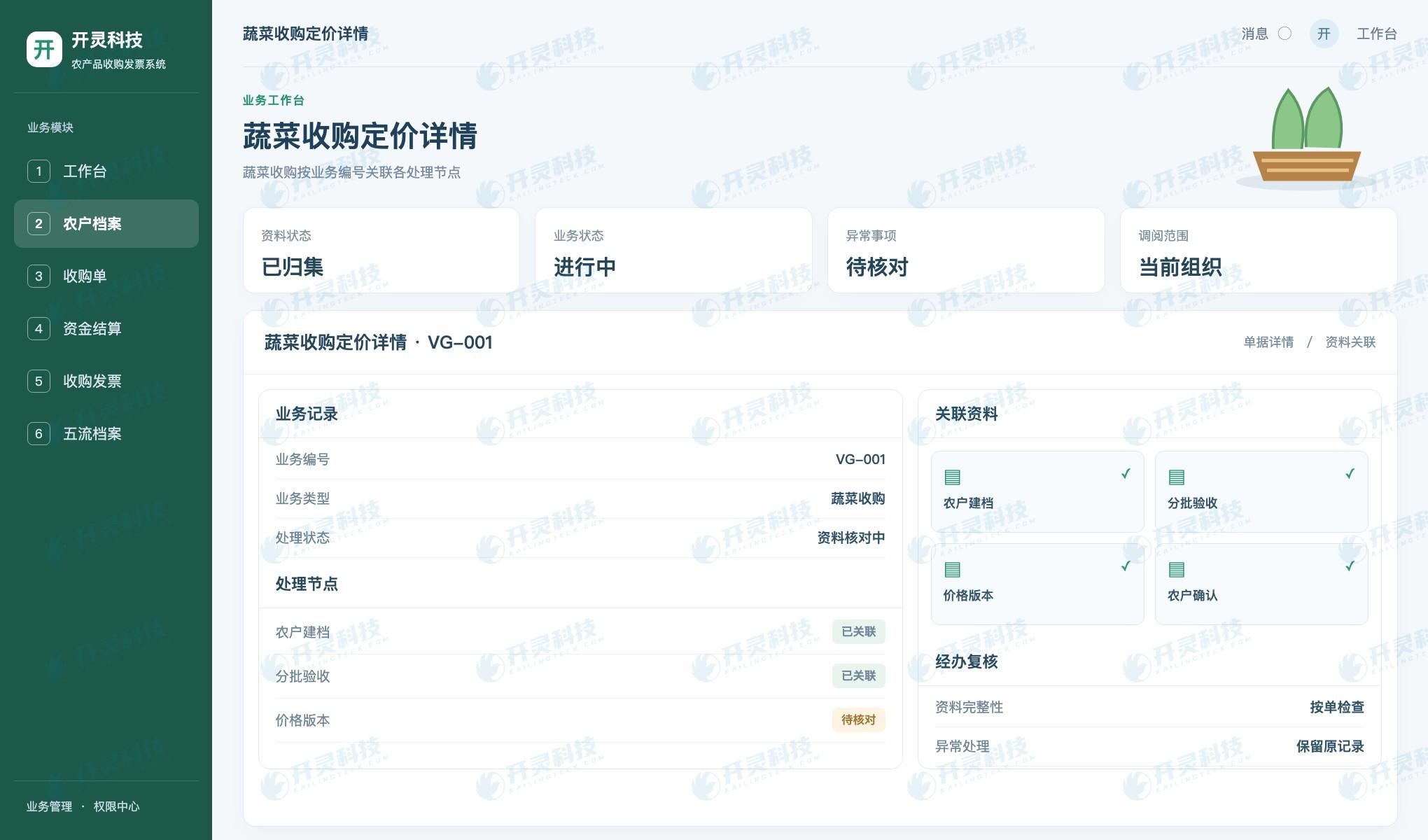
Vegetable purchase pricing documents and data linkage
▍Test rules with price adjustment dates
During implementation, select three scenarios: two price adjustments for the same variety in the morning and evening, two households in the same vehicle, and one batch downgraded. Have a finance person who did not participate in purchasing recalculate the priced quantity and amount by order number, then check against bank receipts and invoices. If the total can be "matched" using only the day's average price but cannot be matched per household, the rules are still unqualified.
Business leads should participate in determining how prices take effect, who can adjust them, and whether farmer re-confirmation is required after adjustment. Kailing Technology's solution solidifies these business agreements into traceable records, allowing fast-paced purchasing to leave clear transaction evidence.
▍How to keep records of vegetable price changes
Price lists can be managed by variety, grade, receiving point, and effective time. If weather or market supply causes intraday adjustments, after the purchaser selects a new version, the system should retain the old version and the transactions that used it. If the enterprise allows on-site price negotiation, it must also specify approval authority and the method for farmer confirmation.
The same vegetable may have different transport costs and acceptance standards at different locations. Explaining price differences as business rules is more reliable than manually leveling them at the finance end using the day's average price.
For small-batch, high-frequency purchasing, the quotation and confirmation process should stay as close as possible to the on-site rhythm: first record the goods, then form the settlement, and finally have the farmer verify the amount, so finance does not fill in prices afterward.
▍Recalculate invoice amounts from accepted quantities
For example, if the same household delivers two varieties and one of them has some loss deducted at acceptance, the purchase order should list the original quantity, deduction, actual priced quantity, and unit price line by line, with the invoice amount summarized from each line. If only the final amount is retained, finance cannot determine whether the loss has been included.
Payment is made after farmer confirmation, and the bank receipt returns to that household's purchase order. If the same household has multiple batches on the same day, payment batches can be aggregated, but each batch amount can still be expanded; invoicing also retains details according to applicable rules.
During daily closing, the enterprise can sample one transaction before and one after the day's price adjustment to verify whether the system uses the correct version and whether payment and invoice reference the same confirmation result.
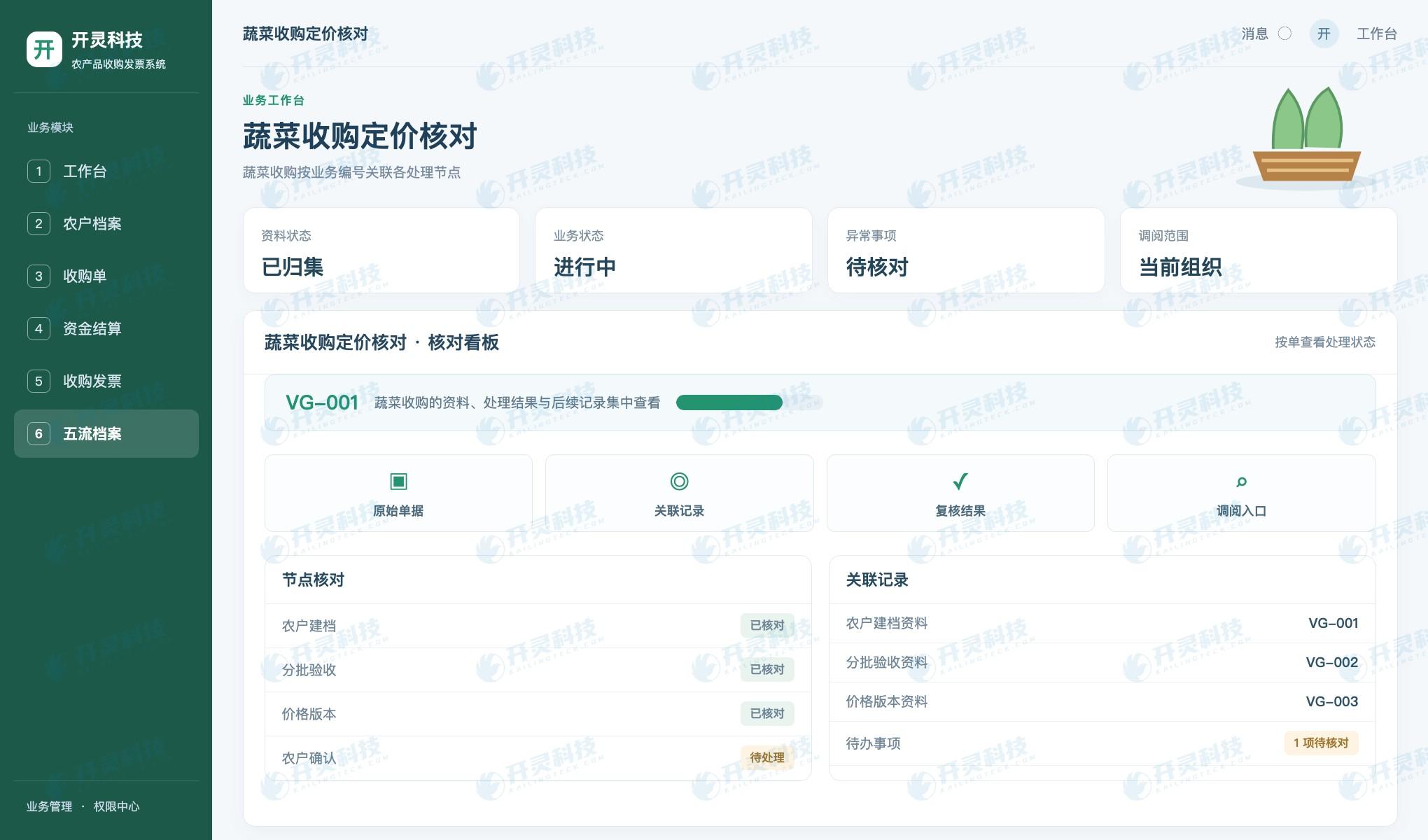
Vegetable purchase pricing node verification
▍Turn exception lists into on-site actionable tasks
"Price to be confirmed" goes to the procurement lead, "acceptance discrepancy" goes to the warehouse or receiver, "payment returned" goes to the cashier, and "paid without invoice" goes to finance. The system shows order numbers, reasons, and handling deadlines, reducing the need to ask people at month-end.
Vegetables have a short freshness period, so receiving disputes need to be handled quickly. Recording photos, grades, and deduction bases helps verify with farmers on the same day, rather than searching weeks later for goods that can no longer be inspected.
The Kailing Technology agricultural product purchase reverse invoicing system places price, goods, payment, and invoice on the same timeline of farmer transactions, preserving a recalculable basis for businesses with frequently changing prices.
▍Check the purchase experience from the farmer's perspective
What farmers care about most is how much was delivered, at what grade it was purchased, when the unit price was determined, and when the money will arrive. If the purchase order states this information clearly and allows the person to verify it, many subsequent price disputes will be avoided. Finance sees the same confirmed result, avoiding one set of on-site verbal quotes and another set of back-office settlement.
During peak season, quotations change quickly, and purchasers should be able to quickly find the currently effective price without frequently asking finance. For vegetables with special specifications, the system can require supplementary acceptance photos and approval, preserving flexibility while leaving a basis for later recalculation.
If the enterprise uses batch payments, the payment list should break out each household's purchase amount per transaction and update the original order after bank results are returned. When a farmer inquires about payment, business staff can specify which delivery it was, rather than giving a vague answer based on the whole batch's bank receipt.
Final invoice verification can start from "a certain household's certain batch of vegetables," checking self-production, quantity, price, confirmation, payment, and invoice in sequence. Even if prices were adjusted multiple times that day, the system still explains the amount according to the transaction version at that time.
▍Approval and review of price versions
Price adjustment permissions can be set by procurement manager, site, or category; temporary negotiations retain approval and farmer confirmation. New prices should not automatically apply to already settled orders, otherwise historical invoice amounts would lose their basis.
During daily settlement, view purchase volumes and average prices of the same variety in different time periods separately. If price differences are concentrated in a certain purchaser or site, the actual acceptance records can be revisited for investigation.
This review also helps procurement judge whether quotes are close to the market and helps finance confirm that invoice amounts are formed based on real transactions.
▍FAQ
Q: If the price is adjusted during the day, should the morning unit price be modified?
A: Confirmed old prices should not be overwritten; each purchase order references the price effective at the corresponding time.
Q: Can multiple households in the same vehicle share only one purchase order?
A: Details should be established by actual farmer, separately verifying self-production, quantity, settlement, and documents.
Q: How can the invoice be checked after payment is returned?
A: Display bank and note statuses separately; the original order retains the failure and subsequent handling records.
Visit Kailing Technology to learn about related products and implementation plans: https://www.kailingteck.com/fxncp/ .
As a national high-tech enterprise, Kailing Technology focuses on the digital and intelligent transformation of enterprise business-finance-tax and operations management, providing software products, system integration, implementation and delivery, and operational services for various government agencies, institutions, group enterprises, and SMEs.
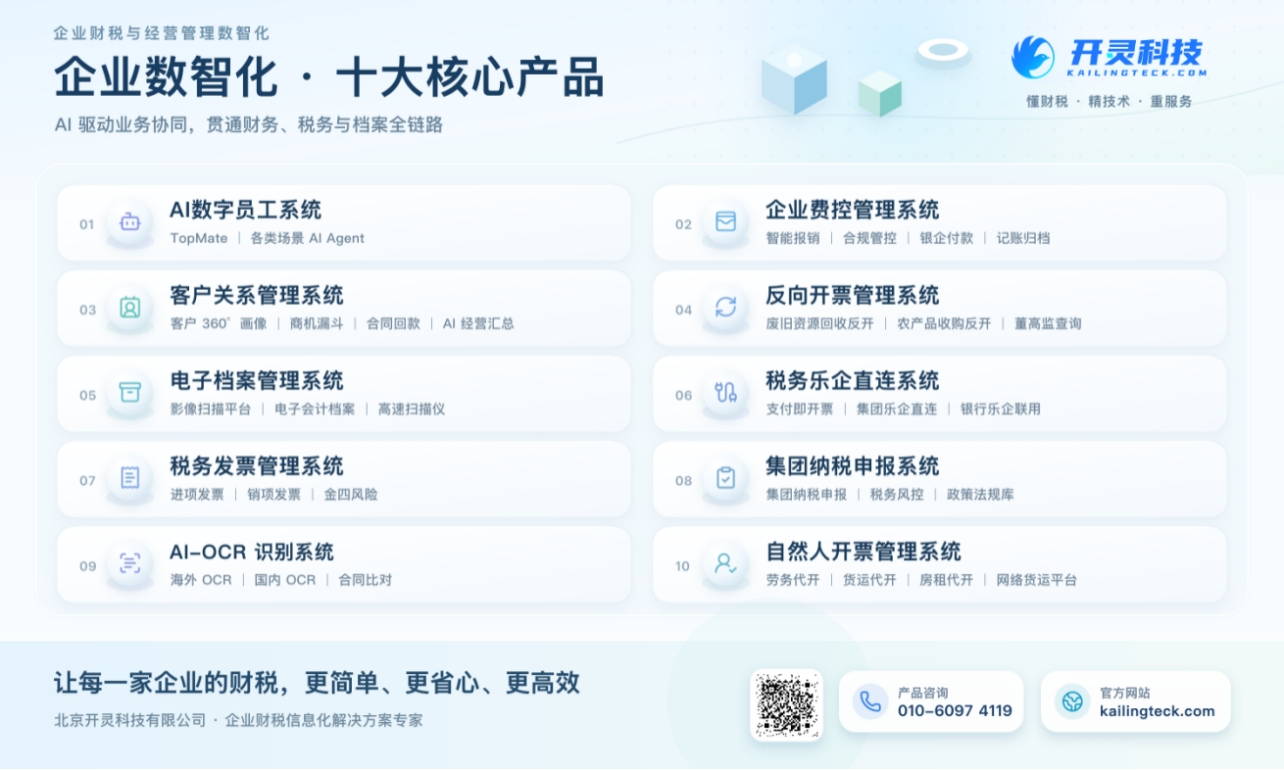
The company has now formed ten core product lines, including: AI digital employee system, enterprise expense control management system, customer relationship management system, reverse invoicing management system, invoice issuance for individuals management system, electronic archives management system, tax fully digitalized e-invoice Leqi system, tax invoice management system, group tax filing system, and AI OCR recognition system. It is committed to connecting enterprise business, finance, tax, funds, and archive data to help customers improve operational efficiency, business-finance-tax compliance capabilities, and digital management levels.
If you have any business-finance-tax digital transformation needs, welcome to contact us. Beijing Kailing Technology will serve you wholeheartedly.
Keywords: Vegetable purchase invoices, farmer pricing, acceptance payment, five-flow compliance, Kailing Technology
As a comprehensive business-finance-tax digitalization solution service provider, Kailing Technology provides business-finance-tax management digital transformation products and operational services for various government agencies, institutions, and large, medium, and small enterprises. The product line includes: solutions for sales contract management system, procurement contract management system, fully digitalized Leqi interface project, automatic output invoicing system, reverse invoicing system, invoice issuance for individuals system, employee expense control and reimbursement system, input VAT invoice management system, supply chain collaborative reconciliation system, image AI OCR recognition system, automatic financial bookkeeping system, electronic accounting archives system, etc., comprehensively driving the digitalization process across various fields.
Consultation Hotline: 18513895936 / 010-60974119 Location: Beijing