
The group operating monthly report always requires companies to repeatedly pull data; can an AI digital employee do it? Kailing Technology's AI digital employee reconciles data across financial and business systems and generates analysis drafts

Group operating monthly reports often spend time on "requesting data, changing definitions, and rechecking numbers": financial statements, sales orders, and inventory data are in different systems, and the versions submitted by each company are inconsistent. Kailing Technology's AI digital employee can retrieve data under authorization, align definitions, flag discrepancies, and generate analysis drafts, so business judgments are based on traceable data.

▍Unify metrics and cut-off points for the monthly report first
Metrics such as revenue, collections, orders, and inventory in the monthly report must clearly state the statistical scope, owning organization, time cut-off, and calculation method. Metrics with the same name may not be equivalent in financial and business systems; for example, invoiced revenue, recognized revenue, and sales order amount should not be mixed into one figure. Before AI digital employees execute, group finance and business leaders should first confirm the metric dictionary.
Reports uploaded by each company must retain versions and submission times. If a subsidiary supplements data after group consolidation, the system should know which version the monthly report references and why the difference occurred. Kailing Technology's AI digital employee can configure data retrieval paths by task, reducing the need for staff to repeatedly open the same reports every month.
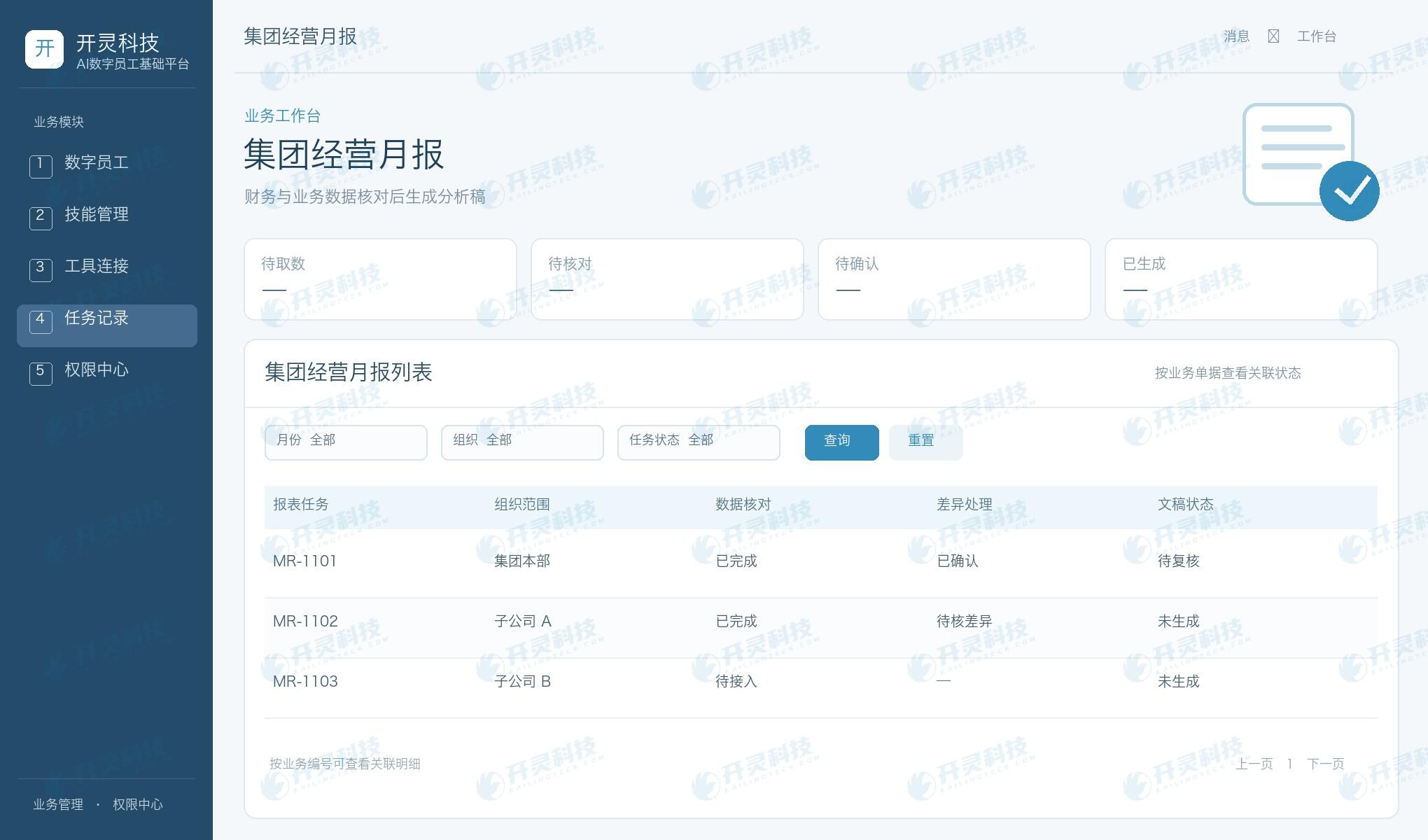
Group operating monthly report tasks and discrepancy status
▍Cross-system data retrieval starts with authorization
Financial systems, ERP, CRM, and business data platforms have different permissions. AI digital employees read only the organizations and fields needed for this monthly report, and record the time, parameters, and return status when calling tools. The scope of reading subsidiary data is determined by group policy; having a task named "business monthly report" does not mean having full detail permissions by default.
If a system does not yet have an interface, you can first connect standard export files and verify format, period, and organization. Gradually replace manual downloads; there is no need to force all systems to be connected during the pilot stage. The key is that every number knows its corresponding system record, report version, and calculation logic.
▍Reconciling discrepancies is more important than automatically writing conclusions
AI digital employees can check financial revenue against business orders, receivables against collections, and inventory books against physical ledgers on a comparable basis, and flag unexplained differences. The difference list should state the organization, period, metric, values on both sides, and possible causes involved, and only enter the formal analysis draft after the responsible person confirms it.
Some differences come from reasonable timing, such as cross-month shipments or invoices not yet received; others are omissions, duplicates, or unit conversions. AI digital employees can suggest possible matches, but should not automatically classify all differences as "normal." The Kailing Technology platform retains manual review opinions, enabling the monthly report to shift from data aggregation to explainable business analysis.
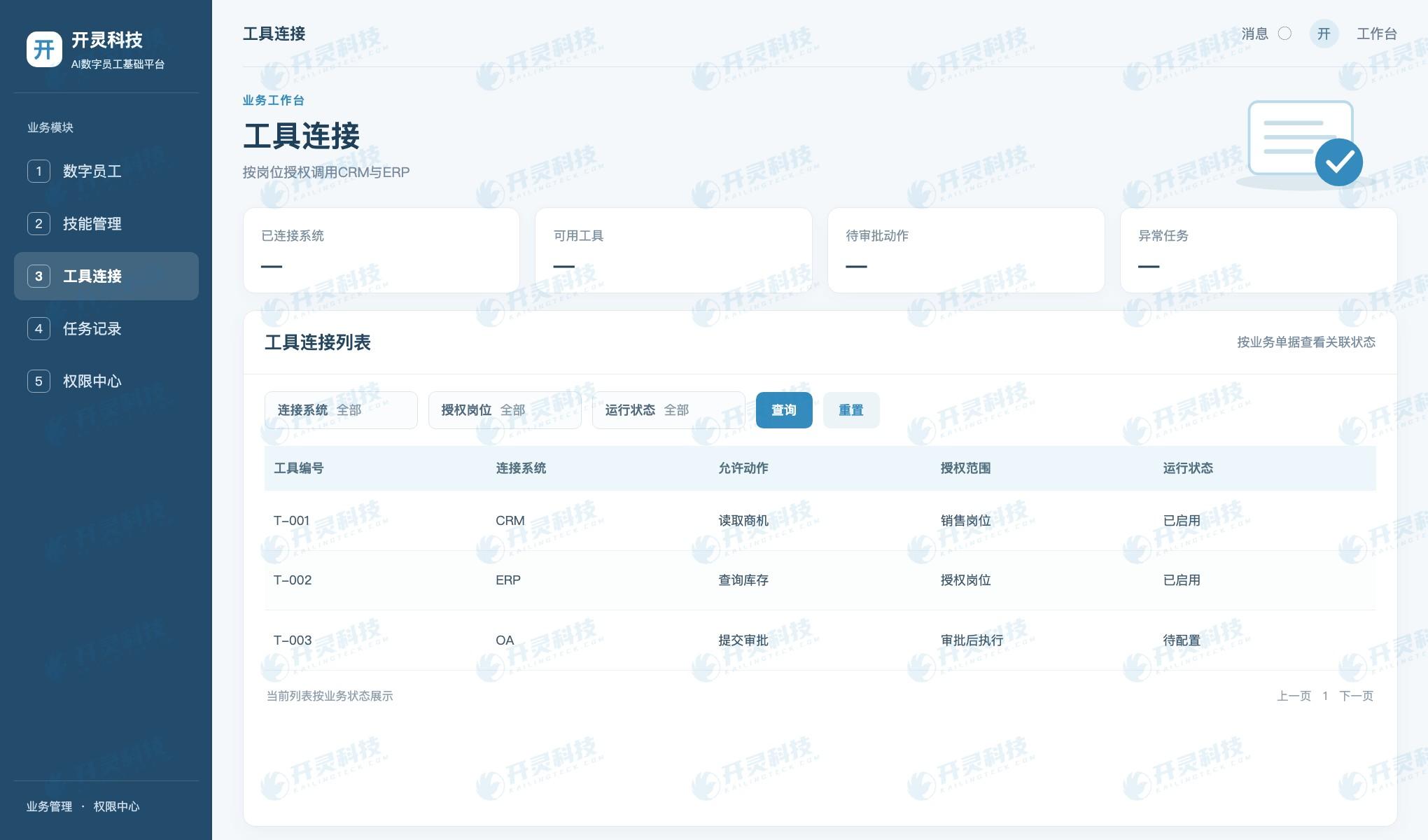
Tool authorization for finance and business systems
▍Generated analysis drafts still require manager review
After data is confirmed, AI digital employees can generate a draft monthly report according to a preset structure, summarizing main changes, anomalies, and items to follow up, with the corresponding figures and calculation basis attached. The wording should distinguish facts, cause judgments, and action recommendations; causes without supporting evidence should not be written as definite conclusions.
Group managers can annotate the draft, and a formal version is formed after finance and business leaders confirm it. The digital employee retains the referenced data snapshots, draft versions, and modification records. In this way, when asking next month "why was this judgment written at the time," the numbers and review comments from that time can be found.
▍Validate value with a one-month closed loop
The pilot can select one group metric package and two subsidiaries with different data structures, covering normal submission, late submission, inconsistent bases, and finance-business differences. Compare the difference list given by AI digital employees with manual review results to check for omissions or false reports.
The Kailing Technology AI digital employee is suitable for taking over repetitive data retrieval and preliminary verification, but explaining group operations still requires the participation of business owners. Implementation should focus on clarifying metric ownership, access permissions, and review steps; this improves management quality more than simply generating a polished monthly report text.
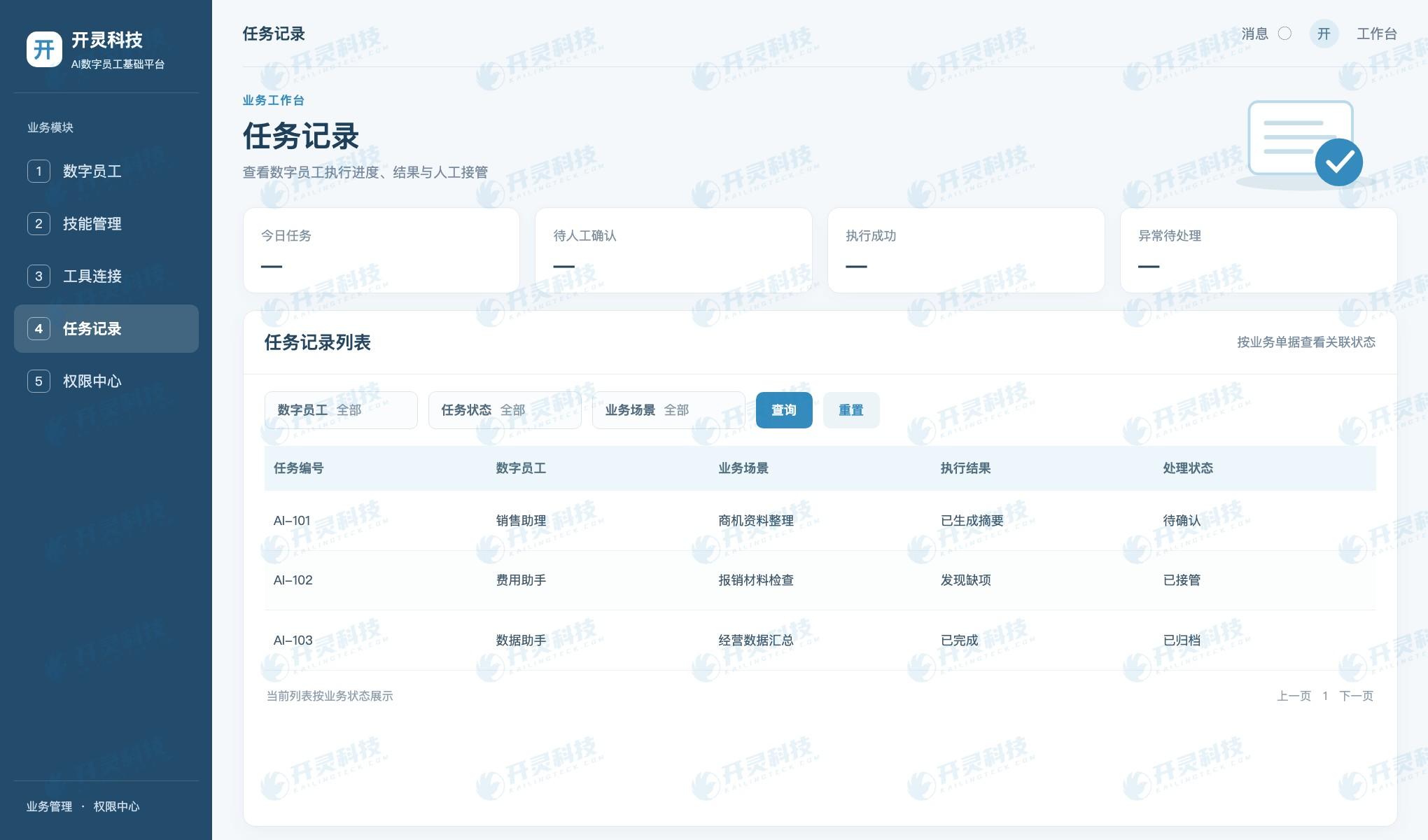
AI digital employee execution records
▍Versioning and explanation of the monthly business report are equally important
Before group consolidation, subsidiaries may use different accounting period closing times. The digital employee should record each company's data cutoff; unclosed figures can be used as an estimated version and must not be mixed with confirmed data in one formal monthly report. If supplementary entries occur after consolidation, a version difference explanation is needed, so leaders do not see two numbers without knowing which one is valid.
Metric verification can be divided into three layers: first check whether fields and units are consistent, then check the aggregation relationships within the same system, and finally check logical differences between financial and business systems. If the first two layers already have gaps, it is not appropriate to directly generate cross-system anomaly conclusions. Layer-by-layer investigation makes it easier to locate whether the issue is an interface problem, a definition problem, or an actual business change.
Monthly report writing also needs to distinguish year-over-year, month-over-month, and budget variance. AI digital employees can calculate, but should attach the time range, base period, and formula; when the base period is zero or the scope of organizational consolidation changes, a percentage must not be mechanically given. The Kailing Technology system allows the analysis draft to cite confirmed data tables rather than temporarily copying figures from chat records.
For abnormal fluctuations, the AI digital employee can list potentially related orders, payment collections, or inventory records for the person in charge to verify. The cause analysis should retain a "to be confirmed" status until the business department provides evidence. If the system directly attributes fluctuations to market demand or management errors, it may mislead business decisions.
Group management usually cares about actions rather than the number of report pages. The analysis draft can place verified issues, responsible organizations, next steps, and follow-up times in one place. The next month, the digital employee continues to read last month's open items and checks whether there is new evidence or a handling result, turning the monthly report from a one-time document into a continuous management record.
The implementation sequence can first cover a small number of stable indicators, then expand to complex business forecasts. In the pilot, every number can be traced back to system records, responsible persons can quickly confirm differences, and text can be reviewed and modified, indicating that the cross-system AI digital employee has truly entered the group's way of working.
▍Make group monthly report data explainable
If the business monthly report shows order growth, it should also state whether the order basis is signed, shipped, or invoiced; if it shows changes in collections, it should state whether advances and cross-period payments are included. AI digital employees read metric definitions before generating text, and attach values and the period involved when writing, avoiding seemingly smooth wording that confuses business meaning.
Cross-company data consolidation must also consider intercompany transaction elimination, different currencies, and changes in organizational structure. Parts that can be standardized are calculated by rule; parts that cannot be determined automatically are listed as items pending confirmation and handed to group finance for handling. The system should not conceal unresolved differences just to produce a complete report.
After management annotations, AI digital employees can track to-dos and next month's verification points. When data is retrieved again next month, compare against the causes and improvement actions proposed last month to see whether new evidence appears. This continuous tracking can make the monthly report a management tool, rather than rewriting a piece of text from scratch every month.
▍FAQ
Q: Can a digital employee directly publish the group monthly business report on behalf of the group?
A: It can generate a draft and follow up on tasks; formal conclusions should be reviewed by an authorized person in charge.
Q: What if subsidiaries use different metric definitions?
A: First establish unified metric definitions and mapping rules, then retrieve and reconcile data by organization and period.
Q: Does a difference between financial and business system figures mean there is an error?
A: Not necessarily; check the statistical timing, recognition rules, and business status, then have the responsible person judge the discrepancy.
Visit Kailing Technology to learn about related products and implementation plans: https://www.kailingteck.com/de/ .
As a national high-tech enterprise, Kailing Technology focuses on the digital and intelligent transformation of enterprise business-finance-tax and operations management, providing software products, system integration, implementation and delivery, and operational services for various government agencies, institutions, group enterprises, and SMEs.
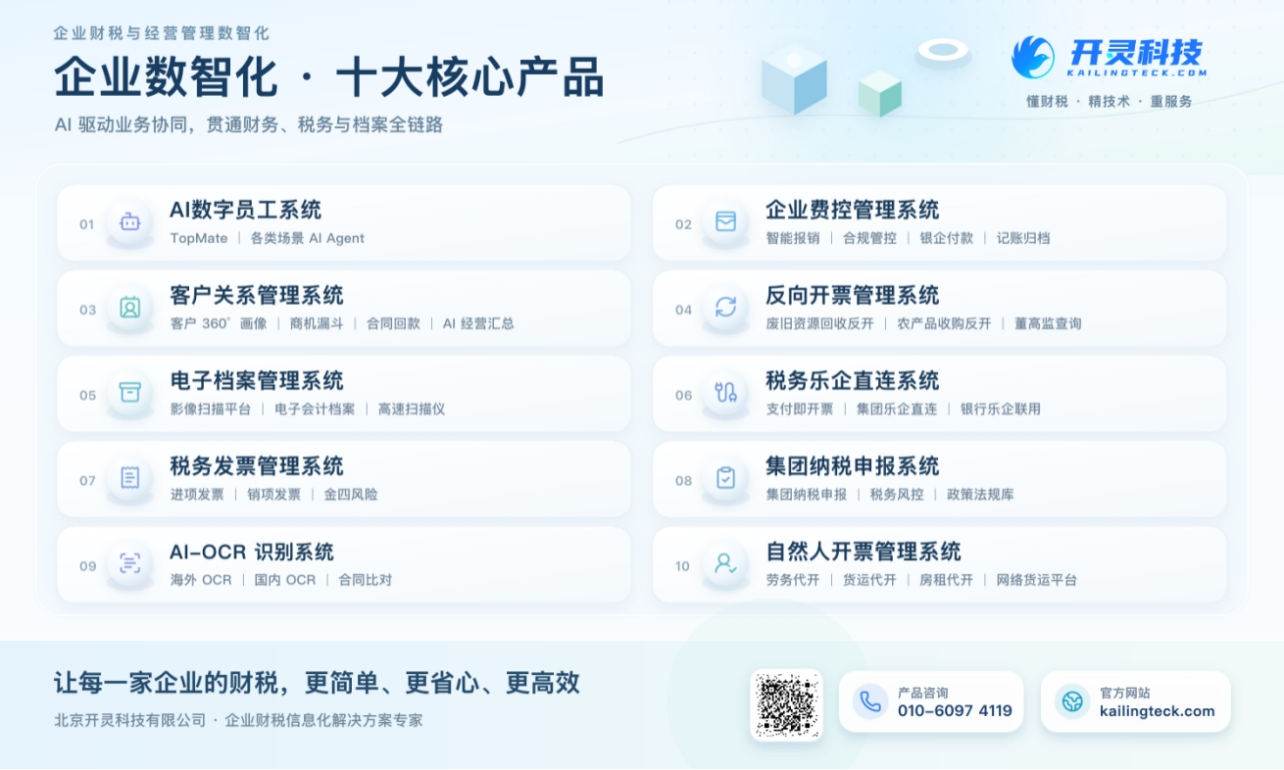
The company has now formed ten core product lines, including: AI digital employee system, enterprise expense control management system, customer relationship management system, reverse invoicing management system, invoice issuance for individuals management system, electronic archives management system, tax fully digitalized e-invoice Leqi system, tax invoice management system, group tax filing system, and AI OCR recognition system. It is committed to connecting enterprise business, finance, tax, funds, and archive data to help customers improve operational efficiency, business-finance-tax compliance capabilities, and digital management levels.
If you have any business-finance-tax digital transformation needs, welcome to contact us. Beijing Kailing Technology will serve you wholeheartedly.
Keywords: Kailing Technology AI digital employee, group monthly business report, cross-system data retrieval, data discrepancy verification, monthly report analysis
As a comprehensive business-finance-tax digitalization solution service provider, Kailing Technology provides business-finance-tax management digital transformation products and operational services for various government agencies, institutions, and large, medium, and small enterprises. The product line includes: solutions for sales contract management system, procurement contract management system, fully digitalized Leqi interface project, automatic output invoicing system, reverse invoicing system, invoice issuance for individuals system, employee expense control and reimbursement system, input VAT invoice management system, supply chain collaborative reconciliation system, image AI OCR recognition system, automatic financial bookkeeping system, electronic accounting archives system, etc., comprehensively driving the digitalization process across various fields.
Consultation Hotline: 18513895936 / 010-60974119 Location: Beijing