
Why do customers brought by promotion not close? Kailing Technology's marketing system building service adjusts the customer acquisition direction based on sales feedback, and the AI-CRM system records opportunity results

Advertising and campaigns brought in lists, but sales said the customers were unsuitable; marketing believed sales followed up untimely. The focus of the argument is not which side is busier, but that there is no shared record of the process from lead entry to lost deal. Kailing Technology's marketing system building service turns sales feedback into the basis for channel and content adjustments, and the AI-CRM system records opportunity stages and final results.

▍First identify at which stage the failure to convert occurs
A customer who did not connect after inquiring, no budget after needs communication, no key-person support after solution evaluation, and being postponed after quotation have completely different reasons. Lumping all of these as "non-closure" prevents marketing from changing its customer acquisition direction and prevents sales from discovering process problems.
The AI-CRM opportunity dashboard can record source, owner, stage, next action, and stagnation reason. Stage advancement should be backed by actual verification items, such as requirement confirmation, decision chain, and solution feedback. This way managers see not a pretty funnel, but the specific conditions of each bottleneck.
First check response speed. If a customer has just submitted an inquiry but no one contacts them for several days, it cannot simply be inferred that channel quality is poor. Lead allocation, to-do reminders, and timeout handling must be in place first for review to have a fair basis.
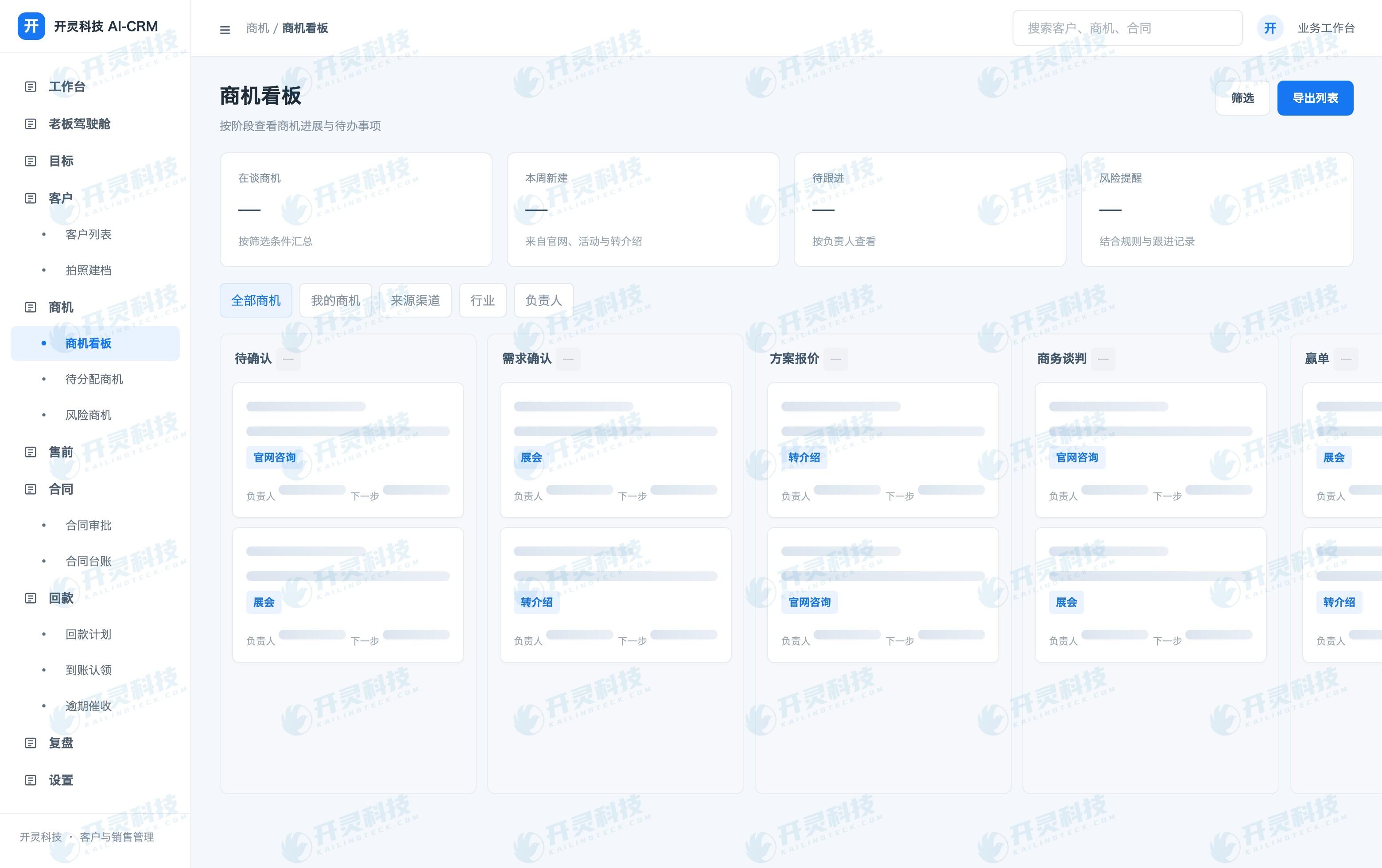
Opportunity stages and source channels
▍Re-examine customer acquisition direction with sales feedback
Sales should record the customer's industry, business scenario, existing systems, and purchase trigger during the first communication. If a batch of customers only wants an invoicing interface while the promotional content promises a complete process platform, the page positioning is misaligned with actual demand.
Marketing can view the proportion of valid leads, common objections, and opportunity stages by channel. A channel that brings few leads but most of which enter solution evaluation may be more valuable than a channel that submits many blank forms. When allocating budget, look at subsequent quality and do not replace results with lead volume.
Also distinguish target misalignment from product delivery boundaries. When a customer requests a feature not covered by the current solution, sales should report it truthfully and marketing should adjust content promptly, avoiding attracting similar unsuitable demand in the next round.
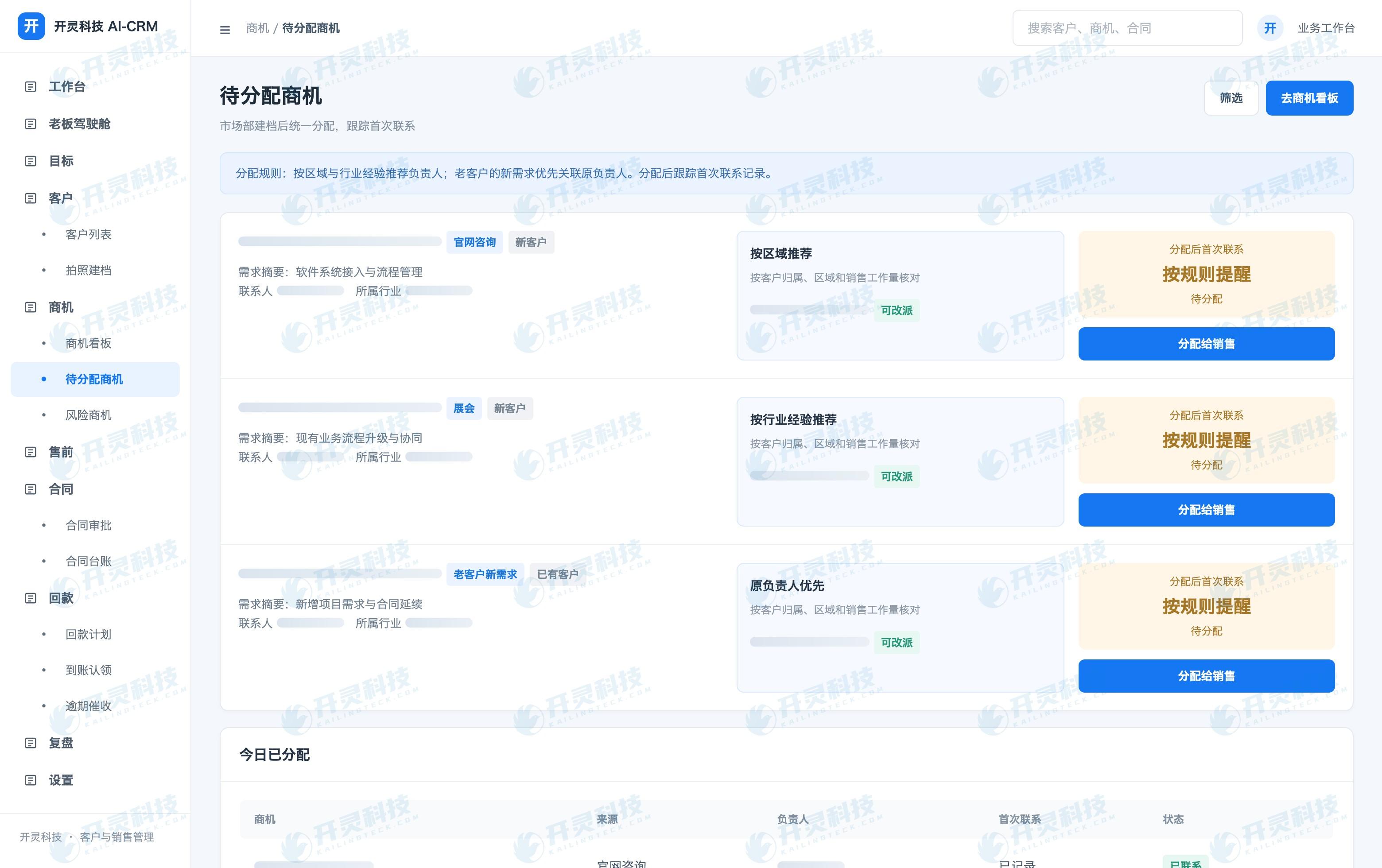
Opportunity assignment and follow-up responsibility
▍Opportunity records should retain actionable information
Lost-deal reasons should not be limited to only two options: "price too high" and "customer not interested." Budget range, decision timeline, existing supplier relationships, interface concerns, and deferral triggers can be added. Keep a re-contact time for customers willing to restart in the future, and do not let clearly closed opportunities occupy forecast amounts for a long time.
When an opportunity involves multiple contacts, pre-sales consultants, and approvers, follow-up notes, solution versions, and customer feedback should be filed under the same enterprise archive. When the customer is revisited, the new salesperson can continue from the previous issues instead of asking from scratch.
Kailing Technology's AI-CRM system can support customer, opportunity, follow-up, and review views. Marketing adjusts keywords, pages, and campaign themes based on these facts; sales optimizes actions for discovering needs and advancing stages based on feedback.
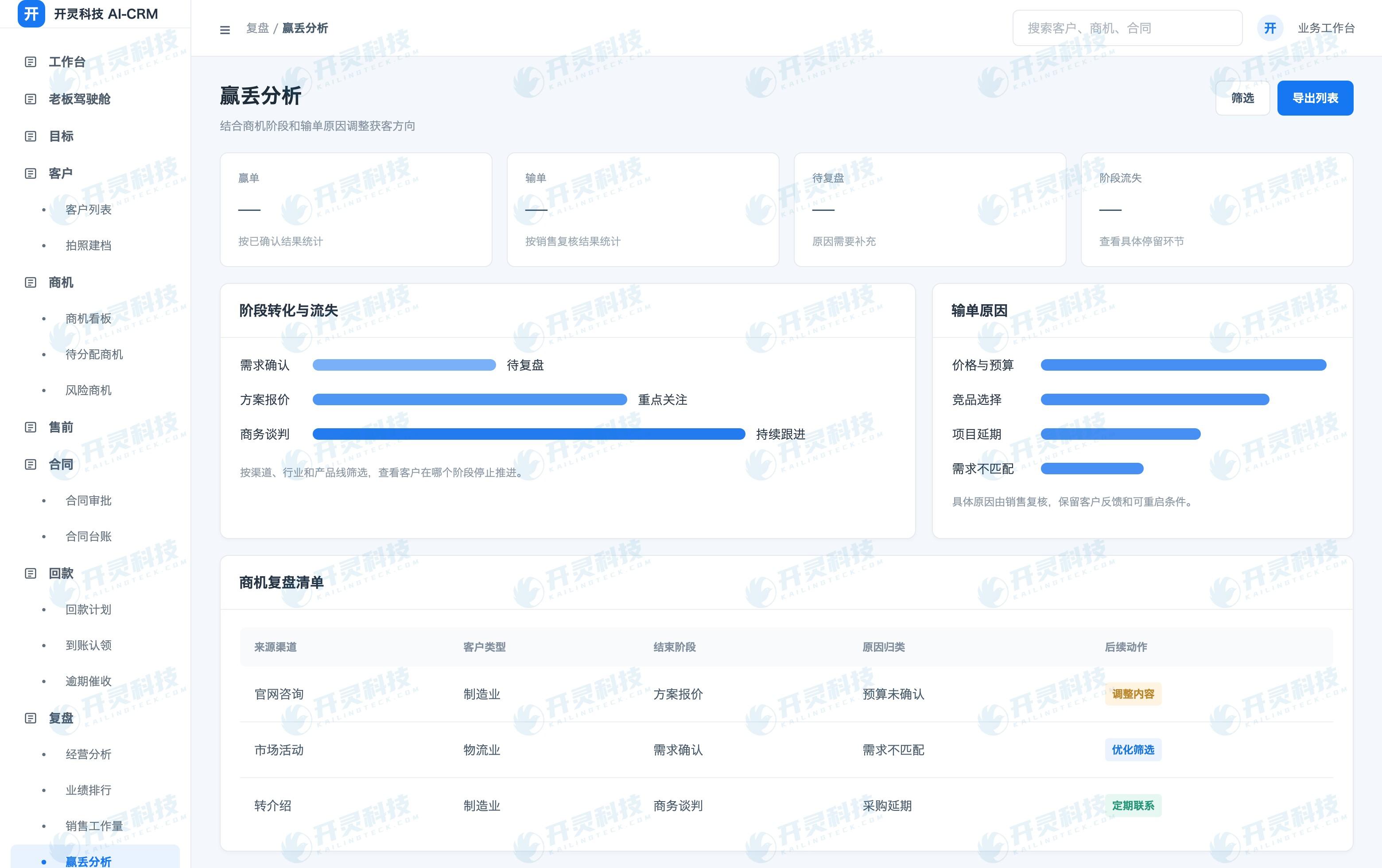
Review promotion results by stage and lost-deal reason
▍Turn the review into the next round of experiments
Each month, select one high-investment channel and one high-conversion channel for comparison, and analyze customer profiles, first response, conditions for entering the opportunity stage, and reasons for lost deals. Change only one key variable, such as the page title or campaign theme, and then see whether opportunity quality changes.
For long-stalled customers, arrange a follow-up visit with a clear purpose: whether the budget has started, whether the person in charge has changed, and whether technical concerns have been resolved. Follow-up records are used to determine whether to re-enter the opportunity or continue nurturing, rather than simply mass-sending the same marketing pitch.
Kailing Technology's marketing system building service and AI-CRM system together form a "promotion—feedback—correction" working mechanism. Whether customer acquisition is effective should ultimately allow marketing, sales, and managers to draw explainable conclusions from the same batch of opportunity records.
▍Have marketing and sales hold review meetings around the same batch of customers
Before the review, first extract customers brought in by a certain campaign or a certain set of keywords from AI-CRM, and group them by whether they were contacted, whether an opportunity was formed, the stage where they stopped, and the final result. Marketing brings page and channel information, sales brings communication notes, and both sides review the same enterprise item by item. The discussion object is the traceable customer process, not scoring each other's departments.
For valid customers who did not close, focus on the conditions for the next contact: budget approval, system expiration, key-person changes, or business expansion. Sales determines the follow-up time and material preparation, and marketing supplements the corresponding cases, interface descriptions, or policy articles. Customers without clear trigger conditions can enter long-term nurturing and do not need to keep occupying this quarter's closing forecast.
For clearly unsuitable leads, record whether it is an industry mismatch, a role mismatch, or overly broad content wording. If a certain ad theme frequently attracts job seekers or free-tool inquiries, adjust targeting and copy first; if the customers brought by a campaign need a different product combination, adjust the registration page and pre-event screening. Change only a few factors each time so the cause can be seen in the next round.
Managers should also check whether follow-up actions are completed on time. Even a correct marketing direction can be dragged down by delayed response, and even good sales execution can spin idle due to mismatched traffic. Kailing Technology services review customer acquisition experiments and opportunity records together, helping teams decide what to focus investment on and what to stop in the next round.
▍Define a verifiable round of promotion correction
If sales feedback says a campaign attracted many small-scale customers while the solution mainly suits multi-organization enterprises, the next round can adjust the registration page eligibility conditions and invitation list. Keep the campaign theme and sales allocation rules as stable as possible, and observe whether the proportion of target customers, number of solution evaluations, and reasons for lost deals change. If too many things are changed at once, it is hard to identify the cause even if results improve.
The review conclusions should be written into AI-CRM or the marketing plan: which customers still need nurturing, which channels to stop investing in, and which issues require new content. Marketing and sales jointly check before the next campaign whether the changes promised last time have been completed. This way, "non-closure" becomes a specific marketing experiment rather than repeated departmental arguments.
Lost-deal records should allow later correction. If a customer initially says the budget was not approved and later adds that the real reason is an unsuitable system interface, sales should update the reason and retain the communication time. Marketing adjusts content based on the latest facts while being able to see when the judgment changed, avoiding treating early guesses as conclusions.
▍FAQ
Q: Is a lead failing to convert necessarily a channel problem?
A: It may also be slow response, insufficient needs discovery, solution mismatch, or procurement delay; analyze by stage.
Q: How should loss reasons be recorded to be useful?
A: State the specific obstacle, customer evidence, and possible restart conditions; avoid filling in only a vague label.
Q: What results should the marketing department look at to adjust promotion?
A: Combine valid enterprises, opportunity advancement, common objections, and loss reasons, rather than looking only at clicks and form counts.
Q: When sales says lead quality is poor, what should marketing look at first?
A: First extract specific customers and compare whether their industry and needs match the original profile, whether the lead capture page accurately conveys the product, whether sales contacted them promptly, and whether the first conversation clarified the purchase trigger. If source data and follow-up notes are missing, fill in the records first. Using samples to determine which segment the problem occurs in is more useful than discussing the vague evaluation of "poor quality."
Q: If a customer defers procurement, should it be counted as a loss in the CRM?
A: Distinguish clear abandonment from deferral according to the enterprise's opportunity rules. If the customer gives restart conditions, record the trigger event and follow-up time, remove it from the current closing forecast but retain the customer relationship; if procurement has ended and another solution was chosen, record the specific loss reason. Market reviews should also distinguish the two situations.
Learn about Kailing Technology's related products and implementation plans: https://www.kailingteck.com/aicrm/ .
As a national high-tech enterprise, Kailing Technology focuses on the digital and intelligent transformation of enterprise business-finance-tax and operations management, providing software products, system integration, implementation and delivery, and operational services for various government agencies, institutions, group enterprises, and SMEs.
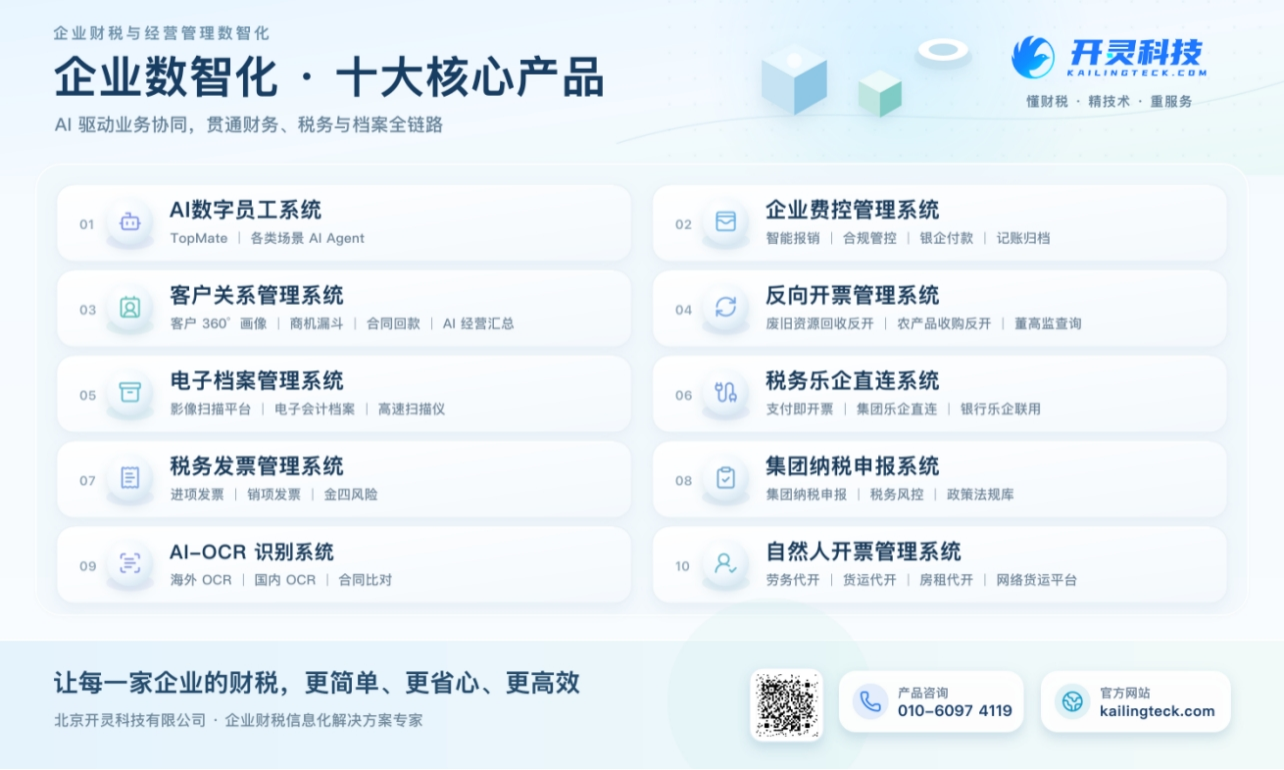
The company has now formed ten core product lines, including: AI digital employee system, enterprise expense control management system, customer relationship management system, reverse invoicing management system, invoice issuance for individuals management system, electronic archives management system, tax fully digitalized e-invoice Leqi system, tax invoice management system, group tax filing system, and AI OCR recognition system. It is committed to connecting enterprise business, finance, tax, funds, and archive data to help customers improve operational efficiency, business-finance-tax compliance capabilities, and digital management levels.
If you have any business-finance-tax digital transformation needs, welcome to contact us. Beijing Kailing Technology will serve you wholeheartedly.
Keywords: Promotion leads not closing, sales feedback loop, AI-CRM opportunity review, Kailing Technology marketing system building
As a comprehensive business-finance-tax digitalization solution service provider, Kailing Technology provides business-finance-tax management digital transformation products and operational services for various government agencies, institutions, and large, medium, and small enterprises. The product line includes: solutions for sales contract management system, procurement contract management system, fully digitalized Leqi interface project, automatic output invoicing system, reverse invoicing system, invoice issuance for individuals system, employee expense control and reimbursement system, input VAT invoice management system, supply chain collaborative reconciliation system, image AI OCR recognition system, automatic financial bookkeeping system, electronic accounting archives system, etc., comprehensively driving the digitalization process across various fields.
Consultation Hotline: 18513895936 / 010-60974119 Location: Beijing