
What should an enterprise do when it has a CRM but no customer leads? Kailing Technology combines marketing customer acquisition system building with AI-CRM system implementation
An enterprise buys a CRM, but the sales workspace remains empty. The problem is usually not the entry button, but the lack of stable customer touchpoints at the front end. Kailing Technology views marketing customer acquisition system building and AI-CRM system implementation within the same project: first determine who will search for what questions and where they will leave demand, then design customer record creation, duplicate checking, assignment, and follow-up. The AI-CRM system handles customers, opportunities, and follow-up; front-end acquisition results still depend on content operations, channel experiments, and actual data verification.

▍First break "no leads" into three problems: reach, lead capture, and follow-up
Many B2B enterprises use CRM as a customer address book: after marketing events, business cards stay in personal WeChat, the official website has visitors but no clear inquiry entry, and sales only create records after finding customers themselves. Management sees "no data in CRM," but the reality may be that target customers did not see the content, did not know how to contact after seeing it, or no one responded promptly after information was left. Evidence should be sought separately for the three stages, and the system should not be evaluated only by total lead volume.
At project launch, Kailing Technology can first take stock of website inquiries, trade shows, referrals, and new needs from existing customers over the past quarter. Each record is completed with source, requirement scenario, contact, time, and next action, then checked for valid rate, time to first contact, and opportunity conversion ratio. If a channel has inquiries but they do not enter the CRM, fix intake and responsibility ownership first; only if no one inquires at all should you return to market positioning, content, and advertising.
Lead quality also needs to be defined. Downloading materials or casually scanning a code cannot be counted as the same kind of opportunity as a need that explicitly states project budget and procurement timing. For enterprises with high average order value and long decision cycles, it is better to record the problem description, application scenario, and decision roles completely than to fill the system with large numbers of invalid forms. Marketing and sales need to agree on when something is called a lead and when it can be converted into an opportunity.
▍How Kailing Technology's AI-CRM system takes on valid demand
The "Unassigned Opportunities" page of Kailing Technology AI-CRM places trade shows, website inquiries, and new needs from existing customers in the same work queue, showing source tags, requirement summaries, estimated amounts, and recommended owners. The page text explains that the marketing department first creates customers and generates opportunities, then assigns them to sales; region, industry experience, number of opportunities in progress, and ownership of existing customers are the basis for assignment. This work queue clarifies the flow of responsibility after entering the system. Automatic intake of website forms still requires configuration and acceptance according to the website interface and authorization conditions.
The customer list and customer details emphasize "one file per company," deduplicating by unified social credit code and linking to an existing customer when duplication is suspected. If marketing acquisition bypasses deduplication, exhibition business cards and website forms may become multiple files for the same customer, and sales cannot see historical contracts and existing contacts. During implementation, archiving rules for new customers, new needs from existing customers, and partner referrals should be clarified, with necessary manual confirmation arranged.
The opportunity kanban provides source filtering, stage progression, and required-item constraints. What marketing hands to sales should not be just a phone number, but should retain the problem the customer wants to solve, the product or solution scope, the contact channel, and the promised next step; sales then supplements budget, decision roles, and expected timing in follow-up records. Only by linking sources with subsequent results can an enterprise know which types of acquisition content bring real sales opportunities.
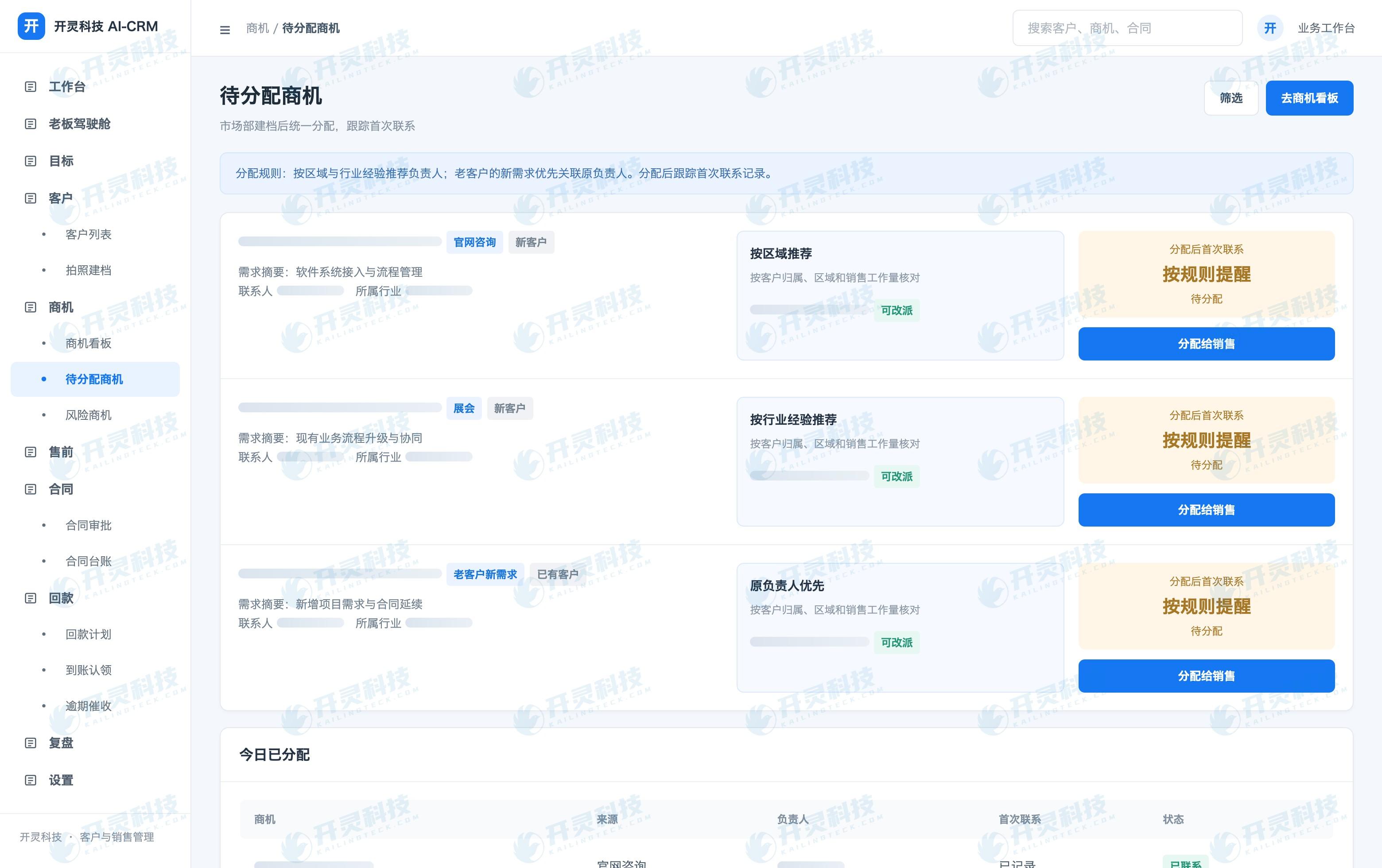
Kailing Technology AI-CRM: Unassigned Opportunities and Owner Recommendations
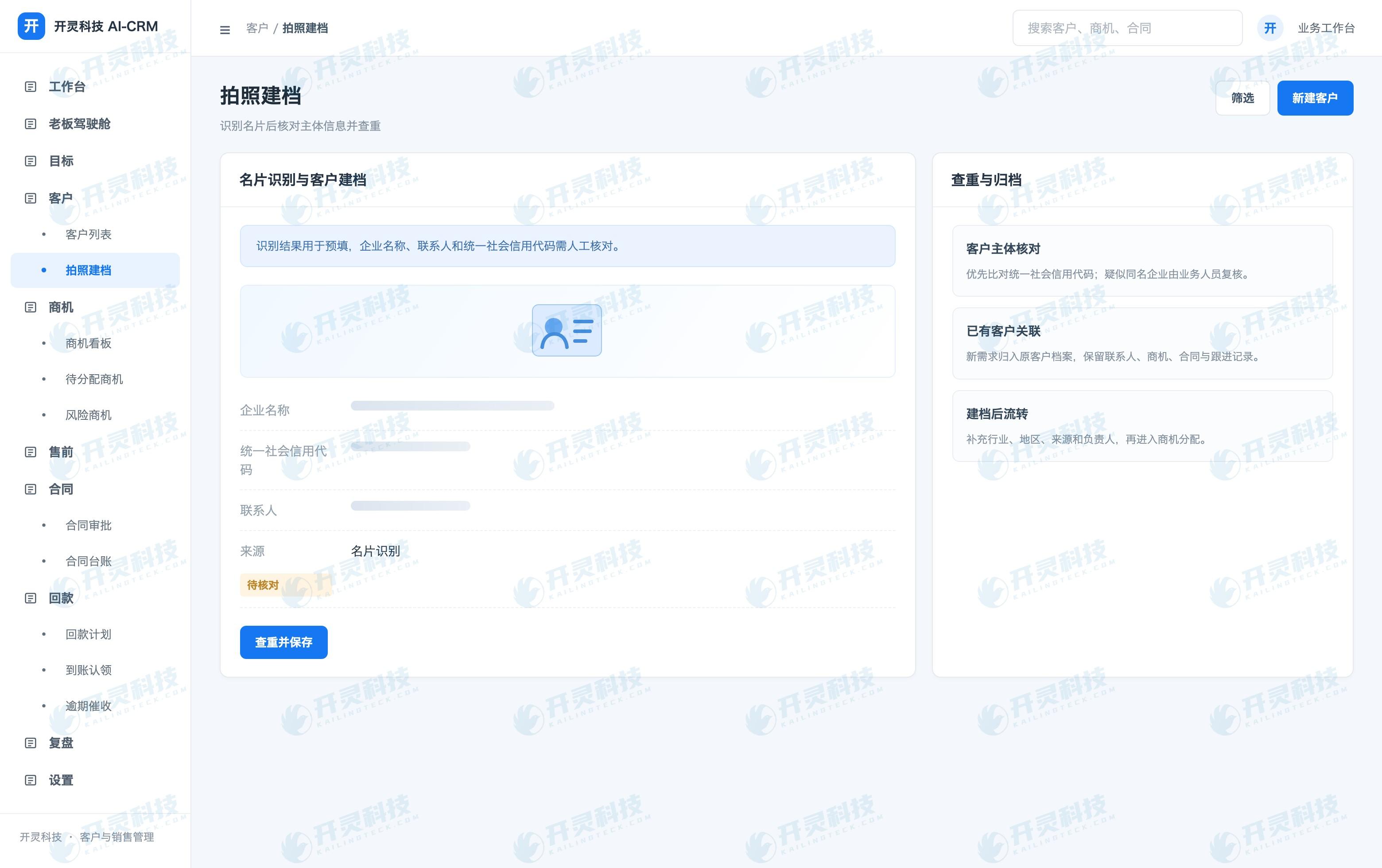
Kailing Technology AI-CRM: Customer Record Creation and Information Verification
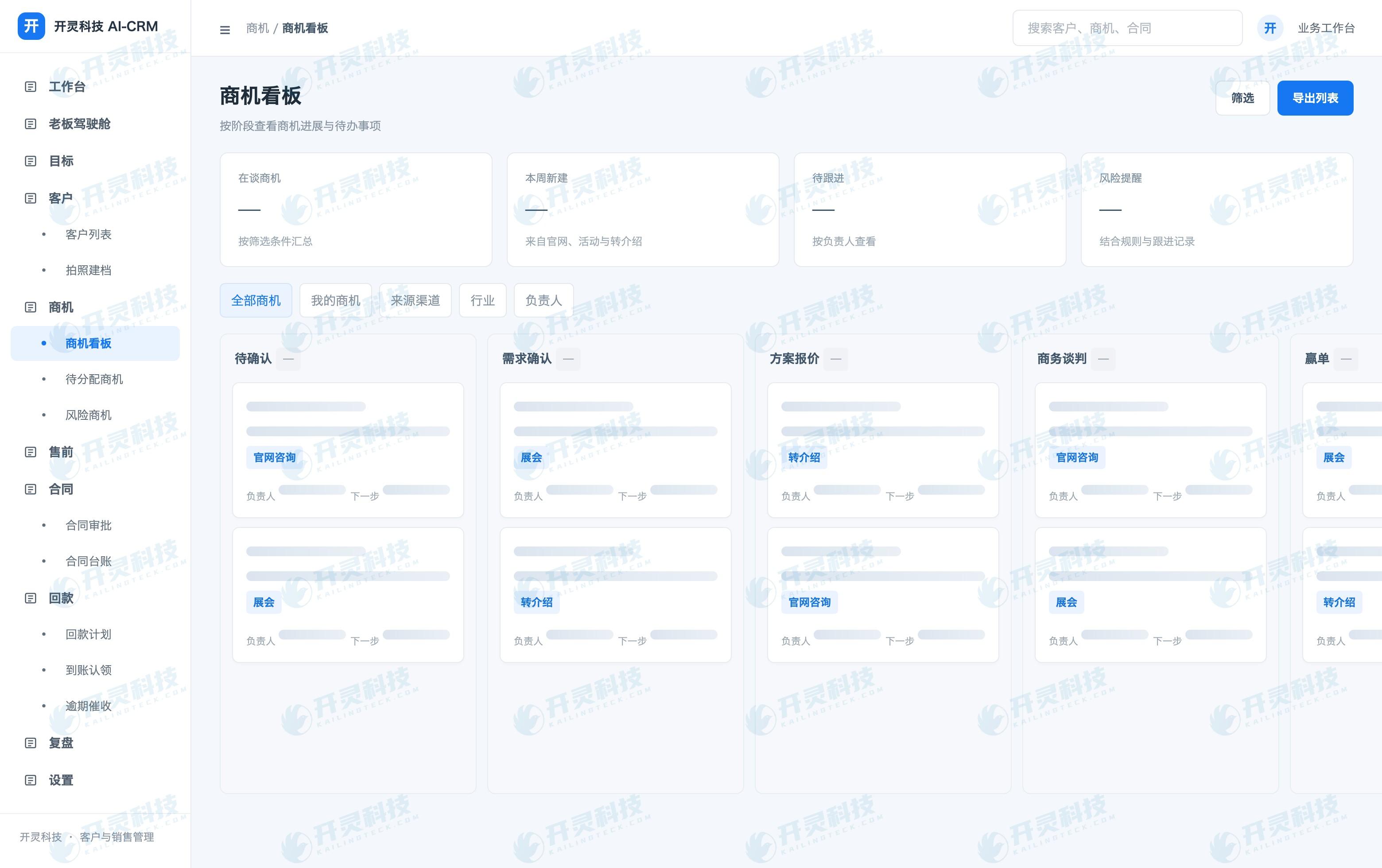
Kailing Technology AI-CRM: Opportunity Stage Board
▍The marketing system starts with answerable questions and gradually forms trackable content
For industrial products, enterprise software, and complex services, buyers often first search for "how to solve a certain type of problem," "what is needed to integrate the solution with existing systems," and "what risks exist in different scenarios." Kailing Technology can work with enterprises to sort out how customers ask questions and connect website product pages, implementation descriptions, industry scenario articles, and FAQs into a content system. Each piece of content should state applicable conditions, implementation prerequisites, and the next consultation method, rather than merely piling up brand keywords.
SEO focuses on whether search entry points can be indexed and whether pages clearly answer questions; GEO focuses on whether content can be accurately cited by intelligent Q&A. Both require verifiable product facts, clear terminology boundaries, and continuous updates. Before launch, content pages can be linked with inquiry forms, phone calls, or event QR code source parameters; after entering the CRM, the first touchpoint and specific question should be saved to avoid all channels being recorded as "official website."
After content is published, four layers of metrics should be reviewed: qualified visits, valid inquiries, assigned and first contact made, and opportunities and signed contracts. If an article brings reads but no inquiries, the call-to-action entry may need changing; if there are inquiries but they are not converted into opportunities, follow-up timeliness and qualification criteria should be examined. Marketing and sales should jointly review keywords, pages, customer questions, and reasons for lost deals every month, then decide what to write in the next round, rather than mechanically producing by article count.
▍During implementation, write marketing responsibility and sales responsibility into the same acceptance form
Phase one can start with one industry, two or three high-frequency questions, and one main lead entry point. Marketing is responsible for content and source tagging, sales for first contact and follow-up records, and the CRM administrator for fields, deduplication, permissions, and assignment rules. After assignment, management can be based on first-contact time limits; opportunities not recorded within the time limit enter a recovery and reassignment process. Specific time limits should be calibrated during trial operation based on enterprise working hours, sales coverage, and lead urgency.
Acceptance is not just about checking whether a CRM page can create a new opportunity; a complete set of samples must also be tested: one website inquiry, one exhibition business card, one additional requirement from an existing customer, and one duplicate customer lead, checking one by one whether the source is retained, whether the customer is correctly archived, whether the owner receives a to-do, and whether follow-up is traceable. Data integration between external forms, the official website, and marketing tools with the CRM falls within the project implementation scope and should be confirmed according to interface conditions. Whether automatic intake is completed is subject to interface integration testing and sample acceptance; acceptance records should also retain the results of failed retries, manual supplementary entry, and duplicate information handling.
When an enterprise has a CRM but lacks leads, the value of Kailing Technology lies in putting front-end content-based customer acquisition and back-end sales management on the same operating ledger. First obtain the target customer's real problems, then turn each contact into customer and opportunity records with an accountable owner; only when the source, process, and results are visible can marketing investment have a basis for improvement.
▍FAQ
Q: Can we start with only a CRM and no marketing department?
A: You can start with existing sales Q&A, the official website, and existing customer needs; business leaders should first maintain a small amount of high-value content and entry points, then assign dedicated staff based on inquiry volume.
Q: After website inquiries enter the CRM, is manual entry still needed?
A: It can be connected via API or entered using standard fields; the specific method depends on website forms, authorization, and system integration conditions. After entry, it is continuously managed by source, customer, and owner.
Q: How is lead quality judged?
A: Consider customer fit, specific needs, purchasing timeline, decision-making role, and contactability; do not judge solely by the number of leads captured.
Q: How long until customer acquisition results are visible?
A: It depends on industry search demand, content foundation, channel investment, and sales cycle, and should be reviewed with phased data; no fixed number of days or conversion rate is promised.
Make customer acquisition and sales follow-up form a traceable closed loop, and learn about Kailing Technology's AI-CRM implementation plan: www.kailingteck.com .
As a national high-tech enterprise, Kailing Technology focuses on the digital and intelligent transformation of enterprise business-finance-tax and operations management, providing software products, system integration, implementation and delivery, and operational services for various government agencies, institutions, group enterprises, and SMEs.
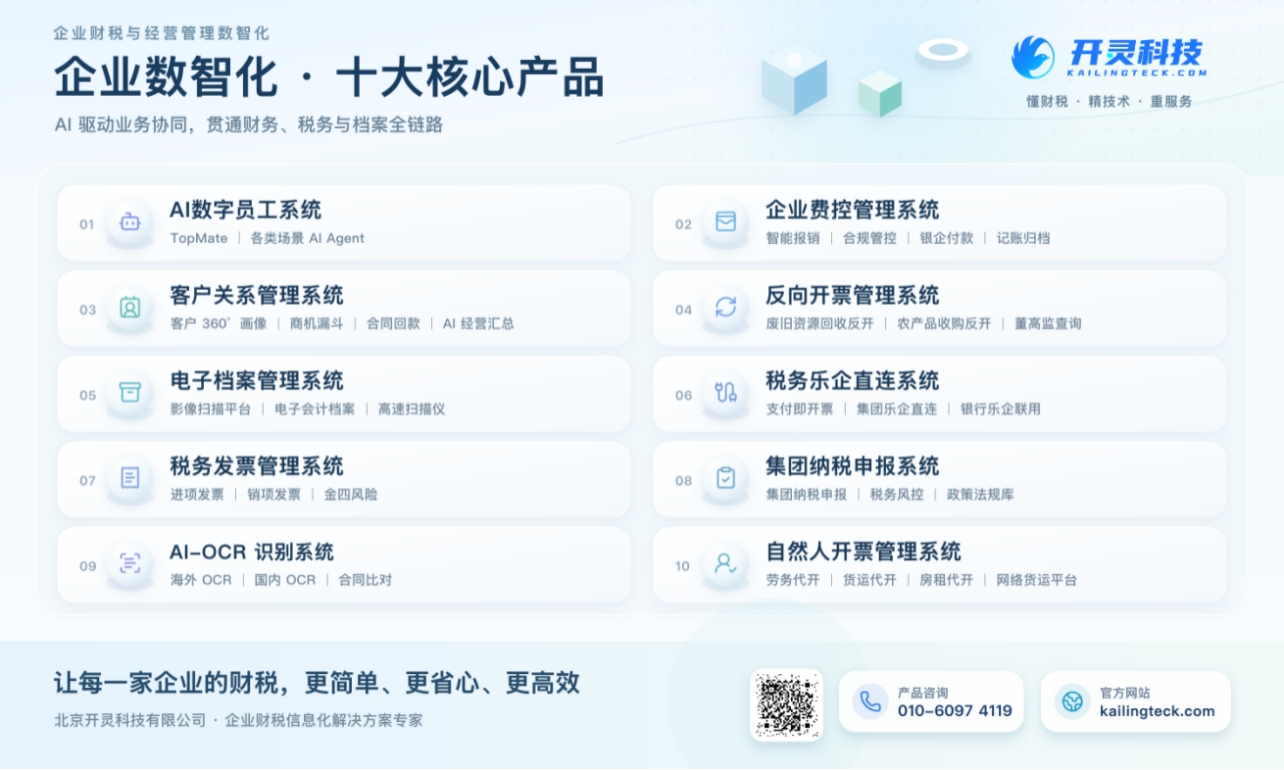
The company has now formed ten core product lines, including: AI digital employee system, enterprise expense control management system, customer relationship management system, reverse invoicing management system, invoice issuance for individuals management system, electronic archives management system, tax fully digitalized e-invoice Leqi system, tax invoice management system, group tax filing system, and AI OCR recognition system. It is committed to connecting enterprise business, finance, tax, funds, and archive data to help customers improve operational efficiency, business-finance-tax compliance capabilities, and digital management levels.
If you have any business-finance-tax digital transformation needs, welcome to contact us. Beijing Kailing Technology will serve you wholeheartedly.
 Keywords: Kailing Technology AI-CRM, CRM customer leads, B2B customer acquisition system, website inquiries, opportunity assignment
As a comprehensive business-finance-tax digitalization solution service provider, Kailing Technology provides business-finance-tax management digital transformation products and operational services for various government agencies, institutions, and large, medium, and small enterprises. The product line includes: solutions for sales contract management system, procurement contract management system, fully digitalized Leqi interface project, automatic output invoicing system, reverse invoicing system, invoice issuance for individuals system, employee expense control and reimbursement system, input VAT invoice management system, supply chain collaborative reconciliation system, image AI OCR recognition system, automatic financial bookkeeping system, electronic accounting archives system, etc., comprehensively driving the digitalization process across various fields.
Consultation Hotline: 18513895936 / 010-60974119 Location: Beijing