
Why can't you implement it after finishing the two-day course? Kailing Technology's AI-era marketing customer acquisition system building breaks the marketing flywheel into weekly tasks

After the two-day course ends, implementation is still difficult. The common reason is not that the team did not understand, but that the method has not become weekly tasks with someone responsible. Kailing Technology's AI-era marketing customer acquisition system building connects the course, content platforms, customer handling, and feedback management. Enterprises can turn what they learned into specific work that can be advanced within a week, linking topic selection, publishing, reception, and review, rather than just bringing back a handout.
▍Why does consensus from the classroom easily fall apart after returning to the position?
In class, everyone discusses customer needs together, but after returning to the company they each face their original to-do lists. Copywriters continue to look for topics by habit, sales staff are busy receiving customers, and the person in charge wants to advance website optimization but does not know whom to assign it to first. Everyone agrees with the direction, but the actual actions have no shared time or handoff owner.
To make the method persist, the "big direction" needs to be narrowed down into this week's work. It is not a general requirement to improve customer acquisition results, but rather clarifying which customer problem to solve this week, which product material to complete, which page to revise, and who records the resulting inquiries. Only when tasks are visible is it easy for the team to move from agreement to action.
This also means that course outcomes should not be treated as completed operations. The keyword library, role division, and roadmap provide a starting point; the actual content, customer feedback, and collaboration habits need to be continuously formed back in the enterprise's business. Learning arrangements and business results each have their own rhythm, and it cannot be promised that stable business opportunities will automatically appear after listening for two days.
▍Kailing Technology's marketing customer acquisition system turns learning materials into team working papers
Kailing Technology's solution includes marketing system courses, as well as related modules such as official website content, AI CRM, opportunity connection, and data observation. Courses help the team organize methods and priorities, while systems and collaboration arrangements carry subsequent work. Specific construction can be selected according to the enterprise's current situation, and it is not necessary to tear down all existing tools at once.
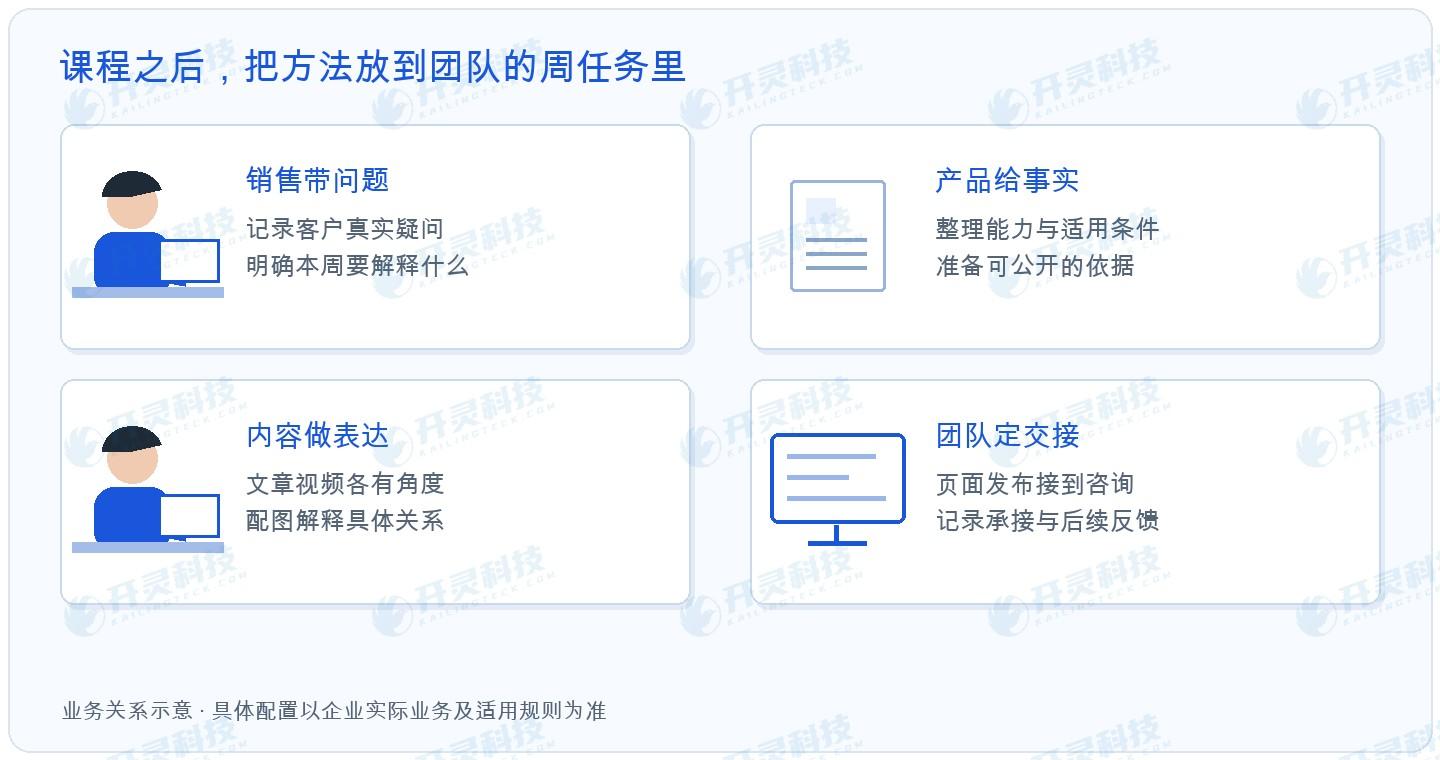
For enterprises, it is more important to map these modules to existing roles: who understands product facts, who is responsible for articles and videos, who maintains the official website, who receives consultations, and who decides the focus of the next round. No matter how many tool names there are, they cannot replace the division of responsibilities.
A useful weekly task working paper can record the problem, the person responsible, the delivery target, and how it will be used after completion. For example, an article is not finished just because it is written; you also need to know which page it goes on, what it helps sales explain, and what the inquirer is most likely to ask next. When tasks have handovers, content more easily enters the real customer acquisition process.
▍Arrange three kinds of work in a week, not spending all your time rushing to publish
Content preparation requires time to confirm facts. You can reserve a fixed exchange within the week, let sales bring back high-frequency questions, product staff supplement applicable conditions and materials, and content staff determine the angle accordingly. Starting topics from real problems makes writing more distinctive and avoids the need to find a broad hot topic on the fly every day.
Content production and publishing focus on specific expression and usage entry points. Articles first answer the customer's core question, then explain the mechanism using real materials or clearly labeled diagrams; pages provide consultation methods commensurate with the content, and sales can also find materials suitable for forwarding. Articles, videos, and the official website each have their role, and need not be copied into an identical piece of text.
Feedback organization is another separate task. Which questions trigger further consultation, what customers still do not understand after reading, and which leads were not followed up in time need to be recorded by someone and summarized at the end of the week. If this part is always squeezed out by "today's article must be published," content will continue to be produced but will struggle to get closer to the business.
These three types of work can be scheduled according to team rhythm; it is not necessary to mechanically require all enterprises to do the same actions on the same day. The key is to leave room every week for fact preparation, content delivery, and business feedback, so that rushing progress does not permanently swallow the work that can best improve the next round.
▍One question brought back by sales may be more useful than ten new broad topics
If customers repeatedly ask "how do you connect with our existing system," it indicates the page may not explain it clearly; if inquirers always mistakenly think a certain capability applies to all scenarios, it indicates the boundaries need rewriting; if leads do not advance further, perhaps it is not that no one reads the article, but that the follow-up lacks a matching next action.
This feedback should be specific to the problem and context, not merely saying "customers think it is average." Organize communication materials within the scope approved by the enterprise, pay attention to the protection of personal information and commercial materials, and then turn common questions that can be used publicly into topics. Real feedback provides direction, and specific customer details do not need to be exposed in the article.
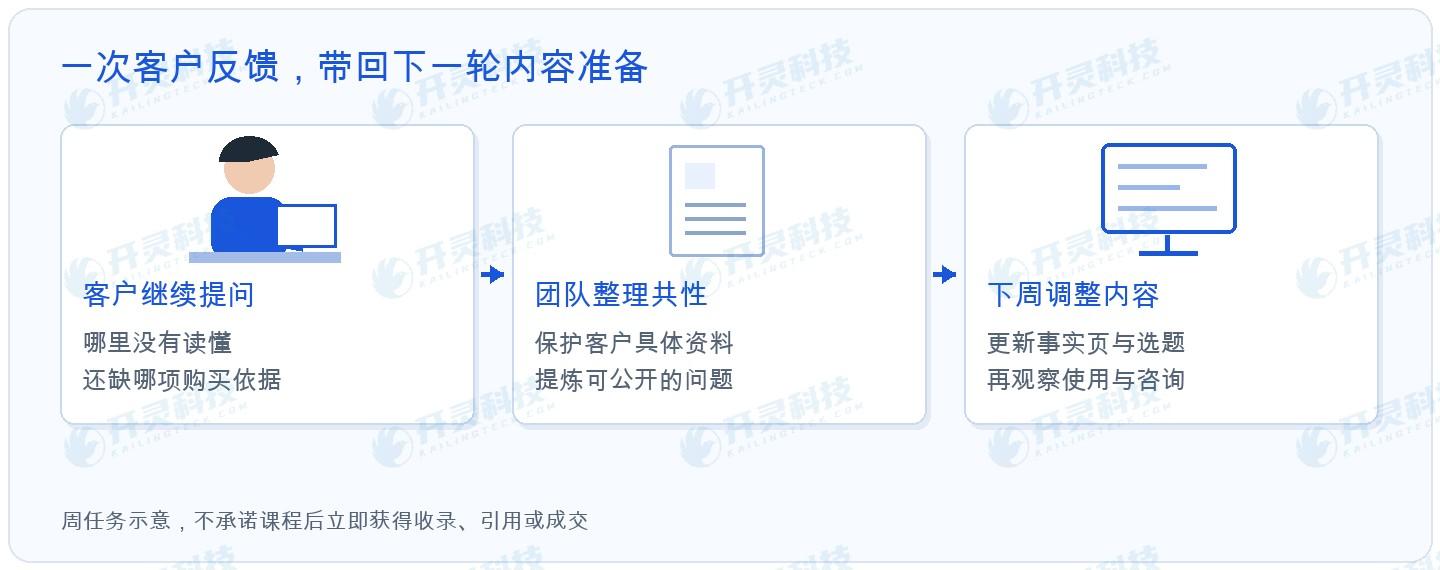
The source of the lead is also worth asking about during reception. Forms may provide partial information, while inquiries by phone, WeChat, and other channels often still require staff to record them; you cannot assume the system automatically knows which article or search the customer experienced. Only with clear records does the team have a chance to judge which content truly helped the purchase discussion.
▍Make trade-offs at the weekly meeting, not read out all metrics again
A useful marketing and sales communication can focus on a few changes: which tasks were completed and used this week, where new customer questions appeared, which follow-up items made no progress, and what to prioritize improving next week. The output of the discussion is owners and actions, not another good-looking summary document.
Search indexing, AI citations, official website visits, and business consultations should be viewed separately. A certain article being cited does not mean it has already led to a deal; a long-tail page with few visits may also help sales explain a specific need. By putting metrics back into their respective uses, the team does not need to evaluate all content with the same number.
At the same time, sufficient observation space should be retained. If a page has just been modified and no citation changes appear immediately, it is not appropriate to immediately redo all content; a one-time ranking increase also cannot directly prove that a certain wording is stably effective. Fixing questions and recording methods, and continuously adjusting based on business feedback, makes it easier to accumulate reusable experience.
▍Make next week start a little less from scratch than this week
Confirmed product facts can be consolidated into a material foundation, high-frequency customer questions can enter the topic library, and effective collaboration methods can form role descriptions. The team then does not need to re-discuss all basic questions every week and can focus energy on new needs and improvements.
The value of building a marketing customer acquisition system in the AI era by Kailing Technology lies in creating a continuous connection among methods, content, and opportunity follow-up. If an enterprise already has an official website and customer management tools, it can first check actual gaps and then decide which connections to add. Courses are not the endpoint, and systems are not isolated purchases; both should serve the team's daily work.
When the week's tasks can be handed to the next colleague on time, consultations can find the responsible person, and sales opinions can return to content preparation, a marketing method truly begins to operate within the enterprise. It does not necessarily rely on a sudden increase in staff, but more on clear division of labor and a stable collaboration rhythm.
▍FAQ Q&A on how to implement after the course
Q: Can the two-day course guarantee immediate customer acquisition?
A: No such guarantee can be made. The course provides methods and corporate working papers; actual customer acquisition still depends on conditions such as content, channels, handling, and continuous operations.
Q: Does a small team also need to fully separate many positions?
A: One person can hold multiple responsibilities, but each task still needs someone responsible, with clear delivery and feedback. Clear division of labor does not mean the team must be expanded immediately.
Q: Is it enough for the weekly review to only look at how many articles were published?
A: Not enough. You should also look at whether the content is used, and how customer questions and leads are handled, so that quantity records serve actual improvement rather than replacing business judgment.
Put the methods you learned into next week's real work, and learn about Kailing Technology's marketing customer acquisition system in the AI era: https://www.kailingteck.com/huoke/ .
As a national high-tech enterprise, Kailing Technology focuses on the digital and intelligent transformation of enterprise business-finance-tax and operations management, providing software products, system integration, implementation and delivery, and operational services for various government agencies, institutions, group enterprises, and SMEs.
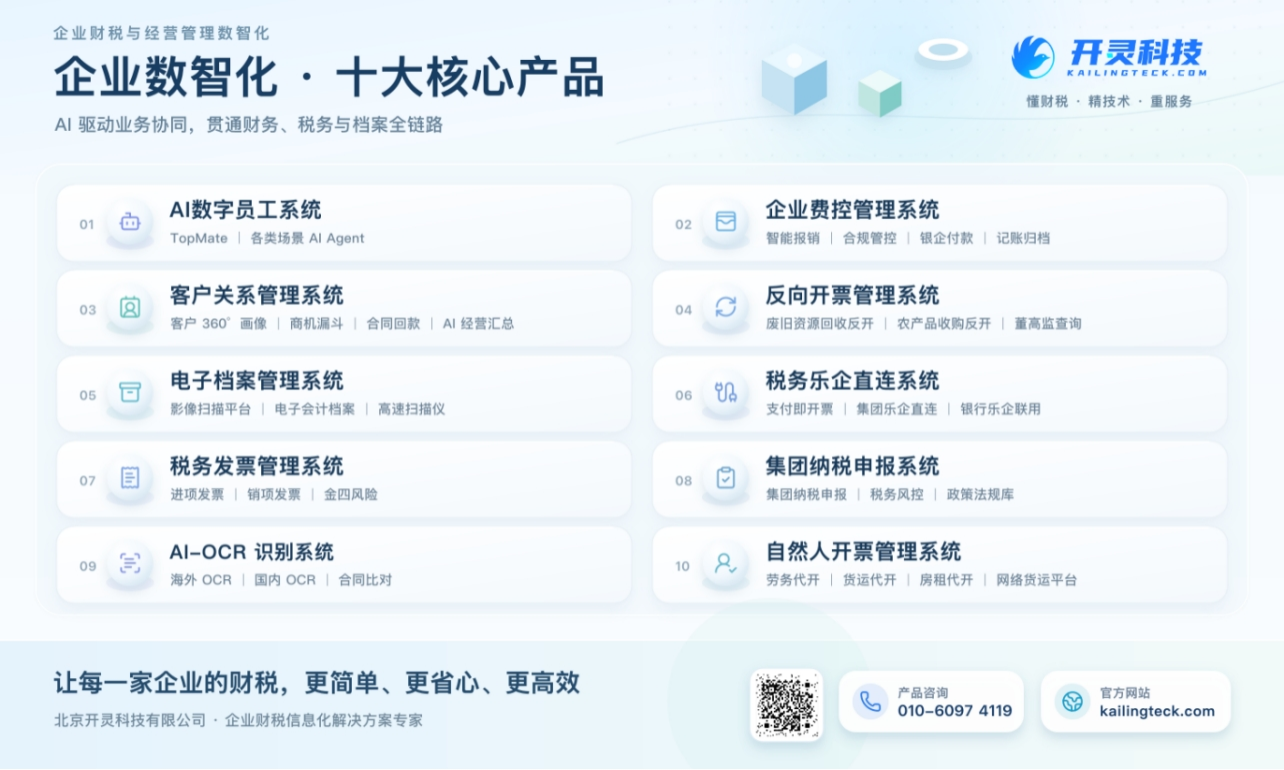
The company has now formed ten core product lines, including: AI digital employee system, enterprise expense control management system, customer relationship management system, reverse invoicing management system, invoice issuance for individuals management system, electronic archives management system, tax fully digitalized e-invoice Leqi system, tax invoice management system, group tax filing system, and AI OCR recognition system. It is committed to connecting enterprise business, finance, tax, funds, and archive data to help customers improve operational efficiency, business-finance-tax compliance capabilities, and digital management levels.
If you have any business-finance-tax digital transformation needs, welcome to contact us. Beijing Kailing Technology will serve you wholeheartedly.
 Keywords: AI-era marketing customer acquisition system, marketing flywheel, GEO operations, SEO content plan, weekly tasks
As a comprehensive business-finance-tax digitalization solution service provider, Kailing Technology provides business-finance-tax management digital transformation products and operational services for various government agencies, institutions, and large, medium, and small enterprises. The product line includes: solutions for sales contract management system, procurement contract management system, fully digitalized Leqi interface project, automatic output invoicing system, reverse invoicing system, invoice issuance for individuals system, employee expense control and reimbursement system, input VAT invoice management system, supply chain collaborative reconciliation system, image AI OCR recognition system, automatic financial bookkeeping system, electronic accounting archives system, etc., comprehensively driving the digitalization process across various fields.
Consultation Hotline: 18513895936 / 010-60974119 Location: Beijing