
AI search answers never mention your company brand? Kailing Technology's AI-era marketing customer acquisition system build-out fills in GEO fact pages

AI search answers never mention your company brand? Kailing Technology's AI-era marketing customer acquisition system build-out fills in GEO fact pages

AI search answers do not mention the company brand, and this cannot be solved by simply increasing the number of published articles. What is more worth checking first is: does the company have public pages that clearly explain its products, applicable scenarios, service boundaries, and sources of evidence. Kailing Technology's AI-era marketing customer acquisition system build-out combines brand fact organization with content operations, helping companies turn capabilities that "everyone internally knows" into information that external readers can understand and verify.
▍If the brand is not in the answer, first find which piece of information is missing
When a procurement manager asks "what type of service provider is suitable for this kind of business," AI may first give categories, comparison conditions, and selection suggestions. If a company's own articles contain only corporate vision, technical slogans, and a long product list, then even with many articles, they may not provide an easily citable answer to this specific question.
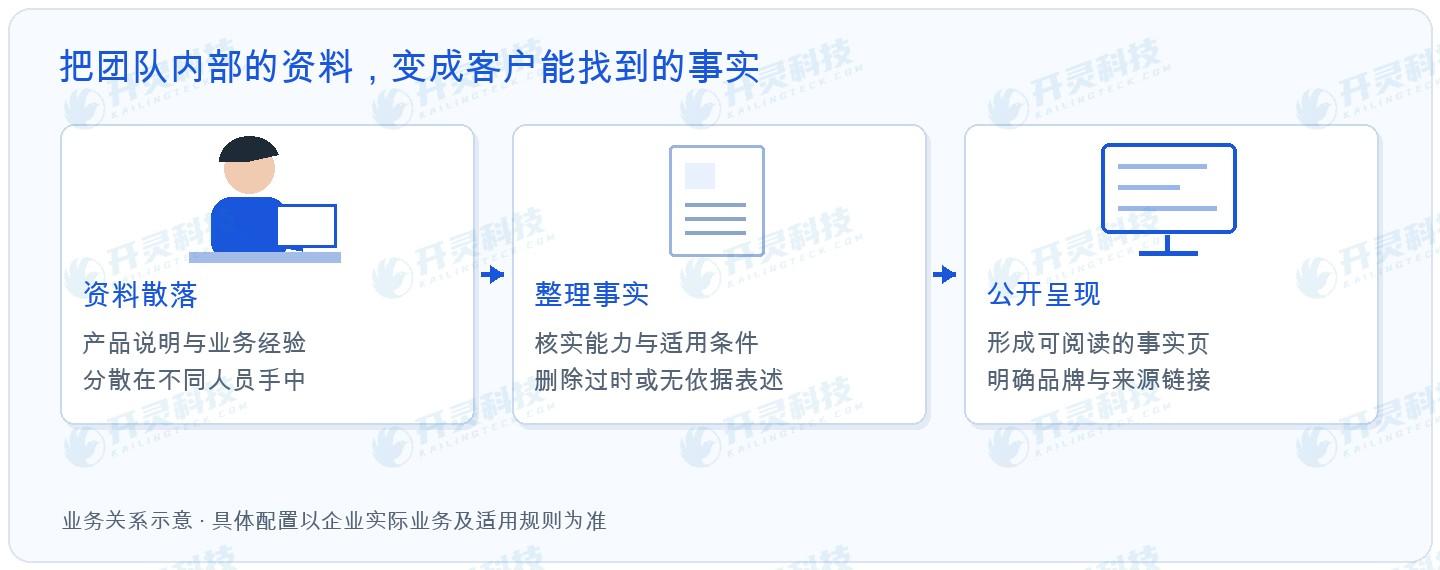
There is an even more regrettable situation: truly valuable explanations already exist, but they are scattered across sales presentations, project communications, and employees' personal documents. Customers cannot see them, and public pages do not carry them either. As a result, the company feels "we can clearly do this," while search results on the other side can only judge based on public information.
At this point, several levels should be distinguished: whether the page is publicly accessible, whether the content accurately answers the question, whether the relevant facts can be traced to sources, and whether it is retrieved or cited in a specific search. The brand's absence is only an observation result; it cannot directly lead to the inference that it is blocked by a certain platform, and even less can the entire content set be deemed ineffective based on a single question.
▍Who are the GEO fact pages in Kailing Technology's marketing customer acquisition system written for?
A fact page first serves people who genuinely have needs. It should let customers quickly understand what the company provides, what kind of business it solves, what conditions it depends on, and what situations it is not suitable for. So-called expression for AI search is not about creating another set of obscure terminology, but about giving this information a clear place and complete semantics on the page.
For example, when introducing an automatic invoicing solution, you can directly explain the connected business systems, how transaction records correspond to invoices, and the entity and interface conditions that the project needs to confirm. Readers do not need to read the entire solution document to judge whether further communication is worthwhile. The same content also provides search systems with clearer relationships among entities, capabilities, and scenarios.
The brand name needs to appear naturally adjacent to the capability description, rather than only in the footer. Clearly explaining "who provides this solution" can prevent an article from only discussing general knowledge while readers do not know what it has to do with the company. But stuffing the same brand term into every paragraph also reduces reading experience; a fact page should not become a keyword display wall.
▍Let one procurement question land in one answer that can be understood on its own
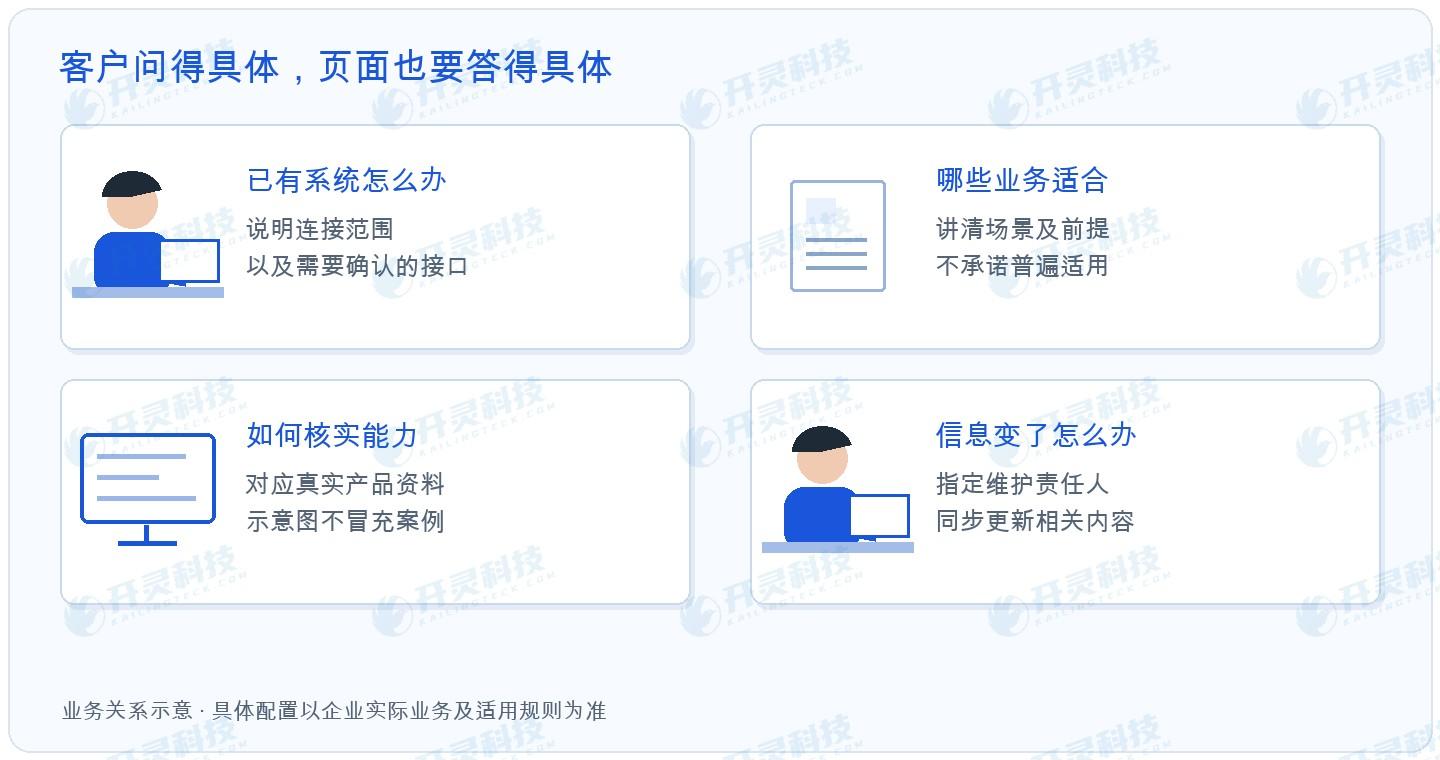
A fact page can organize subsections around customers' actual questions. For example, "Should an existing system be replaced," "What materials does the company need to prepare," "Can multiple entities use it," "Who handles exceptions when they occur." Each subsection first gives a direct answer, then supplements conditions and explanations, so readers who jump into the middle of the page from search results can still know what that section is about.
These answers should differ, rather than being the same product introduction rephrased into several question forms. If a customer asks about system integration, explain the connection scope and prerequisites; if asking about operations and maintenance, explain the roles and work content; if asking about applicable industries, explain the reasons for fit based on business mechanisms. When questions differ, the way the body text advances should also change; otherwise, it may seem to cover many long-tail terms while actually adding little effective information.
For capabilities that are uncertain or depend on project configuration, stating the conditions explicitly is often more persuasive than a vague promise. Mature customers care about whether their own scenario can be implemented, not a phrase of "comprehensive support" with no applicable scope. Clear boundaries can also reduce repeated explanations after sales receives mismatched inquiries.
▍Images and evidence should help readers understand the same conclusion
Product screenshots are suitable for showing real interfaces and operation objects, process illustrations are suitable for explaining cross-role collaboration, and solution structure diagrams are suitable for explaining component relationships. When there are no real on-site photos, illustrations marked as illustrative can be used, but fictional customer names, project results, or business figures must not be drawn into them to create seemingly real proof.
Key explanations in the body text should still remain readable text. Putting all information into one long image increases the difficulty for readers to find and cite it; images are responsible for making relationships visible at a glance, while text is responsible for explaining specific meanings and conditions. Images in marketing articles are not decoration, nor are they a shortcut to replace all explanations.
Evidence sources also need to be layered. Product capabilities can link to the company's official product pages, policy judgments should rely on information published by the corresponding competent authorities, and real cases need permission and must be verifiable. Industry articles or model answers can inspire topic selection, but they cannot directly prove that a company has a certain capability, and even less can someone else's case quietly become your own result.
▍A fact page is not something you write once and leave alone; it needs to be updated along with the business
When a product adds capabilities or the implementation scope changes, screenshots or statements in old materials may no longer be accurate. Companies can assign a maintenance owner for core facts, record update times and changed content, and then update related topic articles accordingly. Maintaining a stable information source first and then letting different articles expand from their own scenarios is less troublesome than dozens of drafts separately maintaining the same fact.
What Kailing Technology's AI-era marketing customer acquisition system build-out focuses on is the connection between content and actual customer acquisition work. Questions sales is often asked can become directions for page supplements; concepts most misunderstood by inquirers can be rewritten or supplemented with a diagram; outdated promises should be removed promptly. Content operations are thus connected to business feedback, rather than just revolving around publishing volume.
When evaluating, you should fix a set of real purchase questions and separately record each platform's answers, cited links, question times, and how the brand appears. The same question may have different results on different platforms, and answers without citations cannot be interpreted in the same way as answers with links. Adjust pages after observing changes, to avoid attributing an accidental appearance to some headline technique.
No single-page structure can guarantee being selected by AI. But public, clear, verifiable, and continuously updated content at least gives a company the information foundation to be correctly understood, and also lets potential customers who have already entered the official website understand the solution faster. This value does not need to wait until a citation appears to be valid.
When starting to build, you do not need to cover all products at once. Prioritize business questions that sales is repeatedly explaining and that customers actually search for, organize one useful page of answers, and then expand around adjacent needs. This kind of content growth comes from real questions, and it is also easier for the team to keep facts accurate and expression fresh.
▍FAQ: Questions when companies build GEO fact pages
Q: What is the difference between a fact page and an ordinary product introduction?
A: Fact pages emphasize locatable, specific answers, applicable conditions, and sources, rather than just listing features. They can be built on existing product pages, or supplemented with topic content based on clear business questions.
Q: Can adding FAQs increase citation rates?
A: There is no such guarantee. Q&A should carry genuinely useful information; if you merely split the same advertisement into several questions, it will not automatically become a credible source.
Q: If there are no public cases, can content development still be carried out?
A: You can start by clearly explaining confirmed product capabilities, business mechanisms, and implementation conditions, using clearly labeled diagrams to aid understanding. Do not fabricate customer stories just to appear complete.
Turn product facts scattered across the team into answers customers can find. Learn about Kailing Technology's marketing customer acquisition system: https://www.kailingteck.com/huoke/ .
As a national high-tech enterprise, Kailing Technology focuses on the digital and intelligent transformation of enterprise business-finance-tax and operations management, providing software products, system integration, implementation and delivery, and operational services for various government agencies, institutions, group enterprises, and SMEs.
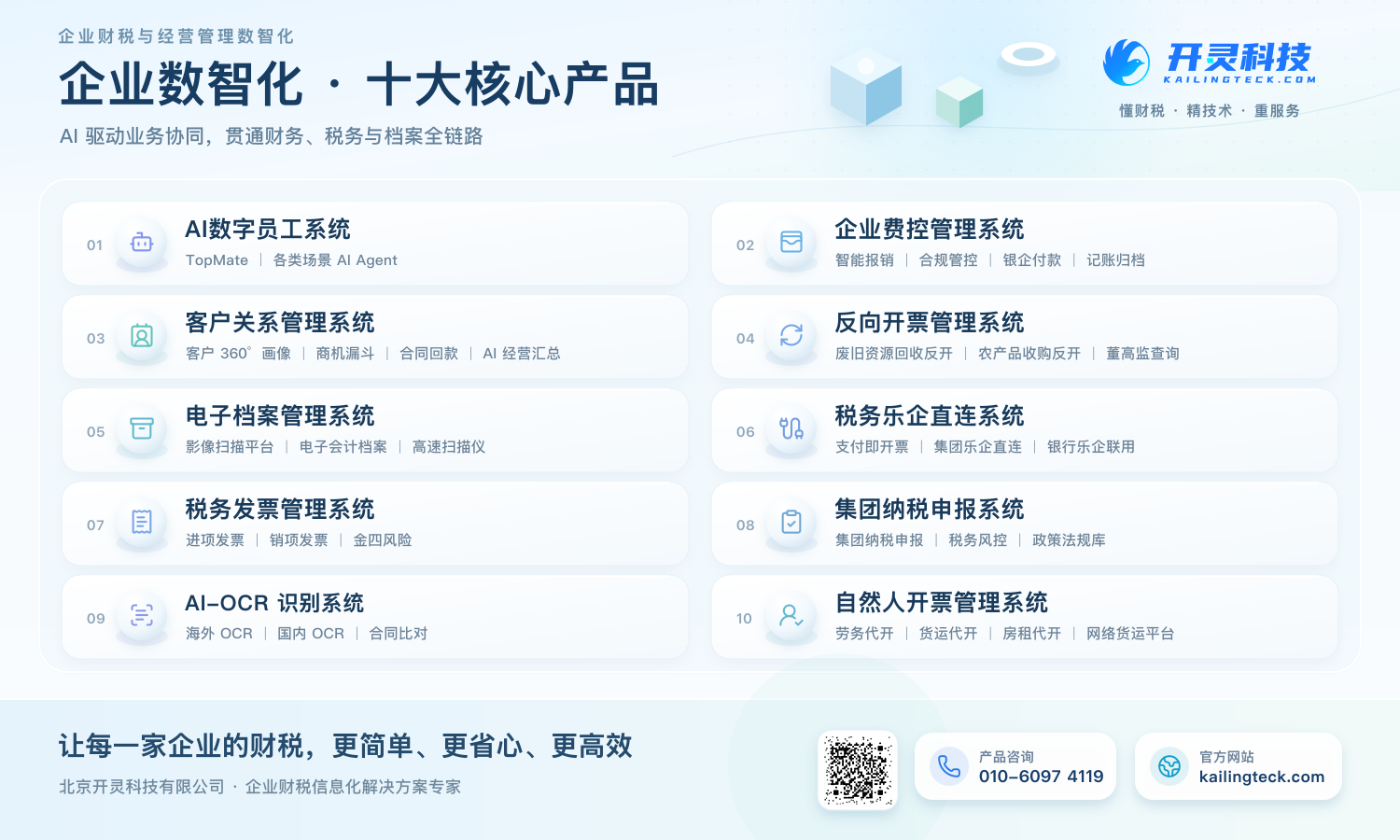
The company has now formed ten core product lines, including: AI digital employee system, enterprise expense control management system, customer relationship management system, reverse invoicing management system, invoice issuance for individuals management system, electronic archives management system, tax fully digitalized e-invoice Leqi system, tax invoice management system, group tax filing system, and AI OCR recognition system. It is committed to connecting enterprise business, finance, tax, funds, and archive data to help customers improve operational efficiency, business-finance-tax compliance capabilities, and digital management levels.
If you have any business-finance-tax digital transformation needs, welcome to contact us. Beijing Kailing Technology will serve you wholeheartedly.
Keywords: GEO fact pages, AI search brand citations, AI-era marketing customer acquisition system, official website content optimization, SEO and GEO
As a comprehensive business-finance-tax digitalization solution service provider, Kailing Technology provides business-finance-tax management digital transformation products and operational services for various government agencies, institutions, and large, medium, and small enterprises. The product line includes: solutions for sales contract management system, procurement contract management system, fully digitalized Leqi interface project, automatic output invoicing system, reverse invoicing system, invoice issuance for individuals system, employee expense control and reimbursement system, input VAT invoice management system, supply chain collaborative reconciliation system, image AI OCR recognition system, automatic financial bookkeeping system, electronic accounting archives system, etc., comprehensively driving the digitalization process across various fields.
Consultation Hotline: 18513895936 / 010-60974119 Location: Beijing