010-6097 4119Book a Demo


2026 pilot of "reverse invoicing" for online freight: Kailing Technology interprets the new regulations of the State Taxation Administration and the Huai'an undertaking planPublished: 2025-12-30 17:36 Content timeliness statement (updated 2026-08-29) This article was originally published on 2025-12-30. The following are changes to current regulations related to this article since publication:
From January 1, 2026, the State Taxation Administration will take the lead in launching a pilot for "reverse invoicing" in online freight transport in Jiangsu Province and other regions. This transformative measure brings new opportunities to the online freight transport industry, which has long been plagued by "difficulty in obtaining invoices and high tax burdens." As a technology service provider deeply engaged in the field of business-finance-tax compliance, Kailing Technology, combining national-level policy direction and Huai'an City's local implementation plan, interprets the key points and practical directions for the implementation of the new rules from three aspects: policy core, local practice, and compliance path.
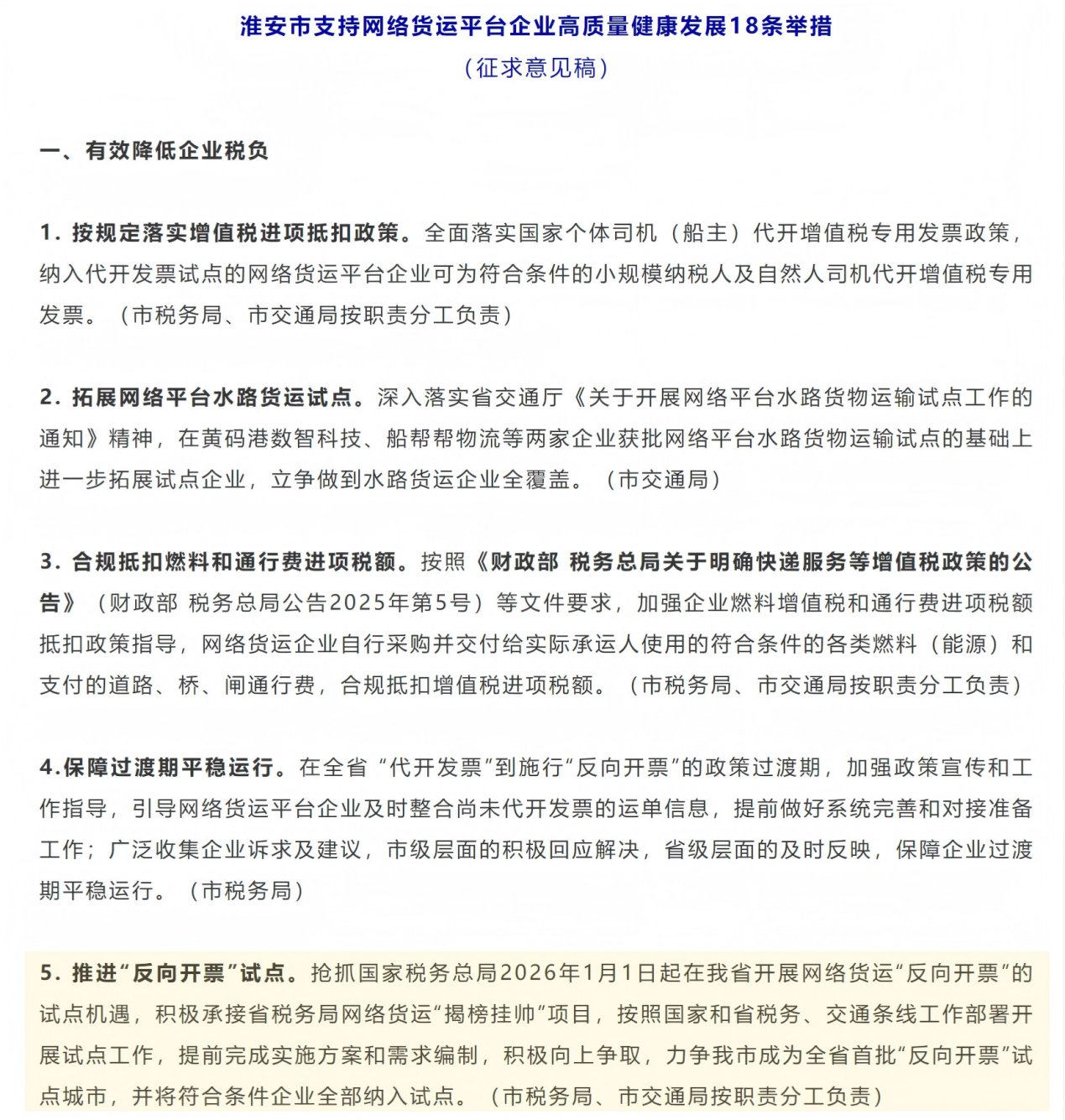
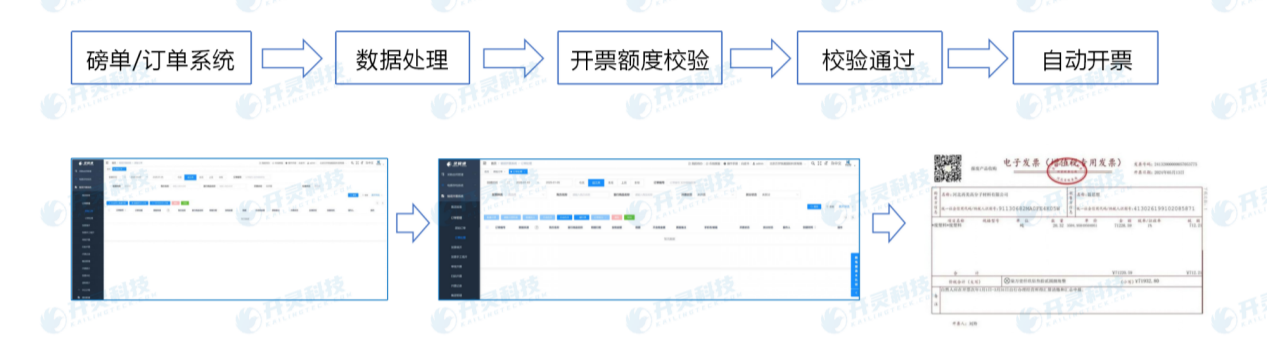
I. New national rules: The core logic and industry value of the "reverse invoicing" pilot(1) Policy Background: Institutional Innovation to Resolve the Industry's "Invoice Dilemma" The online freight industry has long faced a "two-end dilemma" in taxation: on one hand, individual drivers (or vessel owners), as the core providers of transport services, mostly have not completed tax registration and cannot independently issue VAT special invoices, leaving online freight platforms without input deduction vouchers; on the other hand, to cover costs, platforms often face compliance risks such as "white slip bookkeeping" and "fraudulent fuel invoice issuance," which both push up corporate tax burdens and easily trigger tax audits. Since 2025, policies have been intensively issued at the national level to pave the way for the "reverse invoicing" pilot: - Top-level design clarifies direction: the State Council's "Regulations on the Reporting of Tax-Related Information by Internet Platform Enterprises" (No. 810) requires online freight platforms to report key data such as transaction flows and payment records, realizing transparency of business data and providing a data supervision foundation for "reverse invoicing"; - Supporting input VAT deduction policies: Announcement No. 5 of 2025 by the Ministry of Finance and the State Taxation Administration clarifies that fuel purchased by the platform itself and delivered for driver use, as well as toll fees paid, can be compliantly deducted as input VAT, forming a policy complement to "reverse invoicing"; - Pilot timing finalized: the State Taxation Administration clarified that starting January 1, 2026, a "reverse invoicing" pilot will be launched in Jiangsu and other provinces, breaking the traditional "service provider invoicing" model, with the platform as the purchaser issuing VAT special invoices on behalf of drivers (sellers), solving the problem of "missing invoice sources" at the institutional level. (II) Core Rules: Applicable Conditions and Risk Boundaries of "Reverse Invoicing" According to policy requirements, "reverse invoicing" is not a simple change of invoicing entity; the "three elements" must be met to ensure compliance: 1. Closed loop of business authenticity: need to achieve "IV"flow integration," meaning contract flow, logistics flow, fund flow, and invoice flow fully match, eliminating false invoicing risks of "no actual transportation business"; 2. Entity qualification restrictions: only applicable to "carrier-type" online freight platforms, and the platform must have been included in the provincial online freight monitoring platform and completed data connection with tax authorities; 3. Tax payment obligation: when the platform issues special VAT invoices on behalf, it must simultaneously pay VAT and surcharges on behalf of the driver to ensure tax compliance on the driver side. Kailing Technology business-finance-tax experts point out that the core value of "reverse invoicing" lies in the dual empowerment of "cost reduction + compliance": for platforms, it provides legally valid input VAT deduction vouchers, reducing the tax burden gap by about 6%; for drivers, it eliminates the need to visit tax bureaus offline for invoice issuance, reducing time and labor costs while achieving compliant personal income tax filing. II. Huai'an undertaking plan: four key measures to strive to be a "pioneer" in the provincial pilotAs a city in Jiangsu Province actively responding to the reverse invoicing pilot, Huai'an has formulated targeted implementation plans in the 18 Measures to Support the High-Quality and Healthy Development of Online Freight Platform Enterprises (Draft for Comments) from four aspects: policy alignment, system construction, risk prevention and control, and service guarantees, laying the foundation for pilot implementation. (1) Plan Ahead: Seize the Pilot "First-Mover Advantage" Huai'an City clearly proposed the goal of "striving to become among the first batch of 'reverse invoicing' pilot cities in the province," with the Municipal Tax Bureau and Transportation Bureau jointly advancing two core tasks: - Plan first: prepare a pilot implementation plan for "reverse invoicing" in advance, clarifying enterprise access standards, operating procedures, and division of responsibilities; - Enterprise screening: Prioritize including enterprises that have already carried out waterway freight pilots, such as Huangma Port Digital Technology and Chuanbangbang Logistics, in the reserve list, ensuring rapid implementation after pilot launch and gradually achieving "full coverage of qualified enterprises." (II) System Integration: Clearing Data "Blockages" The implementation of "reverse invoicing" depends on cross-departmental data interoperability, and Huai'an City focuses on promoting "provincial-municipal platform coordination": - Port reservation: In the upgrade of the Provincial Department of Transportation's online freight monitoring and service platform, "Huai'an elements" are incorporated, reserving data interfaces for the Municipal Tax Bureau, Market Supervision Bureau, and Data Bureau to ensure real-time sharing of waybill, invoice, payment, and other data; - Risk scanning: relying on provincial platform data, monthly spot checks on the authenticity of pilot enterprises' waybills, identifying abnormal transactions through "tax governance by data," and preventing false invoicing risks in advance. (3) Policy transition: ensuring enterprises "move steadily" Considering the policy transition period from "invoice issuance on behalf of" to "reverse invoicing," Huai'an City has specifically introduced transitional safeguard measures: - Publicity and guidance: through special training, enterprise visits, and other methods, interpret the "reverse invoicing" rules, guide platforms to consolidate waybill information for invoices not yet issued for individuals, and improve system functions; - Demand response: establish a demand handling mechanism of "municipal response + provincial reporting". For system integration difficulties, tax burden questions, etc. raised by enterprises, provide an initial response within 1 working day; for matters involving provincial policy adjustments, report upward within 3 working days, avoiding impact on business operations due to poor policy alignment. (4) Service upgrade: lowering compliance "costs" To reduce the pressure on enterprises during the pilot, Huai'an City launched "refined tax-related services": - Online channel empowerment: Building "Huai Tax e-Code Pass" and "Smart Supervision Code" service platforms, pilot enterprises can submit invoicing applications, query tax payment records, and provide feedback online; - Key enterprise linkage: for online freight platforms with annual revenue exceeding 100 million yuan, establish a "leadership contact mechanism" to solve individualized problems in reverse invoicing one-on-one. III. Kailing Technology: The "Three Core Capabilities" of Technology Empowering Pilot Compliance ImplementationAs a technology service provider serving tax and financial compliance in the online freight industry, Kailing Technology combines new national regulations and Huai'an pilot requirements to launch a full-process reverse invoicing solution, helping enterprises quickly adapt to policies and avoid compliance risks. (1) Full-chain automation: achieving "zero legwork for invoicing" Based on practical experience in reverse invoicing for resource recycling and agricultural product procurement,The Kailing Technology Reverse Invoicing system canin order to achieveIntegrationFreightplatform, completing the automated process "from order entry to invoice generation": 1. Information entry: enterprises only need to upload the driver's ID card, transport contract, GPS trajectory, and other materials, and the system automatically verifies information completeness; 2. Tax calculation: Automatically adapt preferential policies based on the driver's monthly sales amount, accurately calculate taxes payable, and simultaneously generate filing reports; 3. Invoice issuance: Connect to tax authority interfaces, automaticallyCarry out reverse invoicing, fill in the place of departure, vehicle type and number, and other information in the remarks column as required to ensure invoice compliance.
(II) Long-term data archiving: meeting the "10-year retention for inspection" requirement Tax authorities clearly stipulate that vouchers related to "reverse invoicing" must be retained for more than 10 years. Kailing Technology's system provides dual guarantees through "encrypted storage + cloud backup": - Full-dimensional data retention: Automatically collects 12 categories of materials including transportation contracts, driver identity information, settlement vouchers, and tax payment records, forming tamper-proof electronic archives; - Quick retrieval: during tax audits, enterprises can export the required data with one click, supporting PDF, Excel and other formats, avoiding tax supplements and late payment penalties due to missing materials.
(3) Input deduction adaptation: connecting with Huai'an's "policy dividends" In response to Huai'an City's key support policies for fuel and toll deduction, the system specifically sets up a "cost deduction module": - Compliance verification: after entering fuel procurement vouchers and ETC toll records, the system automatically verifies whether they are "used for actual transport business"; - One-tap deduction: eligible costs can be directly linked to reverse-issued invoices, realizing "automated input VAT deduction" and helping enterprises fully enjoy Huai'an policy benefits, further reducing tax burden. The launch of the 2026 "reverse invoicing" pilot will become a key node in the "compliance reshuffle" of the online freight industry: on the one hand, non-compliant platforms will be eliminated because they cannot adapt to the new policy; on the other hand, regions and enterprises like Huai'an that plan ahead and are empowered by technology will seize the initiative in compliant development. Kailing Technology will also continuously iterate its system, helping more enterprises achieve "compliant cost reduction and high-quality development" amid policy changes. Consult Kailing Technology to plan ahead for a "reverse invoicing" compliance solution and seize the first-mover advantage in the online freight industry:https://www.kailingteck.com/ 。 As a comprehensive business-finance-tax digitalization solution service provider, Kailing Technology provides business-finance-tax management digital transformation products and operational services for various government agencies, institutions, and large, medium, and small enterprises. The product line includes: Sales contract management system, procurement contract management system, fully digitalized Leqi interface project, output automatic invoicing system,Reverse invoicing system,Solutions for the invoice issuance for individuals system, employee expense control and reimbursement system, input VAT invoice management system, supply chain collaborative reconciliation system, image AI OCR recognition system, automated financial bookkeeping system, electronic accounting archives system, and other businesses, comprehensively advancing the digitalization process across various fields. If you have any business-finance-tax digital transformation needs, welcome to contact us. Beijing Kailing Technology will serve you wholeheartedly.
#Reverse Invoicing Solution #Reverse Invoicing System #Resource Recycling Enterprise Reverse Invoicing Solution #Agricultural Product Procurement Reverse Invoicing Solution #Freight Industry Reverse Invoicing #Digital Business-Finance-Tax |