010-6097 4119Book a Demo


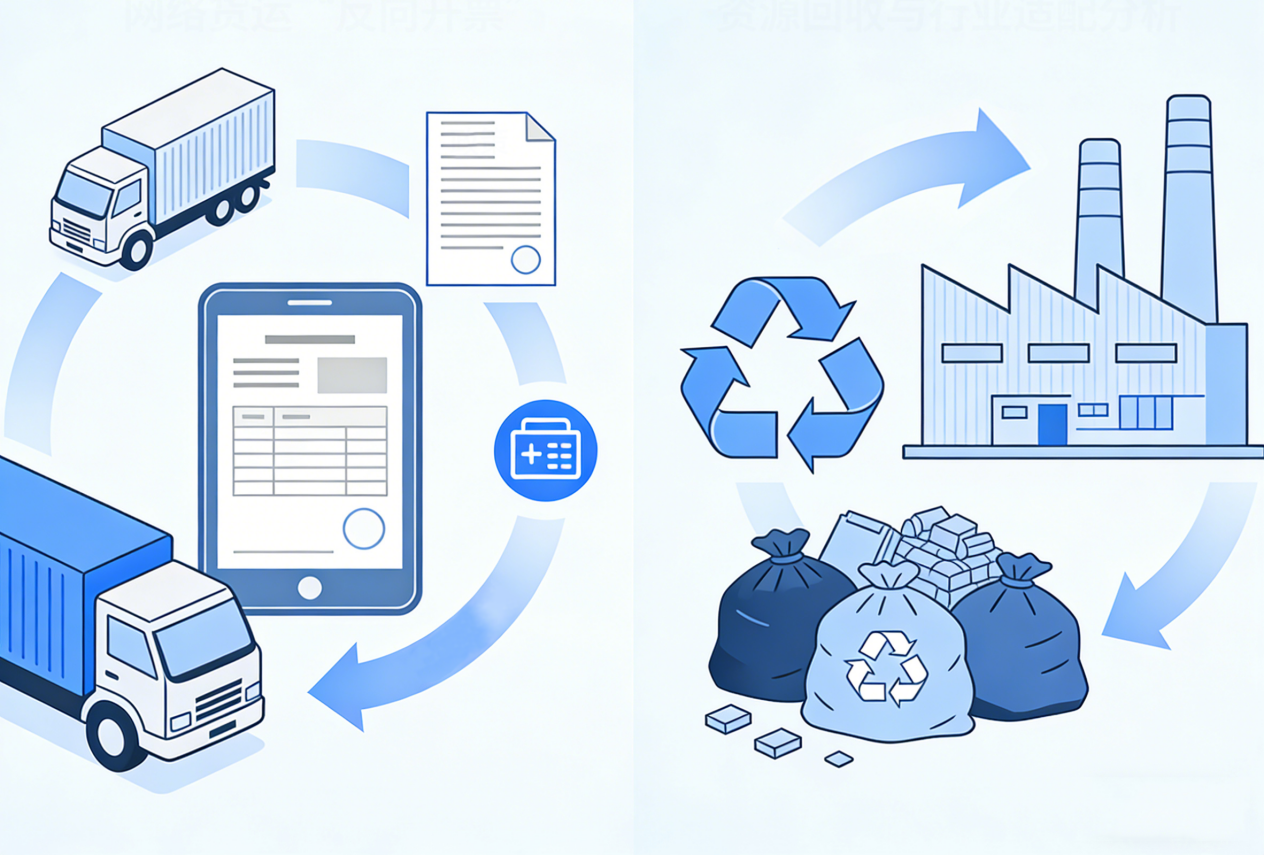
Comparison between "reverse invoicing" for online freight and practices in the resource recycling industry: Policy reference and industry adaptation analysisPublished: 2025-12-30 17:35 As China's tax collection and administration system transitions toward "tax governance by data," tax policies for new business forms and segmented fields are continuously optimized. As an innovative measure to solve the problems of dispersed upstream entities and difficult invoicing, "reverse invoicing" has already been implemented first in the resource recycling industry and has gradually sparked extensive discussion in the online freight industry. Both online freight and resource recycling industries share common pain points such as scattered underlying transaction counterparties, a high proportion of small-scale taxpayers, and broken input VAT deduction chains. However, due to differences in industry characteristics, policy support, and digital foundations, the practical paths and implementation effects of "reverse invoicing" differ significantly. By comparing the policy frameworks and current practices of "reverse invoicing" in the two major industries, this article distills policy experience that can be referenced, analyzes differences in industry applicability, and, combined with the practical results of Kailing Technology's reverse invoicing solution, provides reference for the compliant development of the two industries.
I. Policy Traceability: The Policy Framework and Core Logic of "Reverse Invoicing" in Two Major IndustriesThe core logic of "reverse invoicing" is to break through the conventional model of "seller issues invoice, buyer receives invoice," with the buyer issuing invoices for qualified upstream scattered sellers, thereby opening up the input deduction chain and standardizing industry tax collection and administration. The policies for both industries are based on the core demand of solving upstream invoicing difficulties, but there are obvious differences in policy positioning, implementation scope, and supporting support. (1) Resource recycling industry: policies clearly implemented, supporting systems complete The "reverse invoicing" policy for the resource recycling industry is centered on Announcement No. 5 of 2024 by the State Taxation Administration, which clarifies the scope, conditions, and operating procedures for policy implementation, forming a complete supporting system of "reverse invoicing + VAT incentives." According to the announcement, starting from April 29, 2024, qualifying resource recycling enterprises may issue invoices in reverse to natural person sellers of scrapped products marked "scrapped product purchase," and the seller must be a natural person whose cumulative reverse invoicing sales amount over 12 consecutive months does not exceed RMB 5 million. The policy also clarifies the qualification requirements for resource recycling enterprises, including core conditions such as a hazardous waste operating permit, end-of-life vehicle recycling and dismantling qualification, or renewable resource recycling filing, regulating invoicing entity qualifications from the source. More critically, the "reverse invoicing" in the resource recycling industry forms a policy synergy with the "Announcement of the Ministry of Finance and the State Taxation Administration on Improving the VAT Policy for Comprehensive Resource Utilization" (Document No. 40 of 2021): recycling enterprises may choose the simplified taxation method and pay tax at a 3% levy rate, while resource-utilizing enterprises may enjoy the VAT immediate refund policy based on invoices issued in reverse, such as a 70% refund for waste plastics and a 30% refund for scrap steel. This combined model of "reverse invoicing + tax incentives" effectively balances corporate tax burdens and solves the long-standing industry problems of missing input VAT deduction and pre-tax deduction vouchers. (II) Online Freight Industry: Policy Exploration Stage, Lack of Supporting Support No unified national special policy has yet been issued for "reverse invoicing" in the online freight industry, which remains at the stage of theoretical discussion and local exploration. The industry's core pain points are highly similar to those of the resource recycling industry: individual truck drivers, as the main transport providers, mostly have not completed business registration and cannot issue VAT special invoices in a compliant manner, resulting in insufficient input deductions for online freight enterprises and an inverted tax burden of "9% output tax rate, 0 input deduction." The Third Plenary Session of the 20th Central Committee proposed to "study tax systems suited to new business forms," providing direction for policy exploration of "reverse invoicing" in the online freight industry. From current practice, the exploration of "reverse invoicing" in the online freight industry focuses on the design of the deduction mechanism, referencing the "3% levy, 9% deduction" model in the agricultural product purchasing industry, and proposing a plan based on truck drivers' freight income, taxed at a 3% levy rate and deducted at a 9% deduction rate. Case calculations show that this model can reduce the tax payable of online freight enterprises from an inverted tax burden state to a reasonable range, effectively repairing the tax chain. However, there is currently a lack of supporting preferential policies similar to Document No. 40 for the resource recycling industry, and the core obstacle to policy implementation has not yet been overcome. II. Practical comparison: implementation differences and core challenges determined by industry characteristicsDifferences in transaction models, digital foundations, and regulatory environments between the two industries cause "reverse invoicing" to show different implementation results and core challenges in practice. Although the resource recycling industry has complete supporting policies, it faces compliance risks due to weak digitalization; the online freight industry, with its natural digital DNA, has the foundation for "tax governance by data" but is constrained by policy gaps that make progress difficult. (1) Transaction entities and models: differentiated characteristics under common decentralization The upstream transaction entities in both industries are highly dispersed: over 90% of business in the resource recycling industry is completed by individual small traders, including unregistered individual operators; the carriers in the online freight industry are tens of millions of individual truck drivers, most of whom are self-financing individual operators. However, the transaction models of the two differ fundamentally: the resource recycling industry has long transaction chains, frequent cash transactions, and some non-standardized transactions, such as large differences in the category and condition of scrap materials, making unified accounting difficult; the online freight industry is standardized, with freight costs and fuel, road and bridge, insurance, and other costs accounting for relatively fixed proportions, and market competition tends to align industry profit margins, providing a basis for tax burden calculation and deduction mechanism design. (II) Digital foundation: sharp contrast from weak to mature The level of digitalization is a key factor affecting the compliance cost and regulatory effectiveness of "reverse invoicing." The resource recycling industry has a weak digital foundation, and most enterprises rely on manual ledgers to record transaction information, where data is easily tampered with and difficult to trace, creating room for fraudulent invoicing. After the implementation of reverse invoicing, cases have emerged of enterprises using affiliated employees to impersonate individual sellers and inflating procurement costs to fraudulently obtain tax refunds. Tax authorities need to strengthen supervision through big data comparison and on-site inspections, resulting in high compliance costs. The online freight industry has a natural digital DNA. According to the Interim Measures for the Administration of Online Platform Road Freight Transport Operations, platforms must record waybills, trajectories, payments, and other information throughout the process to form a complete electronic data chain. As of 2024, more than 3,200 online freight enterprises nationwide had uploaded over 80 million waybills cumulatively, and with the establishment of provincial monitoring platforms in Anhui, Tianjin, and other regions, data interconnection and sharing between transport and tax authorities has been achieved, providing solid support for the regulation of "reverse invoicing." In 2025, the State Council's "Order No. 810" further clarified platforms' tax-related information reporting responsibilities, driving industry regulation toward intelligent and precise upgrading. (3) Core challenge: the two-way interplay between supporting policies and compliance supervision The core challenge of the resource recycling industry lies in compliance supervision. Although the policy clarifies the operating procedures for reverse invoicing, weak digitalization in the industry makes it difficult to verify transaction authenticity, and some enterprises exploit policy loopholes to falsely issue invoices, which both erodes the tax base and affects the effectiveness of policy implementation. In addition, resource recycling enterprises must handle tax filings on behalf of sellers, including 0.5% prepayment of individual income tax on business income and filing of VAT and surcharges, a cumbersome process prone to omissions, further increasing compliance difficulty. The core challenge for the online freight industry is the lack of supporting policies. If the reverse invoicing model of the resource recycling industry were simply copied, online freight enterprises would need to pay 3% VAT on behalf of individual drivers while still paying 6% VAT themselves, with no fundamental improvement in the actual tax burden. Therefore, the industry urgently needs supporting preferential policies similar to Document No. 40 to clarify the deduction mechanism and tax reduction plans, so as to truly realize the policy value of reverse invoicing. III. Policy reference and industry adaptation: resource recycling experience empowers online freight practiceFrom the practical comparison of the two major industries, it can be seen that the mature policy framework and practical experience of reverse invoicing in the resource recycling industry provide an important reference blueprint for solving the tax pain points of the online freight industry. The core of effective implementation of reverse invoicing lies in the precise matching of policy support and industry characteristics. Therefore, it is necessary to base it on the characteristics of the online freight industry, absorb the experience of the resource recycling industry in a targeted manner, and build a practical path suitable for its development. (1) Core referenceable experience of the resource recycling scenario The policy combination model of "reverse invoicing + supporting incentives" in the resource recycling industry is the key to its successful implementation, and this core experience can be directly applied to the online freight industry. Specifically, first is the dual-standardization experience of "entity qualifications + transaction boundaries": the resource recycling industry clarifies the qualification thresholds for reverse invoicing enterprises and the sales amount limits for natural person sellers, delineating a clear scope for tax supervision and avoiding the risk of false invoicing; second is the tax burden balancing experience of "reverse invoicing + tax incentives": by linking reverse invoicing with preferential policies such as VAT immediate refund upon collection, it both solves the input tax deduction problem and ensures a reasonable overall tax burden for the industry, and this combination logic can resolve the inverted tax burden problem in the online freight industry; third is the "full-process policy closed loop" experience: from invoicing operation standards to tax filing processes and then to subsequent supervision mechanisms, the resource recycling industry has formed complete policy guidance, providing a process-based reference for policy design in the online freight industry. In addition, the practical approach of the resource recycling industry in addressing the compliance of retail transactions also has reference value. In response to the common problem of dispersed upstream entities, the resource recycling industry has clarified the responsibilities and processes for enterprises to handle tax filing on behalf of retail sellers. Through the model of "enterprise filing on behalf + tax supervision", it lowers the tax handling threshold for retail sellers while ensuring the effectiveness of tax collection and administration. This approach can solve the problems of difficult tax handling and low willingness to issue invoices for individual drivers in the online freight industry. (II) Optimization Path for Adaptability of the Online Freight Industry Drawing on resource recycling experience requires adaptation based on the characteristics of the online freight industry, avoiding simple copying. At the policy design level, a "reverse invoicing + supporting incentives" system adapted to its service attributes should be built: on the one hand, reference should be made to the "levy 3% and deduct 9%" deduction logic, and in light of the industry reality that truck drivers' operating costs already include 7.3% VAT, clarify the plan whereby individual drivers pay tax at a 3% levy rate and online freight enterprises deduct at a 9% deduction rate, while exploring converting the tax burden difference into pension insurance subsidies for truck drivers, balancing enterprise burden reduction with protection for workers in new employment forms; on the other hand, it can connect with the policy requirements of Announcement No. 5 of 2025 on energy and toll fee deductions, forming a policy synergy between reverse invoicing and fuel (gas) invoice and toll invoice deductions to solve the industry's insufficient deduction problem. From the implementation and landing level, precise adaptation must rely on the mature digital foundation of the online freight industry. The resource recycling industry faces the challenge of verifying transaction authenticity due to weak digitalization, while online freight platforms have already achieved full-process recording of waybills, trajectories, payments, and other data. As of 2024, more than 3,200 online freight enterprises nationwide had cumulatively uploaded more than 80 million waybills, and in 2025 the State Council's "Order No. 810" further strengthened the responsibility for reporting tax-related information. This advantage can be fully utilized to deeply integrate reverse invoicing with platform digital supervision, using blockchain and AI technology to realize real-time verification of waybills, trajectories, payment data, and invoicing information, ensuring transaction authenticity; at the same time, with the data-sharing mechanism between transportation and tax authorities, build a full-chain regulatory system of "qualification review-transaction monitoring-follow-up inspection," adapting to the cross-regional and highly mobile service characteristics of online freight and ensuring the standardized implementation of reverse invoicing. IV. Solution empowerment: Kailing Technology helps the industry develop compliantly and efficientlyWhether it is the digital transformation needs of the resource recycling industry or the policy implementation preparation of the online freight industry, a professional reverse invoicing solution can significantly reduce enterprise compliance costs and improve operational efficiency. With deep industry accumulation and technical advantages, Kailing Technology's full-process reverse invoicing solution has been implemented and verified in many large renewable resource enterprises, and its core advantages precisely match the practical needs of the two major industries. (1) Full-process integration to break down data silos Kailing Technology's solution realizes full-lifecycle integration from the business front end to the finance-tax back end, supports seamless connection among weighbridge systems, order systems, capital platforms, and tax systems, and enables real-time data synchronization, avoiding errors and delays from manual entry. For resource recycling enterprises, the system can automatically associate the category, weight, and tax code of scrap materials to achieve precise invoicing; for online freight enterprises, it can connect waybill trajectories and payment data to provide data support for the transaction authenticity of reverse invoicing. (II) Intelligent tax calculation and filing, reducing labor costs The system has a built-in automated tax calculation engine that can calculate in real time, per policy requirements, the VAT (supporting a 3% or 1% levy rate) and the 0.5% prepaid individual income tax on business income for individual sellers, and generate the Tax Payment Agency Report with one click, greatly reducing the workload of finance staff. For the tax payment agency needs of resource recycling enterprises, the system can automatically collect and submit filing data, ensuring a compliant and efficient filing process. (3) Full-chain evidence chain management, worry-free response to tax audits Relying on the regulatory requirements of "tax governance by data", Kailing Technology's solution automatically collects and archives key evidence of each transaction, including procurement contracts, weighbridge tickets, payment vouchers, and transportation records, forming a complete and traceable data chain. This function precisely solves the difficulty of verifying transaction authenticity in the resource recycling industry, and also provides compliance assurance for future reverse invoicing regulation in the online freight industry, helping enterprises easily pass tax audits. (4) Flexible adaptation, supporting differentiated industry needs The solution can flexibly adapt to both the general taxation method and the simplified taxation method, and supports the issuance of special VAT invoices and ordinary invoices, meeting the needs of resource recycling enterprises in different business scenarios; for the online freight industry, it can reserve adaptation space for deduction mechanisms such as "levy 3, deduct 9," enabling rapid system upgrades once the policy is implemented. At the same time, it supports private deployment and Leqi Direct Connection interface upgrades, ensuring enterprise data security while proactively preparing for future tax digital transformation needs. As an important exploration of tax policy adaptation to new business forms, the practice of "reverse invoicing" in the resource recycling industry provides valuable policy reference for the online freight industry, while the digital experience of the online freight industry points out the direction for the compliant development of the resource recycling industry. The core demand of both industries is to achieve a win-win of "policy compliance + efficiency improvement," a goal inseparable from the support of professional digital solutions. The Kailing Technology Reverse Invoicing Solution is policy-oriented, technology-centered, and service-guaranteed, precisely solving the compliance pain points of two major industries. It not only helps resource recycling enterprises achieve digital transformation and compliant operations, but also provides solid technical reserves for online freight enterprises to respond to future policy implementation. As the tax system continues to adapt to new business formats, it is believed that with the empowerment of professional solutions, the two major industries will gradually break through the development bottleneck of a broken tax chain and move toward a new stage of standardized, high-quality development. The Kailing Technology Reverse Invoicing Solution uses the power of digital intelligence to connect policy and industry, safeguarding enterprises' compliant advancement and efficient growth:https://www.kailingteck.com/ 。 As a comprehensive business-finance-tax digitalization solution service provider, Kailing Technology provides business-finance-tax management digital transformation products and operational services for various government agencies, institutions, and large, medium, and small enterprises. The product line includes: Sales contract management system, procurement contract management system, fully digitalized Leqi interface project, output automatic invoicing system,Reverse invoicing system,Solutions for the invoice issuance for individuals system, employee expense control and reimbursement system, input VAT invoice management system, supply chain collaborative reconciliation system, image AI OCR recognition system, automated financial bookkeeping system, electronic accounting archives system, and other businesses, comprehensively advancing the digitalization process across various fields. If you have any business-finance-tax digital transformation needs, welcome to contact us. Beijing Kailing Technology will serve you wholeheartedly.
#Reverse Invoicing Solution #Reverse Invoicing System #Resource Recycling Enterprise Reverse Invoicing Solution #Agricultural Product Procurement Reverse Invoicing Solution #Freight Industry Reverse Invoicing #Digital Business-Finance-Tax |