010-6097 4119Book a Demo


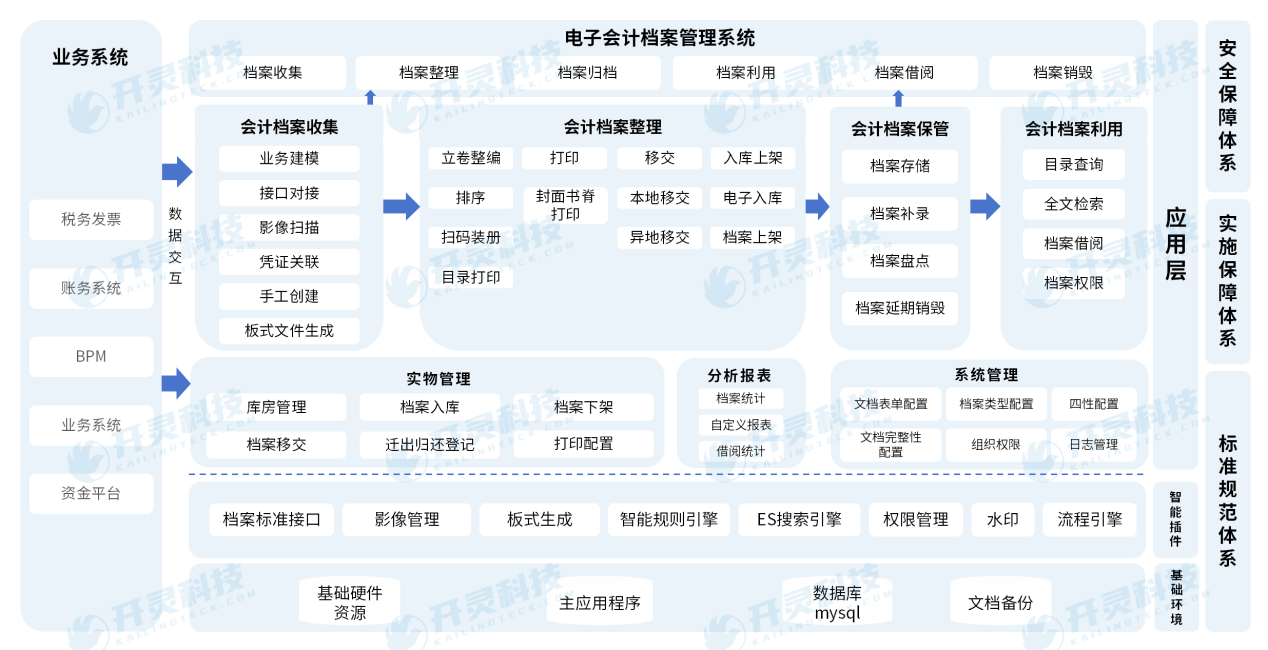
Kailing Technology practice: technical compliance service guide for electronic accounting archives vendor selectionPublished: 2025-10-23 17:02 In the era of digital supervision with the comprehensive implementation of China Golden Tax Phase IV and the nationwide adoption of fully digitalized e-invoices, corporate accounting archives management is accelerating its transformation toward "full-process electronicization." Policies such as the Measures for the Management of Accounting Archives (Order No. 79 of the National Archives Administration), the Notice on Regulating the Reimbursement, Booking, and Archiving of Electronic Accounting Vouchers (Cai Kuai [2020] No. 6), and the Ministry of Finance's 14th Five-Year Plan for accounting informatization explicitly require that electronic accounting vouchers have the same legal effect as paper vouchers and that full-chain compliance be achieved across "receipt-verification-archiving-custody-utilization." Against this backdrop, choosing a reliable electronic accounting archives vendor is not only a need for technology implementation but also the core safeguard for enterprises to respond to high-frequency supervision and avoid business-finance-tax risks. This article, based on the practice of Kailing Technology's electronic accounting archives solution, breaks down the core traits of reliable vendors from four dimensions—technical strength, compliance capability, successful cases, and service system—providing practical reference for enterprise selection. I. Technical Strength: Hardcore Support from Architecture to Functions, Building a Solid System FoundationThe stability, security, and scalability of the electronic accounting archives system directly determine enterprise financial management efficiency and data security.Reliable vendor's technical strength is not only reflected in a single function, but also in the completeness of the full-process technical architecture and the differentiation of core capabilities, which can be verified from the following dimensions。 1. Underlying architecture: high-availability design adapted to enterprise scaleReliable vendorsystem needs to have the characteristics of "high concurrency, high fault tolerance, and scalability" to cope with enterprise business growth and surging data volumes. Taking Kailing Technology's electronic accounting archives system as an example, it adopts a microservices architecture + distributed storage design, supporting cross-regional deployment and elastic scaling: - Data processing capability:Can carry archive data such as vouchers, invoices, and contracts at the billion level, with full-text search response time ≤1 second, meeting the archive management needs of large group enterprises with multiple entities and multiple business formats。 - System compatibility:Compatible with mainstream databases such as MySQL and Oracle, supporting seamless integration with financial systems such as Yonyou, Kingdee, SAP, and Oracle, as well as enterprise self-developed business systems such as ERP, OA, and SRM, achieving automatic aggregation of the four-stream data of "financial flow-business flow-tax flow-fund flow" (such as connecting to fund systems to obtain bank receipts, and connecting to tax systems to obtain output and input VAT invoices).
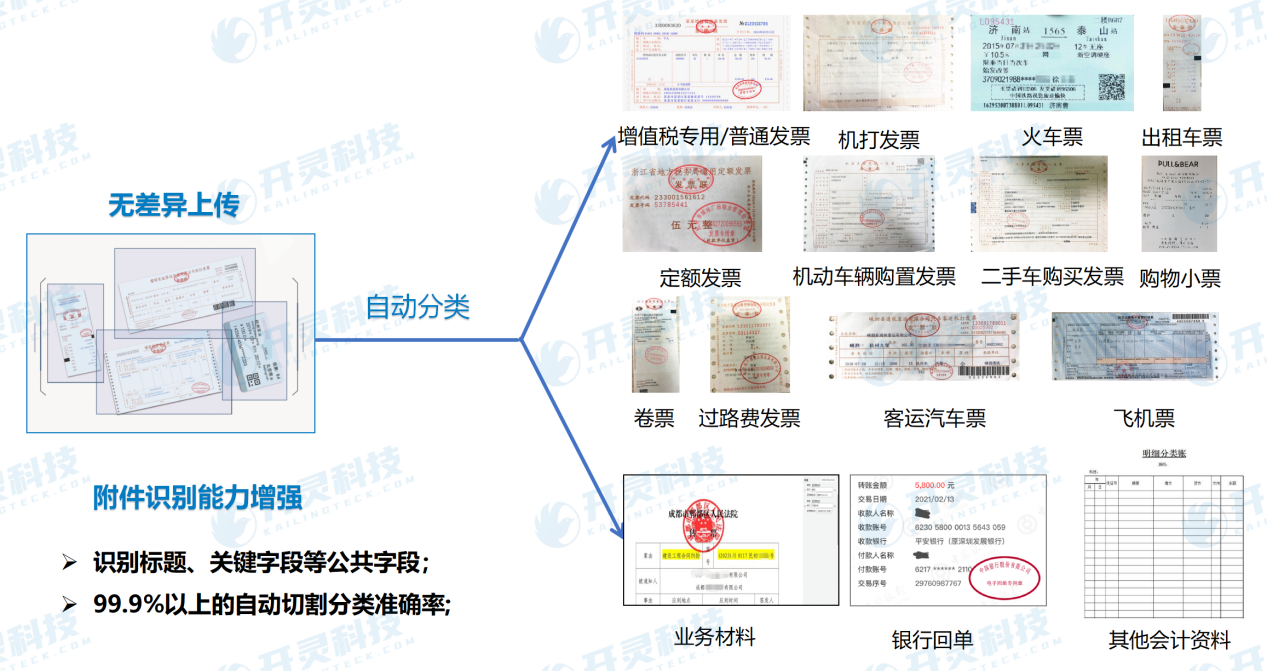
2. Core functions: intelligent capabilities covering the full lifecycle of archives Reliable vendorsystem needs to break through the limitations of "simple storage" and realize intelligent management of the entire archive process from collection to destruction. Key functions need to meet the following requirements: - OCR recognition: private deployment ensures data security An OCR recognition platform supporting private deployment is the core safeguard against leakage of sensitive enterprise data (such as invoices and bank receipts). The Kailing Technology OCR system can accurately recognize over 20 types of documents (VAT special/general invoices, train tickets, flight itineraries, taxi receipts, bank receipts, etc.), with recognition accuracy exceeding 99.9%, and supports custom model training to achieve structured extraction and electronic archiving of paper documents, reducing manual entry workload by over 70%.
- Four-property detection: Full-dimensional compliance verification, avoiding archiving risks According to the requirements of the Basic Terminology for Electronic Archive Management, the system needs to automatically complete the "four-property" testing of authenticity, integrity, usability, and security:
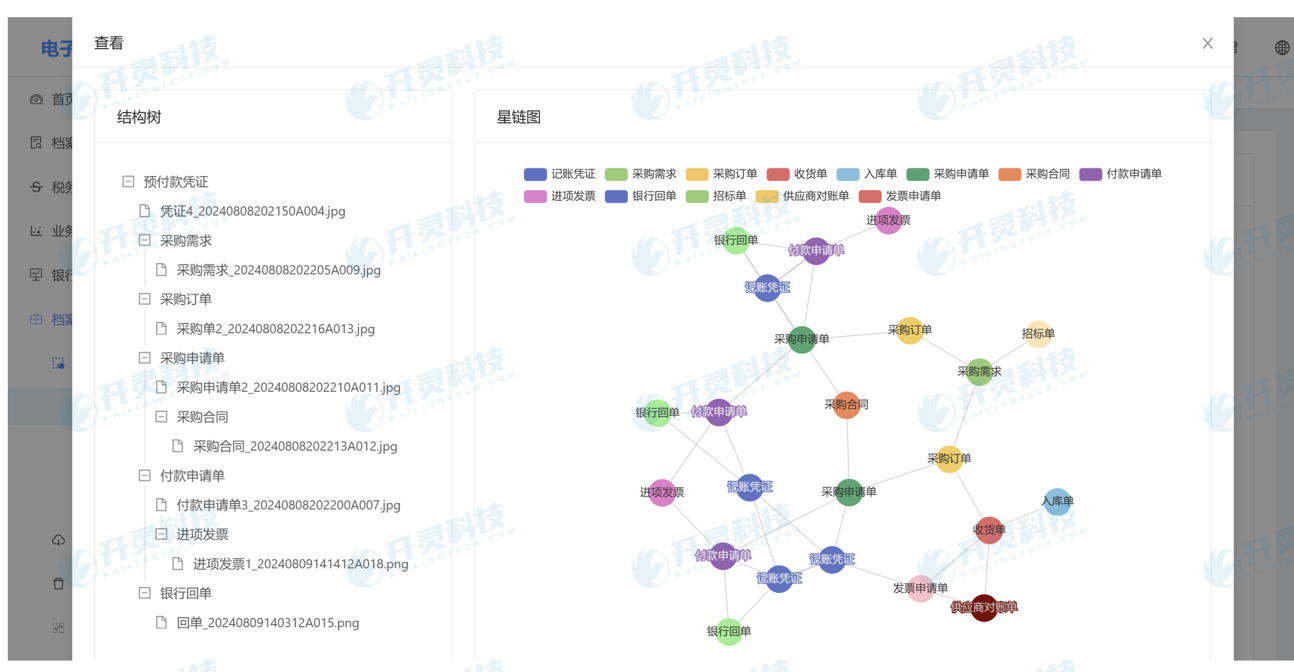
- StarchainFigure: Data penetration improves archive utilization efficiency For scenarios where "one business transaction is linked to multiple archives" (e.g., a 1 million procurement contract paid in 3 installments, linked to 3 invoices, 3 bank receipts, and 3 accounting vouchers), the system uses Xinglian Graph visualization technology, with core documents (such as contract numbers) as nodes, to automatically link all upstream and downstream archives, achieving "one-point penetration, full-chain viewing."
- Customization capabilities: source code knowledge transfer reduces expansion costs Reliable vendorEnterprises need to be given independent expansion capabilities to avoid cost surges caused by relying on vendors for subsequent feature upgrades. Kailing TechnologyCanProvides source code delivery + knowledge transfer services; enterprises can independently define archive forms and configure index fields without additional development costs, adapting to changes in business scenarios. II. Compliance capability: Keeping pace with policy iterations to ensure full-chain policy adaptationThe core value of electronic accounting archives lies in "compliance,"Reliable vendorIt is necessary to have policy foresight and rapid system adaptation capabilities to ensure the system always complies with the latest regulatory requirements. This can be verified from the following aspects:。 1. Policy Coverage: Fully Adapting to Core Regulatory RequirementsReliable vendorsystem needs to deeply interpret and implement the following key policies, rather than simply meeting the basic requirement of "being able to store electronic archives": - "Measures for the Management of Accounting Archives" (Order No. 79):Meet the 6 major conditions for "internal electronic accounting materials to be kept only in electronic form" (authentic source, system can receive, tamper-proof, backup mechanism, etc.). For example, the Kailing system uses "electronic signature + blockchain evidence storage" to ensure archives cannot be tampered with, complying with Article 8 of Order No. 79; - "Finance and Accounting Document No. 6 of 2020":Solve the compliance risk of "archiving only paper printouts of electronic invoices"; the system mandates "synchronous preservation of electronic vouchers and paper printouts" and verifies invoice authenticity in real time through connection to the Electronic Tax Bureau, preventing duplicate reimbursement and fraudulent invoice entry; - Ministry of Finance "14th Five-Year" Accounting Informatization Plan:Adapts to indicators in the plan such as "80% of non-manual accounting units apply electronic voucher standards" and "50% of central enterprises apply underlying accounting data standards"; the Kailing system supports parsing of electronic voucher XML/XBRL formats and can directly connect to the Ministry of Finance's accounting data standards platform, meeting the compliance requirements of large enterprises such as central and state-owned enterprises; - China Golden Tax Phase IV's "non-tax" supervision requirements:The system connects to the electronic tax bureau to automatically obtain the PDF source files of tax filing forms (such asVAT filing form, stamp tax filing form) and invoice status (such as red-letter reversal and voiding), realizing a full-process closed loop of "invoice-filing-archiving" and responding to the trend of "full-data, full-business, full-process cloud-based supervision of taxes and fees" under China Golden Tax Phase IV. 2. Special adaptation for fully digitalized e-invoices: meeting the latest invoice management requirementsWith the popularization of fully digitalized e-invoices, the Caihui [2025] No. 9 document sets new requirements for fully digitalized e-invoice archiving,Reliable vendorIt is necessary to have full-process management capabilities for fully digitalized e-invoices: - Fully digitalized e-invoice collection:Supports automatic import of XML/OFD files, extracting metadata such as invoice number, invoicing date, and amount, with no manual entry required; - Status monitoring:Connect to the Electronic Tax Bureau for real-time polling of invoice status (e.g., already deducted, already red-reversed). If the invoice status is abnormal (e.g., voided), the system automatically triggers an alert to prevent non-compliant invoices from being recorded; - Archiving compliance:As required by the National Archives Administration, archive fully digitalized e-invoice metadata together with invoice face files, generate archive packages compliant with national standards, and ensure traceability during subsequent audits and regulatory retrieval. III. Service system: full lifecycle assurance from implementation to operations and maintenanceThe electronic accounting archives system is not a one-time delivered product, but a management tool that requires long-term iterative optimization.Reliable vendor's service system needs to cover the full lifecycle of "project implementation - system operation and maintenance - policy iteration", avoiding enterprises falling into the dilemma of "termination upon delivery"。 1. Implementation Services: Standardized Processes Ensure Implementation ResultsReliable vendorIt is necessary to have a clear implementation methodology, rather than disorderly advancement of "changing while doing." Kailing Technology adopts a "five-stage implementation method" to ensure the project is implemented on time and in compliance: - Requirements research stage:Work with enterprise finance, IT, and tax departments to sort out archiving content and clarify "mandatory archive items" and "optional archive items"; - Blueprint design phase:Based on the enterprise's existing system architecture, design a "system integration plan" and "process optimization plan," and pass enterprise review; - System implementation phase:Complete system deployment, interface development, data migration, and user training; - System switchover phase:Adopt a "parallel operation + gradual replacement" strategy, first verifying system stability through small-scale pilots, then fully replacing the traditional paper archive management model; - Optimization and improvement stage:Continuously optimize functions based on enterprise feedback and policy changes. 2. Operations and maintenance services: rapid response to ensure system stabilityReliable vendorIt is necessary to have "7×24-hour response + localized support" capabilities to resolve enterprise system failures and operational issues: - Technical Support: Provide a three-tier response mechanism of phone, remote assistance, and on-site support, with fault response time ≤1 hour and on-site arrival within 4 hours for major faults; - System upgrades: regularly push system upgrade packages to ensure long-term compliance; - Knowledge transfer:If there is a source code delivery need,Provide enterprise IT teams with source code training and interface development training, enabling them to independently solve simple problems and reducing long-term dependency costs. 3. Value-added services: helping enterprises deepen digital transformationReliableVendors not only provide "archive management" services, but can also provide value-added support to enterprises based on their own experience: - Policy Interpretation:Periodically organize finance and tax policy training to help enterprise finance teams understand policy changes; - Process optimization:Based on industry best practices, assist enterprises in reconstructing financial management processes to further improve efficiency; - Data value mining:Through statistical analysis of archive data, it provides data support for enterprise budget management and cost control. Under the dual trends of full-dimensional regulation under China Golden Tax Phase IV and full-process electronization of accounting informatization, electronic accounting archives systems have become infrastructure for corporate finance management. ChoosingReliable vendor, it means not only obtaining a compliant system, but also gaining a digital transformation partner that understands policy, technology, and business. As a professional, efficient, and reliable business-finance-tax digital solution service provider, Kailing Technology always takes policy as the guiding principle, technology as the foundation, and service as the core, helping enterprises upgrade accounting archives from compliant storage to value mining, and safeguarding steady business operations. To learn more about electronic accounting archives system selection details or to obtain a customized solution, visit Kailing Technology for 1-on-1 consultation support from a professional team.:https://www.kailingteck.com/h-col-110.html 。 As a comprehensive business-finance-tax digitalization solution service provider, Kailing Technology provides business-finance-tax management digital transformation products and operational services for various government agencies, institutions, and large, medium, and small enterprises. The product line includes: Solutions for sales contract management system, procurement contract management system, fully digitalized Leqi interface project, automatic output VAT invoicing system, invoice issuance for individuals system, employee expense control and reimbursement system, input VAT invoice management system, supply chain collaborative reconciliation system, imaging OCR recognition system, automatic financial bookkeeping system, electronic accounting archives system and other businesses, comprehensively advancing the digitalization process across various fields. If you have any business-finance-tax digital transformation needs, welcome to contact us. Beijing Kailing Technology will serve you wholeheartedly.
|