010-6097 4119Book a Demo


The Era of Fully Digitalized E-Invoices: The Path to Building an Invoice SystemPublished: 2025-04-23 16:18 At present in 2024-2025, tax-controlled invoices and fully digitalized e-invoices are in a parallel stage. Although tax-controlled invoices are gradually being used less, they will still exist for some time; while fully digitalized e-invoices are developing rapidly, they have not yet fully stabilized. Many group enterprises, business-finance-tax service software companies, and B-end internet companies have joined in, jointly opening a new era of fully digitalized e-invoices under China Golden Tax Phase IV, with the goal of achieving digitalization, electronification, and unified management of invoices across 36 provinces, cities, and regions nationwide. Against this backdrop, how to build an invoice system that fits enterprise needs has become a key issue. Next, this article will elaborate in detail from multiple aspects such as the basic concepts of invoice systems, business processes and architecture, product design, and business support systems, hoping to spark discussion and exchange among more professionals. I. Basic understanding of the invoice systemAs payment and receipt vouchers issued and received in the purchase and sale of goods, the provision or acceptance of services, and other business activities, invoices are of extremely important significance. They are not only the record carrier of economic activity content, but also the basic original voucher for accounting. For tax authorities, invoices are the key basis for controlling tax sources and collecting taxes; from the national perspective, invoices are an important means of supervising economic activities, maintaining economic order, and safeguarding national property security.
Currently, the main entities participating in building invoice systems are the State Taxation Administration, enterprises with business-finance-tax informatization needs, software service providers offering business-finance-tax integrated services, and software service providers offering invoice services. Although different entities have different focuses when building invoice systems, they all need to deeply understand the business and task forms in economic activities, and use software systems to transform business into tasks, achieve association with economic activities, and accurately record the flow process of economic activities. In actual life scenarios, whether it isRetail、Catering、hotels,Internetand other enterprises, or individuals consuming at these venues, as well as institutions such as public institutions and schools, all involve the issuance and use of invoices. For example, after receiving medical treatment at a hospital, a patient can obtain a medical service invoice for supplementary medical reimbursement, and the enterprise's finance staff will use it as a financial voucher for booking. II. Invoice system business process and architectureAt the fully digitalized stage, the electronic tax bureau divides the invoice system into two modules: invoicing and invoice use; during China Golden Tax Phase III, some service providers divided the invoice system into output VAT invoice and input VAT invoice modules. In essence, both classification methods distinguish around the issuance and use of invoices. This article will introduce them according to the electronic tax bureau's classification of invoicing and invoice use.
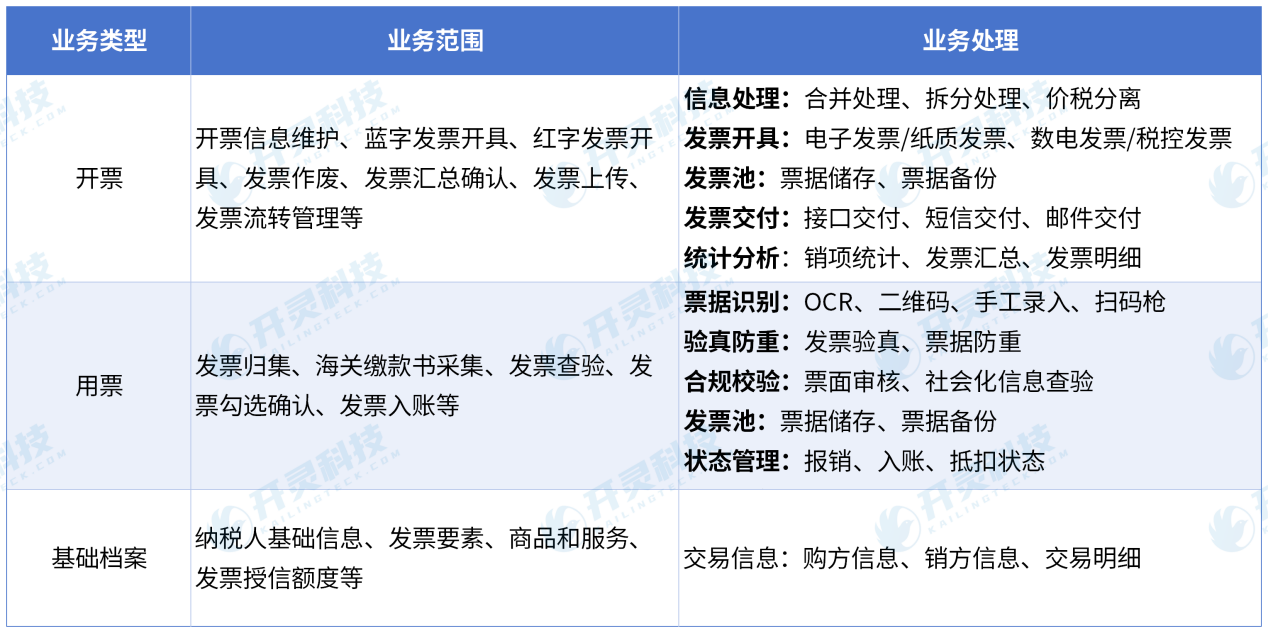
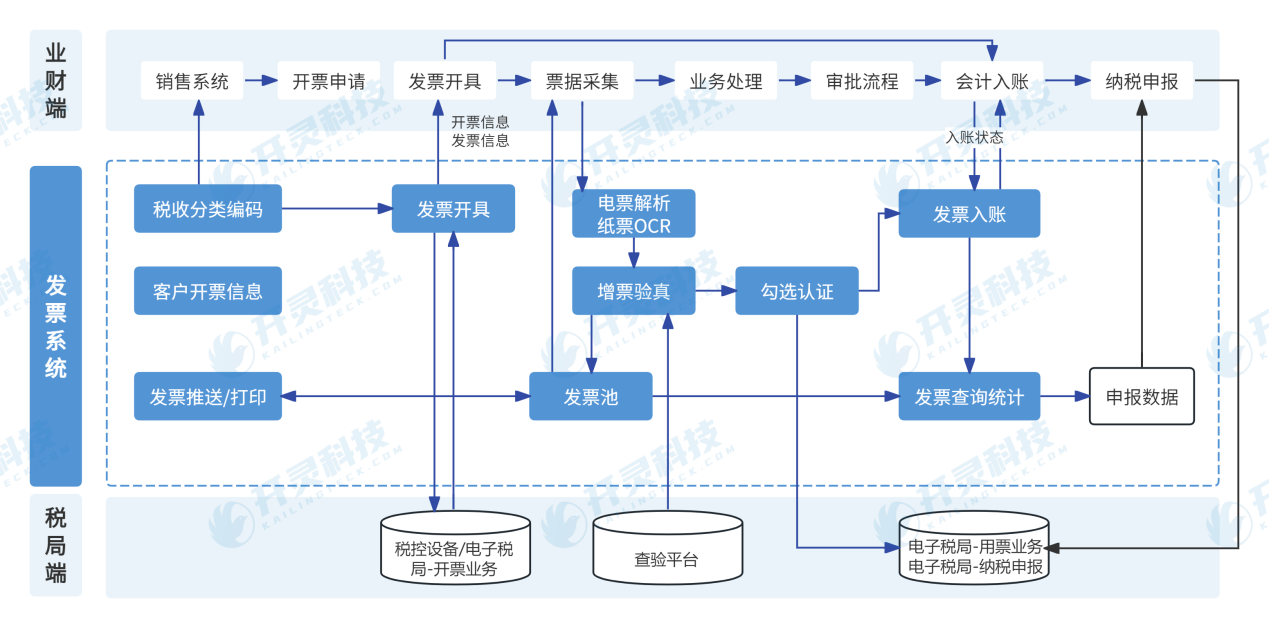
The business scope of the invoice system covers multiple parts such as invoicing, invoice use, and basic archives. Invoicing business includes invoicing information maintenance, blue-letter and red-letter invoice issuance, invoice voiding, summary confirmation, upload, circulation, etc., and also involves information processing, invoice issuance type management, invoice pool storage, delivery, and statistical analysis; invoice use business includes invoice collection, verification, check confirmation, accounting entry, as well as invoice recognition, authenticity verification and duplicate prevention, compliance verification, status management, and statistical analysis; basic archives mainly record basic taxpayer information, invoice elements, goods and services information, transaction information, and credit limits. In actual business operations, when enterprises sell or transfer goods, labor or services, they can initiate invoicing applications from business systems or financial systems. After invoicing information is complete and data verification is correct, invoices are issued and delivered to recipients. If the recipient is an enterprise, it needs to collect and verify invoice information and include it in the invoice pool. For deductible invoices such as special VAT invoices, selection and deduction operations must be performed to reduce the enterprise's output tax. In addition, both the invoicing party and the recipient need to complete tax filing and financial booking to ensure accurate correspondence among financial, tax and invoice data. At the same time, enterprises can also generate various reports through query, statistics, summary and analysis of invoice data, thereby clearly understanding company operations and providing strong support for subsequent business decisions.
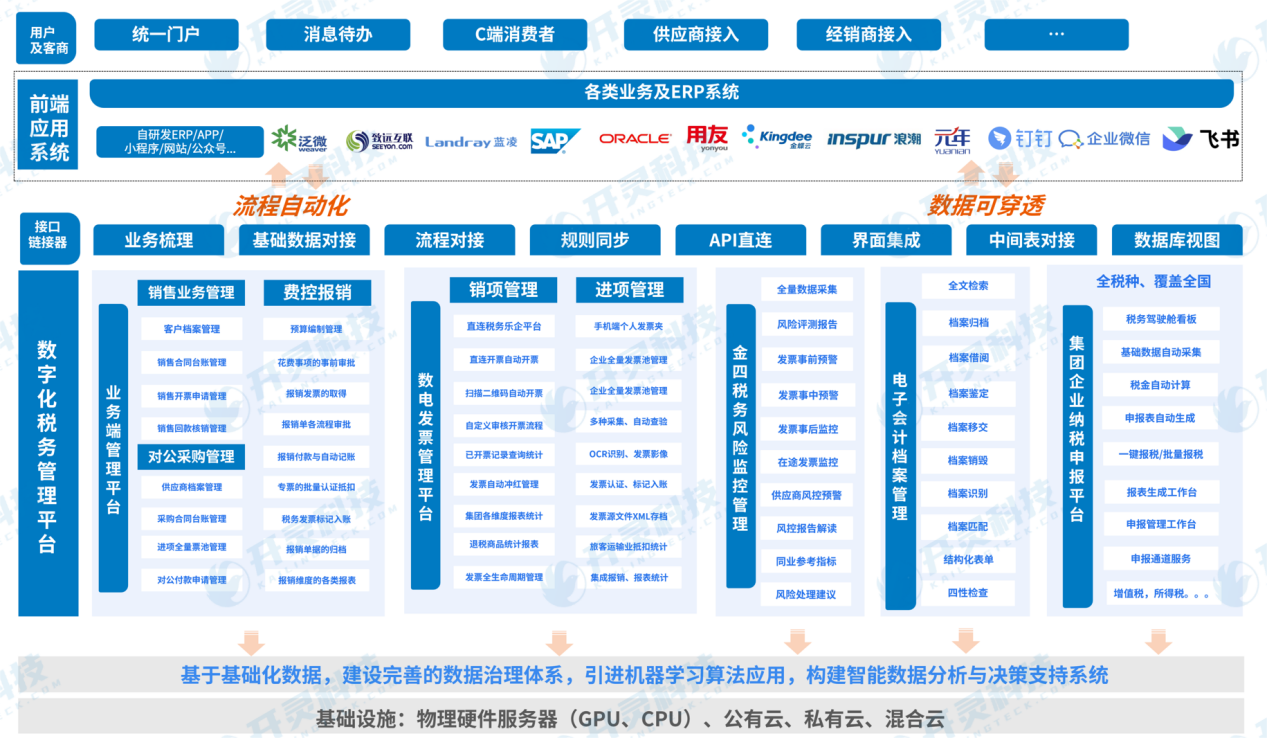
Based on the above business scenarios and processes, the invoice system can be built into a product architecture with three modules: the bill middle platform, invoice business, and invoice pool. The bill middle platform is responsible for connecting external systems, receiving invoicing data from business-finance systems, and after bill processing and rule processing, passing standard invoicing and invoice usage data to the invoice business module for operations such as invoice issuance and selection for deduction. All issued and obtained invoices are ultimately stored in the invoice pool for invocation and analysis by various systems and modules. During invoice business processing, interaction with multiple systems such as tax bureaus, banks, and finance departments is required. Some enterprises, in order to achieve a fully automated closed loop, choose to connect to third-party channel systems and outsource invoice business processing. III. Preliminary preparations for invoice system constructionBefore building an invoice system, enterprises need to complete a series of preparatory work. First, they must obtain the taxpayer qualification for issuing and using invoices. Enterprises can apply to the local tax authority to become a general taxpayer or small-scale taxpayer according to their actual situation. After completing qualification applications, enterprises still need to choose an appropriate invoice business processing method. Currently, common methods on the market include the Golden Tax disk, tax-control disk, tax UKey, tax-control server, and electronic tax bureau (such as the VAT comprehensive service platform and electronic tax bureau). Notably, traditional hardware devices for pre-invoicing preparation are gradually being phased out by the market, and more enterprises handling business on the VAT comprehensive service platform are transitioning to the electronic tax bureau. The electronic tax bureau has multiple product forms such as web, Leqi interface services, and APP. When integrating, large enterprises may consider applying for the Leqi interface to achieve direct connection with the tax bureau.
In the era of fully digitalized e-invoices, building an invoice system is crucial to a company's business-finance-tax management and operational decision-making. Companies need to fully consider their own needs and, in line with industry trends, reasonably build an invoice system to improve financial management efficiency and adapt to the new requirements of digital tax collection and administration. For more business-finance-tax digitalization needs, please consult Kailing Technology:https://www.kailingteck.com/ 。 As a comprehensive business-finance-tax digitalization solution service provider, Kailing Technology provides business-finance-tax management digital transformation products and operational services for various government agencies, institutions, and large, medium, and small enterprises. The product line includes: Solutions for sales contract management system, procurement contract management system, fully digitalized Leqi interface project, automatic output VAT invoicing system, invoice issuance for individuals system, employee expense control and reimbursement system, input VAT invoice management system, supply chain collaborative reconciliation system, imaging OCR recognition system, automatic financial bookkeeping system, electronic accounting archives system and other businesses, comprehensively advancing the digitalization process across various fields. If you have any business-finance-tax digital transformation needs, welcome to contact us. Beijing Kailing Technology will serve you wholeheartedly.
|