010-6097 4119Book a Demo


Interpretation of the Electronic Archives Management Measures (Part IV): Organization, Archiving and StandardizationPublished on: 2024-11-12 16:42 Decree No. 22 of the National Archives Administration, the "Measures for the Management of Electronic Archives," officially took effect on November 1. To help everyone deeply understand the specific intent of the provisions, the scope of implementation, and practical operations of the "Measures," we have specially prepared a series of short articles interpreting and analyzing the "Measures for the Management of Electronic Archives." Today, we will continue to discuss "Chapter 3 of the Measures for the Management of Electronic Archives: organization, archiving, and standardization.
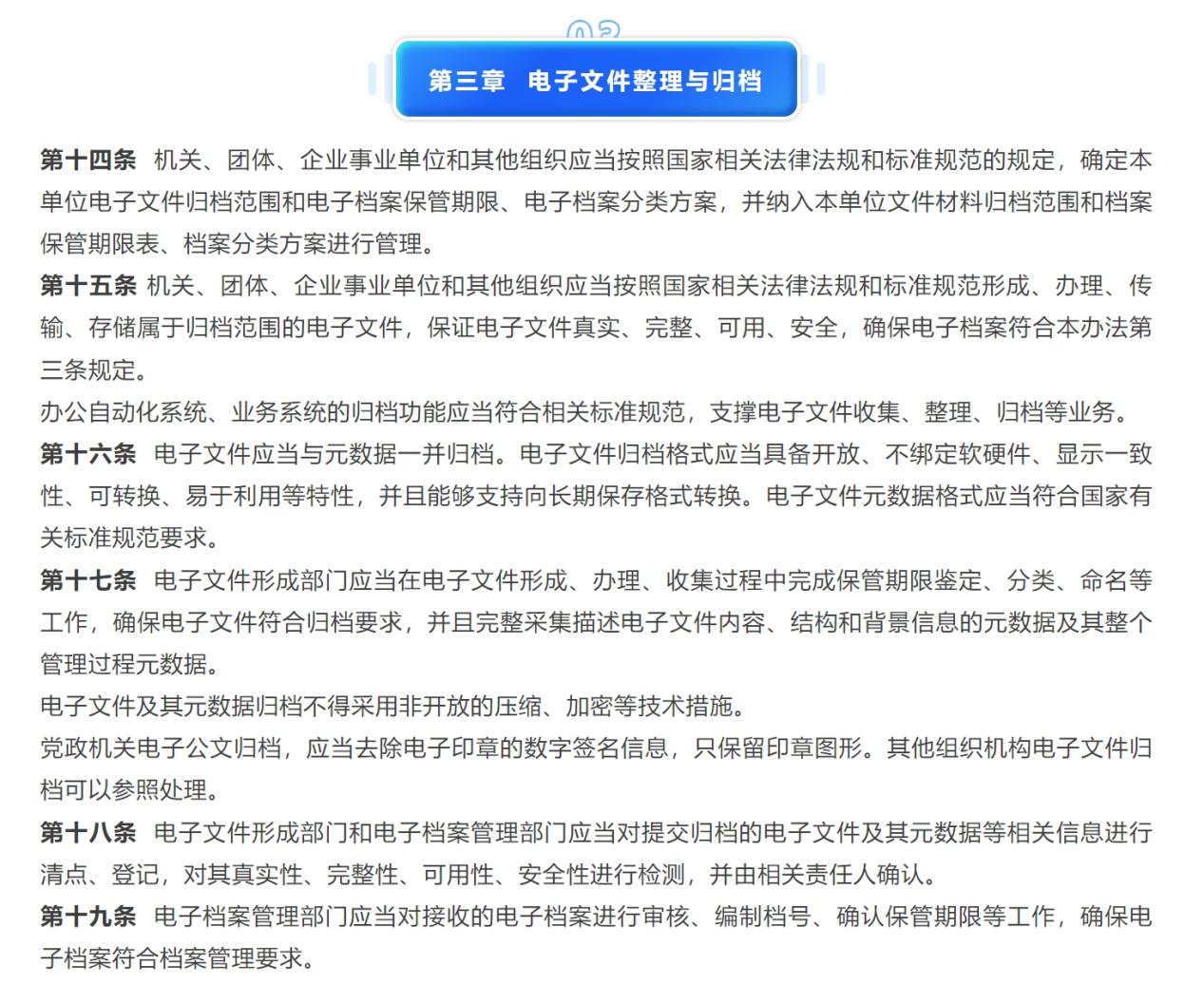
Chapter 3 puts forward comprehensive management specifications for the organization and archiving of electronic documents. When archiving, each unit must ensure that documents meet the organization requirements, collect and preserve all relevant metadata, and follow open-standard format specifications to facilitate the long-term preservation of electronic documents. Steps such as inventory, inspection and review in the provisions form a dual verification mechanism for documents from generation to archiving, ensuring the rigor and reliability of archive management, so that the organization and archiving process of electronic archives complies with national standards and is operable. Article 14 - Archiving Scope and Retention Periods Article 14 provides that when organizing electronic documents, various organizations should clearly define their archiving scope, retention periods and classification plans, and incorporate them into the organization's archives management system. This means that the organization and archiving of electronic documents must, based on the organization's actual circumstances and legal provisions, determine which documents should be archived and their retention periods, and form standardized criteria for archives management, so as to ensure the systematic and operable nature of archives management. Article 15 - Standards for the Electronic Document Management Process Article 15 clarifies the whole-process management requirements for electronic documents within the archiving scope, from creation and handling to storage. Documents need to have archiving functions in office automation systems and business systems, and comply with national standards, ensuring that documents are authentic, complete, usable and secure. The document system must be able to support business operations such as the collection, organization and archiving of electronic documents, so that archiving operations are integrated with the organization's daily work, and technically ensure lossless transfer and storage of documents during the archiving process. Article 16 - Archiving Format and Metadata Article 16 requires that electronic documents be archived together with their metadata, and that the archiving format have characteristics such as openness, universality and convertibility to support long-term preservation. This standard ensures that electronic archives are not restricted by specific software or hardware, increasing the universality and future adaptability of electronic archives in long-term preservation. Document and metadata formats should follow national standards, so that archive information is complete and consistent in terms of content, structure and background information. Article 17 - Classification, naming, and metadata collection Article 17 provides that when creating and collecting electronic documents, the document creation department must complete operations such as retention period appraisal, classification, and naming, and fully collect the metadata of the documents. The use of non-open compression or encryption technologies is prohibited. This requirement ensures the transparency and openness of electronic document management and avoids affecting subsequent management and utilization of documents due to technical limitations. In particular, the archiving requirements for documents of Party and government organs remove the digital signature information of electronic seals to ensure the long-term validity of the information in the document itself. Article 18 - Inventory and Inspection of Document Archiving Article 18 emphasizes that before archiving submission, the department that created the electronic documents and the archives management department must inventory, register and inspect the documents and metadata. The purpose of inspection is to ensure the authenticity, completeness, usability and security of the documents, and after the responsible persons confirm that they are correct, they are submitted for archiving. This operating process ensures a dual review system at the time of document archiving, avoiding omissions or errors in information during archiving. Article 19 - Review and Filing of Electronic Archives Article 19 requires the archives management department to review the electronic archives received, compile archive numbers and confirm retention periods, so as to ensure the archives meet the requirements of standardized management. The secondary review of archived documents by the archives management department, including the compilation of archive numbers and confirmation of retention periods, strengthens the structured management of the archives system, ensures orderly classified storage of archives, and facilitates future retrieval and use. Summary Chapter 3 puts forward comprehensive management specifications for the organization and archiving of electronic documents. When archiving, each unit must ensure that documents meet the organization requirements, collect and preserve all relevant metadata, and follow open-standard format specifications to facilitate the long-term preservation of electronic documents. Steps such as inventory, inspection and review in the provisions form a dual verification mechanism for documents from generation to archiving, ensuring the rigor and reliability of archive management, so that the organization and archiving process of electronic archives complies with national standards and is operable. Source: internet As a comprehensive business-finance-tax digitalization solution service provider, Kailing Technology provides business-finance-tax management digital transformation products and operational services for various government agencies, institutions, and large, medium, and small enterprises. The product line includes: Solutions for businesses including sales contract management system, procurement contract management system, fully digitalized Leqi interface project, output automatic invoicing system, employee expense control and reimbursement system, input VAT invoice management system, supply chain collaborative reconciliation system, image OCR recognition system, automatic financial bookkeeping system, and electronic accounting archives system, comprehensively driving the digitalization process across various fields. If you have any business-finance-tax digital transformation needs, welcome to contact us. Beijing Kailing Technology will serve you wholeheartedly.
|