News Details

The Electronic Archives Management Measures take effect from November 1, and the construction of electronic accounting archives brooks no delay

Published: 2024-10-30 17:07

Recently, the National Archives Administration issued Order No. 22, releasing the "Measures for the Management of Electronic Archives." These Measures will take effect on November 1, 2024.

The Electronic Archives Management Measures take effect from November 1, and the construction of electronic accounting archives brooks no delay


Chapter One General

Then


Article 1
These Measures are enacted in accordance with the Archives Law of the People's Republic of China and other laws and regulations to strengthen and standardize electronic archives management, ensure that electronic archives are authentic, complete, usable, and secure, and promote archive work to better serve the overall work of the Party and the state and serve the people.

Article 2

These Measures apply to electronic archive management by archives, organs, organizations, enterprises, public institutions, and other organizations (hereinafter referred to as organizations).


Electronic archives referred to in these Measures means various information records formed, processed, transmitted, and stored through computers and other electronic devices by organs, groups, enterprises, public institutions, and other organizations as well as individuals in the course of performing statutory duties or handling affairs, which have preservation value for the state and society and are archived for preservation.

Article 3

Organizations shall ensure that electronic archives meet the following requirements:

(1) Reliable source. Produced by a lawful and clearly defined creator in the course of performing statutory duties or handling affairs; the creator, creation activity, and creation time can be confirmed; and the systems for creation, handling, organization, archiving, preservation, and transfer are secure and reliable.

(2) Standardized procedures. Full-process management complies with the provisions of relevant national laws, regulations, and standards and specifications, and is accurately recorded and traceable.

(3) Compliant elements. Constituent elements such as content, structure, background information, and management process information meet the requirements of relevant national standards and specifications.

Electronic archives have the same effect as archives on traditional carriers and may be used as evidence in electronic form.

Article 4

Organizations shall be equipped with necessary facilities and equipment, establish management mechanisms, institutional norms, security measures, and talent teams to meet electronic archive management needs.

Article 5

Organizations shall strengthen whole-process management of electronic archives, ensure that application systems carrying out business stages such as creation, arrangement, archiving, transfer, receipt, custody, disposal, and utilization are interconnected, and continuously carry out activities such as metadata collection and maintenance to fully record the electronic archives management process.

Article 6

Organizations shall actively apply the new generation of information technology to continuously improve the level of electronic archive management.

Article 7

Organs, organizations, enterprises, public institutions, and other organizations shall strengthen the collection and archiving of various electronic documents, ensure that electronic documents with preservation value are archived to the fullest extent, and transfer them to archives repositories as required. Archives repositories shall enhance their capacity to receive and manage various electronic archives and ensure that electronic archives are collected to the fullest extent.

Article 8

The entire process of electronic archives management shall comply with relevant laws and regulations on national cybersecurity, data security, personal information protection, confidentiality management, and cryptography management to ensure the security of electronic archives.


Chapter 2 Institutions and their responsibilities


Article 9

The national archives competent department shall coordinate planning, organize coordination, supervise and guide national electronic archives management, study and formulate policies and systems, establish and improve the standards and specifications system, advance the secure custody and effective use of electronic archives, and promote evaluation of full-process management capabilities for electronic archives.

Local archives authorities at or above the county level supervise and guide electronic archives management within their administrative regions.

Township people's governments shall incorporate electronic archive management into the scope of archive work and supervise and guide the electronic archive management work of affiliated enterprises and institutions, grassroots self-governing organizations, and others.

Article 10

Organs, groups, enterprises, public institutions, and other organizations that should form archives according to national regulations shall perform the following duties:

(1) Determine the institution or personnel managing electronic archives, incorporate electronic archive management into the archive work responsibility system and into the unit's informatization construction plan, establish and improve electronic archive management systems and specifications, and equip information infrastructure that meets the needs of electronic archive management;


(2) Coordinate functional departments such as archives, secretarial, business, informatization, and confidentiality to jointly advance electronic archive management, and strengthen the construction of archiving functions in office automation systems and business systems;

(3) The department that forms electronic documents is responsible for the collection, organization, and archiving of electronic documents within that department;

(4) The institution or personnel managing electronic archives is responsible for the management of the unit's electronic archives, supervises and guides the formation, collection, organization, and archiving of electronic documents in each department, and transfers electronic archives to the archive repository in accordance with relevant provisions.

Article 11
Archives shall perform the following duties:

(1) Build information infrastructure that meets the needs of long-term preservation and security management of electronic archives;

(2) Collect, preserve, and provide for use the electronic archives within the scope of responsibility of this archive repository;

(3) Establish and improve the electronic archive management system and specifications of this archive repository.

Article 12
Archive authorities should strengthen coordination with competent departments responsible for informatization, e-government, electronic records management, data management, cryptography management, and confidentiality management within their administrative regions to jointly advance electronic archive management.

Article 13
Organizations shall support electronic archive management personnel in participating in business training in accordance with relevant provisions, and electronic archive management personnel shall possess corresponding professional knowledge and skills.


Chapter 3
Organization and archiving of electronic files


Article 14

Organs, organizations, enterprises, public institutions, and other organizations shall, in accordance with relevant national laws, regulations, and standards and specifications, determine the archiving scope of their electronic documents, the retention period of electronic archives, and the classification scheme for electronic archives, and incorporate them into their document and material archiving scope and archive retention schedule and archive classification scheme for management.

Article 15
Organs, organizations, enterprises, public institutions, and other organizations shall, in accordance with relevant national laws, regulations, and standards and specifications, form, process, transmit, and store electronic documents within the archiving scope, ensuring that electronic documents are authentic, complete, usable, and secure, and ensuring that electronic archives comply with Article 3 of these Measures.

The archiving functions of office automation systems and business systems shall comply with relevant standards and specifications, supporting the collection, organization, and archiving of electronic documents.

Article 16

Electronic files shall be archived together with metadata. The archiving format of electronic files shall have characteristics such as openness, not being bound to software or hardware, display consistency, convertibility and ease of use, and shall support conversion to long-term preservation formats. The metadata format of electronic files shall comply with relevant national standards and specifications.

Article 17

The department that forms electronic files shall complete retention period appraisal, classification and naming during the formation, handling and collection of electronic files, ensuring that electronic files meet archiving requirements, and fully collect metadata describing the content, structure and background information of electronic files as well as metadata of the entire management process.

Non-open compression, encryption and other technical measures shall not be used for archiving electronic files and their metadata.

When party and government organs archive electronic official documents, the digital signature information of electronic seals should be removed, retaining only the seal graphic. Other organizations may refer to this handling for archiving electronic documents.

Article 18

The department that forms electronic files and the electronic archive management department shall inventory and register the electronic files and their metadata and other related information submitted for archiving, test their authenticity, integrity, usability and security, and have the relevant responsible persons confirm.

Article 19

The electronic archives management department shall review received electronic archives, compile archive numbers, and confirm retention periods, among other tasks, to ensure that electronic archives meet archive management requirements.


Chapter 4
Transfer and receipt of electronic archives


Article 20
Organs, organizations, enterprises, public institutions, and other organizations shall, in accordance with relevant national regulations, regularly transfer electronic archives to archives repositories. Archives repositories shall properly carry out reception work and shall not refuse to receive electronic archives that meet the requirements of relevant national laws, regulations, and standards and specifications.

With the consent of the archive administration department at the same level, electronic archives that are highly specialized or need to be kept confidential may have the period for transfer to the archives repository extended in accordance with relevant national provisions.

With the consent of the archives repository, for electronic archives that have not reached the national transfer period, after clearly defining the rights and responsibilities involved in utilization, conversion, migration, and other matters before the transfer period expires, they may be transferred to the archives repository for custody in advance. Where government information disclosure matters are involved, they shall be handled in accordance with the provisions of Article 15, Paragraph 2 of the Archives Law of the People's Republic of China.

Article 21

When organs, organizations, enterprises, public institutions, and other organizations transfer electronic archives to archives repositories, they shall meet the following requirements:

(1) Organize the transferred electronic archives in accordance with national standards and specifications for the transfer and receipt of electronic archives, and conduct authenticity, integrity, usability, and security testing; transfer may proceed only after passing.

(2) Electronic archives do not retain the digital signature information of electronic seals, retaining only the seal graphic;

(3) Electronic archives encrypted by technical means shall be transferred after the encryption measures are removed;

(4) Transferred electronic archives shall be accompanied by expiration opening opinions, government information disclosure status, classification change status, etc.

Article 22

Archives shall, in accordance with relevant national standards and specifications, conduct authenticity, integrity, usability, and security inspections of transferred electronic archives. Only after passing may handover procedures be processed and receipt registration and storage be carried out.

Article 23

The transfer and receipt of electronic archives shall be conducted through networks and information systems that meet security management requirements. Where online transfer conditions are not available, storage media that meet security management requirements shall be provided for offline transfer, and the selection and testing of storage media shall comply with relevant national standards and specifications.


Chapter 5 Electronic Archive Custody and Disposal


Article 24

Organs, organizations, enterprises, public institutions, and other organizations shall build electronic archive management information systems that meet the requirements of relevant national standards and specifications, and interconnect them with office automation systems and business systems.

Archives shall build application systems that meet the requirements of relevant national standards and specifications to support electronic archive receipt, storage, backup, appraisal, development, utilization, statistical conversion, migration, destruction, and other work.

Article 25

Organizations shall conduct unified management of archive digital resources such as electronic archives and digitized results of traditional carrier archives.

National archives repositories shall build dedicated local area networks and be equipped with servers, storage, security, and other facilities and equipment for centralized management of archives digital resources.

Article 26

Organizations shall strengthen electronic archive backup work, formulate electronic archive backup work plans, and make complete backups of electronic archives, electronic archive management information systems, and related items.

At least two types of storage media meeting long-term security management requirements should be selected from magnetic media, optical media, microfilm, and other media, with at least three complete sets of data stored online and offline, one complete set on each medium, one set for online application and two sets for backup. A detection strategy should be established to regularly detect the readability of electronic archives, the software and hardware environment, and the integrity of storage media, promptly handling any issues found, and converting or migrating electronic archive data when necessary.

Article 27
Archives shall back up important electronic archives off-site. Based on needs, qualified archives may build disaster backup systems to achieve backup and disaster recovery of important electronic archives and their management information systems. Organs, organizations, enterprises, public institutions, and other organizations may refer to this for implementation.

National archives repositories may build electronic archives backup centers to provide electronic archives backup services.

Article 28

Organizations shall establish a system for electronic archive conversion and migration. After technical requirement analysis and risk assessment, if truly necessary, electronic archives and electronic archive
case management information system, etc., and retain records of the operation process. Conversion
after replacement or migration, the authenticity, integrity, usability, and security of the electronic archives shall be tested.

Article 29

Organizations shall regularly appraise electronic archives that have reached their retention period. For electronic archives that still need to be retained, the retention period shall be redefined and related management data changed.

Article 30
The destruction of electronic archives shall comply with relevant national regulations and go through relevant approval procedures; unauthorized destruction of electronic archives is prohibited.

For electronic archives that need to be destroyed, they should be completely deleted from online storage devices, disaster recovery backups, and other systems and offline storage media, and the scope, quantity, size, reviewer, operator, and other information of the destroyed electronic archives should be recorded.


Chapter 6 Opening and Utilization of Electronic Archives


Article 31

The opening of electronic archives shall comply with relevant provisions of national laws and regulations. Archives shall regularly publish catalogs of open electronic archives through websites or other means.

Article 32

Organizations shall establish an electronic archive utilization system, adopt effective management measures and technical means, and fully utilize channels such as government networks and the Internet to achieve convenient, efficient, and secure utilization of electronic archives.

Article 33

Users utilizing electronic archives shall comply with relevant national laws and regulations and the provisions on archive utilization, and shall not copy or tamper with electronic archives without authorization, nor damage national interests, public interests, or the lawful rights and interests of other entities.

Article 34

Organizations shall establish archive digital resource utilization service platforms on corresponding networks according to different service targets and utilization scopes.

Article 35

Organizations shall actively use information technologies such as artificial intelligence to carry out work such as compilation and research, exhibitions, and building thematic databases, and continuously develop archive digital resources.


Article 36

Archive authorities should promote the sharing of archive digital resources and facilitate cross-regional, cross-level, and cross-departmental sharing and utilization.


Chapter 7 Supplementary

Then


Article 37

These Measures shall be interpreted by the National Archives Administration.

Article 38
  These Measures take effect from November 1, 2024.


The Electronic Archives Management Measures take effect from November 1, and the construction of electronic accounting archives brooks no delay


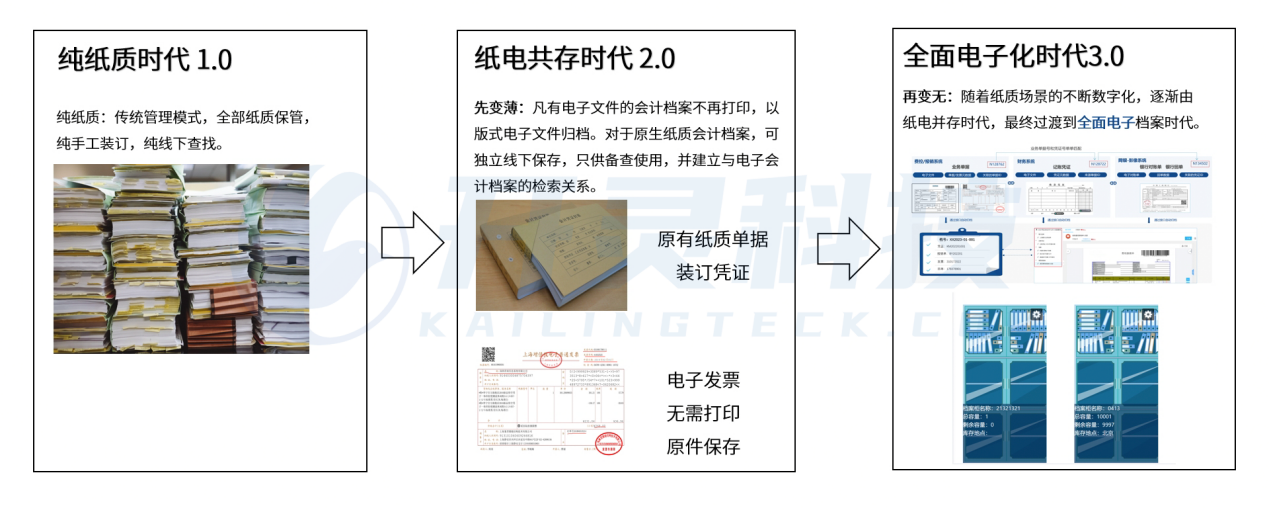
Electronic accounting archivesDevelopment process


Fully paper-based stage 1.0

Fully paper-basedFully paper-based archive management mode, with all paper storage, purely manual binding, and purely offline storage and retrieval.

Paper-electronic hybrid stage 2.0

First become thinnerAccounting archives with electronic files are no longer printed and are archived as fixed-layout electronic files. For native paper accounting archives, they may be stored offline independently for reference only, and a retrieval relationship with electronic accounting archives should be established.

Comprehensive electronification stage 3.0

Change again to noneAs paper-based scenarios continue to be digitalized, the era of coexistence of paper and electronic records will eventually transition to a fully electronic archive era.


The Electronic Archives Management Measures take effect from November 1, and the construction of electronic accounting archives brooks no delay


KailingElectronic accounting archives: a new power engine accelerating leaps in work efficiency


At a time when information technology is advancing rapidly, an unprecedented wave of change is sweeping through the business-finance-tax field. With the continuous improvement of underlying infrastructure and in-depth exploration of R&D technology, the legal validity of electronic accounting archives has been clearly established, and purely paper-based accounting archives are gradually being replaced by electronic archives. This major transformation not only greatly improves work efficiency but also provides enterprises with more efficient, secure, and intelligent solutions for financial management.

For enterprises, the digital construction of electronic accounting archives has become an urgent and necessary mission. Enterprises need to closely align with the latest policy direction, quickly complete the optimization and upgrade of business-finance-tax systems, and vigorously advance accounting informatization construction to a new level.

Kailing Technology's overall electronic accounting archives solution, committed to building solutions that fitA financial accounting archives management system required by national laws and regulations and enterprise systems. Through perfect integration with business systems, financial accounting systems, tax management systems, and others, it fully achieves electronic and standardized management of the company's accounting archives throughout their lifecycle, reduces the number of paper vouchers printed, and achieves the dual goals of cost reduction and efficiency improvement and energy conservation and environmental protection.


Electronic accounting archives construction brooks no delay. If your enterprise is still unclear about the compliance requirements for electronic accounting archives and does not know where to begin, you are welcome to contactKailing TechnologyGet in touchKailing expertsWillCarefully customize an exclusive solution for you


As a comprehensive business-finance-tax digitalization solution service provider, Kailing Technology provides business-finance-tax management digital transformation products and operational services for various government agencies, institutions, and large, medium, and small enterprises. The product line includes:

Solutions for businesses including sales contract management system, procurement contract management system, fully digitalized Leqi interface project, output automatic invoicing system, employee expense control and reimbursement system, input VAT invoice management system, supply chain collaborative reconciliation system, image OCR recognition system, automatic financial bookkeeping system, and electronic accounting archives system, comprehensively driving the digitalization process across various fields.

If you have any business-finance-tax digital transformation needs, welcome to contact us. Beijing Kailing Technology will serve you wholeheartedly.

The Electronic Archives Management Measures take effect from November 1, and the construction of electronic accounting archives brooks no delay


Share to:
Contact Us

Contact: 010-60974119

VIP Dedicated Consultant: 185-1389-5936

Address: Room 410, 4th Floor, Jianjin Center, No. Jia 1 Yongtaiyuan, Qinghe, Haidian District, Beijing
Scan to add customer service on WeChat
Industry Websites
Scan to follow our WeChat official account
Scan to view our video account
Scan to follow our Douyin account
Common Questions
Why must electronic accounting archives construction be done now?
Because the Measures for the Administration of Electronic Archives require organizations to ensure that electronic archives are authentic, complete, usable, and secure, and to actively apply new-generation information technology to improve management levels. Enterprises need to build electronic accounting archive systems as soon as possible to comply with regulatory requirements and avoid compliance risks.
Do electronic archives and paper archives have the same legal effect?
Yes. The Measures clearly stipulate that electronic archives have the same effect as archives on traditional carriers and can be used as vouchers in electronic form.
What basic requirements must enterprises meet to build electronic accounting archives?
Enterprises need to equip informatization infrastructure and establish management systems to ensure that electronic archives have reliable sources, standardized procedures, and compliant elements, and achieve full-process management. At the same time, they must meet the requirements of laws and regulations such as network security and data security.
Related solutions
Electronic Accounting Archive Management
Electronic voucher archiving, single-set system, compliant and auditable →
HD high-speed scanner
Batch digitization of massive documents and archives, duplex simultaneous scanning →
Enterprise expense control and reimbursement system
Intelligent reimbursement, compliance control, one-click bookkeeping →
Further Reading
Difficulties in Electronic Accounting Archives Construction and Hot Q&A
In recent years, with the rapid improvement of enterprise informatization management and the state's active promotion of accounting digital transformation… →
The Electronic Archives Management Measures take effect this month, strengthening standardized electronic...
Days ago, the National Archives Administration Order No. 22 published the "Electronic Archives Management Measures" (hereinafter referred to as... →
Electronic accounting archive solutions usher in a new transformation in archive management
Faced with these challenges, driven by policy orientation and digitalization needs, many enterprises are actively... →