010-6097 4119Book a Demo


Kailing Technology ID document OCR custom recognition technology product solutionPublished: 2024-08-30 17:10 At a time when informatization and digitalization are developing rapidly, ID document OCR (Optical Character Recognition) technology has become a key tool for processing identity information and accelerating business processes, and is widely used in many fields such as finance, public security, and administrative management. This article aims to provide a detailed introduction to customized ID document OCR recognition technology, focusing on explaining the specific steps for customizing OCR for ID document types, and using ID card recognition and passport recognition, two examples already applied in the market, to further demonstrate the technology's characteristics and application value.
I. Overview of Custom Document OCR Recognition TechnologyCustom document OCR recognition technology is a technology that uses computer vision and artificial intelligence algorithms to automatically process and recognize specific types of document images. Through a series of steps such as image capture, preprocessing, character segmentation, feature extraction, character recognition, and post-processing, this technology achieves precise extraction and parsing of text, numbers, images, and other information on documents, ultimately converting them into structured data or editable text. Compared with traditional manual entry methods, custom document OCR recognition technology has many features such as high efficiency, accuracy, flexibility, and ease of use, and can greatly improve work efficiency and the accuracy of data processing. II. Steps for custom document type OCR
1. Requirements analysis and planningWhen starting to customize ID document type OCR, you must first engage in in-depth communication with the client to clearly understand their specific needs, covering the document types to be recognized, key information fields, recognition accuracy requirements, processing speed, and application scenarios. Based on these needs, draft a detailed technical plan and development plan, specifying the technical route, algorithm selection, development cycle, and testing standards. 2. Data collection and annotationData is the cornerstone of training OCR models. According to customized document types, collect a large amount of real document image data and carefully annotate it. The annotated content covers all key information fields on the document, such as name, gender, date of birth, document number, etc. The accuracy and richness of the annotated data directly affect the model's recognition performance and generalization ability. 3. Image preprocessingImage preprocessing plays an important role in the OCR recognition process, with the purpose of improving image quality and character clarity. Targeting the image characteristics of customized certificate types, preprocessing techniques such as denoising, enhancement, and binarization are used to eliminate interfering factors in the image, such as noise, shadows, and reflections, making the text area clearer and more prominent. 4. Character segmentationCharacter segmentation is the process of dividing the text regions in a preprocessed image into individual characters or text blocks. This step is crucial for subsequent character recognition. According to the layout characteristics and text arrangement of customized certificates, appropriate segmentation algorithms are adopted, such as projection-based methods and connected component analysis, to ensure the accuracy and completeness of character segmentation. 5. Feature extraction and character recognitionFeature extraction is the process of extracting representative features such as strokes, shapes and structures from segmented character regions. These features will be used for subsequent character recognition. In the character recognition stage, the extracted features are matched with pre-trained character models, and accurate character recognition is achieved with the help of pattern recognition and digital image processing technologies. To improve recognition accuracy, deep learning technologies such as convolutional neural networks (CNN) and recurrent neural networks (RNN) can be used to build high-precision, highly robust recognition models. 6. Post-processing and result optimizationBecause OCR technology may be affected by factors such as image quality and text layout during recognition, recognition results may contain errors or formatting confusion. Therefore, post-processing of recognition results is required, including text correction and format organization, to improve recognition accuracy and usability. In addition, recognition results can be further optimized according to actual needs, such as data validation and information integration. 7. Testing and tuningAfter completing model training, it is necessary to use the test dataset to conduct performance testing on the model, evaluating key indicators such as recognition accuracy and processing speed. Based on the test results, the model is tuned, including adjusting algorithm parameters and optimizing model structure, to further improve model performance. 8. Deployment and ApplicationDeploy trained OCR models into actual application scenarios to achieve automated recognition and extraction of document information. Provide multiple deployment methods such as cloud deployment and local deployment according to customer needs to meet application requirements in different scenarios. III. Examples of ID card recognition and passport recognition
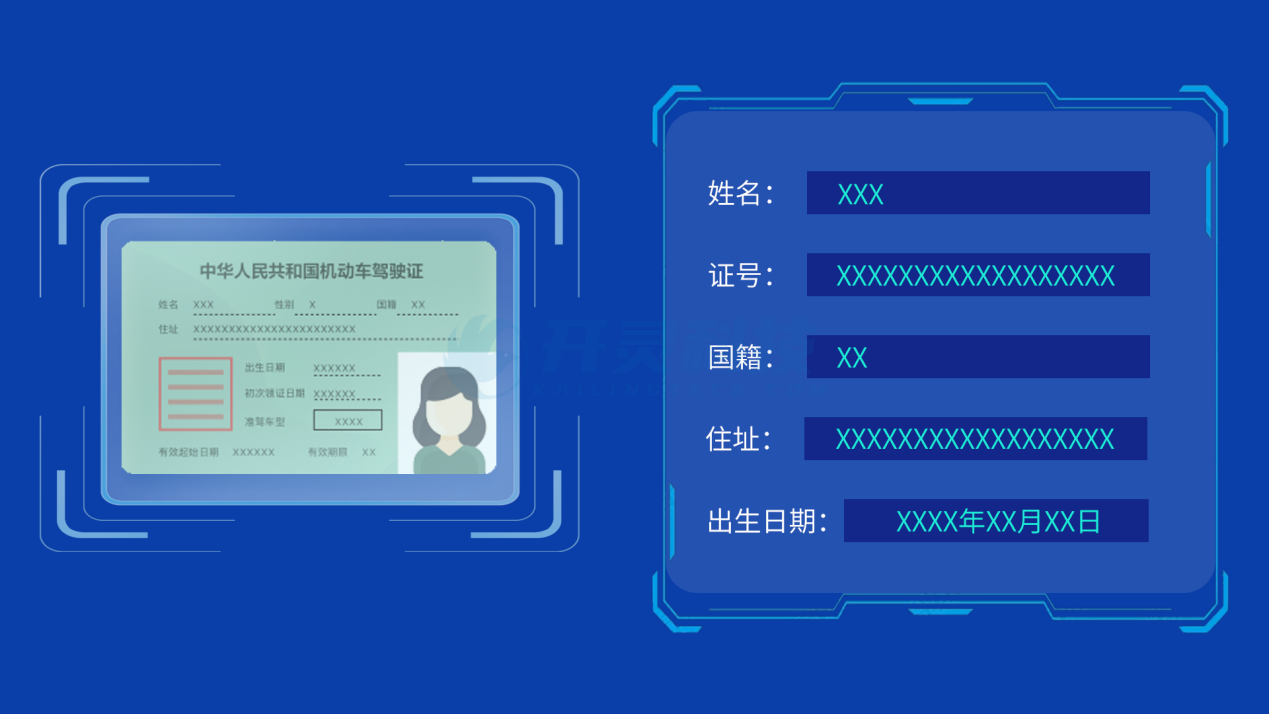
1. ID card recognitionAs a key proof document of personal identity, the ID card is widely used in many fields such as financial services and public security. ID card recognition technology uses customized OCR recognition algorithms to quickly and accurately extract key information from ID cards. In the image preprocessing stage, according to the characteristics of ID card images, processing techniques such as denoising, enhancement, and binarization are used to improve image quality and character clarity. In the character segmentation stage, based on the fixed layout characteristics of ID cards, segmentation algorithms based on template matching or projection methods are used to ensure the accuracy of character segmentation. In the feature extraction and character recognition stage, deep learning technology is used to build a high-precision recognition model to accurately recognize key information such as name, gender, date of birth, and ID number. Finally, post-processing is used to optimize the recognition results and ensure the completeness and accuracy of the information. 2. Passport recognitionAs an important document for international travel and identity verification, a passport carries key information such as a citizen's personal information and nationality. Passport recognition technology uses customized OCR recognition algorithms to automatically extract key information from passports. In the image preprocessing stage, more refined denoising, enhancement, binarization, and other processing techniques are adopted based on the characteristics of passport images to improve image quality and character clarity. In the character segmentation stage, because the information layout on passports is relatively complex, more advanced segmentation algorithms are needed, such as deep learning-based image segmentation technology, to ensure the accuracy and completeness of character segmentation. In the feature extraction and character recognition stage, deep learning technology is also used to build high-precision recognition models to accurately recognize key information such as name, gender, date of birth, and passport number. In addition, passport recognition technology must pay special attention to parsing machine-readable code information. By parsing the optical barcode information in the machine-readable code, recognition accuracy and reliability are further improved. Finally, post-processing optimizes the recognition results to ensure the completeness and accuracy of the information while meeting the needs of application scenarios such as immigration management. IV. Advantages and application scenarios of Kailing ID document AI OCR custom recognition technology1. Technical advantagesEfficiency:Using advanced OCR technology and image processing technology, it can quickly process and recognize ID document images, thereby improving work efficiency. Accuracy:Through optimization steps such as image preprocessing and character recognition, precise extraction and recognition of certificate information can be achieved, reducing the error rate. Flexibility:Supports customized recognition of multiple document types, meeting the document recognition needs of different fields. Usability:Provides a simple and easy-to-operate interface and process; users only need to upload document images and set relevant parameters to achieve automated recognition and processing. 2. Application scenariosFinancial services:In scenarios such as banking business and insurance claims, it is necessary to recognize and process customer documents such as ID cards and bank cards. Public safety:In fields such as public security and transportation, documents such as driver's licenses and vehicle registration certificates need to be recognized and processed to achieve effective management of vehicles and drivers. Administrative Management:In government agencies, various certificates need to be recognized and processed to achieve effective management and querying of citizen information. Entry-exit management:At immigration management agencies such as airports and customs, the application of passport OCR recognition technology enables fast and accurate reading of passport information, improving work efficiency and security. Invoicing system:In scenarios such as purchasing flight tickets and train tickets, passport OCR recognition technology can quickly and accurately read passport information, ensuring the security of the ticket purchase process. Text information extraction for libraries, newspaper offices, etc.:Passport OCR recognition technology can quickly extract text information from passports for automated entry and management, improving the efficiency of information processing. Financial sector:In the financial sector, passport OCR recognition technology can be used to quickly and accurately extract passport information, assisting business processes such as identity verification and anti-fraud. With its outstanding features such as high efficiency, accuracy, flexibility, and ease of use, custom document OCR recognition technology is playing an increasingly important role in various industries. ThroughKailing TechnologyCustomized development and services; this technology can effectively meet the diverse document recognition needs of different fields, bringing great convenience to personal life and enterprise work, and providing stronger support for digital transformation and intelligent upgrading. Kailing Technology provides enterprise business-finance-tax digital product lines according to enterprise needs: Solutions for businesses including sales contract management system, procurement contract management system, fully digitalized Leqi interface project, output automatic invoicing system, employee expense control and reimbursement system, input VAT invoice management system, supply chain collaborative reconciliation system, image OCR recognition system, automatic financial bookkeeping system, and electronic accounting archives system, professionally and efficiently supporting the transformation and upgrading of enterprise business-finance-tax digital management. If you have any business-finance-tax digital transformation needs, welcome to contact us. Beijing Kailing Technology will serve you wholeheartedly.
|