010-6097 4119Book a Demo


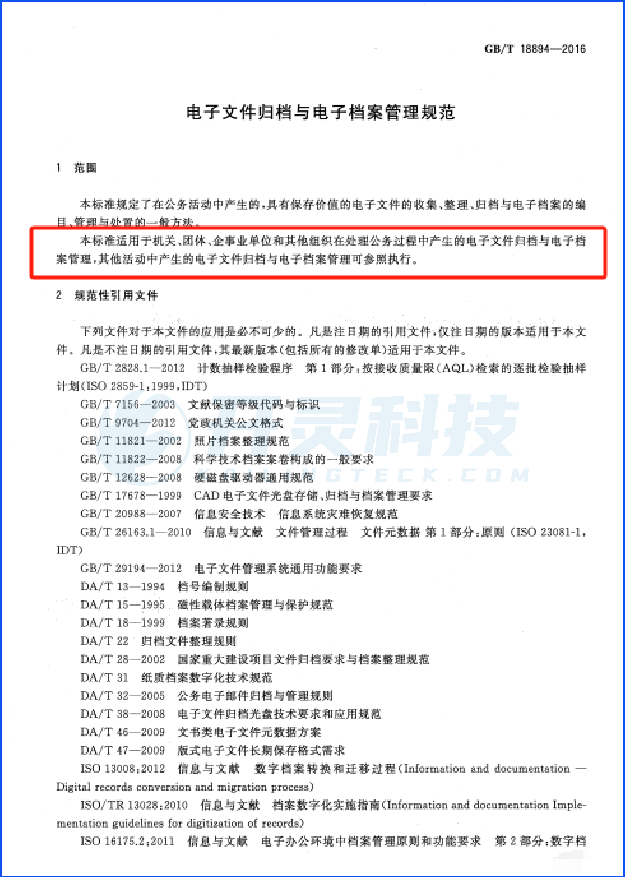
Comprehensive Analysis of the Kailing Electronic Accounting Archives Solution and Core FunctionsPublished: 2024-08-26 18:11 I. Background of Electronic Accounting Archives Construction1. Electronic Archives BackgroundThe Specifications for Electronic Document Archiving and Electronic Archives Management GB/T 18894 - 2016 is a new version of the electronic archives management specifications issued in 2016. It applies to units across all industries and is the baseline requirement for electronic archives management in all industries, standardizing the terminology and definitions of electronic archives.
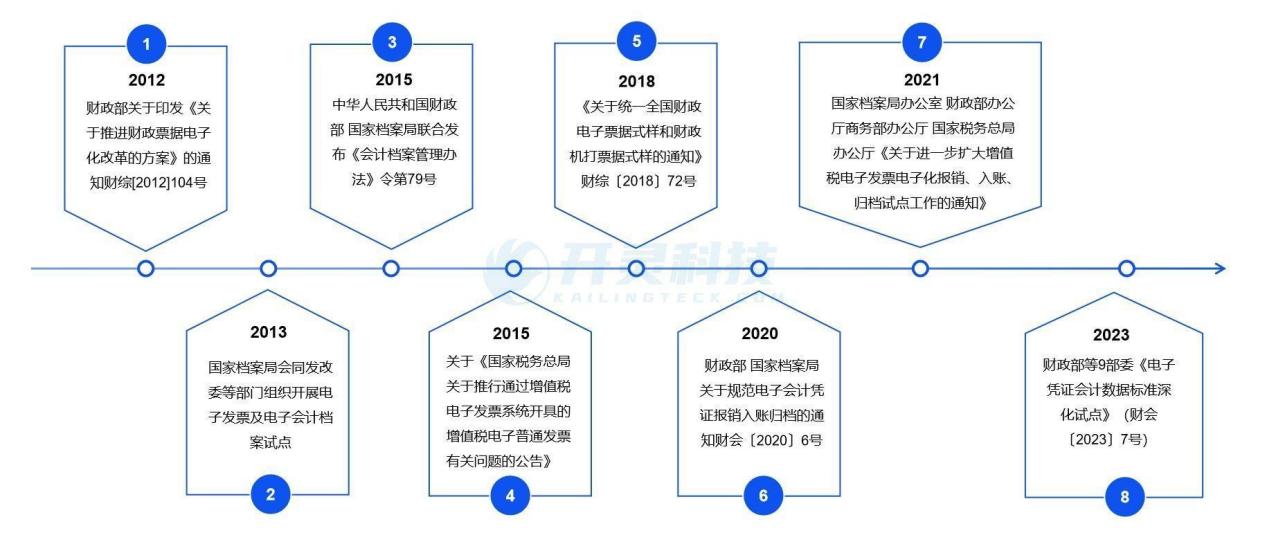
2. Development background of electronic accounting archivesThe Ministry of Finance and other departments have successively issued a series of notices and policies on advancing the reform of fiscal bill digitalization, standardizing accounting archives management, unifying the format of fiscal electronic bills, and expanding the pilot program for electronic reimbursement, booking and archiving of VAT electronic invoices.
3. Policy Support for Electronic Accounting Archives ArchivingAccording to the Measures for the Administration of Accounting Archives, Order No. 79 of the National Archives Administration, and Document No. 6 jointly issued by the Ministry of Finance and the National Archives Administration, electronic accounting materials formed within a unit and within the archiving scope may be stored only in electronic form when certain conditions are met, forming electronic accounting archives. At the same time, if a unit uses paper printouts of electronic accounting vouchers as the basis for reimbursement, accounting entry, and archiving, it must also preserve the source files of the electronic accounting vouchers. In addition, for external vouchers such as electronic invoices and bank receipts, electronic originals must be retained. 4. Instructions on automatic original file archiving of e-invoicesThe electronic accounting archives system is connected with the electronic tax bureau, synchronizing all of the enterprise's invoice data and fully digitalized e-invoice XML originals to the archive system every day. At the same time, it obtains voucher information and invoice numbers from the accounting system every day, matches the electronic invoice originals according to invoice numbers, automatically retains the XML originals, and forms paperless voucher archiving.
5. Tax archive filing instructionsThe electronic accounting archives system is connected with the electronic tax bureau, synchronizing the electronic tax-related archives of enterprises across thirty-six provincial bureaus, and automatically assembling and matching them with corresponding vouchers to complete electronic archiving and form complete electronic tax archives.
6. Bank receipt archiving processThe system automatically downloads bank receipts in batches from online banking, saves them to the electronic accounting archives platform, and forms structured information. Based on the bank name + bank transaction serial number in the receipt, it automatically matches with the bank transaction serial number in the financial system to the corresponding business order number and voucher number. The archive system automatically completes online assembly, achieving automated archiving of bank receipts.
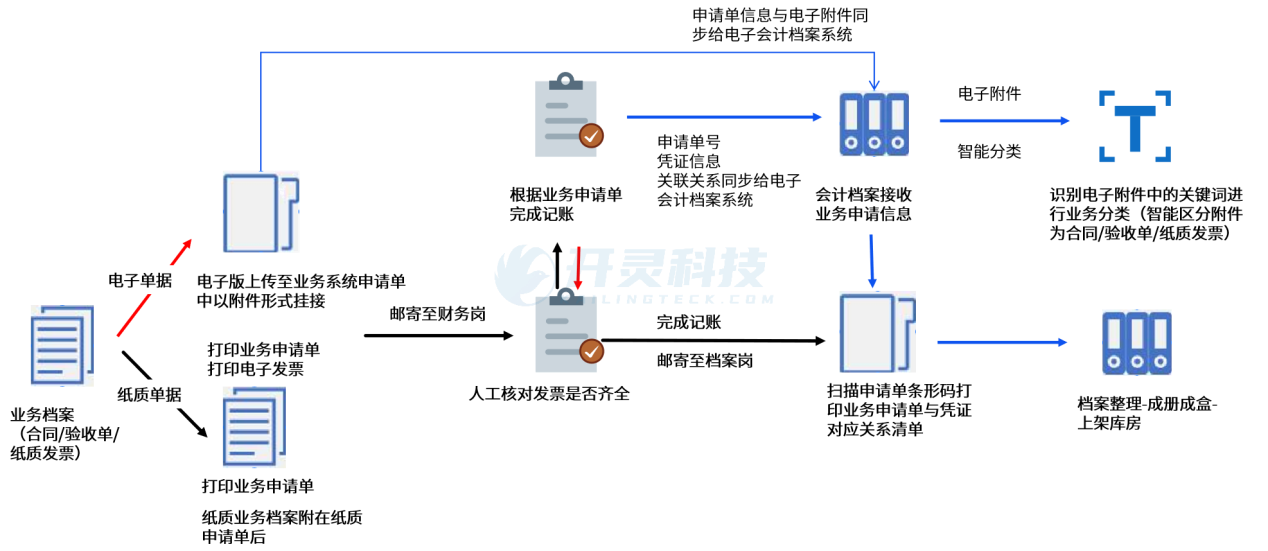
7. Explanation of the circulation mode for printing application forms and electronic invoices, and not printing accounting vouchers The electronic version of business archives is uploaded to the business system application form as an attachment, and paper business archives are attached after the paper application form. Print the business application form and electronic invoice, identify keywords in the electronic attachment for business classification, synchronize the application form information and electronic attachment to the electronic accounting archives system, and complete bookkeeping based on the business application form. Accounting archives receive business application information and electronic attachments, and the association relationship is synchronized to the electronic accounting archives system.
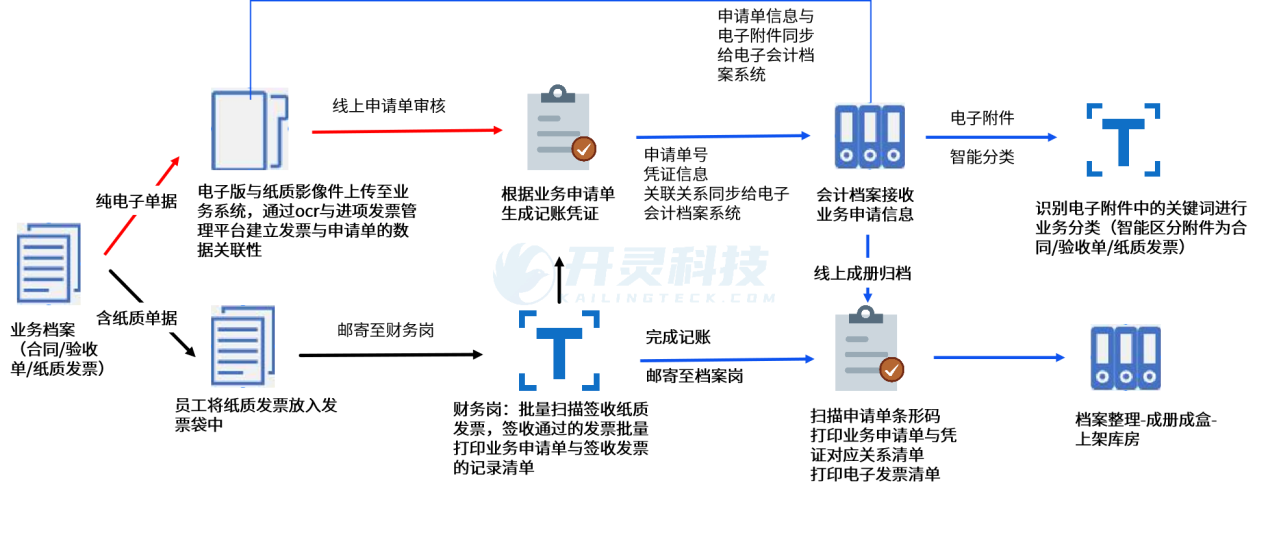
8. Explanation of the circulation mode without printing application forms, electronic invoices and bookkeeping vouchers The electronic version and paper image of business archives are uploaded to the business system, and the data association between invoices and application forms is established through OCR and the input VAT invoice management platform. Identify keywords in the electronic attachment for business classification, synchronize the application form information and electronic attachment to the electronic accounting archives system, and generate accounting vouchers based on the business application form. Online binding and archiving: employees place paper invoices into invoice bags, the finance position scans and receives paper invoices in batches, and for received invoices, batch prints the record list of business application forms and received invoices.
II. Kailing Electronic Accounting Archives Construction Plan
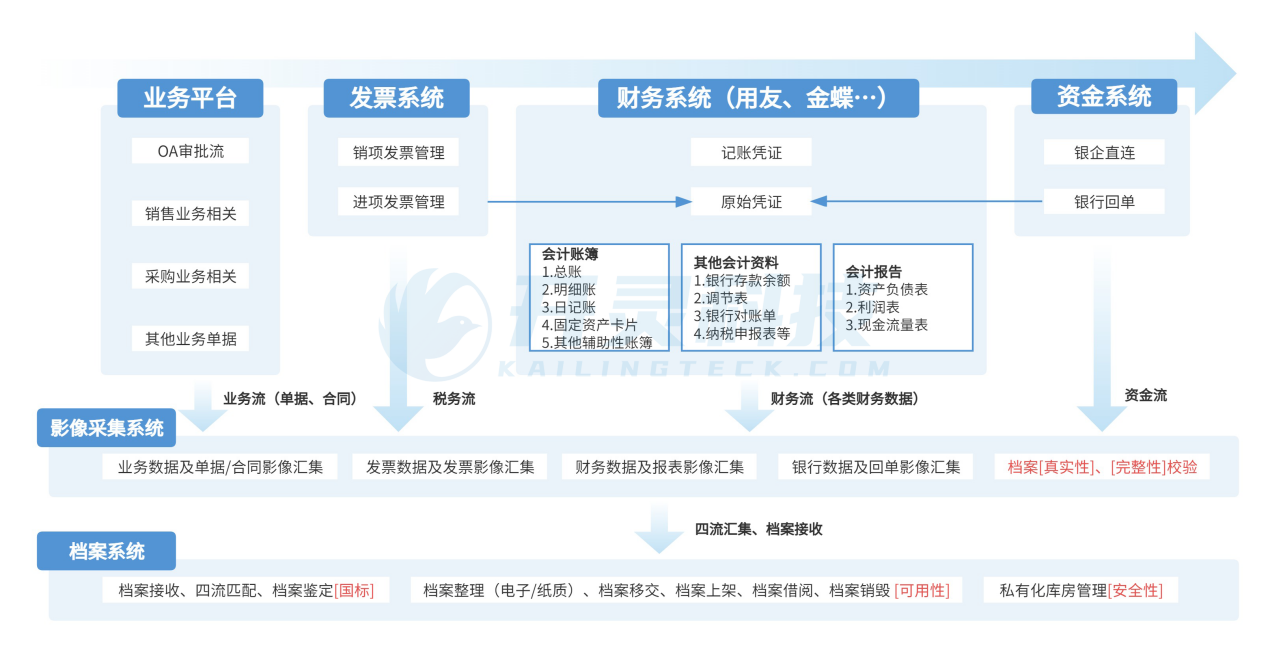
1. System ArchitectureThe electronic accounting archives system architecture includes functional modules such as the interface layer, pre-archiving, archive receipt, association configuration, data association, archive generation, archiving appraisal, arrangement and custody, full-text search, archive utilization, and appraisal and destruction. The system connects to tax invoices, business systems, other accounting materials (obtained without a fixed system), accounting systems, financial auditing, input VAT invoice management, output VAT invoice management, other accounting materials, paper materials, reimbursement forms/attachments, approval processes, bookkeeping vouchers, accounting books, accounting reports, fund systems, online banking receipts, bank statements, and other systems. 2. Archiving content organizationThe data and files required to be collected by the financial system include accounting vouchers, accounting books, financial accounting reports, related indexes, etc.; the data and files required to be collected by the fund system include receipt and payment information, linking information, etc.; the data and files required to be collected by the OA system include application forms, approval records, etc.; the data and files required to be collected by the tax system include invoice information, linking information, etc.; the data and files required to be collected by the business system include procurement-related, output-related, etc.; the information and files required to be collected by the imaging system include external report materials, tax-related materials, fund-related materials, statistical registration materials, institutional norms, and other categories. 3. Description of Core Archive CapabilitiesData acquisition: The system can obtain data from multiple data sources and perform pre-archiving and organization of the data. Scanned image compression: saves the highest-precision images in the smallest space. Scanned image processing: includes functions such as image enhancement and image rotation correction. OCR recognition platform: private deployment, self-trainable, able to recognize multiple document types, extract key information, and achieve information exchange and structured output. OCR application scenarios of the archive system: including recognition and classification of various invoices, bills, approval forms, bank receipts, etc. Automatic collection and matching, pre-archiving: based on archive source and process type, automatically collect and perform completeness verification; the pre-archiving page can be embedded and integrated with accounting systems and review processes to achieve in-process compliance management. Automatic collection and matching, Starlink graph: the Starlink graph allows you to view the assembly status of any data group, adapting to scenarios where a single document is referenced multiple times for quick associated viewing. Archive four-property inspection standards: Based on the Electronic Accounting Archive Management Specification (DA/T 94 - 2022), authenticity, integrity, usability, and security inspections are performed on electronic accounting archives. Archive four-property inspection report: After files are received into the system, the four-property inspection is automatically completed. For those that fail, the abnormal reasons can be viewed, and the four-property inspection report can be integrated with the financial audit review process. Core logic of four-property detection: Includes the integrity of the total volume and structural files of electronic archive data, the integrity of electronic archive metadata, the integrity of paper archive handover, external data authenticity verification, usability detection, security detection, and other aspects. Borrowing Management: Account functions are divided by function. Functional accounts can be opened in the archive system for auditors, restricting menus, directory counts, and shielding key fields; permission hosting allows hosting permissions to be set for each account, meeting the need for reviewers or archive staff to be unable to perform borrowing approval and outbound approval during leave; role division assigns corresponding viewing and operation permissions by role. Full-text search, category search, period search, archivist search, and other conditions can be used for cross-searching to obtain final results, optimizing the utilization experience. Shelf placement process for paper archive warehouses: electronic materials generate an electronic document list, are automatically bound into volumes (electronic archives), archiving is completed, box spines and location codes are printed and affixed to archive boxes, and physical archives are put into storage and placed on shelves in batches. Electronic Accounting Archive Transfer: Financial archives that have completed file assembly/box compilation can be transferred in batches, and a transfer list is generated. The corresponding document receiving position will receive a pending archive receipt task, and signing off is completed by scanning the barcode.
The construction of an electronic accounting archives platform is of great significance to an enterprise's financial management and archives management,Kailing Technology Electronic Accounting Archives SystemHelp enterprisesImprove work efficiency, reduce costs, meet tax and audit requirements, and achieve enterprise digital transformation. Kailing Technology provides enterprise business-finance-tax digital product lines according to enterprise needs: Solutions for businesses including sales contract management system, procurement contract management system, fully digitalized Leqi interface project, output automatic invoicing system, employee expense control and reimbursement system, input VAT invoice management system, supply chain collaborative reconciliation system, image OCR recognition system, automatic financial bookkeeping system, and electronic accounting archives system, professionally and efficiently supporting the transformation and upgrading of enterprise business-finance-tax digital management. If you have any business-finance-tax digital transformation needs, welcome to contact us. Beijing Kailing Technology will serve you wholeheartedly.
|