010-6097 4119Book a Demo


In Business-Finance-Tax Digital Transformation, How Fully Digitalized E-Invoices Address the Pain Points of the New Retail IndustryPublished: 2024-05-13 16:44 In this era of rapid digital development, business-finance-tax digital transformation is undoubtedly an inevitable move for enterprises to adapt to market trends and enhance their competitiveness. Especially in the new retail industry, due to its refined operating model combining online and offline, it inevitably encounters many challenges such as frequent transactions, diversified channels, and massive data volumes. So how to build a standardized and intelligent tax management system through digital means, thereby enhancing the enterprise's core competitiveness and exploring entirely new growth paths, is crucial for the new retail industry to achieve high-quality development. Pain points of new retail 1. Huge invoicing volume, high labor costs With economic development and continuously upgrading consumer demand, invoicing volume in the new retail industry continues to climb. The increase in invoicing volume brings enormous resource allocation challenges to new retail enterprises, requiring substantial increases in human, material, and financial resource investment to ensure smooth invoicing work. At the same time, a sudden increase in invoicing volume increases the intensity of invoicing work, and declining operational efficiency can also affect consumers' shopping experience, thereby reducing customer satisfaction. 2. Product types are rich and diverse, and manual maintenance is ineffective The wide variety of product categories places stricter demands on enterprises' precise management of tax codes for stores, requiring that all types of products be accurately classified and assigned the corresponding tax codes. However, manual operations tend to have a high error rate, which not only affects the accuracy of tax filing but may also increase enterprises' legal risks. In addition, during invoicing, manually listing purchase details is also quite complex and cumbersome, especially when product categories are numerous and quantities vary. Invoice issuers need to verify product information item by item, which not only severely affects invoicing efficiency but also greatly increases the risk of errors. 3. Traditional invoice management and control is both time-consuming and labor-intensiveBecause the enterprise has many stores and data is scattered, integrating invoice data becomes extremely complex and difficult to meet daily statistics needs. In addition, store invoicing needs must be issued and routed through headquarters, further increasing process complexity and reducing overall efficiency. In B2B procurement business, issuing special VAT invoices requires strict approval and control to ensure consistency between invoices and orders. If invoices do not match orders, risks such as duplicate invoicing and false invoicing may arise, which can not only cause economic losses to the enterprise but also damage its reputation. Kailing Technology one-stop solution
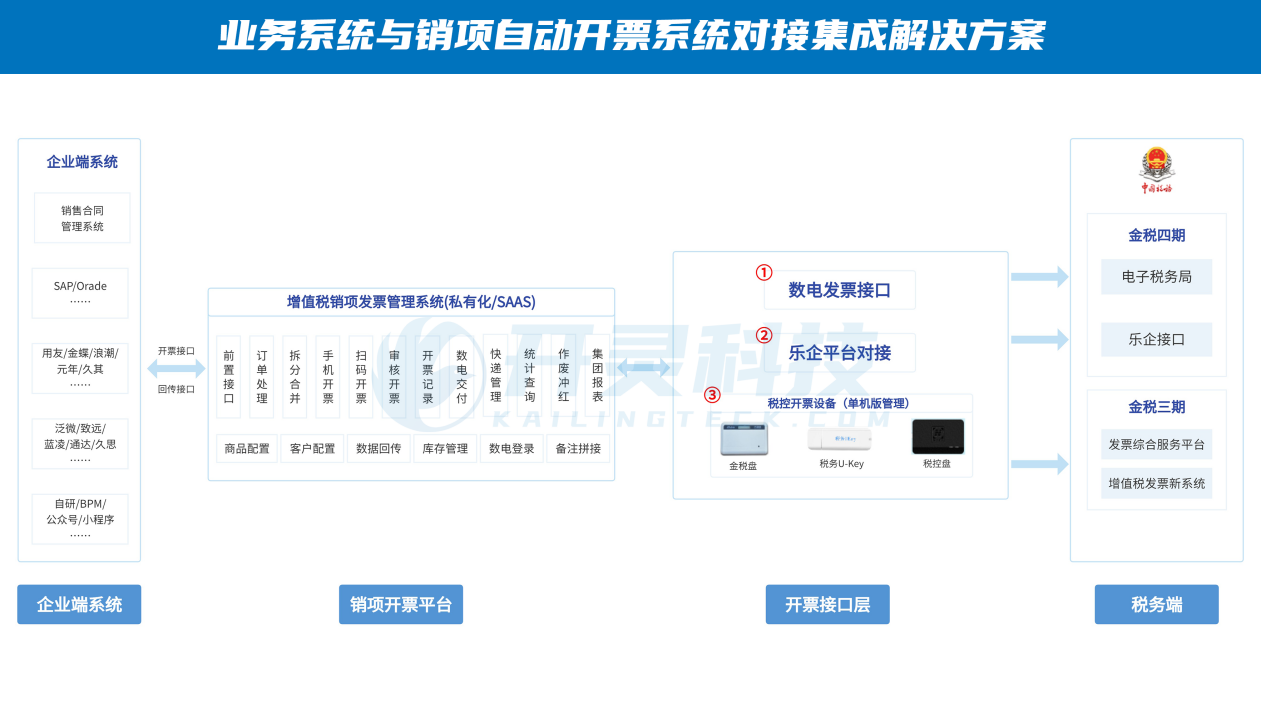
1. Able to integrate with systems such as ERP and CRM, it can automatically obtain relevant information and quickly complete invoice generation. 2. Provide multiple invoice delivery methods, such as SMS, email, etc., thereby enhancing the convenience, security, and traceability of transactions, and effectively preventing the loss and tampering of invoices. 3. Centrally process and store invoice data, building a comprehensive invoice management system with functions such as quick query, retrieval, and archiving, simplifying management processes while improving data readability and analyzability. 4. Possesses data analysis and reporting functions, through in-depth analysis of invoice usage, transaction trends, and potential risks, promptly detect abnormal behavior, identify fraud risks, formulate corresponding preventive measures, and provide in-depth insights for business decisions.
1. Centralized controlUsing a centralized control model, the enterprise input VAT invoice pool is centrally managed, realizing a full-process management mechanism of electronic informatization, covering key steps such as invoice collection, receipt, verification, duplicate checking, and selection. 2. Verification and duplicate checkingCanAutomatically identify and enter invoice information, effectively avoiding duplicate entry, verifying invoice authenticity in real time, and ensuring data completeness and traceability. 3. Unified managementAdopt efficient and accurate digital methods to uniformly manage invoices, fully solving the difficulties of electronic invoice data extraction, aggregation, and authenticity verification, achieving paperless office work across the entire electronic invoice process, realizing the goals of simplifying workflows and improving enterprise efficiency, and providing strong support for promoting the digital transformation of financial management. Beijing Kailing Technology Co., Ltd.——an enterprise business-finance-tax digitalization solution service provider. Kailing Technology provides solutions for sales management systems, procurement management systems, output invoicing systems, input invoice collection systems, imaging management systems, financial posting systems, electronic accounting archives, fully digitalized e-invoice and Leqi interfaces and other businesses according to enterprise needs, professionally and efficiently helping enterprises transform and upgrade their business-finance-tax digital management. If you have any business-finance-tax digital transformation needs, welcome to contact us. Beijing Kailing Technology will serve you wholeheartedly.
|