010-6097 4119Book a Demo


Always doing accounts and reconciliation all night at month-end and still making errors? One article explains Kailing Technology AI digital employees' 8 onboarding scenariosPublished: 2026-06-29 14:22 What finance should hand over first to AI digital employees are those tasks with all four characteristics: "high-frequency, repetitive, cross-system, requiring judgment"—typically month-end reimbursement review, contract approval, automatic invoicing, and reconciliation.The reason is simple: this type of work has a large volume, fixed rules, requires repeatedly transferring data across multiple systems, and requires item-by-item compliance judgment — exactly where people are most prone to staying up late and making mistakes. Kailing Technology AI digital employee is not a "chat-capable" assistant, but a "task-capable" colleague — it can autonomously drive the entire process across ERP, contracts, expense control, the Electronic Tax Bureau and other systems like a real person, only asking for human confirmation at key nodes. Below, 8 actionable finance scenarios explain "what it does for you + real results," and at the end, the principle of "which to build first" is given.
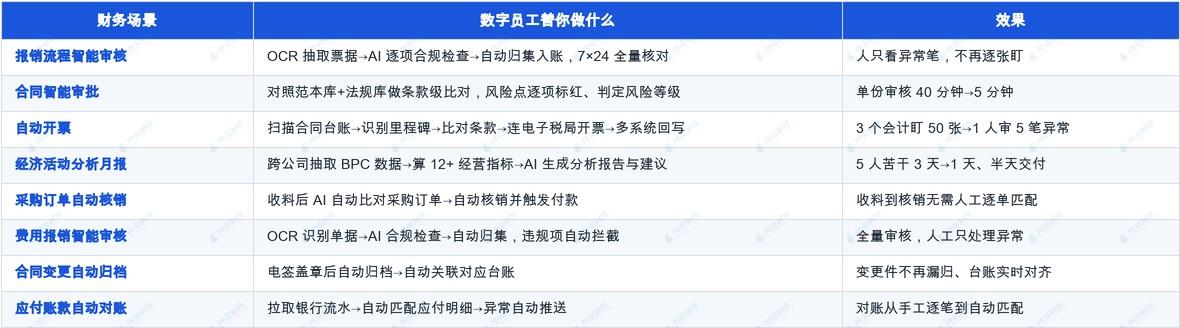
I. Why financial shared service centers are best suited to adopt digital employees firstFinancial shared service centers are inherently the "best soil" for deploying digital employees: many systems (ERP, BPC, SAP, OA, contracts, expense control running in parallel), a high degree of process standardization, and urgent repetitive needs every month. In the past it was "people finding systems"—accountants had to log in one by one to retrieve data, compare, and enter it; now it is reversed so that "AI calls systems on people's behalf," turning business systems from a "toolbox" into an "all-around assistant" that can handle tasks across systems. It is online 7×24, automatically runs processes on scheduled/event/manual triggers, and sets "human-in-the-loop" at key nodes, assisting rather than replacing human decision-making. II. 8 digital employee scenarios finance can deploy immediatelyCombining classic scenarios from Kailing's actual projects and similar scalable capabilities, this summarizes the 8 most worthwhile onboarding scenarios for financial shared service centers. First view the overview table, then break them down one by one.
It is a 7×24 online AI financial reviewer, running through a 10-step full-process closed loop from OCR extraction of invoices, AI compliance checks, to automatic aggregation, with exception approval as a manual node. The specific mechanism is: after an employee submits a reimbursement, the digital employee first uses OCR to extract invoices, itineraries, and other documents into structured data, then checks compliance item by item against the reimbursement policy—whether limits are exceeded, whether documents are complete, whether content matches—and after confirming there are no issues, automatically aggregates and books them. In the past, accountants had to check limits, standards, and invoice authenticity one by one, which was especially strenuous during month-end surges; now the digital employee reviews all documents first, and accountants only look at the flagged exceptions, changing from "full manual review" to "review only exceptions," so manpower no longer rises linearly with document volume. 2 | Intelligent Contract Approval: Clause-level comparison, cut from 40 minutes to 5 minutesIt is an AI compliance reviewer. After a contract is uploaded, it automatically compares it against the built-in template library and regulation library, comparing each clause sentence by sentence, marking missing, contradictory, and non-compliant risk points in red item by item and determining risk levels, and giving revision suggestions. In the past, a contract had to be manually compared clause by clause against templates and regulations verified, taking 40 minutes to review one; month-end concentrated signing caused even more backlog; now results come out in 5 minutes, and the reviewer only needs to review the red-flagged items to decide. Contract approval simultaneously hits the two keywords "repetitive" and "requires judgment," making it a typical scenario that frees people from mechanical comparison while retaining professional judgment authority. 3 | Automatic invoicing: do 6 things for you, you only click 2 timesAutomatic invoicing is the most representative cross-system scenario in a financial shared service center: it completes 6 things for you, and you only need to click to confirm at 2 key nodes. The following real timeline compresses the invoicing process into 6 steps.
Real results:Previously, 3 accountants watched over the issuance of 50 invoices each month; now, 1 person reviewing 5 exceptions is enough. Invoicing requires logging into multiple systems and judging item by item whether the conditions for invoicing are met — "high frequency + cross-system + requires judgment" hits at least one of the three, and the return is immediate. 4 | Monthly economic activity analysis report: from 5 people and 3 days to half a dayMonthly reports are one of the most exhausting tasks for finance. This digital employee automatically starts on the 3rd of each month, first extracting BPC data across multiple companies, then notifying relevant business departments to submit business summaries, automatically calculating more than 12 business indicators, and using AI to generate a complete analysis report and recommendations. After departmental review, responsible person review, and company leadership review and approval level by level, it is submitted to the group for archiving—heavy tasks such as data extraction, calculation, report writing, and summary collection all run automatically, with people only reviewing conclusions. What originally required 5 accountants working hard for 3 days for monthly analysis is now compressed to 1 day, with delivery in as fast as half a day, with unified standards and no more rework due to inconsistent manual data extraction standards. 5–8 | Four similar scalable scenarios: completing the month-end closed loop Using the same capability foundation, the following four scenarios can be quickly replicated after being proven in a pilot, completing the remaining steps of month-end "review, issue, calculate, reconcile, and archive." Automatic write-off of procurement orders:After materials are received and booked, AI automatically compares the quantity and amount of the purchase order with the arrival details. If they match, it automatically writes off and triggers payment, eliminating manual order-by-order reconciliation among procurement, warehousing, and finance. Intelligent Expense Reimbursement Review:OCR recognizes documents → AI compliance check → automatic collection, with violations automatically intercepted; rules are fixed and change little, making it a typical representative of the 'repetitive' category, and it can share the compliance rule library with the first scenario. Automatic archiving of contract changes:After electronic signing and sealing, contracts are automatically archived and linked to the corresponding ledger. Changed documents are no longer missed in archiving, the ledger and originals are aligned in real time, and audit tracing has evidence to check. Automated accounts payable reconciliation:Automatically pull bank statements and match them transaction by transaction with payable details. When amount, account name, and purpose are consistent, they are automatically reconciled. Exceptions that cannot be matched are automatically pushed to accountants for handling—leaving the most tedious transaction-by-transaction verification to machines, with people only checking exceptions. Together with the previous four, these four cover the main month-end finance steps of "review, issue, calculate, reconcile, and archive," gradually retiring the old model of all-night bookkeeping and reconciliation.
III. Traditional manual vs. digital employees: what's the difference
In addition, Kailing's AI digital employees are fully privately deployed, with zero data leaving the domain, meeting Level 3 of the Multi-Level Protection Scheme, compatible with Xinchuang environments such as Kylin, Phytium, UnionTech, and KingbaseES, and reusing the MaaS large models already deployed by the enterprise, enabling IT assets to "come alive" with zero additional investment. IV. Which to build first? Use the four-keyword rule of "high-frequency/repetitive/cross-system/requires judgment"Facing a long list of candidate scenarios, which should the finance leader tackle first? Kailing's judgment rule is very direct: see how many keywords a scenario hits; the more hits, the more it should be built first. High frequency:Must be repeated daily/weekly/monthly (such as regularly producing the monthly economic analysis report every month). Duplicate:Fixed process, few changes (such as month-end cross-system data extraction and reconciliation). Cross-system:Need to transfer data between 2 or more systems (e.g., invoicing requires logging into 4 systems). It is necessary to determine:Not just mechanical operations, but includes "yes/no" compliance judgments (such as contract clause review). Practical suggestions:Check candidate scenarios item by item against the four keywords; prioritize building those that hit all four (automatic invoicing and accounts payable reconciliation often do); first select one for a pilot, and after the full process runs through, replicate it at scale—"zero-cost pilot validation → methodology replication at scale → group-wide coverage." V. The finance department's first digital employee: how to choose and how to implementAfter narrowing down candidates using the four-keyword rule, there are two practical tips for choosing the first AI digital employee: first, prioritize scenarios with "the strongest pain and the clearest rules"—strong pain means the business department immediately feels the gain after launch, and clear rules mean AI can understand and run it easily; second, prioritize scenarios with "ready data and clear human-in-the-loop points," avoiding picking the hardest bone first with scattered data and vague judgment. For most financial shared service centers, automatic invoicing, accounts payable reconciliation, and intelligent expense reimbursement review are often the most reliable first targets. In terms of implementation pace, Kailing's planned path is "90 employees in 9 months," but the first step has a very low threshold. The pilot breakthrough phase takes only 2–3 weeks and is free of charge: the customer assigns 1–2 employees most familiar with the business to participate, first clarifying the scenario and signing off on the Scenario Definition Document, then our team uses a standard methodology to let the AI understand the process, reuse the company's existing large model, and mark the mandatory stop nodes for "human in the loop," and finally runs it 100 times in a sandbox, going live only after reaching a 99% pass rate. At the end of the pilot, the customer gets one genuinely usable digital employee owned by the company, plus the Scenario Definition Document and an implementation assessment report—validating value at zero cost first, then deciding whether to replicate at scale.
Want finance to no longer stay up all night doing accounts and reconciliation at month-end? Welcome to Kailing Technology to learn about the finance onboarding solution of AI digital employees: www.kailingteck.com . As a comprehensive business-finance-tax digitalization solution service provider, Kailing Technology provides business-finance-tax management digital transformation products and operational services for various government agencies, institutions, and large, medium, and small enterprises. The product line includes: Solutions for businesses including sales contract management system, procurement contract management system, fully digitalized Leqi interface project, output automatic invoicing system, reverse invoicing system, invoice issuance for individuals system, employee expense control and reimbursement system, input VAT invoice management system, supply chain collaborative reconciliation system, image OCR recognition system, automatic financial bookkeeping system, and electronic accounting archives system, comprehensively driving the digitalization process across various fields. If you have any business-finance-tax digital transformation needs, welcome to contact us. Beijing Kailing Technology will serve you wholeheartedly.
Keywords:AI digital employee, financial shared service center, automatic invoicing, intelligent reimbursement review, accounts payable reconciliation, intelligent contract approval, business-finance-tax digitalization |