010-6097 4119Book a Demo


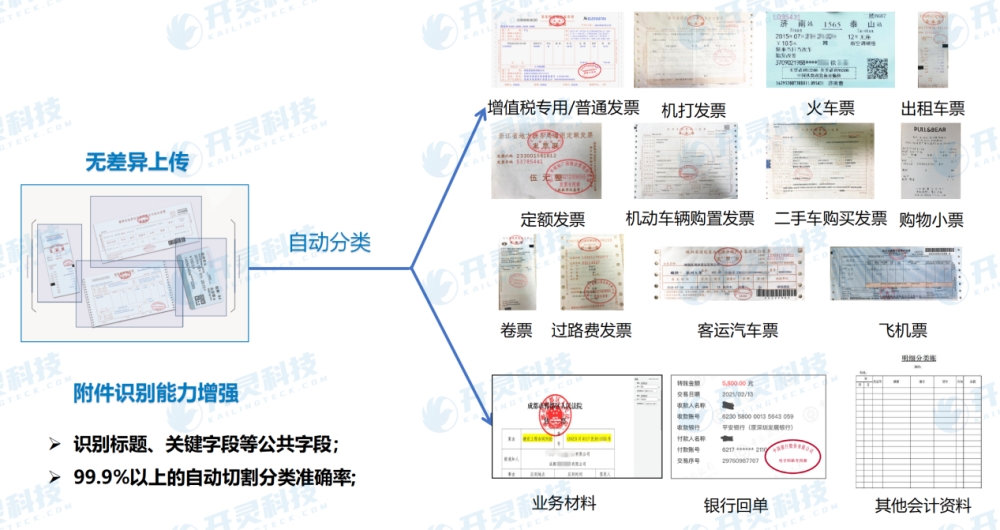
Still relying on manual classification, pasting, and archiving? Kailing Technology AI electronic accounting archives system boosts archiving efficiency 10x from intelligent recognition to automatic associationPublished: 2026-06-01 17:30 At the end of every month and year, there is always a group of people in the finance department doing the same thing: sorting printed accounting vouchers, reimbursement forms, invoices, and bank receipts in order, gluing them together, binding them into volumes by number, attaching covers, and moving them into the archive room to be shelved. A mid-sized enterprise generates tens of thousands to hundreds of thousands of accounting vouchers each year. Behind each voucher may hang 3 to 5 original attachments—printouts of e-invoices, reimbursement approval forms, business trip application forms, bank receipts... all requiring manual matching, manual sorting, and manual binding. This process consumes not only time, but also people's patience. If something is pasted incorrectly, it must be torn off and repasted; if one attachment is missing, the entire desk must be searched; if the numbering does not match, verification must start from the beginning. A skilled archives administrator can process at most 80 to 100 vouchers for archiving in a day. What is more awkward is that these painstakingly organized paper archives may only be consulted two or three times a year. Most of the time they sit quietly in the archive room taking up space, waiting to be appraised and destroyed after several years. I. Policy Has Already Made It Clear: Electronic Archives Can Replace PaperThe "Notice on Standardizing the Reimbursement, Booking and Archiving of Electronic Accounting Vouchers" (Cai Kuai [2020] No. 6) and the "Measures for the Management of Accounting Archives" (National Archives Administration Order No. 79), jointly issued by the Ministry of Finance and the National Archives Administration, have already given a clear signal: Eligible electronic accounting materials may be archived and retained only in electronic form, without separately retaining paper form Electronic accounting archives have the same legal effect as paper accounting archives Where paper printouts of electronic invoices are used as the basis for archiving, the electronic source files must also be retained In other words:Policy not only allows you not to print, but also requires you to keep the electronic original. Printing only without storing electronic copies is instead non-compliant. The "14th Five-Year Plan" National Archives Development Plan explicitly proposes: vigorously promote "incremental electronification," and the proportion of electronic archives in the archival resource system must be significantly increased. The policy direction is already irreversible. The only question is: what tools and methods will enterprises use to achieve this transformation? II. Three structural problems of traditional archivingEven if an enterprise is willing to advance electronic archiving, the traditional model still faces three unavoidable challenges: Data is scattered across multiple systems. A complete business archive may involve: accounting vouchers from the financial system, approval forms from the OA system, reimbursement forms from the expense reporting system, invoice scans from the imaging system, bank receipts from the bank-enterprise direct connection system, and invoice source files from the tax system. These data belong to different systems, different formats, and different storage locations, and manual collection and matching one by one is an enormous workload. Related-party relationships rely on human memory. Which original documents correspond to one bookkeeping voucher? Which reimbursement does this bank receipt belong to? Which payment installments is this contract associated with? In paper mode, these relationships are manually marked by number; in the early electronic stage, they are often maintained by finance staff's memory and Excel ledgers. Once personnel change, the associations may break. Archiving completeness cannot be guaranteed. One missing attachment, one missing receipt, one missing invoice source file—these problems may only be discovered at audit under the paper-based model. By then, completing the materials may already be months or even years late. III. Kailing Technology's Approach: Let AI Replace Manual Work, Let Systems Replace MemoryThe design logic of Kailing Technology's AI Electronic Accounting Archive System is:Automate the entire chain of "collection-recognition-association-archiving-detection-utilization"; people only need to define rules, and the system handles the rest. (1) AI intelligent recognition: paper documents instantly become structured dataThe system has a built-in privately deployed OCR-AI recognition platform that supports: Automatic recognition of all categories of invoices (VAT special and general invoices, fully digitalized e-invoices, train tickets, flight tickets, taxi receipts, fixed-amount invoices, and more than 20 other types) Automatic recognition and extraction of key fields from bank receipts and statements Automatic cutting and classification of mixed-pasted invoices (when multiple invoices are pasted together, the system automatically cuts them and recognizes them one by one, with 99.9% accuracy) Custom document template label extraction (supports box selection extraction, table cell extraction, and regular expression extraction) After paper documents are uploaded via a scanner or document camera, AI automatically completes classification, recognition, and structured output. Finance staff do not need to manually enter any information or judge "what type of invoice this is."
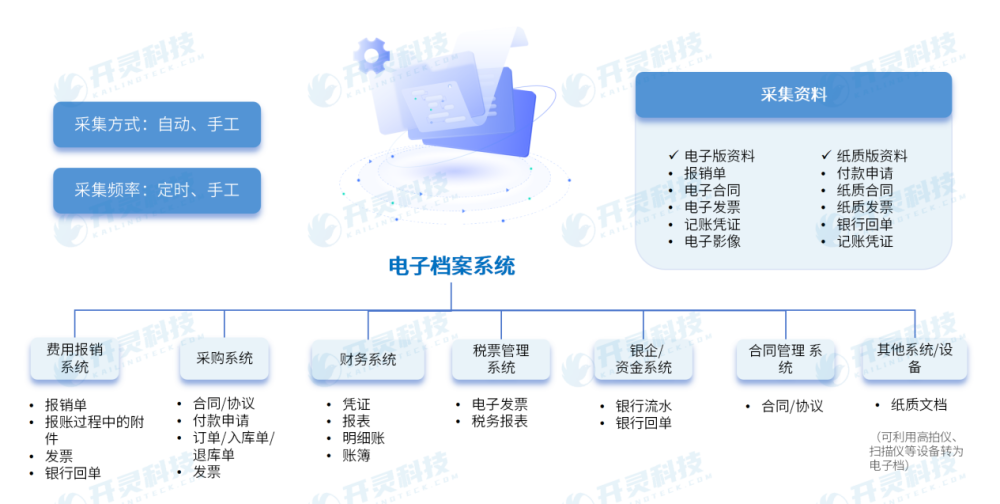
(II) Automatic collection across multiple systems: data actively aggregated rather than manually transferredThe archive system integrates with enterprises' existing systems through standard APIs, automatically collecting all data required for archiving:
The collection logic is automatically linked based on unique primary keys (document number, voucher number, receipt serial number), requiring no manual intervention. The system automatically executes monthly: first capture vouchers → then capture business documents based on the document numbers associated with the vouchers → then capture image attachments based on document numbers → then capture bank receipts based on serial numbers. (3) Automatic association into volumes: all attachments of a voucher are automatically aggregatedThis is the most core capability of the entire system. Under the traditional model, the work that consumes the most time for finance personnel—"finding all documents belonging to the same business transaction and binding them together"—is fully automated in Kailing Technology's system. Based on predefined archiving rules, the system automatically matches all electronic and paper accounting materials of the same business into volumes: accounting vouchers + reimbursement forms + approval flows + electronic invoice source files + paper invoice images + bank receipts, linked with one click and automatically packaged.
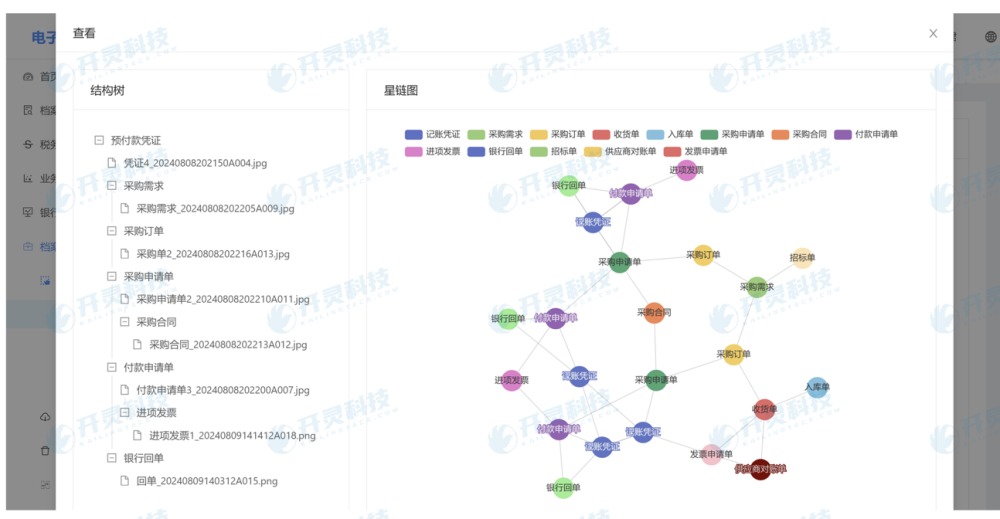
(4) Star-chain graph: one-click drill-through of cross-period vouchersTraditional archives are arranged linearly by year and month. A business spanning multiple years (such as an installment payment contract) is split across ledgers of different years, and viewing it requires flipping through multiple archive volumes to see the full picture. Kailing Technology's original "Star Chain Graph" technology breaks this information isolation. Take a 1 million procurement contract paid over 5 years as an example: the vouchers corresponding to the 5 payments belong to 5 different years, but in the Star Chain Graph, with the contract as the central node, all associated payment vouchers, invoices, and receipts are presented in a network structure. Clicking any node allows drill-through viewing of the original file. The three major advantages of the Star Chain Graph: Multi-dimensional centralized focus: start from any document and expand all associated relationships Dynamic network relationship presentation: supports many-to-one associations, cross-period tracking, and abnormal voucher tracking Enhanced real-time risk insight: Upgrade from static tracing to dynamic monitoring, increasing manual verification efficiency by more than 5 times
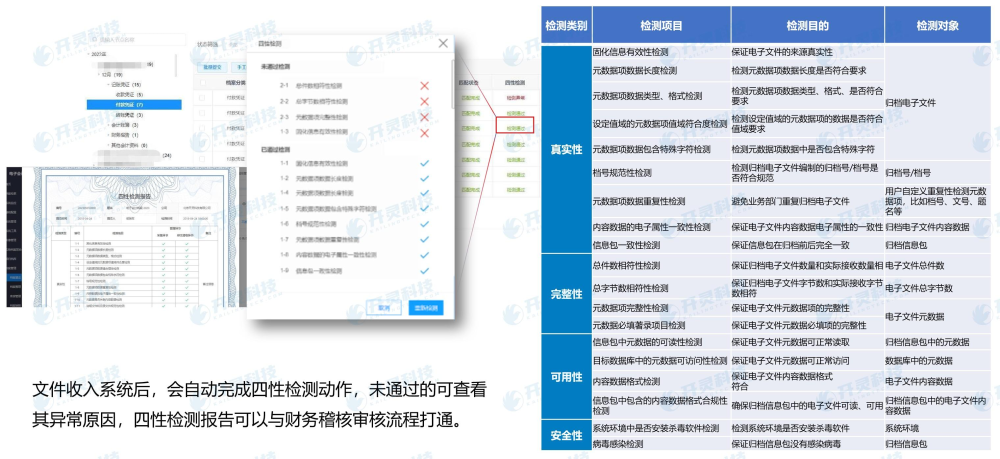
(5) Four-property testing: automatic quality control for archivingBefore each archive is stored, the system automatically performs four-property testing: Authenticity: Electronic signature verification to confirm the document has not been tampered with Completeness: Verify whether attachments are complete based on predefined rules (for example, transfer vouchers must have payment orders + bank receipts) Usability: Verify that the file format can be opened and previewed normally Security: Permission verification, backup status confirmation Vouchers missing attachments cannot pass the completeness check; the system automatically flags them and reminds users to complete them, eliminating the problem of "incomplete archiving" from the source.
(6) Full lifecycle management: one-stop coverage from warehousing to destructionArchiving is just the starting point. The Kailing Technology system covers the complete lifecycle of archives: Collection → Recognition → Association and binding → Four-Property Testing → Storage and shelving → Full-text search → Borrowing approval → Inventory statistics → Appraisal → Destruction upon expiry Supports preview in all formats (covering all file formats worldwide), multi-condition combined retrieval, confidentiality levels precise to a single original voucher, and separately setting audit packages for auditors.
IV. Actual results: from 65 minutes to 6 minutesTaking the archiving of a travel reimbursement as an example: Traditional model: Print accounting vouchers → print reimbursement forms → print invoice verification results → print bank receipts → paste in order → bind → number → shelve. Takes about 65 minutes. Kailing Technology model: The system automatically collects vouchers + reimbursement forms + invoice source files + bank receipts → automatically links them into volumes → passes four-property testing → electronic storage. Finance staff operation time: about 6 minutes (mainly for confirmation and spot checks). For an enterprise generating 30,000 vouchers per year, the labor cost saved in the archiving step alone exceeds 150,000 yuan annually. More importantly: higher archive quality, faster retrieval, more convenient auditing and lower compliance risk. Accounting archive management is undergoing an irreversible paradigm shift: from paper to electronic, from manual to intelligent, from passive storage to active utilization. What Kailing Technology's AI Electronic Accounting Archive System does is not simply moving paper processes online, but using AI to redefine the underlying logic of "archiving"—letting data find each other on its own, letting associations be established automatically, letting integrity be verified automatically, and letting cross-period tracing be completed with one click. To learn more about the electronic accounting archives system or to book a product demo, please consult Kailing Technology:https://www.kailingteck.com/h-col-110.html 。 As a comprehensive business-finance-tax digitalization solution service provider, Kailing Technology provides business-finance-tax management digital transformation products and operational services for various government agencies, institutions, and large, medium, and small enterprises. The product line includes: Solutions for businesses including sales contract management system, procurement contract management system, fully digitalized Leqi interface project, output automatic invoicing system, reverse invoicing system, natural-person invoicing system, employee expense control and reimbursement system, input VAT invoice management system, supply chain collaborative reconciliation system, image OCR recognition system, automatic financial bookkeeping system, and electronic accounting archives system, comprehensively driving the digitalization process across various fields. If you have any business-finance-tax digital transformation needs, welcome to contact us. Beijing Kailing Technology will serve you wholeheartedly.
#Electronic Accounting Archives System #Enterprise Compliance Management #Digital Business-Finance-Tax Transformation #Electronic Accounting Archives Solution #Financial Digidigital |