010-6097 4119Book a Demo


Kailing Technology Innovative Technology: From batch scanning of overseas documents and automatic translation to AI semantic parsing, efficient retrieval and penetrating audit, helping enterprises successfully IPOPublished: 2026-04-08 16:41 When an enterprise decides to enter the global market, the complexity of its financial management often rises exponentially. What internal audit and finance teams face is no longer uniform VAT invoices, but "request forms" scattered in drawers of the Tokyo office, Korean tax bills in corners of Seoul warehouses, handwritten German expense lists at Frankfurt project sites, and even port miscellaneous fee receipts in various formats from Southeast Asian countries. During the IPO sprint stage, these paper documents spanning several time zones and carrying information in dozens of languages constitute a key focus of regulators—penetrating verification. The traditional operating model that relied on manual organization, visual comparison, and manual entry in the past not only consumed a large amount of labor costs, but also planted hidden dangers of inaccurate information disclosure caused by translation ambiguity and broken associations. This article will deeply explore how to use a new generation of intelligent business-finance-tax tools to open up the full chain from digitization of paper vouchers, automatic multilingual translation, to in-depth analysis of business relationships, using technical means to turn "fog" into "thoroughfare," and provide solid working paper support for enterprises entering the capital market. I. The sword of supervision hangs high: why IPOs fall under "transaction flows and documents"Looking back at recent IPO market dynamics, cases of failure due to minor flaws in financial internal controls are common. "Insufficient bank statement verification" and "source documents disconnected from business substance" have become high-frequency minefields in regulatory inquiries. The uniqueness of cross-border business lies in the "three difficulties": 1. Difficult alignment of language and semantics:Different languagesThe accounting treatment logic under the context is completely different. Manual translation often only converts the literal meaning without translating the connotation, which easily leads to incorrect account classification. 2. Difficult to unify layout formats:Overseas invoices lack unified anti-counterfeiting and layout standards, with handwritten modifications, stamps covering text, and mixed barcode information. Conventional scanners can only retain images and cannot convert them into searchable structured fields. 3. Difficult traceability of related evidence:A cross-border procurement transaction may involve overseas contracts, proforma invoices, multimodal transport bills of lading, customs duty-paid certificates, and multiple bank deduction records. Once the evidence chain has a break in time or amount, auditors cannot complete a "full-path penetration" from financial statement accounts to the business source. ▶ Under the traditional model, to respond to a round of inquiries, enterprises often need to assign several finance personnel to "manually rummage" for weeks, which is inefficient and highly prone to human omissions caused by fatigue. II. Kailing Technology's Breakthrough: A Technological Leap from "Mechanical Scanning" to "Cognitive Understanding"To solve the above challenges, relying solely on software with multilingual entry functions is far from enough. Current technological evolution is making a deep leap from visual recognition (OCR) to semantic cognition (AI Parsing).
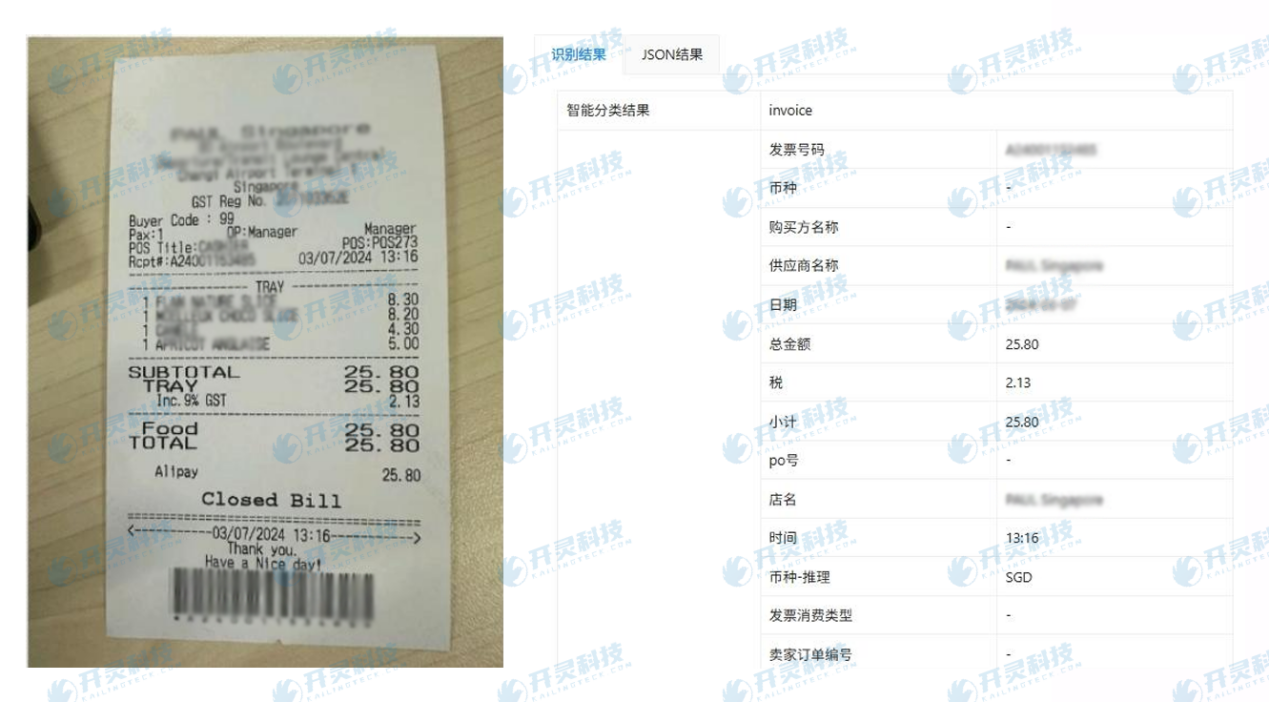
1."One-click collection and full reading" of multilingual invoicesKailing TechnologyThe advanced intelligent image processing system is no longer limited to English recognition. Its underlying model has been trained on massive samples of business-finance-tax invoices from major global trading partners (such as Japan, South Korea, Germany, France, Spain, Vietnam, etc.), enabling it to automatically identify languages and precisely locate key information coordinates. Anti-interference extraction: even if the invoice bears a bright red company seal or even handwritten notes from a salesperson, the algorithm can still penetrate the obstruction and accurately capture the taxpayer identification number, tax-inclusive net value, currency symbol, and goods description. Real-time currency conversion: the system automatically captures and unifies amount expressions in different currencies, completing conversion and aggregation based on the exchange rate benchmark on the business occurrence date, eliminating manual calculation rounding differences at the source. 2. Semantic parsing: letting the system understand "why"This is the core dividing line that distinguishes it from traditional translation software. AI not only recognizes characters, but must also understand logic. Associative reasoning: the system understands that "Landed Cost" consists of "goods value + freight + insurance + tariffs," and automatically traces the linked logistics documents and customs payment certificates for cross-checking and reconciliation. Anomaly alerts: When the number of nights on an overseas hotel bill does not match the corresponding travel allowance standard, or when the same batch of goods generates two duplicate inspection fee claims, the AI engine proactively pops up an alert based on the preset compliance risk control model, exposing audit doubts at the data entry stage.
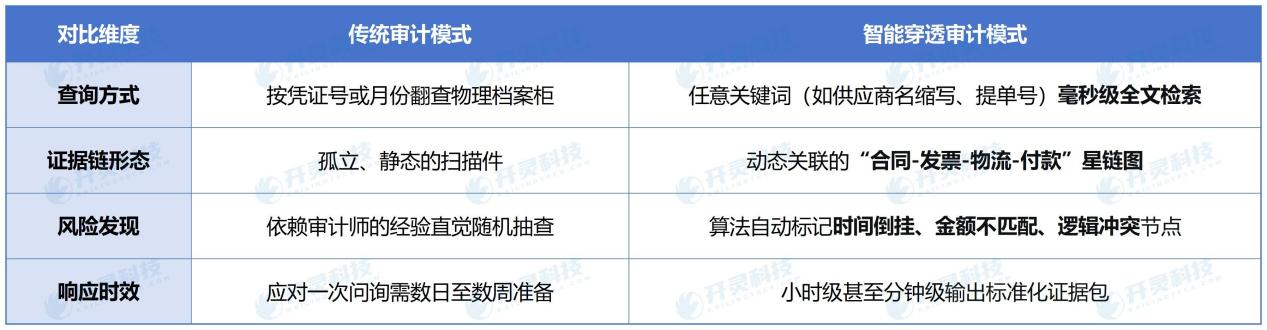
III. Star-chain tracing: building a "digital twin ledger" under drill-through supervisionFaced with regulators' requirement to "penetrate upward to the final supplier and downward to the end customer," image files stored in a scattered manner have limited value; the real value lies in the construction of relationship graphs. Kailing TechnologyThe key technology lies in a multi-dimensional data association engine (which can be viewed as a network-like data structure). Its working principle is as follows:
Through this "point-to-chain-to-surface" visual traceability technology, auditors can double-click an invoice and unfold a complete business river on the screen: when was the upstream purchase instruction issued? When did the goods load and leave port? Which party advanced the tariff? Which bank transaction corresponds to the final payment voucher? This transparency not only meets the stringent review requirements of an IPO, but also represents a qualitative leap in enterprise internal risk control. IV. Escorting IPO: compliance is not a cost, but competitivenessIn the marathon of enterprises sprinting toward an IPO, financial compliance capability is shifting from a back-office support function to a front-office pricing factor. A well-functioning intelligent business-finance-tax governance system can bring enterprises threefold assurance: Ensure the authenticity of information disclosure:Ensure that every cent of income and expenditure is verifiable and logically consistent, able to withstand any form of retrospective review and scrutiny. Improve the due diligence efficiency of intermediary agencies:Brokerages, accountants, and lawyers can quickly obtain the required working papers through authorized ports, shortening the listing coaching cycle and reducing the risk of missing market windows due to process delays. Establishment of a long-term internal control mechanism:Listing is not the end point, but the starting point of stricter regulation. Intelligent archive and parsing systems will become the normalized infrastructure for listed companies to respond to annual report audits and tax inspections. A cross-border business footprint requires cross-language intelligent governance. When every document in overseas business can be precisely scanned, intelligently translated, deeply parsed, and efficiently retrieved, the enterprise's financial data is no longer a heavy burden sleeping in the archives, but fresh blood flowing through the capital pipeline. For enterprises aiming to enter the capital market, choosing a compliance path driven by technological innovation is undoubtedly the most calm and cost-effective strategic layout for responding to the era of strict supervision. Kailing Technology helps enterprisesSay goodbye to cumbersome manual reconciliation and embrace full-chain digital penetrating audit to go far and steadily in this long capital race:https://www.kailingteck.com/h-col-109.html 。 Kailing TechnologyAs a comprehensive business-finance-tax digitalization solution service provider, we provide business-finance-tax management digital transformation products and operational services for various government agencies, institutions, and large, medium, and small enterprises. The product line includes: Sales contract management system, procurement contract management system, fully digitalized Leqi interface project, output automatic invoicing system,Reverse invoicing system,Solutions for the invoice issuance for individuals system, employee expense control and reimbursement system, input VAT invoice management system, supply chain collaborative reconciliation system, image AI OCR recognition system, automated financial bookkeeping system, electronic accounting archives system, and other businesses, comprehensively advancing the digitalization process across various fields. If you have any business-finance-tax digital transformation needs, welcome to contact us. Beijing KailingKailing TechnologyWe will serve you wholeheartedly.
#OCR Recognition #Image Recognition System #Invoice Recognition #Overseas Invoice Recognition #Overseas Invoice OCR #Global Invoice Recognition System #AI Semantic Parsing #Paperless Office #Intelligent Finance #Digital Business-Finance-Tax |