
Why are the expense reports the boss wants always late? Kailing Technology's expense control system supports expense decisions with custom reports and drill-down queries
When management questions expenses at an operating meeting, they usually do not stop at a single number. First they ask where this month's expenses were spent, then whether it is more or less than budget, then which department and which project supported it, and finally they always point to a certain line and say: pull this one out for me to see. The month-end summary report in finance's hands can mostly only answer the first question; the next question requires another round of calculation, and going further requires digging through a stack of documents. When Kailing Technology implements expense control and reimbursement projects for industries such as manufacturing, retail, and design consulting, it repeatedly hears the same feedback—it is not that reports do not exist, but that they come late and cannot be drilled into. Lingdong Reimbursement breaks this into two actions: report definitions are left to the enterprise itself, and summary numbers can be clicked all the way back to original documents and invoices.
▍What management wants isn't that month-end summary table
A summary table is a product of one-time reading, while decision-making is a series of follow-up questions. If travel expenses are higher than last month, what managers want to know is never the conclusion that they are higher, but the three layers below: which department they are higher in, which few people or which project they are concentrated in, and what kind of invoices these people submitted. Once the second layer breaks, the discussion will retreat to experiential judgment, and the meeting minutes will mostly contain phrases like strengthen control with no actionable focus.
Another common form of lateness is when the numbers themselves are correct but the timing is wrong. The table produced at month-end describes money that has already been spent and paid; by the time it is seen, the budget has already been used, and all that can be done is explain, not decide. What management really wants is to see the trend while expenses are still in application, approval, and pending payment stages, placing control actions before the money goes out.
▍The root cause of late reports: one table must be pieced together from six places
Break down a complete expense report and you will see that the data it needs is actually scattered across six mutually independent places: invoices are in the invoice pool, reimbursement items are in the reimbursement form, who signed is in the approval records, whether payment was made is in bank receipts, whether it was recorded is in accounting vouchers, and deductibility status is in the invoice ledger. As long as these places are not under the same data set, producing the report can only rely on people: exporting separately, matching item by item, and then unifying the standards.
- Standards not aligned— Reimbursement forms are classified by reason, vouchers are grouped by accounting account, and the ledger is counted by invoice type—putting these three tables together always requires someone to do a manual conversion.
- Timing misalignment— The document date is the submission date, the payment date is the transfer date, and the voucher date is the booking date; the same expense falls in different months across three tables.
- The busier, the further back— Month-end closing, certification and deduction, and binding and archiving all pile up at once, so management reports naturally rank last, and delays are almost determined by scheduling.
So slowness is often not an attitude problem, but a structural problem. If you want reports to be on time, you must first make these data grow on the same chain from the very beginning.
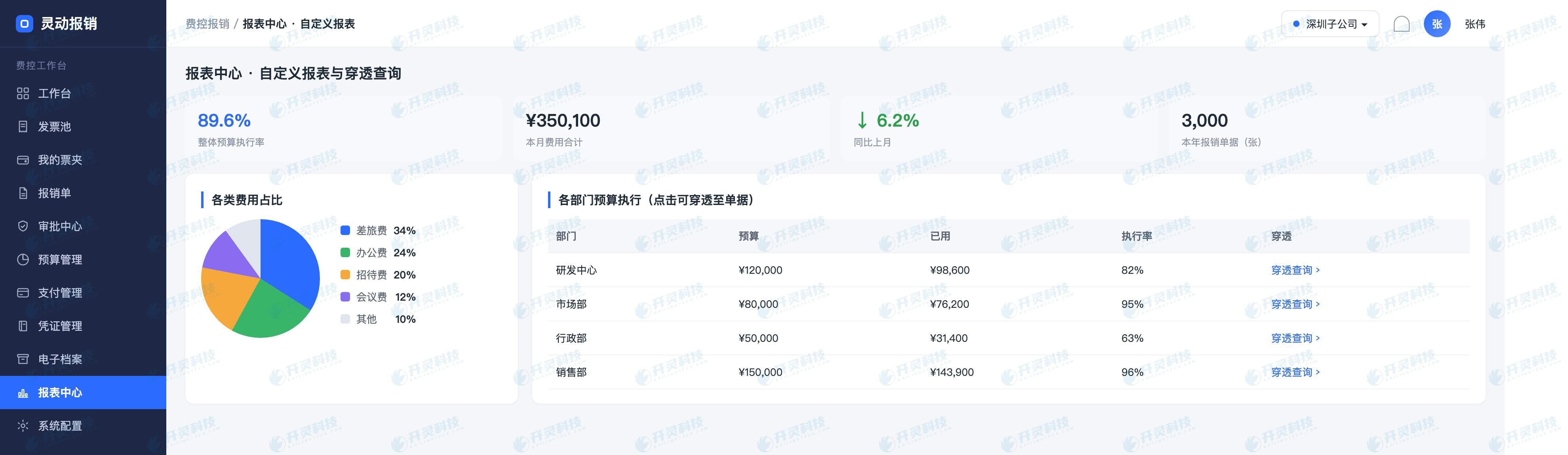
▍Kailing Technology's drill-down query: from summary figures all the way to source documents and invoices
Lingdong Reimbursement covers the full chain of invoice collection, validation, reimbursement, approval, payment, booking, and archiving. An expense stays in the same dataset from invoice entry to booking and archiving. The direct benefit of this premise is that every summary figure on a report can be traced back along its path.
Expand a department's total expenses and you see the list of reimbursement forms that make it up; expand a reimbursement form and you see the specific items reimbursed this time, each associated invoice, who approved it, which bank receipt paid it, and which accounting voucher was generated; click further in and you can also retrieve the invoice's source file and verification results. Kailing Technology turns this path into one continuous click, instead of making finance switch back and forth among several systems and manually compare document numbers.
What penetrating query changes is actually the way people speak in meetings. Documents hang behind the numbers, anyone can follow up on the next layer on the spot, and conclusions no longer depend on someone's memory or explanation; when anomalies are found, there is no need to wait for a special verification—clicking in to view the original voucher completes a check.
▍Define report standards yourself: a new way to view data without scheduling development every time
The angle from which enterprises view expenses will change. This year they look at it by department; next year when the project system is adopted, they will look at it by project; headquarters cares about budget execution rate, business leaders care about per-capita expenses, and finance cares about the distribution of deductible tax amounts. If every change in perspective requires submitting a request, scheduling, and waiting for a version, reports will always lag a quarter behind the management rhythm.
Lingdong Reimbursement provides custom data reports, where data fields, statistical dimensions, filter conditions, and presentation methods are configured by the enterprise itself. Newly added report definitions can go live the next day, and configured reports also support drill-down layer by layer. Common configurations include: budget vs. actual execution comparison, departmental expense composition, project expense vs. output value comparison, expense category trends, personnel reimbursement details, invoice tax amount and deduction distribution, etc., arranged according to each company's own management language.
▍View output value on your phone: by department, person, and project
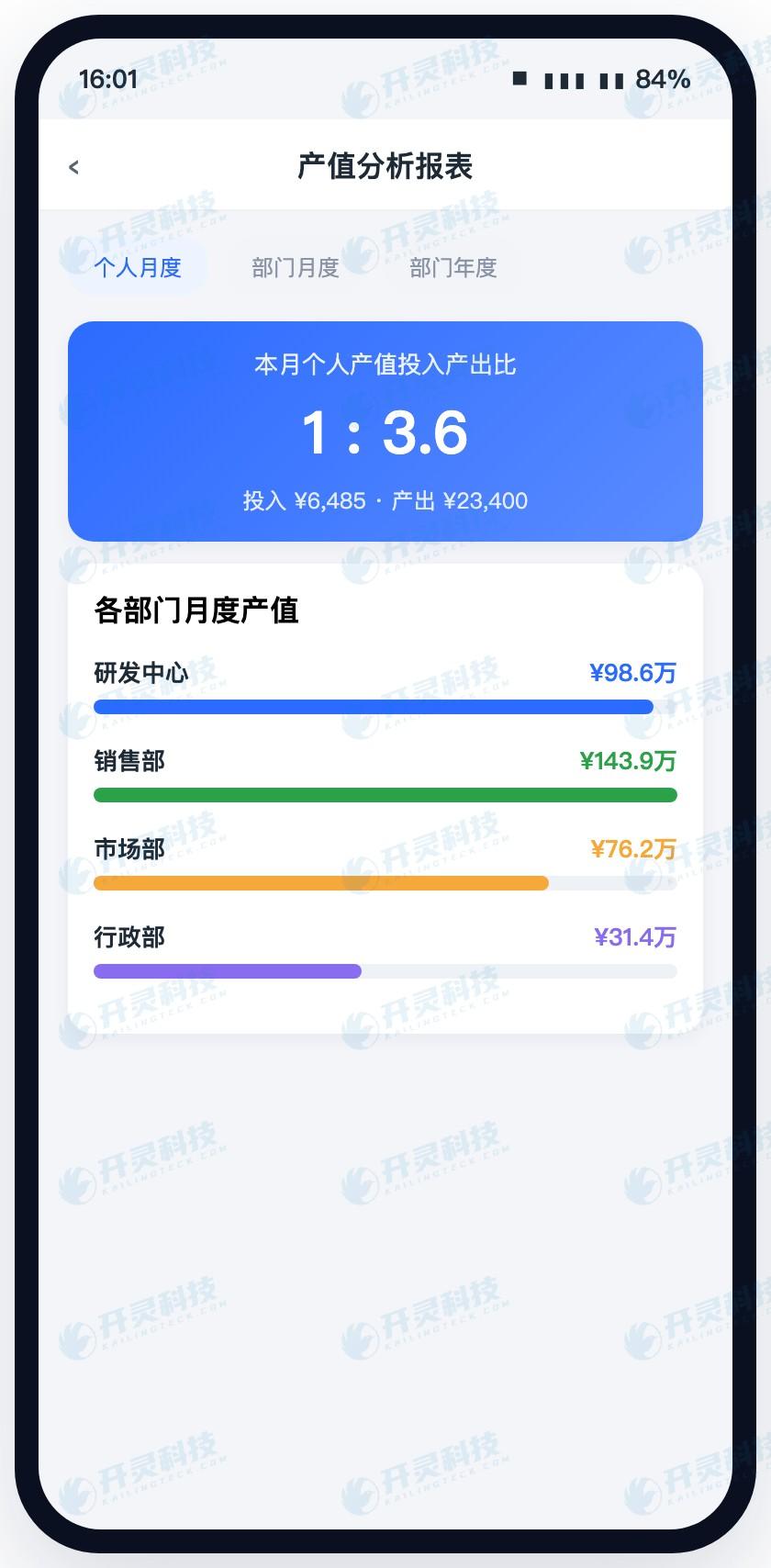
People who need to see the numbers are often not at a computer. Lingdong Reimbursement's mobile end provides output value analysis, supporting viewing by three dimensions: department, personnel, and project. It can be opened for a quick confirmation on a business trip, at a client site, or on the way to a meeting room, without first returning to the office to turn on a computer or asking finance for a report.
The mobile end is better suited for judging whether there are anomalies rather than doing full-volume analysis: first check whether totals and trends are correct, which department or project clearly deviates, and then decide whether to continue drilling down on the computer. With a clear division between viewing data and drilling into data, the cost of daily browsing can be reduced.
▍From viewing numbers to controlling numbers: budget pre-control and exception alerts
The value of reports ultimately comes down to controlling money. The idea of comprehensive budget control and pre-control is to connect budget standards to the moment reimbursement occurs: when employees submit, they can see the remaining quota of their department or project, and overages are identified during submission and approval rather than only discovered after monthly reports show that a certain line has overspent.
Paired with this are exception alerts. The system focuses on two types of objects: whether the invoice itself has problems, and whether the supplier behind the invoice has problems. Suspicious situations appearing on either line are pushed to the forefront. Combined with duplicate reimbursement interception and multi-dimensional invoice verification, every exception item managers see in reports can be opened to verify the corresponding original document, eliminating the need to separately initiate another round of ledger investigation.
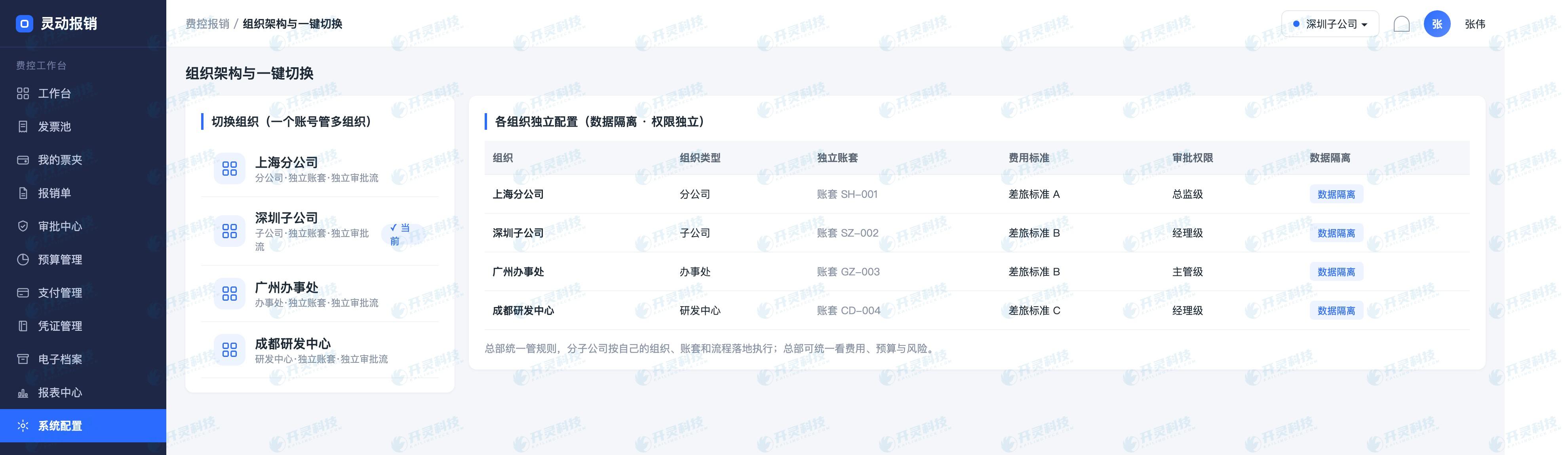
Multiple organizations are merely one dimension in the reporting scope here. Group enterprises can use one account to switch perspectives among their affiliated entities to view data, and how much they can see is determined by the authorization scope; after switching perspectives, the ability to drill down through reports remains the same.
▍FAQ
Q: Do reports need separate development?
A: Routine expense reports can be configured through custom data reports, with data fields, statistical dimensions, filter conditions, and display methods set by the user. New bases can go live the next day without going through development scheduling each time. Specially customized complex models can be discussed and assessed separately.
Q: Can drill-through queries go all the way down to the invoice itself?
A: Yes. From summary figures downward, the sequence is reimbursement form list, document details and approval records, associated invoices, payment receipts, and accounting vouchers. At the invoice layer, collected source files and verification results can also be viewed, forming the correspondence among documents, invoices, payments, and vouchers.
Q: What content can be viewed on mobile?
A: The mobile end provides output value analysis, supporting viewing expenses and output value by department, personnel, and project dimensions, suitable for quickly confirming totals and trends in daily work; when detailed item-by-item investigation is needed, continuing to drill down on the desktop end is more convenient.
Q: How often is the report data updated?
A: Reports take the real-time status of documents and invoices in the system. Once actions such as employee submission, approval, payment completion, and voucher generation occur, they can be reflected, without waiting for month-end consolidated summary. The specific presentation cadence can be determined according to the reporting criteria configured by the enterprise.
Q: Will data from multiple group entities be mixed together?
A: No. Each entity's data is presented separately according to authorization scope. Accounts can switch between entities they have permission for to change perspective, and the visible scope changes accordingly; after switching, drill-down queries in reports remain available as usual.
Want to see whether expense reports can be drilled down on demand? Welcome to learn about Kailing Technology Lingdong Reimbursement expense control management solution: https://www.kailingteck.com/feikong/ .
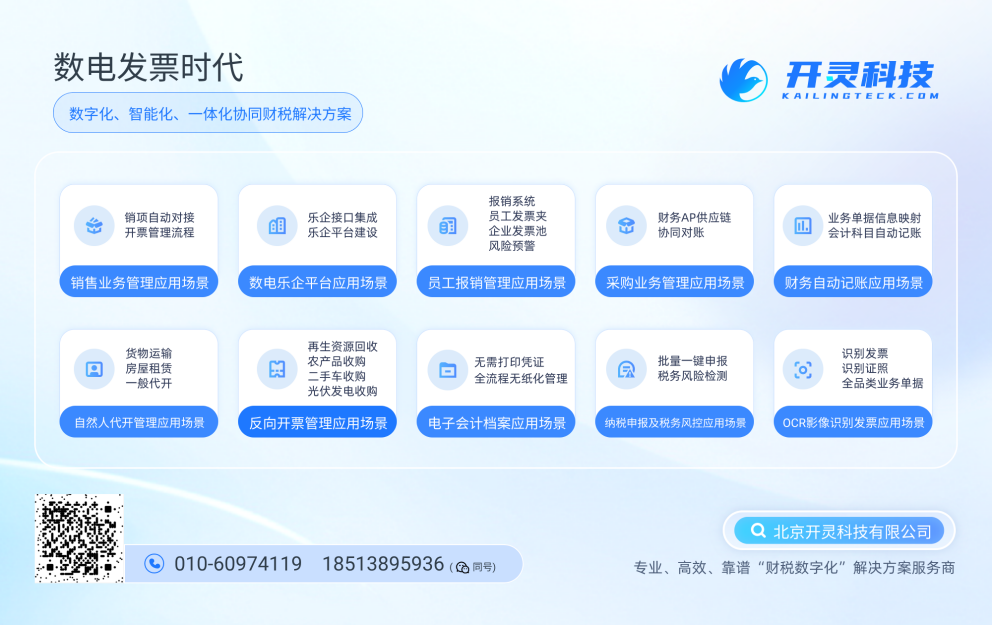
As a comprehensive business-finance-tax digitalization solution service provider, Kailing Technology provides business-finance-tax management digital transformation products and operational services for various government agencies, institutions, and large, medium, and small enterprises. The product line includes:
Solutions for businesses including sales contract management system, procurement contract management system, fully digitalized Leqi interface project, output automatic invoicing system, reverse invoicing system, invoice issuance for individuals system, employee expense control and reimbursement system, input VAT invoice management system, supply chain collaborative reconciliation system, image OCR recognition system, automatic financial bookkeeping system, and electronic accounting archives system, comprehensively driving the digitalization process across various fields.
If you have any business-finance-tax digital transformation needs, welcome to contact us. Beijing Kailing Technology will serve you wholeheartedly.
Keywords: Expense reports, drill-through queries, custom data reports, expense control and reimbursement system, budget control, output value analysis, Kailing Technology, agile reimbursement
As a comprehensive business-finance-tax digitalization solution service provider, Kailing Technology provides business-finance-tax management digital transformation products and operational services for various government agencies, institutions, and large, medium, and small enterprises. The product line includes: solutions for sales contract management system, procurement contract management system, fully digitalized Leqi interface project, automatic output invoicing system, reverse invoicing system, invoice issuance for individuals system, employee expense control and reimbursement system, input VAT invoice management system, supply chain collaborative reconciliation system, image AI OCR recognition system, automatic financial bookkeeping system, electronic accounting archives system, etc., comprehensively driving the digitalization process across various fields.
Consultation Hotline: 18513895936 / 010-60974119 Location: Beijing