
Reimbursement archiving and electronic accounting archives split in two? Kailing Technology's expense control system makes booking and archiving a single action directly connected to archives
During the month-end closing days, a strange division of labor often appears in the finance department. One group checks documents, creates vouchers, and monitors payments in the reimbursement system, with their work ending at "this month's books are balanced"; the other group holds printed reimbursement forms and invoices, supplementing, linking, and numbering them one by one in the electronic accounting archives system, with their work ending at "this batch of materials is stored." The two groups are actually busy with the same batch of business, yet a wall seems to stand between them—the document in the reimbursement system was booked long ago, but in the archives system it is still an empty record waiting to be filled. This is what many enterprises call the "two skins." Kailing Technology has seen many such scenes in expense control and reimbursement projects. Lingdong Reimbursement's approach is not to add another moving position, but to merge the archiving action directly into the booking action: at the moment of reimbursement booking, whatever should be retained is retained, and the archives side receives a complete set of materials at the same time, without waiting for anyone to move it again.
▍How the two separate tracks emerge: one manages process completion, the other manages keeping things retained
Lay out the goals of the two systems and neither is wrong. The goal of the reimbursement system is to "complete the process"—invoices are collected, forms are submitted, money is paid out, and entries are recorded; once the process closes, the matter is considered finished from a business perspective. The goal of the electronic accounting archives system is to "retain things"—according to accounting archive standards, vouchers, documents, attachments, and receipts are kept as a complete set, retrievable and transferable at any time, and able to withstand inspection. Both goals stand on their own; the problem lies at the junction: from "process completion" to "archive entry," usually no system is responsible, and only people can move things.
Relying on people to move things also brings a more hidden problem — the time gap. At the moment reimbursement occurs, the materials are most complete: invoices have just been collected, approval traces are still fresh, and payment receipts arrive right after. But archiving is often scheduled after monthly closing or even at quarter-end. During this period, the handler may have changed positions, attachments may be scattered on someone's computer, and paper invoices may be pressed under a drawer. By the time centralized sorting is really needed, what the archives staff does is not archiving, but archaeology.

▍The pain of each of the two groups: repeated organizing, delayed archiving, and inability to retrieve source files when pulling archives
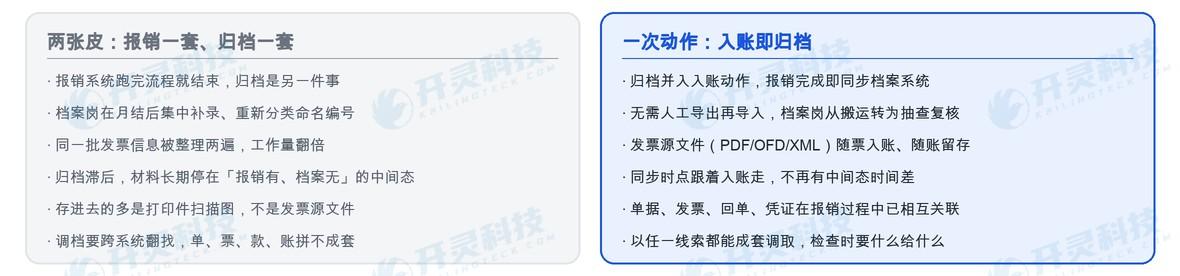
- Duplicate organizing. The same batch of invoices has already been collected, verified, and validated at the reimbursement stage and linked to specific documents; at the archiving stage, they must be reclassified, renamed, numbered, and uploaded again according to archive standards. The information has not increased, but the workload has doubled.
- Archiving delays. Archiving is scheduled after monthly closing, leaving materials in a long-term intermediate state of "present in the reimbursement system but absent from the archive system." During this period, checking an expense requires opening two systems simultaneously to search, and no one can tell which side is accurate.
- Archive retrieval cannot find the source files. This article is most easily exposed during audits, tax inspections, and internal reviews: what lies in the archives is a scanned image or screenshot of a printout, not the original PDF/OFD/XML source file of the invoice. According to the Ministry of Finance Document No. 6, for electronic invoice reimbursement, booking, and archiving, what should be retained is this source file itself.
Put the three together, and they point to the same structural problem: reimbursement and archiving are treated as two things happening one after the other, so there will inevitably be a position for "whoever moves the output of the former into the latter". As long as this moving position exists, duplication, delays, and omissions will always exist.
▍Kailing Technology's approach: not adding an archiving step at the end of the process, but completing archiving at the moment of booking
Lingdong Reimbursement covers the complete chain of 'invoice collection → validation → reimbursement → approval → payment → booking → archiving'. Archiving in this chain is not an add-on final step, but a result inherent to the booking action. Kailing Technology breaks it down into two specific tasks.
First, let the source file land together with the posting. What employees obtain when scanning and quickly recording is the PDF/OFD/XML original itself from the tax end; from the moment it enters the invoice pool, it follows the invoice, follows the document, and at the posting step naturally remains together with the voucher—no one needs to supplement it afterward, and it will not degrade into a printout midway. Only one point is emphasized here: what should truly be archived is this original, not its shadow; by getting this step done at the moment of posting, there will no longer be any work like "going back to find the source file" later.
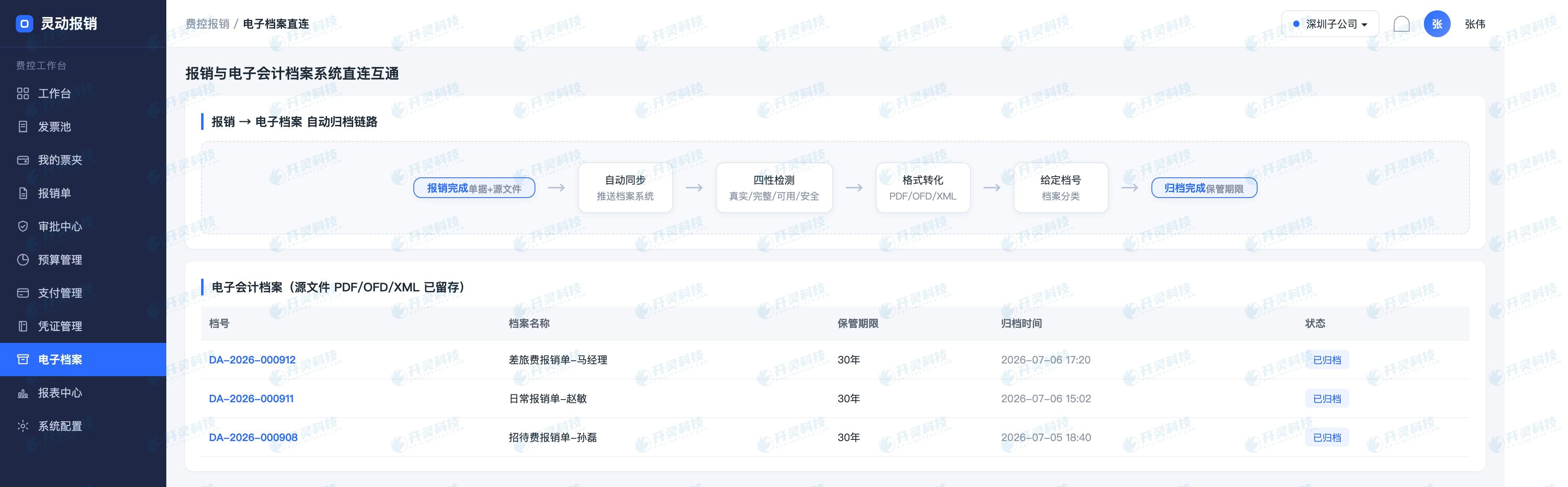
Second, let the archive side receive things at the same moment. Once the reimbursement form is posted, synchronization is triggered. Documents, invoice originals, approval traces, and accounting vouchers are pushed over as a complete set according to pre-defined specifications, with no manual export or re-import in between, and no need to wait for the next batch. Kailing Technology's product line itself includes an electronic accounting archives system, and the two sides communicate through standard interfaces; if an enterprise already has an archive system in use, it only needs to connect according to the same set of field specifications, without having to start over.
▍What exactly does "complete set" mean: documents, invoices, payments, and accounts can find each other
Many enterprises think archiving is done well, until the day they need to retrieve files and discover: documents can be found, invoices must be searched in the invoice pool, payment receipts are in the online banking download directory, and vouchers are in the financial software. All four things exist, but they just cannot be linked together. So-called complete sets do not mean that all four are stored, but that starting from any one, you can find the other three.
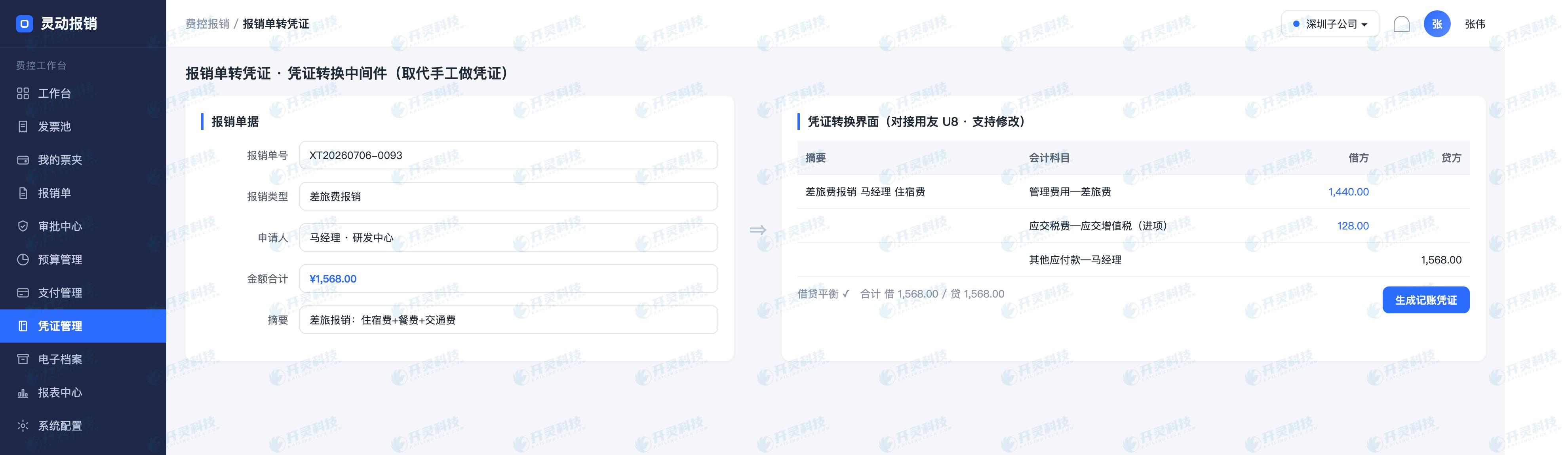
- Documents and vouchers. Fields on the reimbursement form are automatically mapped to the corresponding columns of the accounting voucher. Once generated, the voucher carries its own origin, so at archiving time there is no need to guess from the summary which form it corresponds to.
- Documents and invoices. Reimbursement forms are generated by selecting from the invoice folder, so the form and invoice are inherently linked in both directions; on the ledger, you can see at any time whether an invoice has been reimbursed or recorded.
- Documents and payments. After payment is completed, the bank receipt returns to the system and is attached under the original form. For archiving, it is one item in a complete set of materials, used to show that the money was indeed paid and paid to the object on the document.
These three layers of relationships are established during the reimbursement process; archiving merely moves this already woven web as a whole into the archive repository. So when retrieving archives, inspectors get whatever they ask for: using the reimbursement form as a clue, one can follow it to see the invoice source file, approver and approval comments, payment receipt, and accounting voucher; conversely, using a voucher as a clue, one can trace back to who collected the original invoice and when.
▍During implementation, how to merge the two lines into one
A certain manufacturing enterprise group has multiple legal entities. In the past, reimbursement was reimbursement and archives were archives. After monthly closing, a dedicated person centrally supplemented entries. When audit archive retrieval was needed, they had to flip back and forth between two systems, and for cross-year documents they first had to confirm who handled them at the time. After connecting Lingdong Reimbursement with the electronic accounting archives system and letting archiving follow posting, that dedicated person's work nature changed: from "moving materials over" to "spot-checking whether anything is missing," and those days around monthly closing became noticeably easier.
Based on experience from project implementation, the recommended order for this matter is as follows.
- First align the definitions, then discuss the interface. Align the archiving scope, classification method, naming and numbering rules on both sides first—which documents to archive, which types of attachments each document should carry, and by what dimensions to classify. If the standards are not unified, even a connected interface just synchronizes the chaos.
- Then set the synchronization time point. Recommend using "posting completed" as the trigger point, rather than monthly batch pushing. The closer the trigger point is to the business occurrence, the more complete the materials and the clearer the responsibility, and the less likely intermediate states will occur.
- Get the incremental part running first, then backfill the existing part in batches. First let newly occurring reimbursements run through the path of "archive upon booking" and run steadily for one to two month-end closing cycles; historical stock should be processed in batches by year or by entity, and should not be mixed with incremental work, otherwise both sides will become chaotic.
- Leave one for spot checks. Automatic archiving does not mean no review is needed. Keep a periodic spot-check step, focusing on whether source files are complete, whether receipts are linked, and whether vouchers and documents match, putting manpower into review rather than moving files.
Ultimately, the "two separate systems" problem is not that any one system performs poorly, but that the chain has been artificially cut into two segments. Once the cut is closed, what the reimbursement system hands over is no longer a pile of materials to be organized, but a complete set of archives ready to be filed directly.
▍FAQ
Q: If an enterprise already has an electronic accounting archives system, does it still need to replace it?
A: Generally not needed. Lingdong Reimbursement pushes the complete set of materials through standard interfaces; as long as the archive system can receive them and the field definitions can be agreed upon, it works. During implementation, first define the archiving scope and trigger timing; the interface is actually a later matter.
Q: What exactly does automatic archiving archive?
A: They are the items naturally generated along the reimbursement chain: reimbursement forms and approval traces, invoice originals and their verification results, bank receipts returned to the system after payment, and accounting vouchers mapped from the documents. The scope can be adjusted according to the enterprise's own archive management measures.
Q: How can archives be searched quickly when retrieving them?
A: Retrieving a complete set using the document as the clue is much faster than searching separately by material type. This is because the associations between documents and invoices, documents and payments, and documents and vouchers are established during the reimbursement process. Retrieving one reimbursement form brings out together the invoice source files, approval opinions, payment receipts, and vouchers attached to it.
Q: How are paper invoices and historical documents handled?
A: Paper invoices can be photographed and entered. After the invoice number is compared with the electronic tax bureau, they go through the archiving process together with the documents. Historical documents are recommended to be supplemented in batches by year or by legal entity, separately from newly occurring business.
Want to see how reimbursement posting and electronic accounting archives can be completed in one action? Welcome to visit Kailing Technology to schedule a discussion with a demo based on your company's archiving criteria: https://www.kailingteck.com/feikong/ .
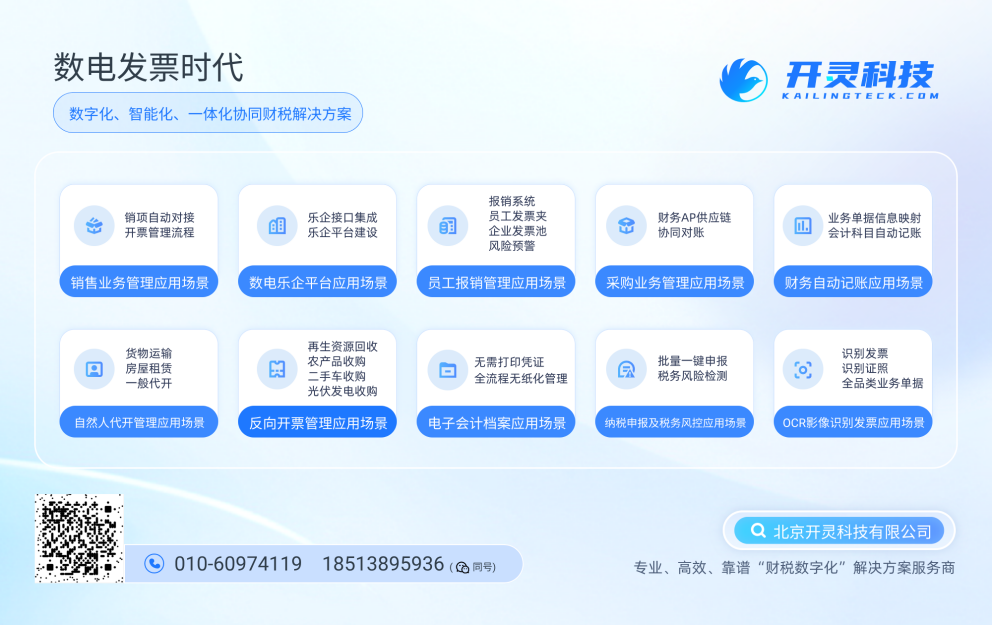
As a comprehensive business-finance-tax digitalization solution service provider, Kailing Technology provides business-finance-tax management digital transformation products and operational services for various government agencies, institutions, and large, medium, and small enterprises. The product line includes:
Solutions for businesses including sales contract management system, procurement contract management system, fully digitalized Leqi interface project, output automatic invoicing system, reverse invoicing system, invoice issuance for individuals system, employee expense control and reimbursement system, input VAT invoice management system, supply chain collaborative reconciliation system, image OCR recognition system, automatic financial bookkeeping system, and electronic accounting archives system, comprehensively driving the digitalization process across various fields.
If you have any business-finance-tax digital transformation needs, welcome to contact us. Beijing Kailing Technology will serve you wholeheartedly.
Keywords: electronic accounting archives; reimbursement archiving; archiving upon booking; invoice source files; PDF OFD XML; four flows in one; Kailing Technology; Lingdong Reimbursement; expense control reimbursement system; direct archive connection
As a comprehensive business-finance-tax digitalization solution service provider, Kailing Technology provides business-finance-tax management digital transformation products and operational services for various government agencies, institutions, and large, medium, and small enterprises. The product line includes: solutions for sales contract management system, procurement contract management system, fully digitalized Leqi interface project, automatic output invoicing system, reverse invoicing system, invoice issuance for individuals system, employee expense control and reimbursement system, input VAT invoice management system, supply chain collaborative reconciliation system, image AI OCR recognition system, automatic financial bookkeeping system, electronic accounting archives system, etc., comprehensively driving the digitalization process across various fields.
Consultation Hotline: 18513895936 / 010-60974119 Location: Beijing