
Still having the cashier download bank receipts one by one? Kailing Technology's reimbursement system bank-enterprise direct connection links payments and automatic receipt returns to reimbursement forms.
In the finance department, the cashier's computer has three things open year-round: the expense control reimbursement system, online banking, and a payment register maintained by themselves. The relationship among these three is roughly the rhythm of a day in this role—orders come from the system, money goes out through online banking, and who paid and whether the voucher was received all depend on that middle table. What Kailing Technology wants to dismantle in Lingdong Reimbursement is exactly the back-and-forth among these three: payments can be initiated directly within the system, and more than 100 banks have already been connected; after the money goes out, the bank-side receipt returns to the system by itself and lands under the document that initiated the payment. Below, follow the cashier role through one day, and by the way explain why that receipt cannot be omitted.
▍Arrive at 8:50: the day starts with three lists
The cashier sits down and first looks at three things: how many reimbursement forms were approved yesterday and are waiting to be paid; which corporate payments are due today; and whether the batch paid out yesterday has complete supporting documents. The first two have deadlines, while the third does not, yet it is often the most time-consuming—it cannot be done in batches and can only be verified one by one.
Without system integration, there is still a purely manual transfer step before payment: the payee, bank, account number, and amount written on the document must be re-entered into the online banking interface or payment template. The trouble is not in the difficulty, but in the volume and cost: dozens or hundreds of documents must be checked field by field, and if one digit of an account number is wrong, the money is returned and must be reconfirmed and repaid. Companies often have accounts at several banks, and each bank requires a different import format.
- Moving information twice: Payment collection information already entered on the document has to be manually entered again, and the probability of error rises with order volume.
- Each follows its own format: With More Than One Bank Branch, Organizing Payment Files Alone Takes Up Fixed Time.
- Status is only in the personal table: Which payment has been made and which has been returned, checked each time someone asks.
▍10 a.m.: at this step the cashier is selecting, not entering data
In LingDong reimbursement, after a reimbursement form is approved, it automatically enters the pending payment step, and information such as payee, bank, and account number is carried along with the document. What the cashier needs to do is select: check the batch of documents to be paid from the pending payment list, verify the amount and payee, and then decide which method to use to send the money out.
There are two paths for sending out payments, and enterprises choose according to their own account opening situation. One is to initiate online payment directly in the system, i.e., bank-enterprise direct connection; currently more than 100 banks are connected, so cashiers do not need to switch between two systems. The other is to have the system generate payment files in the format required by each account-opening bank, for batch import and payment via online banking, suitable for accounts that have not yet enabled direct connection or are accustomed to final review on the online banking side. The two paths do not conflict; different entities and different accounts of the same enterprise can use them separately.
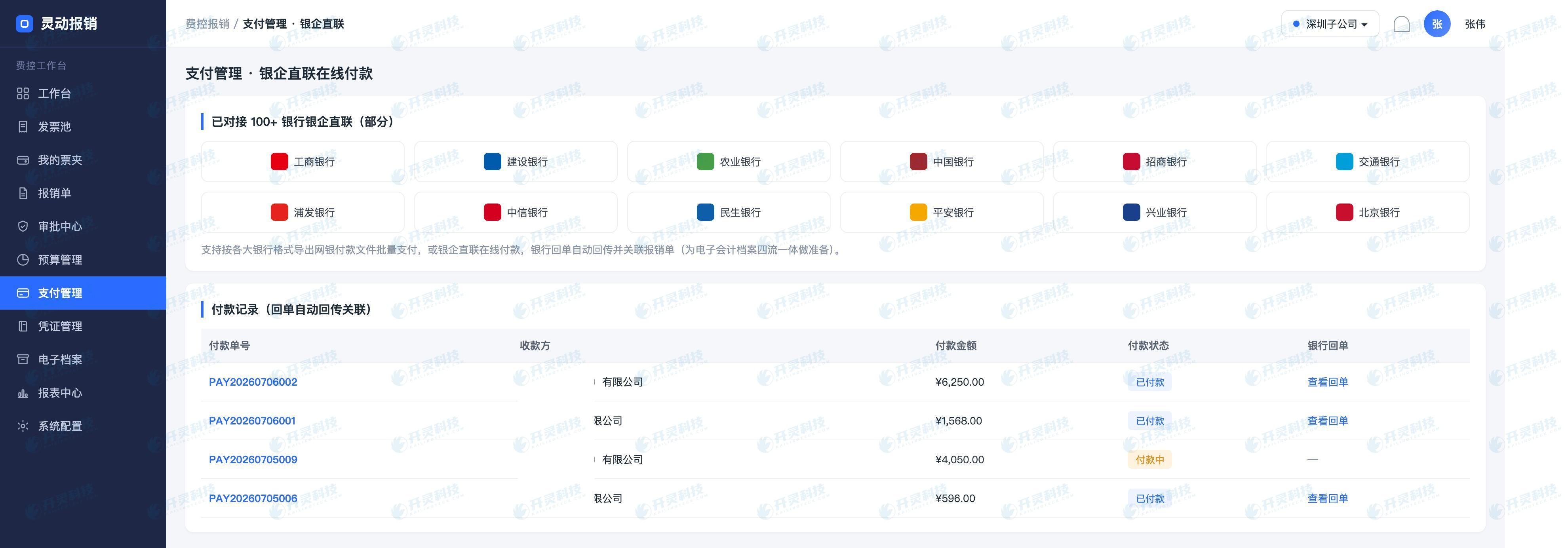
The essential change is replacing "people moving data" with "systems transmitting data," allowing the cashier's attention to shift from field verification to places where human judgment is more appropriate.
▍Those two hours in the afternoon: Kailing Technology lets receipts come back on their own
In the past, every afternoon the cashier's time was basically consumed by the same task: retrieving vouchers. Logging into online banking, filtering transactions by date, identifying those few transactions from the morning on a screen of records, exporting each one, renaming files, printing, and pasting them in document order. Once the number of transactions grew, just figuring out "which document this voucher belongs to" took a long time to verify; if two payments were made to the same payee on the same day, the amount had to be used to work backward.
Kailing Technology's approach at this step is to eliminate the act of searching: once payment is completed, the bank-side receipt flows directly back into the system and is automatically attached under the reimbursement form that initiated the payment. Cashiers no longer need to log into online banking to retrieve documents; who paid at what time, through which account, and against which document can all be seen at once in the document details. More practically for finance leaders, payment progress is no longer private information in someone's spreadsheet, but a public status queryable in the system, so handover during cashier leave or rotation no longer depends on personal memory.

▍Don't rush to calculate efficiency: what exactly is that payment receipt good for
Many people understand payment receipts as "a piece of paper attached behind a voucher" and think it is just a formality. Its real weight should be viewed from the archiving end. Electronic accounting archives require the chain of "reimbursement — bookkeeping — voucher — archive" to be connected end to end, and before archiving it must pass a four-property test — authenticity, completeness, usability, and security, all four of which must hold up. What the payment receipt corresponds to in this chain is the link where funds actually flow out.
Breaking down an expense makes it clearer: the reimbursement form explains why the money was spent, the invoice explains to whom it was paid and for what, the accounting voucher explains how it is recorded in the books, and only bank evidence can prove that the money was indeed paid to this payee in this amount, at this time, from this account. Without this one item, no matter how complete the previous three are, the chain is broken at the final step.
What is more realistic is the issue of supplementary entry. If receipts exist only as files scattered across personal computers, shared drives, or online banking history, archiving requires people to dig them out and re-match them, and such materials pieced together after the fact must have their source proven again. Yet it is bound to the document at the moment payment is completed, and is naturally within the archiving scope.
▍When someone comes to pull files, what exactly do they need to see
Checking one expense rarely involves just one piece of paper; it usually requires a whole set: the reimbursement form itself, the invoice source file, approval records, and the proof of payment. Whether all four can be retrieved at once often determines whether this takes ten minutes or two days.
The voucher side benefits equally. Fields on documents are translated by the voucher conversion middleware into the accounts and summaries of accounting vouchers, which after generation can be pushed to the mainstream financial software the enterprise uses, with no manual entry needed. When payment evidence is already attached to the document, accountants do not need to open online banking separately to verify "whether this voucher's money was actually paid and on which day."
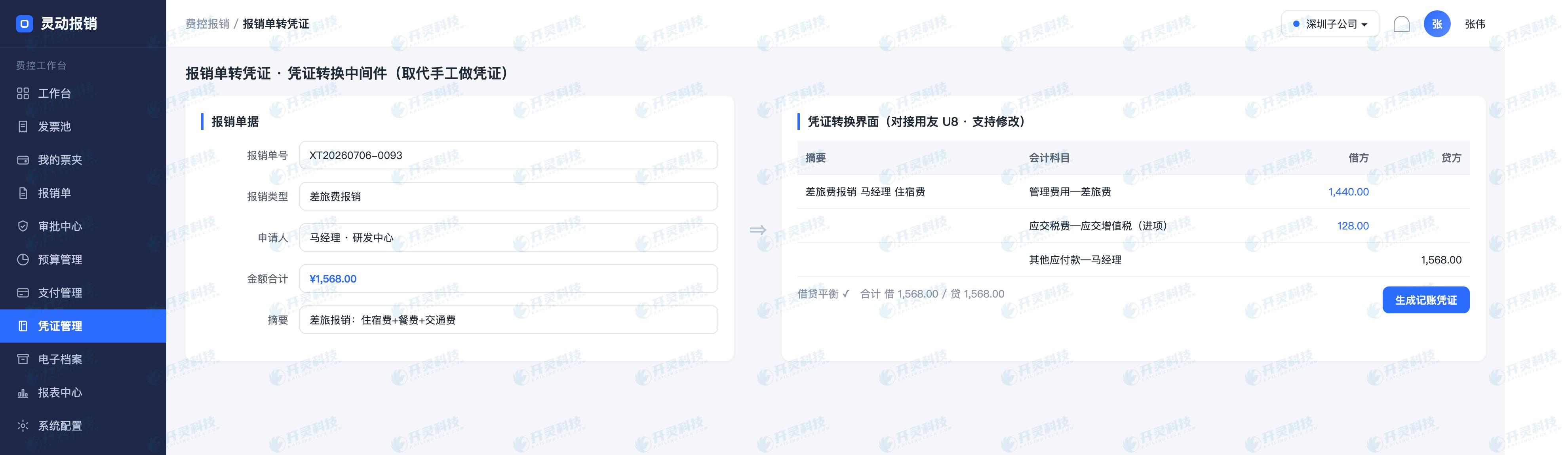
Further on is archiving. Lingdong Reimbursement and the electronic accounting archives system are connected; after posting is completed, they synchronize according to the rules set by the enterprise, with no need to organize manually again. When retrieving archives, search by document, and the materials appear as a complete set. The chain of "reimbursement—bookkeeping—voucher—archive" leaves no gap at the funding link.
▍The check before leaving work: what remains for the cashier role
After a day's work, looking back, almost all the replaced tasks are handling and placing actions: copying account numbers, assembling payment files, checking transaction records, attaching receipts; what remains is the part requiring judgment: fund arrangements, verification of abnormal payments, handling of returned funds, and communication with business departments. The position has not been cut; it just gives back time from repetitive labor.
The experience of a chain retail enterprise can be referenced. This enterprise's stores are scattered across multiple cities, and payment recipients include both employees and small suppliers. In the past, the cashier had to log in to several banks' online banking systems in turn every month, and finding and attaching vouchers was a fixed overtime task. After using Kailing Technology's expense control reimbursement solution, approved documents directly enter pending payment, direct connection and file payment methods are used separately by account, and vouchers automatically flow back and are linked. According to the enterprise internally, the cashier position changed from "busiest at month-end" to "controllable at month-end."
It should be noted that enabling direct connection still depends on cooperation from the bank side, and the materials required vary by bank; for accounts that do not yet meet the conditions, switching to system-generated payment files imported into online banking also eliminates duplicate entry, and running the two methods in parallel during the transition is a common practice.
▍FAQ
Q: Which banks does bank-enterprise direct connection support, and what should enterprises prepare before integration?
A: Lingdong Reimbursement's direct connection capability already covers more than 100 banks, but the specific conditions still depend on the bank where the main payment account is held. Before access, it is usually necessary to confirm services with the account-opening bank, sign an agreement, and complete account and permission configuration, then have the system side handle integration testing; required materials vary by bank, so it is recommended to confirm account by account.
Q: What if the bank where an account is held cannot support direct connection for the time being?
A: Yes, it can be done via file: the system generates a batch payment file in the format required by that bank, and the cashier imports it into online banking to complete payment, likewise eliminating manual entry. It can run in parallel with direct connection within the same enterprise, configured separately by account.
Q: Why must archiving include payment receipts? Is keeping only documents and invoices not enough?
A: Documents and invoices can explain the reason and source of an expense, but cannot prove whether the money was actually paid in that amount, at that time, and to that account. Before electronic accounting archives are archived, four tests must be performed: authenticity, completeness, usability, and security. Without evidence of fund outflow, completeness is difficult to justify.
Q: If multiple payments are made to the same payee on the same day, will the vouchers be attached to the wrong documents?
A: The receipt flows back with this payment instruction, and the linkage follows the payment rather than relying on amount and date for reverse matching, so multiple payments each correspond to their own document.
Want to see how a full day for the cashier position runs from initiating payment to archiving vouchers? Welcome to learn about Kailing Technology Lingdong Reimbursement expense control and reimbursement solution: https://www.kailingteck.com/feikong/ .
As a comprehensive business-finance-tax digitalization solution service provider, Kailing Technology provides business-finance-tax management digital transformation products and operational services for various government agencies, institutions, and large, medium, and small enterprises. The product line includes:
Solutions for businesses including sales contract management system, procurement contract management system, fully digitalized Leqi interface project, output automatic invoicing system, reverse invoicing system, invoice issuance for individuals system, employee expense control and reimbursement system, input VAT invoice management system, supply chain collaborative reconciliation system, image OCR recognition system, automatic financial bookkeeping system, and electronic accounting archives system, comprehensively driving the digitalization process across various fields.
If you have any business-finance-tax digital transformation needs, welcome to contact us. Beijing Kailing Technology will serve you wholeheartedly.
Keywords: Bank-enterprise direct connection, automatic bank receipt return, cashier payment process, reimbursement form linked to receipts, Kailing Technology, Smart Reimbursement, expense control and reimbursement system, electronic accounting archives four flows in one, four-property testing, reimbursement form to voucher
As a comprehensive business-finance-tax digitalization solution service provider, Kailing Technology provides business-finance-tax management digital transformation products and operational services for various government agencies, institutions, and large, medium, and small enterprises. The product line includes: solutions for sales contract management system, procurement contract management system, fully digitalized Leqi interface project, automatic output invoicing system, reverse invoicing system, invoice issuance for individuals system, employee expense control and reimbursement system, input VAT invoice management system, supply chain collaborative reconciliation system, image AI OCR recognition system, automatic financial bookkeeping system, electronic accounting archives system, etc., comprehensively driving the digitalization process across various fields.
Consultation Hotline: 18513895936 / 010-60974119 Location: Beijing