
Who intercepts an invoice reimbursed twice? Kailing Technology expense control and reimbursement system provides multiple risk controls: duplicate checking, blacklist, and custom rules
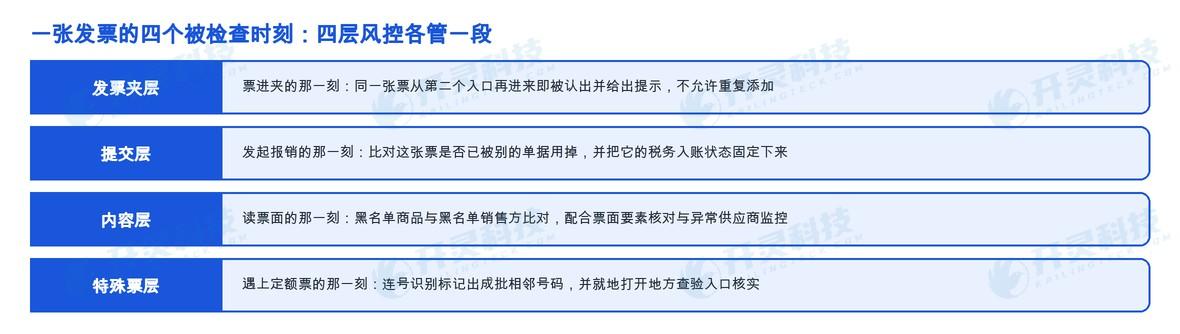
Point the camera at an invoice itself, and its life in an enterprise is actually very short: collected by an employee, attached to a reimbursement form, and entered into the ledger awaiting booking and archiving. The reason duplicate reimbursement occurs is that at several moments along this path, someone should have looked at it but no one did. By the time period-end reconciliation reveals the same number appearing twice, the cost of tracing back is far greater than intercepting it at the time. Kailing Technology's approach in Lingdong Reimbursement places checking actions at four moments along this path.
The four moments are, in order: entering the invoice folder, initiating the reimbursement form, the system reading the invoice content, and encountering special invoice types such as quota invoices, corresponding in the product to the invoice folder layer, submission layer, content layer, and special invoice layer. The first two moments govern the identity of this invoice, while the latter two govern its content and the temperament of the invoice type — yet the latter two are often treated as trivial matters and skipped.
▍The moment it enters the folder: an invoice should not have a second copy in the system
Employees now have far more entry points for receiving invoices than before: in addition to casual scanning, files sitting in WeChat card wallets, files sent by others in chat records, and e-invoices received in email can all be collected into the same invoice folder, and paper invoices can also enter after being photographed. The cost of having many entry points is that the probability of collecting the same invoice once from two places also rises.
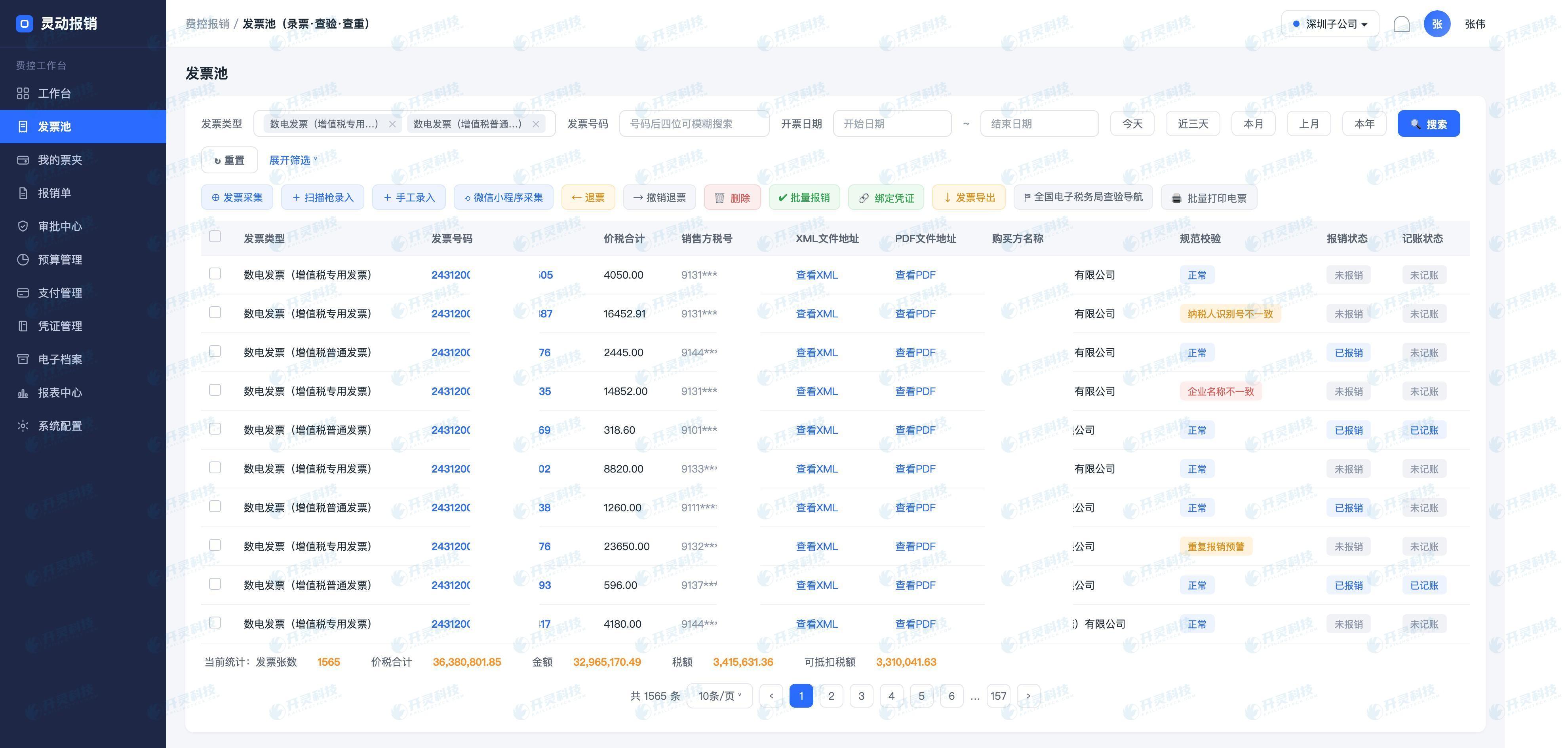
So the initial check action guards the entrance of the invoice folder: if the same invoice enters again from another entrance, the system recognizes it on the spot and prompts, preventing duplicate addition. The basis is elements such as the invoice number that can locate a specific invoice, not the employee's memory. Invoices received are uniformly stored in a personal invoice pool; no matter how many folders are created, the same underlying invoice is used. The entrance can also be set with strong controls so that invoices that do not pass cannot enter the folder.
▍At the moment reimbursement is initiated: first ask whether this invoice has been used on another form
An invoice wallet can only control the same person at the same entry point, but duplicate reimbursement in reality often happens between people: a taxi invoice already reimbursed by the person handling it is organized into another form when the project team consolidates. Lingdong Reimbursement checks again at submission, comparing whether this invoice has already been occupied by another reimbursement form; if matched, the form cannot proceed. Invoices and forms are linked bidirectionally, so when blocked, you can follow the link to see which form it is attached to.
At the same moment there is another action: once the reimbursement form is initiated, the tax posting status of this invoice is fixed, marked as posted and noting whether pre-tax deduction is allowed. The identity issue is settled here; the latter two moments ask a different type of question.
▍The moment the invoice face is read: blacklisted goods and sellers govern whether it should be reported
The first two moments intercept the same invoice. But there is one type of invoice that gives finance even more headaches: it is genuine, passes verification, and has never been reported a second time, yet it simply should not appear on a reimbursement form. For example, the company policy explicitly states that certain product categories are not reimbursable, but an employee submits a general invoice listing such details; or a seller has already terminated cooperation, or has been placed on a watch list due to past issues, yet invoices keep flowing in. If such expenditures are discovered only by reviewing documents afterward, the money has usually already been paid out, and chasing it also involves supplier relationships.
Lingdong Reimbursement makes this into a maintainable list. Enterprises can maintain blacklisted goods and blacklisted sellers in the system; during invoice entry and submission, the invoice line details and seller information are automatically compared, and a risk alert is given upon a match, so that this invoice is seen before moving forward. The content of the list is determined by the enterprise itself—it essentially translates expense policies and supplier management requirements into machine-executable entries; when the policy changes, the list changes accordingly, no longer relying on finance to remind each department by word of mouth.
In parallel with the blacklist is verification of invoice face elements: checking the buyer's name and tax number, together with address, phone, and bank account number, one by one against the enterprise's registration information. The result is not a vague red or yellow light, but a clear statement of whether it is normal or whether the tax number or title does not match. Paper invoice numbers are sent for verification against the data of the Electronic Tax Bureau, while electronic invoices are checked for signatures and whether they have been altered.
Further up is continuous observation: abnormal invoice monitoring and abnormal supplier monitoring will pull out the objects that repeatedly have problems. If invoices from the same seller trigger prompts for several consecutive months, it is most likely not an occasional mistake but a signal that the procurement access link should be reviewed—who should be added to the blacklist, the answer is usually already written in the data.
▍Different scenarios all flow into the same invoice ledger of Kailing Technology
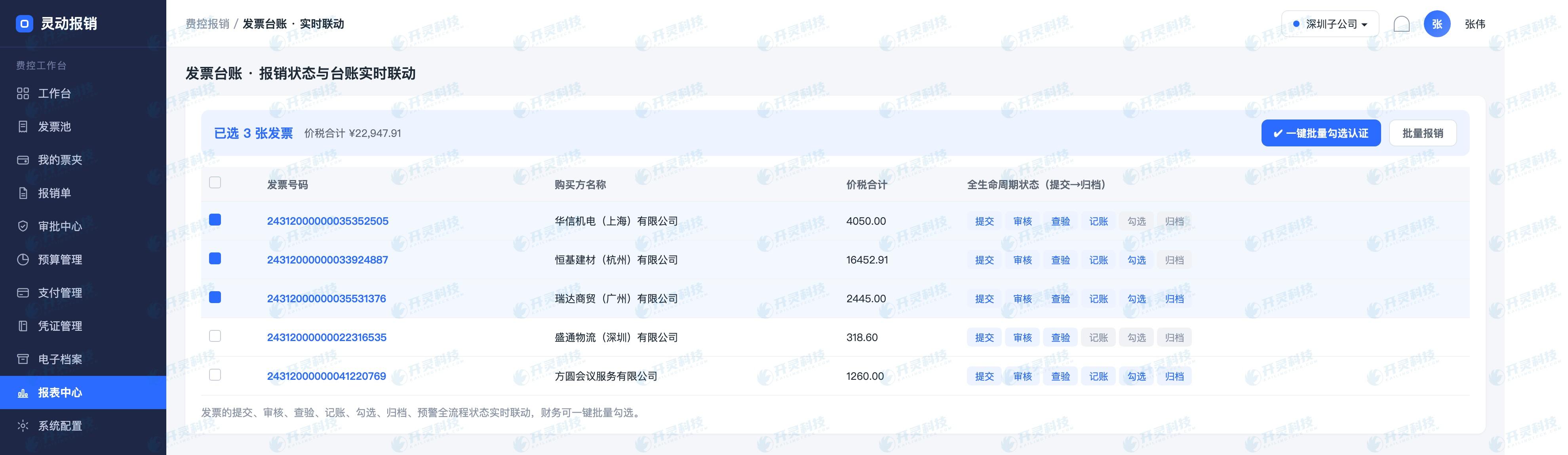
Kailing Technology unifies these conclusions into the invoice ledger: reimbursement progress is linked to the ledger in real time, and what status an invoice is in, which document occupies it, and what the verification result is are all in the same list, with batch selection and centralized processing by conditions. Finance's daily work thus changes from checking one by one to handling only those marked out.
Group enterprises need to consider one more layer: Smart Reimbursement supports multiple organizations, with each entity's data isolated from one another and permissions independent, and the scope of duplicate checking and blacklists can be set by entity. The store reimbursement of a chain retail enterprise is a typical scenario: many stores, small individual amounts, and a high proportion of fixed-amount invoices, making manual period-end spot checks difficult to cover; after spreading the inspection actions across these four moments, finance's energy shifts from verifying invoices to handling the few anomalies that are flagged.
▍FAQ
Q: Who should define blacklisted goods and sellers, and how should they be updated?
A: It is maintained by the enterprise itself, usually assigned to finance or internal control positions, based on the enterprise's own expense policies and supplier management requirements. Once the list is maintained, invoices are automatically compared during entry and submission, without relying on after-the-fact document review; objects repeatedly triggering prompts in abnormal invoice and abnormal supplier monitoring can also be added to the list accordingly.
Q: Why specifically monitor whether fixed-amount invoice numbers are consecutive?
A: Fixed-amount invoices have no buyer information or item details, so checking the header tax number has limited effect, and they are also the invoice type employees submit in large stacks. A batch of invoices with consecutive numbers appearing on the same form is a phenomenon worth reviewing, so the system separately performs consecutive-number recognition to flag it and embeds local verification entry points for on-the-spot confirmation.
Q: Can old invoices across departments and years still be found?
A: It can be detected. The judgment basis is elements such as the invoice number that can locate a specific invoice, unrelated to submission time or submitter. As long as it has previously been occupied by a reimbursement form, it will be identified when submitted again. In multi-organization scenarios, data of each entity is isolated, and the duplicate-check scope is set by entity; when cross-entity viewing is needed, authorized roles can search uniformly.
Q: If a flagged invoice is actually fine, how is it released?
A: A mark is not a conclusion. Verification status is explicitly shown in the invoice pool and ledger, and it can be seen at what time and for what reason it was marked; if it is a misjudgment or occupied by a voided document, finance can release it after confirmation according to permissions, with the process traced and traceable.
Want to know which loopholes these four moments can block under your enterprise's invoice volume? Welcome to learn about Kailing Technology Lingdong Reimbursement: https://www.kailingteck.com/feikong/ .
As a comprehensive business-finance-tax digitalization solution service provider, Kailing Technology provides business-finance-tax management digital transformation products and operational services for various government agencies, institutions, and large, medium, and small enterprises. The product line includes:
Solutions for businesses including sales contract management system, procurement contract management system, fully digitalized Leqi interface project, output automatic invoicing system, reverse invoicing system, invoice issuance for individuals system, employee expense control and reimbursement system, input VAT invoice management system, supply chain collaborative reconciliation system, image OCR recognition system, automatic financial bookkeeping system, and electronic accounting archives system, comprehensively driving the digitalization process across various fields.
If you have any business-finance-tax digital transformation needs, welcome to contact us. Beijing Kailing Technology will serve you wholeheartedly.
Keywords: Duplicate reimbursement interception, invoice duplicate checking, blacklisted sellers, blacklisted goods, consecutive-number identification for fixed-amount invoices, local invoice verification, Kailing Technology, agile reimbursement, expense control reimbursement system
As a comprehensive business-finance-tax digitalization solution service provider, Kailing Technology provides business-finance-tax management digital transformation products and operational services for various government agencies, institutions, and large, medium, and small enterprises. The product line includes: solutions for sales contract management system, procurement contract management system, fully digitalized Leqi interface project, automatic output invoicing system, reverse invoicing system, invoice issuance for individuals system, employee expense control and reimbursement system, input VAT invoice management system, supply chain collaborative reconciliation system, image AI OCR recognition system, automatic financial bookkeeping system, electronic accounting archives system, etc., comprehensively driving the digitalization process across various fields.
Consultation Hotline: 18513895936 / 010-60974119 Location: Beijing