
Only when the reimbursement form reaches the approver is it discovered to exceed limits? Kailing Technology's AI digital employee reviews it against policy first before handing it to a human

At nine in the morning, the business director opens the pending approvals. The list is still the same list, but the arrangement has changed: three items with yellow prompts at the top, and about twenty routine forms that have passed pre-review collapsed below. He opens the one with the prompt, which states that the entertainment expense exceeds the per-instance standard and also flags that the two fixed-amount invoices attached have adjacent numbers. These two points were not found by him digging through the details; they were attached before the document reached his hands. What does this is Kailing Technology's AI digital employee — it runs every document through the company's own "Employee Allowance and Travel Management Policy" first, giving conclusions where it can decide, and pushing to humans where it cannot decide or where there are doubts.
▍The moment you open the to-do list, what changes in the list
Approvers' perception of the reimbursement process is almost entirely compressed into the few minutes when they open their to-do list. In the past, they saw a list without priorities: local taxis, office supplies, customer entertainment, and cross-province travel mixed together, each requiring a click, and they also had to recall the policy standards and how many attachments should be included. Among twenty-plus items, only two or three truly required their level to make a decision; the rest were all doing the same thing—confirming whether any line was crossed.
Now it is a well-grouped list: one group has completed pre-review, all four checks passed, and is confirmed or released according to the enterprise's configured criteria; the other group has been singled out, with the reason written at the top of each—which item exceeded the limit, which rule of the policy it exceeded, which invoice is questionable, and which project has tight quota.
What is reduced is the purely proofreading type of documents—they have not disappeared, they simply no longer require approvers to flip through and confirm them one by one.
▍Which policy clauses can become rules, and which cannot
To connect policies into the approval step, what must first be clarified is not technology but boundaries: not every clause in an "Employee Allowance and Travel Policy" is suitable to become a machine-executed rule. If this layer is not clearly defined, automated review will either cover too little to be useful or cover too much, making decisions on people's behalf that should be made by people.
Clauses that can be converted into rules usually have three characteristics at the same time: a clear threshold, such as a cap per night for accommodation in a certain tier of cities or a per-capita meal allowance; comparable fields, meaning the information needed for the threshold can be obtained from the document or invoice, such as city, number of days, number of people, amount, and invoice line items; and a definite conclusion, meaning the same input yields the same answer regardless of who judges it. Accommodation standards and transportation class restrictions, whether required attachments are complete, whether the header and tax number match the entity, and department and project budget balances mostly fall into this category.
There are also three types of clauses that cannot be converted into rules.
- Business-judgment-dependent— The system states that entertainment expenses should match business necessity, but whether this instance is necessary depends on how far the client negotiation has progressed and what stage the deal is at—information that is not on the reimbursement form to begin with.
- Context-dependent— The same meal expense may not be equally reasonable during a project sprint period and during ordinary periods; the same travel amount may lead to different conclusions when placed in a department with ample budget versus a department under year-end pressure.
- The system itself leaves loopholes— In principle not exceeding, strictly controlling special circumstances, and reimbursing according to actual expenses after approval by the responsible leader—such expressions inherently leave discretion for people, and forcibly reducing them to a single threshold is instead a misinterpretation.
For these three types, there are three pragmatic approaches, none of which force it into a rules engine.
First, route to default manual transfer. For clauses whose judgment basis is not on the document, the rules do not draw conclusions, and the document is handed to a person as-is, only no longer queued together with routine documents.
Second, in turn, push the system to be written clearly. Configuring rules is itself an institutional checkup—whichever threshold is not written, whichever standard is understood inconsistently by two departments, whichever term is semantically vague, is exposed at whichever rule it is configured to. Some clauses are not untranslatable; it is just that the original text was not written to a translatable degree, and adding one sentence makes it translatable.
Third, do not draw conclusions, only prepare information. For the context needed for judgment, the system retrieves in advance whatever it can: the same type of expenses already incurred for this project this year, and the number of same-type documents submitted by the applicant this month. The AI digital employee does not draw conclusions for the approver, but can put in one place what he would otherwise have to look up in several places.
The benefit of clearly defining boundaries is that the scope of automated review is actively limited, rather than reviewing as much as possible. Approvers know clearly: which items the machine has handled, which rule was applied, and which items they are still judging themselves.

▍The four things Kailing Technology AI digital employees review first by rules
Once boundaries are set, execution comes down to four groups of validations that run sequentially upon document submission.
- Standard comparison—— Extract the expense type, place of occurrence, number of people, number of days, and amount, match them against the corresponding tier limits in the policy, and see whether any line has been crossed.
- Document integrity— The travel application that should be attached, the reason and accompanying personnel that should be filled in, and the contract or settlement voucher that should be attached for large expenditures—whichever is missing, it flags it.
- Invoice compliance—— When invoices enter the pool, conclusions on authenticity and duplication are already available, and this step uses them directly; whether the header and tax number are consistent, whether fixed-amount invoices have consecutive numbers, and whether the seller and goods fall into the blacklist are all checked together.
- Budget check— Check whether the corresponding department or project's current-period quota can still accommodate it, so as to avoid overspending only being discovered when reports are produced.
To be clear, connecting a rules engine into the approval process is not novel; many expense control solutions on the market are doing similar things. Kailing Technology's approach is to let it reuse the data already accumulated in the preceding steps: invoice verification and duplicate checking are completed at the moment of pooling, budget balances change with documents in the ledger, and the rules engine does not redo judgments but simply strings existing conclusions together according to policy clauses.
▍Between straight-through and manual handoff, the approver receives documents with conclusions attached
After verification is completed, documents fall into three situations.
Those passing all four go straight through. It can be configured to pass automatically and flow directly to the next step, or to only mark pre-review passed while still requiring a human click to confirm; both options are retained, as companies differ in their acceptance of delegation.
The key to handing suspicious hits to a human lies in the form in which they are handed over: not pushing the original document over for the person to find things themselves, but sending it together with the hit items—which item exceeded the limit, which policy clause it corresponds to, which invoice is suspicious, which quota is tight—so the approver can open it and go straight to the point that needs judgment.
Anything outside the rule boundaries defaults to manual handling. Newly appearing expense types, special cross-period items, and clauses with discretionary room are all handed back to people—better to escalate too much than too little; this is the basic principle of configuring rules.
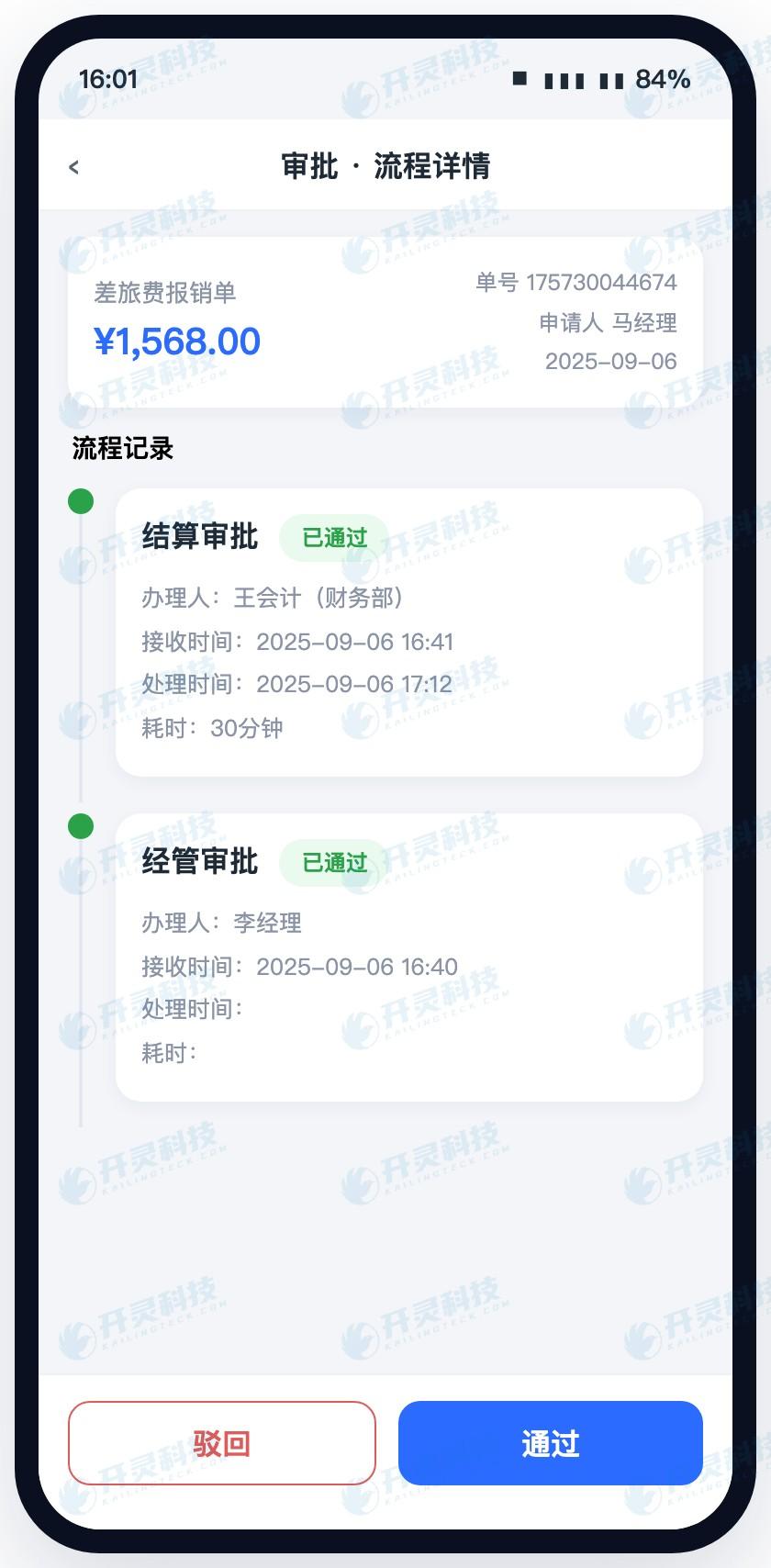
Open an order on your phone and see which steps it went through, who handled it, and how long it took; approve or reject with a single tap.
▍Every order leaves a trace: responsibility falls on systems and people, not machines
A common question about automatic review is: what if it reviews something incorrectly? The answer relies on traceability. The review process of every document is fully recorded: which version of the policy rules was used as the basis, which items were compared, what the conclusion was for each item, whether it passed through directly or was transferred to manual review, and who handled it and how after transfer to manual review.
With this record, the chain of responsibility becomes clear. Rules are set by the enterprise itself and reviewed and published by authorized personnel. AI digital employees execute actions within the authorized scope, and responsibility still rests with the rule-making party and the person with approval authority. If a certain type of document is later relaxed, reviewing the trail can identify whether it was a rule omission or a manual special approval, and then the rule can be revised or the process supplemented. During internal audit review, documents, invoice source files, and review and approval records can be checked as a complete set.
▍Implementation advice: run one or two scenarios first, then gradually expand
Configuring an entire set of policies into rules all at once is not prudent; the pragmatic path has three steps.
Choose scenarios first. Pick high-frequency ones with clear rules: travel and accommodation, local transportation, and daily office procurement have clear standards and simple judgments, delivering direct returns; entertainment expenses and project-specific expenses involve more judgment factors, so leave them for later.
No release without pre-review. In the initial launch period, let the AI digital employee only provide opinions, and still have approvers confirm each document one by one, comparing machine conclusions with human conclusions for a period of time. After a manufacturing enterprise group ran through a full reimbursement cycle and reviewed inconsistent documents, it found that most disagreements were not due to wrong judgments but because the original policy text contained ambiguous wording, and they took the opportunity to clarify the policy. Once consistency stabilized, they then opened up high-frequency, low-risk scenarios for automatic approval.
Then review regularly. Categorize documents transferred to manual handling by reason: if a certain category appears repeatedly with consistent conclusions, it means it can be supplemented as a new rule; if a certain type of rule frequently causes false positives, it means the threshold is set too tightly and needs adjustment. A chain retail enterprise reviews once a quarter, iterating the rules version by version, and the proportion transferred to manual handling gradually converges to the part that truly requires human judgment.

Ultimately, helping approvers spot overspending early does not rely on reminding them to look more carefully, but on first letting rules run through the part hard-coded in the policy, and returning the part left to people as it is. Which part belongs to which side is the question that must be thought through.
▍FAQ
Q: Our policies contain many phrases like "in principle" and "depending on the circumstances"; how are such clauses handled?
A: Such expressions are inherently left to human discretion and are not recommended to be forcibly converted into thresholds. The approach is to mark them as outside rule boundaries, and relevant documents are transferred to manual handling by default, while bringing the context needed for judgment to the approver. When configuring rules, if it is found that a vague expression is actually understood consistently across departments, the original policy text can also be clarified accordingly and then incorporated into the rules.
Q: Does configuring rules require development? What if our policies change frequently?
A: Rules are configured by dimensions such as expense type, standard tier, required attachments, and budget account, without developing separately for each policy. When the policy is revised, simply adjust the rules and publish a new version. Historical documents are still archived according to the version effective at the time, making later review convenient.
Q: If an AI digital employee reviews incorrectly, whose responsibility is it?
A: Rules are formulated and authorized for publication by the enterprise itself. What the AI digital employee executes is comparison actions within the authorized scope, and responsibility still rests with the policy-making party and authorized approvers. The system's role is to fully record the basis version, hit items, and processing process for each document, so that when deviations occur, it can be determined whether the rule was written incompletely or there was a problem in execution.
Q: Can it be used only in some scenarios, while other scenarios still go through the original manual approval?
A: Yes, it can be configured separately by expense type, organizational scope, and amount range. A common approach is to first enable it for scenarios with clear standards such as travel accommodation and local transportation, while entertainment expenses and project-specific expenses still go through full manual approval, and then gradually expand the scope once operations are stable.
Q: Will employees feel blocked by the machine with no channel for appeal?
A: Intercepted documents will show which rule blocked them, by how much they exceeded, and which attachment is missing. Employees can supplement materials accordingly and resubmit. If there are indeed special circumstances, they can go through manual approval with reasons. The rules themselves do not exclude human special approval authority.
Want to know which clauses in your company's reimbursement policy can be turned into rules and which should be left to people? Welcome to learn about the digital employee intelligent approval of Kailing Technology Lingdong Reimbursement: https://www.kailingteck.com/feikong/ .
As a comprehensive business-finance-tax digitalization solution service provider, Kailing Technology provides business-finance-tax management digital transformation products and operational services for various government agencies, institutions, and large, medium, and small enterprises. The product line includes:
Solutions for businesses including sales contract management system, procurement contract management system, fully digitalized Leqi interface project, output automatic invoicing system, reverse invoicing system, invoice issuance for individuals system, employee expense control and reimbursement system, input VAT invoice management system, supply chain collaborative reconciliation system, image OCR recognition system, automatic financial bookkeeping system, and electronic accounting archives system, comprehensively driving the digitalization process across various fields.
If you have any business-finance-tax digital transformation needs, welcome to contact us. Beijing Kailing Technology will serve you wholeheartedly.

Keywords: Kailing Technology's AI digital employee, reimbursement approval automation, expense control and reimbursement system, employee allowance and travel management policy, Smart Reimbursement, over-standard reimbursement forms, budget control, invoice compliance validation, approver's perspective
As a comprehensive business-finance-tax digitalization solution service provider, Kailing Technology provides business-finance-tax management digital transformation products and operational services for various government agencies, institutions, and large, medium, and small enterprises. The product line includes: solutions for sales contract management system, procurement contract management system, fully digitalized Leqi interface project, automatic output invoicing system, reverse invoicing system, invoice issuance for individuals system, employee expense control and reimbursement system, input VAT invoice management system, supply chain collaborative reconciliation system, image AI OCR recognition system, automatic financial bookkeeping system, electronic accounting archives system, etc., comprehensively driving the digitalization process across various fields.
Consultation Hotline: 18513895936 / 010-60974119 Location: Beijing