
How much is spent on invoice verification fees each year? Kailing Technology saves this money by scanning to flash-record and directly retrieving source files from the electronic tax bureau
When finance does annual budget reviews, several expenditures are easily dug up and hard to explain clearly. Office supplies have details, travel has ledgers, but invoice verification is often mixed into categories like "information service fees" and "interface call fees," with neither a separate cost center nor anyone able to immediately say how much was spent in a year. It is not as glaring as a one-time purchase, but it has a very unfriendly characteristic—linear growth with invoice volume: the more invoices, the more this money, and it must be paid anew every year. When Kailing Technology diagnoses enterprise expense control reimbursement chains, it habitually pulls this item out separately to calculate, because among a pile of hard-to-shake costs, it belongs to the few expenditures that "may directly disappear by changing the action." This article does not discuss specific amounts, but only breaks down the structure of the account so you can take it back and apply it according to your own enterprise's invoice volume.
▍First clarify: how exactly was this money generated
The authoritative basis for invoice authenticity is not in the enterprise's hands; the comparison data source is on the tax side. For a few scattered invoices, finance can just open the electronic tax bureau's verification page and enter them manually. Once the requirement becomes "verify every invoice, verify upon system entry, verify in batches," the manual path cannot hold up. Most enterprises will connect to a third-party verification channel, letting the channel provider complete this, and settle with the enterprise based on call volume.
The granularity of billing is usually "per instance," not "per person," nor "per month." This determines its cost curve: when reimbursement invoice volume rises for a while, this expense follows. What is more easily overlooked is that actual billing counts are often higher than the number of invoices — employees first photograph and enter them, then finance verifies them again afterward, so the same invoice is queried twice; verification returns that time out or fail require retries, and retries are also counted; cross-year supplementary entry and audit file retrieval require re-verification, which is another count. So the actual annual call volume is often somewhat larger than intuitively estimated.
▍Calculating this account takes two layers: the visible bill and the invisible labor hours
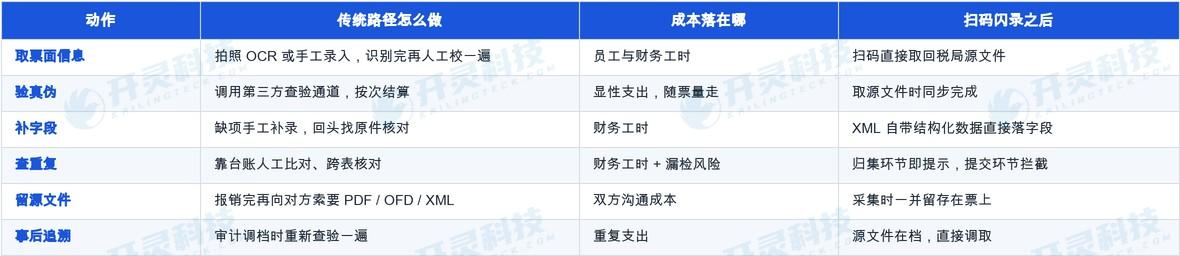
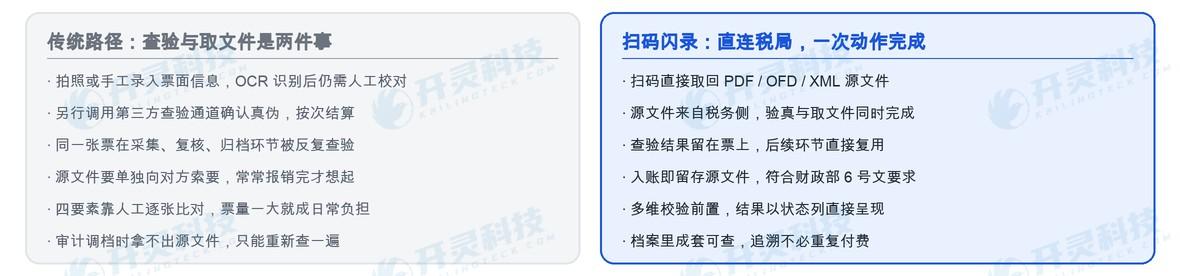
If you look only at interface bills, what you calculate is always only the upper half of the account. For an invoice to go from an employee's hands to being bookable, it must go through several actions in between: retrieving information, verifying authenticity, supplementing fields, checking duplicates, retaining source files, and after-the-fact tracing. The interface fee covers only the "verifying authenticity" step, while the remaining steps fall on the time of employees and finance, enter no account, yet genuinely consume work hours. By laying out these steps side by side under two paths, the structure of the account becomes clear.
▍Kailing Technology uses scan-and-flash entry to merge two tasks into one action
The reason this account can become smaller is not by cutting unit prices, but by merging two actions into one. In the traditional path, “getting invoice information into the system” and “confirming that this invoice is genuine” belong to two steps: the former relies on photo recognition or manual entry, and the latter then uses that information to ask an external channel once. Kailing Technology’s Smart Reimbursement overlays these two steps—scan-and-flash entry. Employees scan the QR code on the invoice with their mobile phones, and the three source files PDF, OFD, and XML are returned at once by the tax side and stored in the system.
The key lies in the source of the file. Since the source file comes back from the tax side, this invoice exists on the tax end and its elements match the tax end—the answer was already there the moment it was retrieved, with no need to spend money again asking a third-party channel the same question. That one question that previously required separate payment is offset by this single action. XML carries structured data, so amounts, tax amounts, and line items can be directly populated into fields, eliminating the back-and-forth of "recognize once, then verify again." As for the Ministry of Finance Document No. 6 requirement that electronic vouchers retain the source file at the reimbursement and booking stage, this is likewise completed conveniently at capture time, with no need to wait until reimbursement is finished to supplement it.
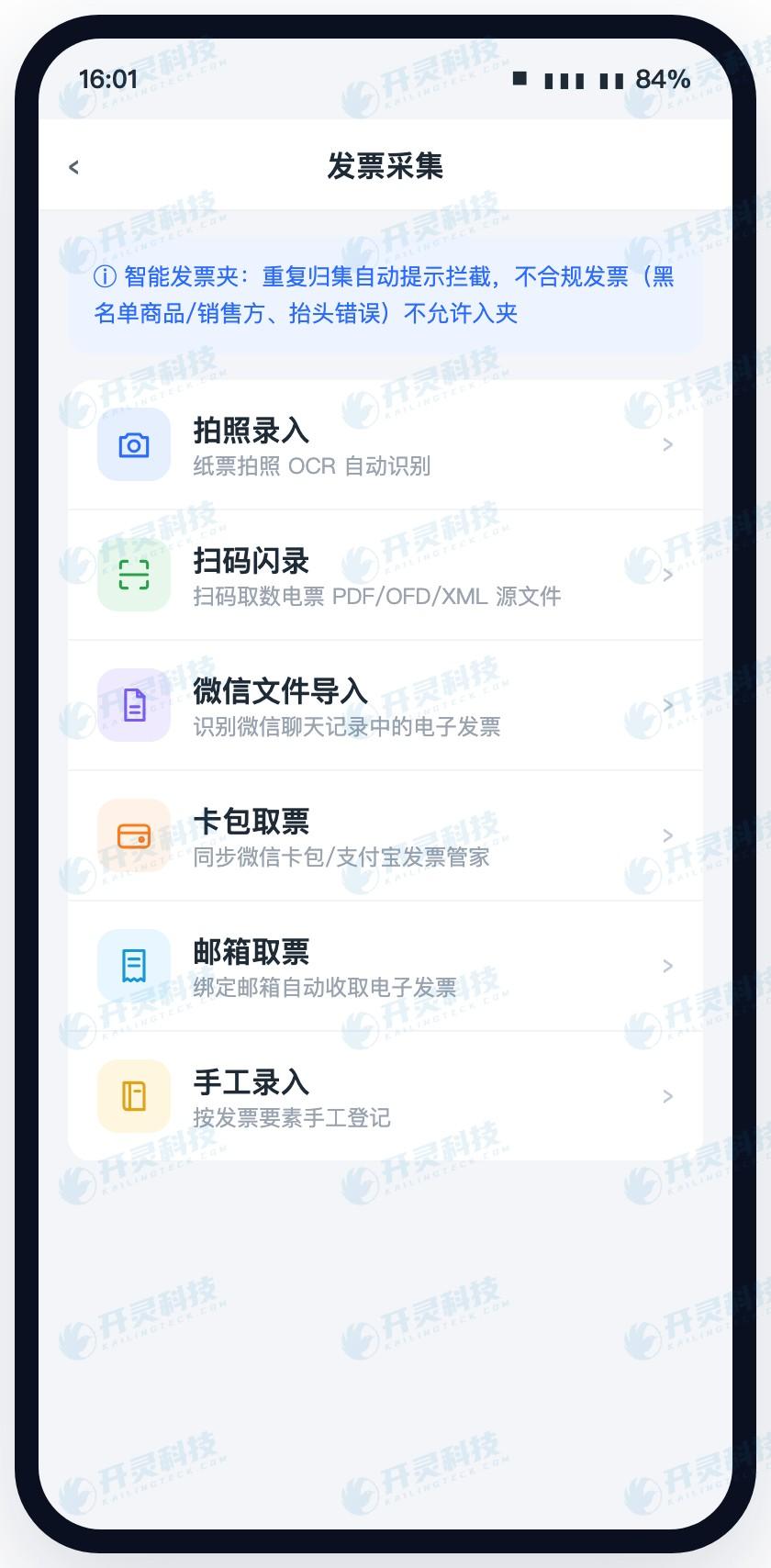
Invoices whose codes cannot be scanned do not have to be returned to manual processing. Classified by the types employees actually submit: the majority are VAT invoices, from special, ordinary, and electronic ordinary through to today's fully digitalized ones, all recognized by the recognition engine; next are the roll invoices and general machine-printed invoices commonly given by restaurants and supermarkets, as well as fixed-amount invoices still in circulation in some regions; further down are motor vehicle and used vehicle vouchers and passenger transport invoices left from car purchases, rentals, and travel. Recognition is only the first step—after paper invoices are read, the numbers still need to be sent back to the tax side for verification, while electronic invoices additionally verify whether the signature has been tampered with. Therefore, Kailing Technology has not cut out the verification step, but merely moved it to a place where it does not need to be paid for repeatedly.
▍What you save isn't just interface fees, but three costs buried in manual work
API fees are visible; once the path changes, they are gone. What truly drags on time and is harder to see are the following three costs.
- Accounts subject to repeated verification: The same invoice is repeatedly confirmed at collection, reimbursement, review, and archiving stages, and going through the channel is one settlement. If the verification result is merely "looked at once at the time" and not retained on the invoice, the next stage can only start over.
- Accounts verified manually: Whether invoicing information is correct depends on people checking item by item: whether the header is complete, whether the tax number is misplaced, and whether the address, phone, and bank account are the current version. Once invoice volume grows, this becomes a fixed daily task for finance. Lingdong Reimbursement moves multi-dimensional verification forward to the collection and submission stages, and the verification conclusion is directly written as a status in the invoice pool—usable ones are marked normal, and mismatches clearly state whether it is the tax number item or the enterprise name item that does not match; non-compliant invoices can also be set with strong controls and not allowed into the folder.
- Reworked accounts: If non-compliant invoices are only rejected when they reach the approval stage, all the time spent earlier on form filling, approval, and transmission is wasted. Moving the interception point one step earlier reduces rework by a large margin in itself.
▍Invoice pool: let the result of one verification be reused by all subsequent steps
The key action to save money is "ask fewer times," and the premise of asking fewer times is "the answers you have asked can be retained." LingDong Reimbursement's PC invoice pool turns each invoice's XML and PDF addresses, standardized verification results, reimbursement status, and bookkeeping status into columns, with summary statistics at the bottom for invoice count, total amount including tax, tax amount, and deductible tax amount. From this interface, you can directly reimburse in batches, bind vouchers, and export ledgers.
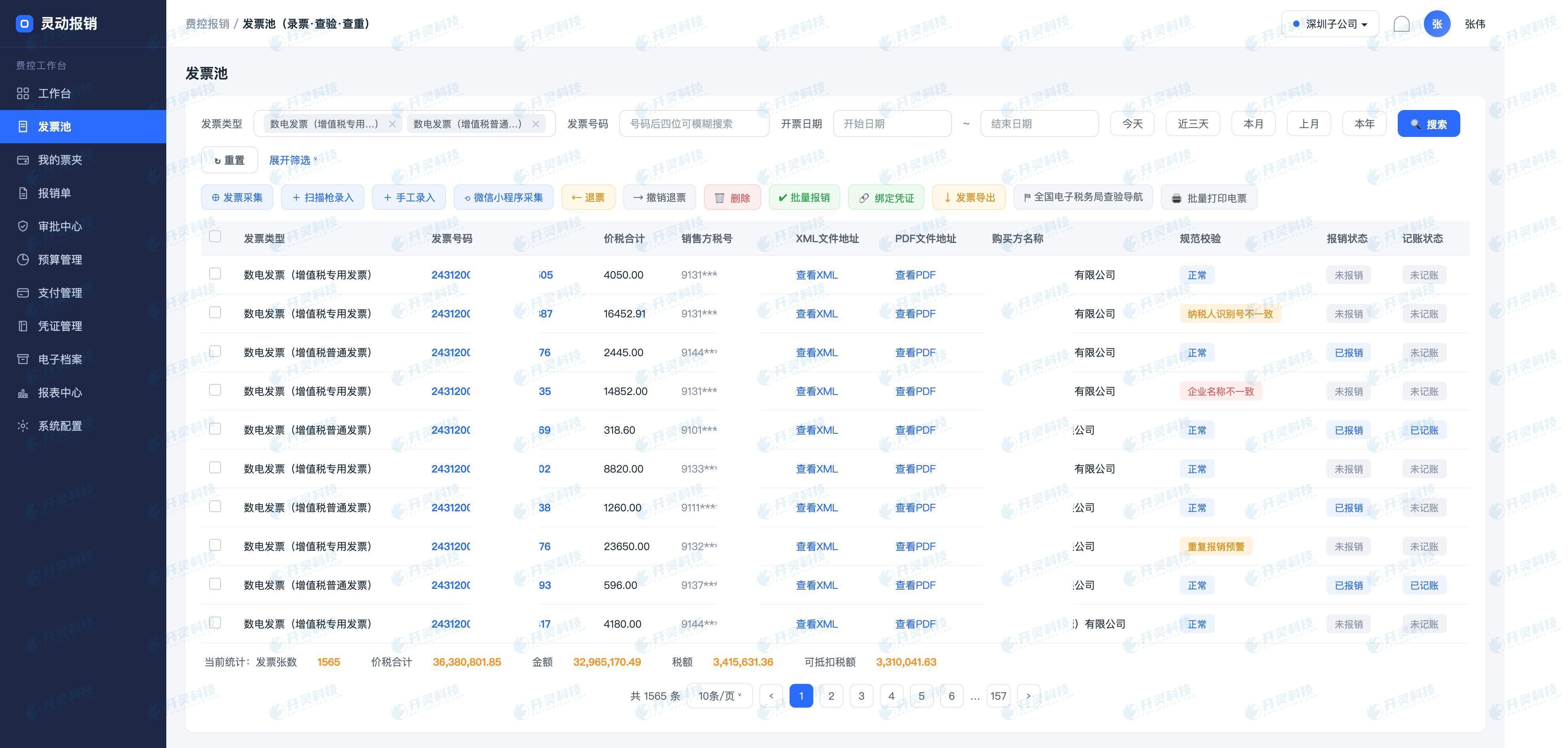
In this way, verification is no longer a one-time action that is “discarded after use,” but an attribute deposited on the invoice. Subsequent steps—duplicate reimbursement interception, blacklist product and seller identification, quota invoice consecutive number identification, one-click input VAT invoice selection and certification, and electronic accounting archives filing—all read the same result and do not need to ask again separately. These problems, which originally could only be discovered by manually flipping through ledgers or making additional calls, are all eliminated from the cost.
▍How to calculate this clearly for your own company
Each enterprise's invoice volume, invoice type structure, and reimbursement frequency are different. Rather than looking at numbers given by others, it is better to calculate it yourself in the following four steps.
- Step 1: First, count the actions, not the money. Pick a document from a normal month and count how many times an invoice is "verified" from collection to archiving, and how many times it is looked at manually. That count is the denominator of this account; if the denominator is unclear, anything calculated afterward is an estimate.
- Step 2: Understand the billing granularity. Review existing service contracts: per invoice or per transaction, whether retries count, whether verification failures count, whether cross-year supplementary checks count. The granularity determines how large a gap there can be between the actual bill and your estimate.
- Step 3, factor in manual time. The time finance spends every day verifying invoices, chasing invoices, and finding source files does not go into any account, but its slope of growth with invoice volume is often steeper than interface fees.
- Step 4, factor in the compliance cost. Whether signed and sealed source files can be produced immediately during an audit or inspection archive retrieval determines whether people must be temporarily organized to recheck everything. This part is usually invisible, but once it happens, it becomes a concentrated expense.
After completing the four steps, most enterprises will find that the bulk of this account may not be on the bill. What is truly worth optimizing is making the three tasks of "obtaining invoices, verifying authenticity, and retaining source files" completed in the same action, so that subsequent steps read results rather than ask again. Verification fees can be saved not because someone negotiated a lower unit price, but because the number of times paid inquiries are needed should not have occurred so many times in the first place.
▍FAQ
Q: Scan-and-flash entry directly connects to the electronic tax bureau to retrieve source files; will there be a verification count limit?
A: Scan-and-flash entry captures the source file of this invoice on the tax side. The action occurs in the enterprise's own collection step and is not the same as purchasing third-party verification channels per use. Specific usage rules are related to the configuration of the enterprise's tax-side account, and a connection confirmation will be made based on actual conditions before implementation.
Q: After retrieving the source file, is a separate duplicate check still needed?
A: Yes. Duplicate checking and authenticity verification are two separate actions and cannot replace each other. During collection, the system prompts for duplicate addition of the same invoice and does not allow it to be added to the folder again, and another duplicate reimbursement block is applied when reimbursement is submitted.
Q: If historical invoices had no source files kept at the time, can they still be recovered?
A: Whether supplementary retrieval is possible depends on the invoice type, issuance time, and the queryable status on the tax side. A feasible approach is to first centrally bring existing invoices into the invoice pool, batch-retrieve what can be retrieved, and for those that cannot be retrieved, attach existing images and ledger information to the invoice to ensure the set is searchable; new invoices uniformly use scan-and-flash entry from the launch date.
If you want to calculate this hidden expense of invoice verification clearly, welcome to visit Kailing Technology. We can conduct a diagnosis of your expense control and reimbursement chain based on your company's actual invoice volume: https://www.kailingteck.com/feikong/ .
As a comprehensive business-finance-tax digitalization solution service provider, Kailing Technology provides business-finance-tax management digital transformation products and operational services for various government agencies, institutions, and large, medium, and small enterprises. The product line includes:
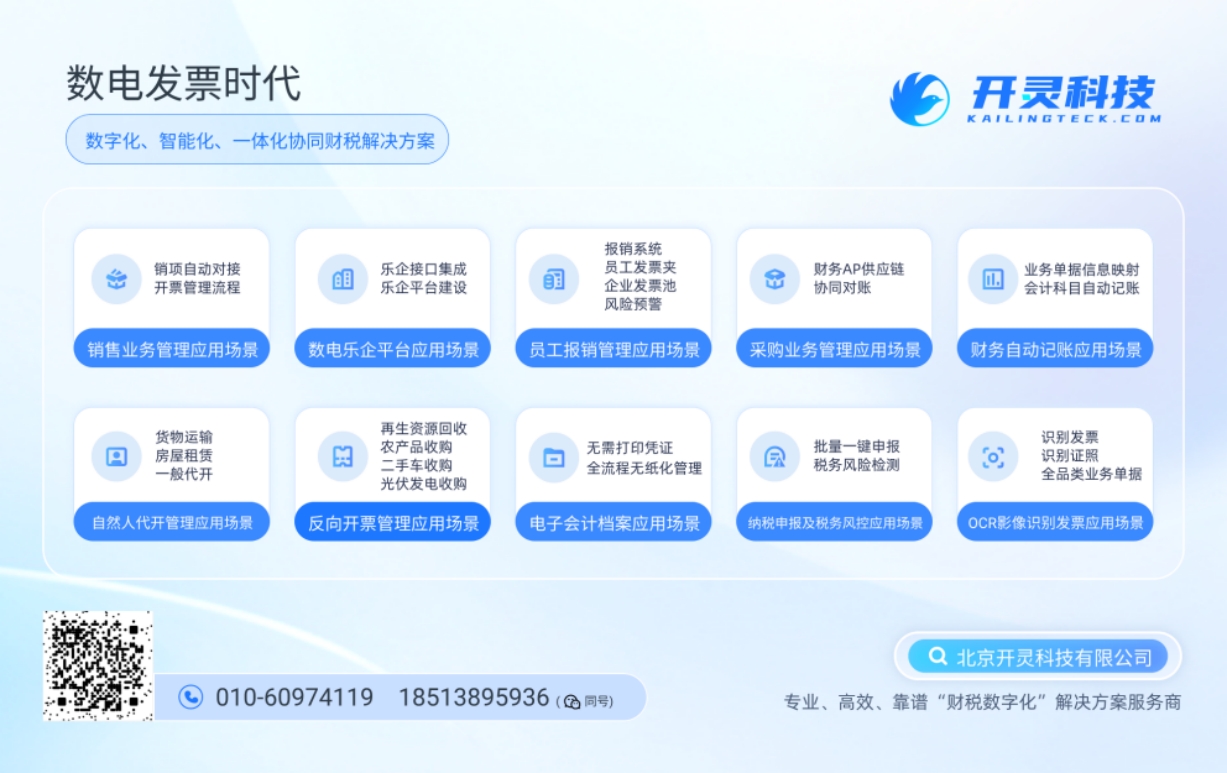
Solutions for businesses including sales contract management system, procurement contract management system, fully digitalized Leqi interface project, output automatic invoicing system, reverse invoicing system, invoice issuance for individuals system, employee expense control and reimbursement system, input VAT invoice management system, supply chain collaborative reconciliation system, image OCR recognition system, automatic financial bookkeeping system, and electronic accounting archives system, comprehensively driving the digitalization process across various fields.
If you have any business-finance-tax digital transformation needs, welcome to contact us. Beijing Kailing Technology will serve you wholeheartedly.
Keywords: invoice verification fees, scan-and-flash entry, electronic tax bureau source files, PDF OFD XML source files, expense control and reimbursement system, invoice verification and duplicate checking, Ministry of Finance Document No. 6, input VAT invoice management, Kailing Technology, Lingdong Reimbursement
As a comprehensive business-finance-tax digitalization solution service provider, Kailing Technology provides business-finance-tax management digital transformation products and operational services for various government agencies, institutions, and large, medium, and small enterprises. The product line includes: solutions for sales contract management system, procurement contract management system, fully digitalized Leqi interface project, automatic output invoicing system, reverse invoicing system, invoice issuance for individuals system, employee expense control and reimbursement system, input VAT invoice management system, supply chain collaborative reconciliation system, image AI OCR recognition system, automatic financial bookkeeping system, electronic accounting archives system, etc., comprehensively driving the digitalization process across various fields.
Consultation Hotline: 18513895936 / 010-60974119 Location: Beijing