
Can't retain invoice source files and hard to comply? Kailing Technology's expense control and reimbursement system automatically retains and archives them in accordance with Ministry of Finance Document No. 6
Can't retain invoice source files and hard to comply? Kailing Technology's expense control and reimbursement system automatically retains and archives them in accordance with Ministry of Finance Document No. 6
Many finance people think that once the reimbursement form is signed and the voucher is booked, the invoice's mission is over. But when annual audit or tax inspection requests files, problems arise: only a printout or an image photo remains in the system, while the electronic invoice source file with true legal effect—that PDF, OFD, or XML—has long since disappeared. This is precisely the most easily missed link in current enterprise paperless reimbursement. The Accounting Informatization Work Standards issued by the Accounting Department of the Ministry of Finance (commonly called in the industry Ministry of Finance Document No. 6) clearly requires: when electronic invoices are used for reimbursement, booking, and archiving, the electronic source files of the invoices must be retained; if only printed copies or image copies exist while the source files are missing, they do not constitute compliant electronic accounting materials.Kailing Technology expense control and reimbursement system It is precisely by building source document retention into every step of reimbursement.
"The real voucher of an electronic invoice is not that printed sheet, but the verifiable and parseable source file behind it; if the source file cannot be retained, paperless is just moving paper onto a hard drive. |
▍Why printed copies and image copies cannot retain compliance
First clarify a concept that is often confused. For an electronic invoice, the layout seen by the naked eye (the printed sheet of paper, or a screenshot image) is only its "appearance," while what truly carries anti-counterfeiting, verifiability, and traceability information is its source data message file—VAT electronic general invoices and fully digitalized e-invoices are usually in PDF, OFD, and XML formats. XML contains complete structured fields and digital signatures, and can be read, signature-verified, and tamper-proofed by systems; once printouts and image files are separated from the source file, they lose these capabilities.
In reality, the reimbursement processes of many enterprises still remain at "printing out electronic invoices and attaching them to forms, or having employees take photos and upload them." On the surface, the documents appear complete, but in fact three hidden dangers are buried: first, source files have never entered the enterprise retention system, so during audit file retrieval there is no verifiable original electronic message; second, the same invoice is repeatedly printed and images are difficult to deduplicate, making duplicate reimbursement impossible to intercept; third, image clarity varies, making even basic authenticity verification difficult afterward. By the time the Ministry of Finance Document No. 6 imposes hard requirements on the completeness of electronic accounting archives, these materials that "appear to have been archived" are precisely the most fragile part.
▍Scan-and-flash entry: retrieving source files directly from the Electronic Tax Bureau
To retain the source file, the first step is to capture the invoice accurately the moment it enters the enterprise.Kailing Technology expense control and reimbursement system's "Scan to Record" capability allows employees to scan the QR code on an invoice with their mobile phones, and the system directly retrieves the PDF/OFD/XML source file of the invoice from the Electronic Tax Bureau, rather than simply taking a photo. The source file is fully captured and stored at the collection stage, eliminating the situation of "only images, no electronic data" at the source.
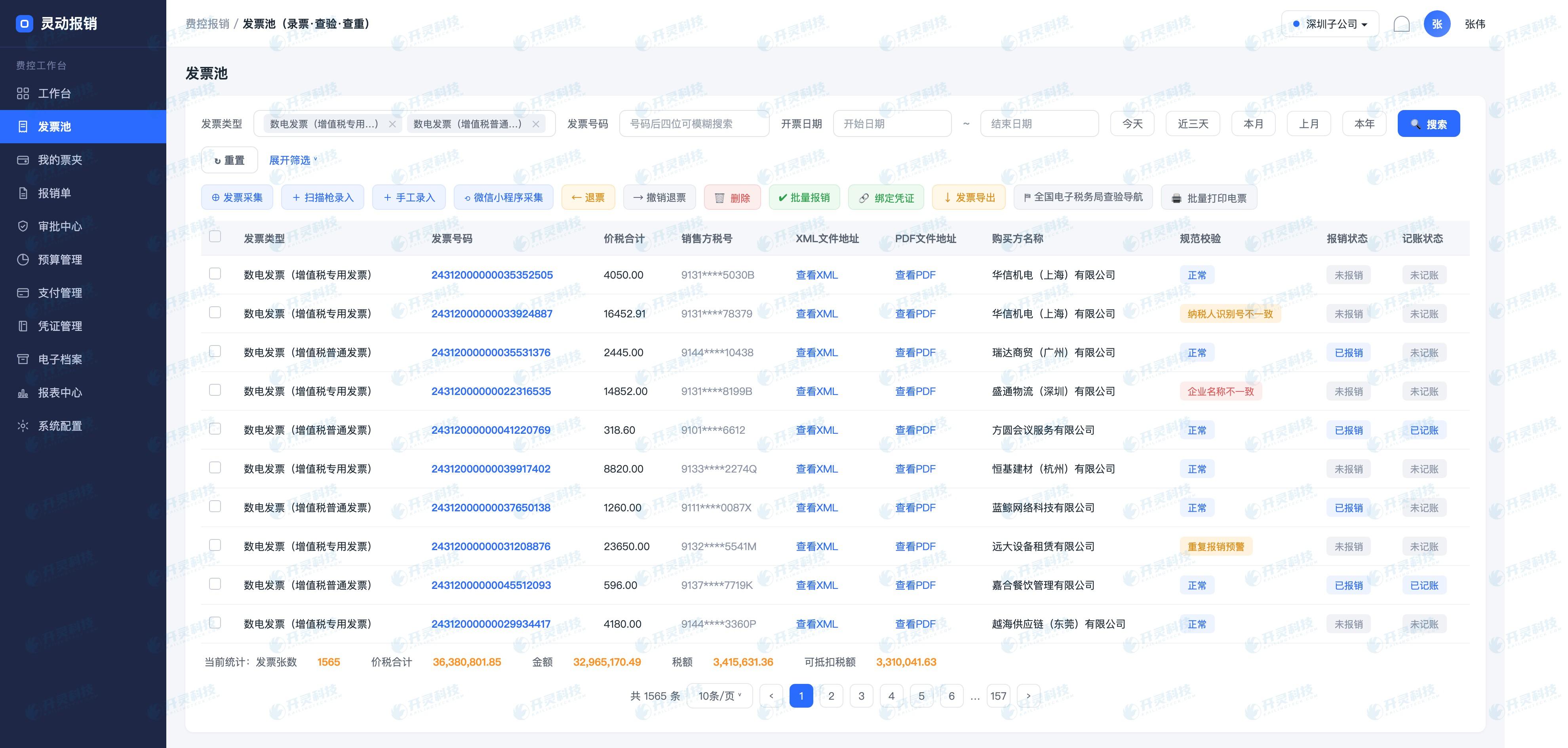
Paired with this is multi-channel collection via the smart invoice folder: scanning codes, manual entry, WeChat card wallet, WeChat chat record files, email invoice retrieval, and other methods can all bring invoices into the personal invoice pool; when the same invoice is repeatedly collected, the system will prompt and not allow duplicate addition, and non-compliant invoices can be set with strong controls and not allowed into the folder. This means that every invoice entering the enterprise scope carries a verifiable source file from the very beginning, and is the only copy. Scan-and-flash entry connects directly to the Electronic Tax Bureau for invoice retrieval, also saving a considerable annual invoice verification fee.
▍Save source files upon entry, and archive directly through connection with the electronic accounting archives system
Collection is only the starting point; what truly determines compliance is the booking and archiving stage. In traditional practice, after finance completes the voucher, the invoice source files and accounting data are often two separate things—the voucher goes into the financial software, but the source files are scattered across various email boxes, chat records, and even personal computers, so unified archiving is out of the question.
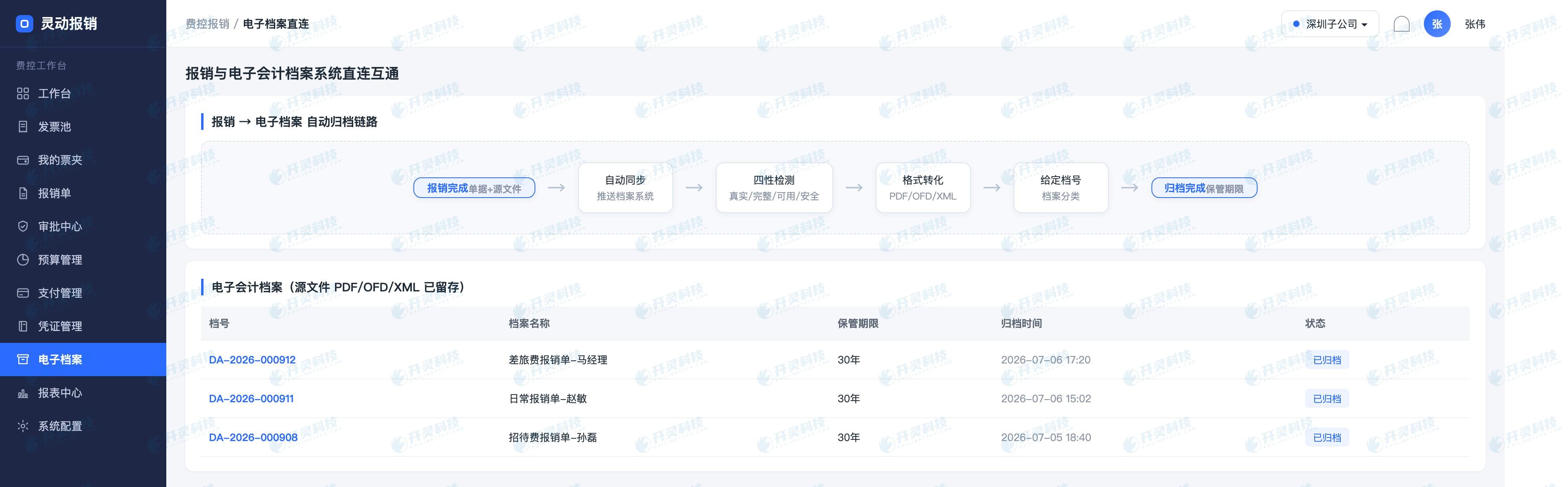
Kailing Technology expense control and reimbursement system Fully connect this chain: when converting reimbursement forms to vouchers, the system uses voucher conversion middleware to automatically map document fields into mainstream financial software such as Yonyou U8 to generate accounting vouchers; at the same moment of booking, the corresponding invoice source files (PDF/OFD/XML) are saved together, strictly aligning with the Ministry of Finance Document No. 6 requirement that "source files must be retained upon booking." More critically, it directly connects and interoperates with the electronic accounting archives system, automatically synchronizing archiving—reimbursement, booking, and archiving are no longer three separate manual transfers, but source files following documents all the way to the archive repository, with full traceability and consistency between accounts and vouchers.

▍Where Kailing Technology's expense control and reimbursement system differs in automatic source file retention
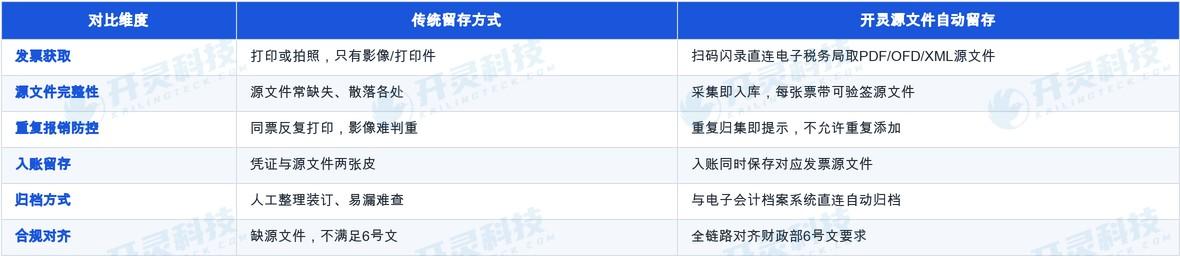
Place the two approaches side by side, and the difference is obvious at a glance. The traditional method relies on manual printing, photographing, and later searching, and source files are often missing; Kailing Technology, by contrast, acquires source files at collection, saves them at posting, and automatically synchronizes them at archiving, with no manual transfer throughout.
▍Keeping the source file is keeping a traceable compliance chain
For enterprises, automatic retention of source files brings more than just "complete archives." It means that any invoice already booked can be retrieved at any time with verifiable original electronic messages, providing a basis for tax inspections, audits, and internal reviews; it means that reimbursement, booking, and archiving data always match accounts and vouchers, and abnormal invoices and abnormal suppliers can be continuously monitored. Compliance no longer depends on finance staff scrambling to gather documents when an archive request comes, but is steadily embedded into every step of daily reimbursement.
This is precisely Kailing Technology expense control and reimbursement system's value—it is not about adding an archiving action at the end of the reimbursement process, but about ensuring that invoice source files leave a trace from the very first second they enter the enterprise, along the entire path of collection, reimbursement, bookkeeping, and archiving, ultimately forming a complete, traceable electronic accounting archive chain that can withstand audits.
▍FAQ
Q: What exactly does the Ministry of Finance Document No. 6 require enterprises to retain?
A: Where electronic invoices are used as the basis for reimbursement booking and archiving, in addition to documents and accounting data, the electronic source files of invoices (such as PDF, OFD, XML) must also be saved. Those with only printouts or image copies and lacking source files do not constitute compliant and complete electronic accounting materials.
Q: We have already printed out the electronic invoice and attached it to the form; do we still need to keep the source file?
A: Yes. Printed copies are only layout appearance and do not have signature verification or structured data capabilities. What compliance requires is verifiable and tamper-proof source files, and printed copies cannot replace them. Kailing retrieves source files directly during the collection stage, avoiding this gap.
Q: After source files are saved, is manual organization and archiving still needed?
A: No. Kailing saves the source files synchronously at the time of booking, and directly connects and interoperates with the electronic accounting archives system for automatic synchronous archiving. Finance staff no longer need to organize and bind each document one by one.
Q: What daily workload can this retention method reduce?
A: Scan-and-flash entry connects directly to verification, automatically prompting on duplicate aggregation to reduce manual duplicate-checking, and automatically synchronizing bookkeeping and archiving to eliminate manual transfer, overall turning compliant retention from after-the-fact supplementation into something done on the spot.
Want the source file of every invoice to be automatically retained and archived with the document and steadily aligned with the Ministry of Finance Document No. 6? Welcome to learn about the Kailing Technology expense control and reimbursement system: https://www.kailingteck.com/feikong/ .
As a comprehensive business-finance-tax digitalization solution service provider, Kailing Technology provides business-finance-tax management digital transformation products and operational services for various government agencies, institutions, and large, medium, and small enterprises. The product line includes:
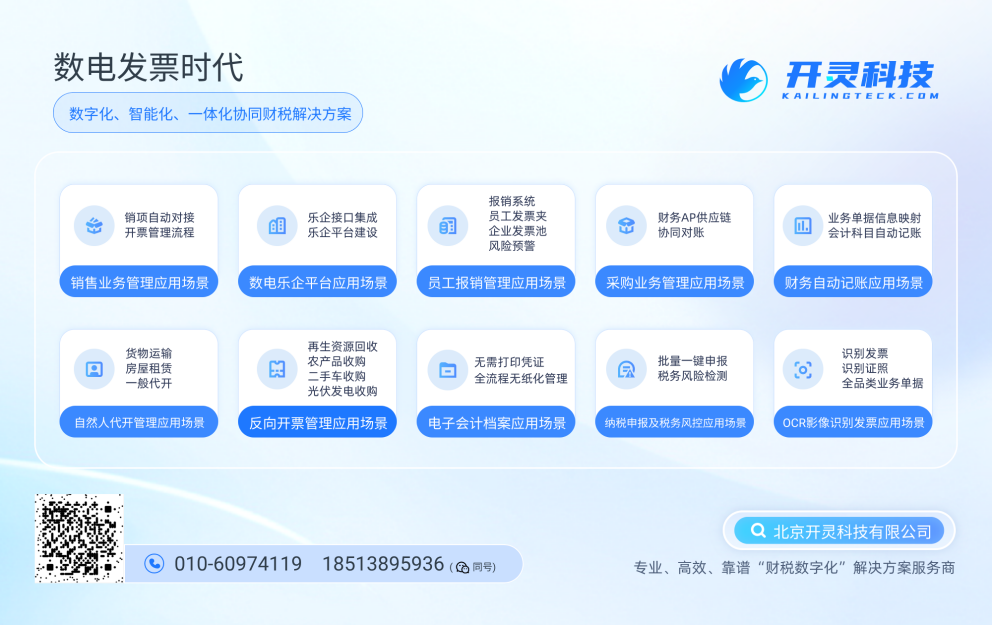
Solutions for businesses including sales contract management system, procurement contract management system, fully digitalized Leqi interface project, output automatic invoicing system, reverse invoicing system, invoice issuance for individuals system, employee expense control and reimbursement system, input VAT invoice management system, supply chain collaborative reconciliation system, image OCR recognition system, automatic financial bookkeeping system, and electronic accounting archives system, comprehensively driving the digitalization process across various fields.
If you have any business-finance-tax digital transformation needs, welcome to contact us. Beijing Kailing Technology will serve you wholeheartedly.
Keywords: Kailing Technology expense control and reimbursement system, Ministry of Finance Document No. 6, invoice source file retention, electronic accounting archives, scan-and-flash entry, paperless reimbursement
As a comprehensive business-finance-tax digitalization solution service provider, Kailing Technology provides business-finance-tax management digital transformation products and operational services for various government agencies, institutions, and large, medium, and small enterprises. The product line includes: solutions for sales contract management system, procurement contract management system, fully digitalized Leqi interface project, automatic output invoicing system, reverse invoicing system, invoice issuance for individuals system, employee expense control and reimbursement system, input VAT invoice management system, supply chain collaborative reconciliation system, image AI OCR recognition system, automatic financial bookkeeping system, electronic accounting archives system, etc., comprehensively driving the digitalization process across various fields.
Consultation Hotline: 18513895936 / 010-60974119 Location: Beijing