
How to Implement Paperless Reimbursement under China Golden Tax Phase IV: Kailing Technology's Expense Control Reimbursement System Full-Process Solution from Scanning to Voucher
After the launch of China Golden Tax Phase IV, "tax administration by data" has turned from a slogan into audit actions that happen every day. With fully digitalized e-invoices fully rolled out, the input VAT invoice pool searchable in real time, and invoice source files mandatorily archived, corporate finance suddenly realized that the old reimbursement process of "piling up invoices, attaching forms and running around for signatures, and manual bookkeeping at month-end" was not just slow, but could cross compliance red lines at any time.
Many enterprises have talked about paperless reimbursement for years, but few can truly implement it. The difficulty is often not "whether to do it," but "where to start, how each step connects, and whether vouchers and archives can automatically connect in the end." This article, combined with the product solution of Kailing Technology's expense control reimbursement system, breaks down and explains clearly the complete chain from employees scanning codes to obtain invoices to finance generating vouchers, to see how paperless reimbursement under China Golden Tax Phase IV should actually be implemented.
I. First see clearly: where exactly does traditional paper reimbursement get stuck
Before discussing the expense control and reimbursement system solution, let's do some math. According to Kailing Technology's estimates, a reimbursement form going through the offline paper process roughly goes through these steps:
- Organize invoices requiring reimbursement, approximately 10 minutes
- Fill out a paper reimbursement form against the invoice, about 10 minutes
- Business leader signature 5 minutes, supervising leader signature 5 minutes
- Finance leader review, about 10 minutes
- Bank payment in 5 minutes, bank receipt download and matching in 5 minutes
- Manual bookkeeping in Yonyou U8 takes 10 minutes, printing and binding vouchers takes 5 minutes
Conservative estimate,A reimbursement form takes about 65 minutes to complete the full process, this is still the ideal case of "passing on the first try." As long as a document is filled out incorrectly and rejected for re-entry, the time directly doubles.
The problem is not just slowness. In paper-based processes, invoice authenticity is checked by the naked eye, duplicate reimbursement by flipping through ledgers, and compliance verification by experience. The actions required by China Golden Tax Phase IV—invoice verification and duplicate checking, source file archiving, and tax accounting locking—simply cannot be supported by purely manual work.
The goal of implementing paperless reimbursement is very clear: compress these 65 minutes while embedding compliance verification into every step of the process. Kailing Technology's estimate is that after the reimbursement process goes online,Each document is expected to take only 9 minutes and then complete the entire process under compliance. Below, follow the sequence "from scanning the code to voucher" to see step by step how this chain is built.
II. Step 1: Invoice collection—from scan-and-flash entry to automatic aggregation of source files
The first hurdle of paperless reimbursement is to make invoices "come in and remain compliant." The most critical change here is that fully digitalized e-invoices no longer need source files to be uploaded; scanning the code is enough.
According to the requirements of Ministry of Finance Document No. 6, PDF, OFD, and XML source files must be preserved when electronic invoices are reimbursed and recorded. In reality, having employees manually upload three formats yields poor results—most upload at most one PDF. Kailing Technology's expense control and reimbursement system has the system retrieve them from the tax bureau on the employee's behalf: the employee only needs to scan the invoice QR code or enter the last 4 digits of the invoice number, and the system automatically links to the full set of PDF, OFD, and XML source files from the "tax digital account" of the Electronic Tax Bureau.
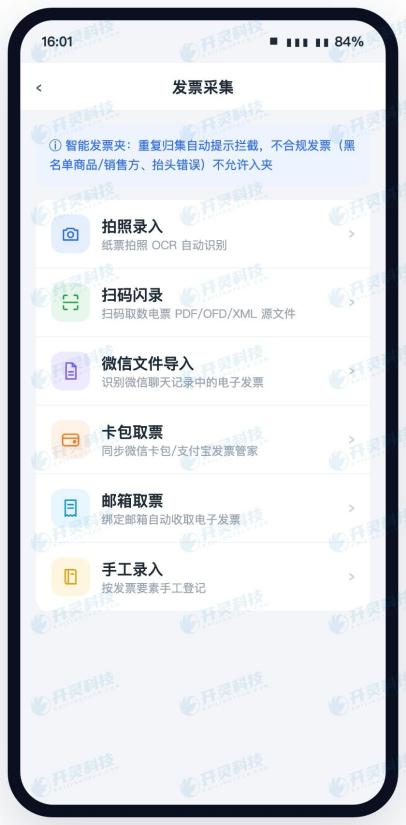
The collection channels are also very comprehensive, covering various real scenarios in which employees obtain invoices:
- One-click collection of fully digitalized e-invoices: Synchronization with WeChat Card Wallet and Alipay Invoice Manager, recognition of invoice files in chat records, invoice retrieval from email, and manual upload
- Paper invoice photo capture and entry: OCR intelligent recognition, supporting multi-image capture, invoice pasting recognition, and cutting
- Scan to flash-capture: Scan the QR code to pull source files directly from the Electronic Tax Bureau, saving annual invoice verification fees
OCR recognition also covers a wide range of invoice types—dozens of common documents such as VAT special invoices and general invoices, fully digitalized e-invoices, motor vehicle/used car invoices, train tickets, flight itineraries, taxi receipts, road and bridge tolls, and fixed-amount invoices can all be automatically classified and recognized.
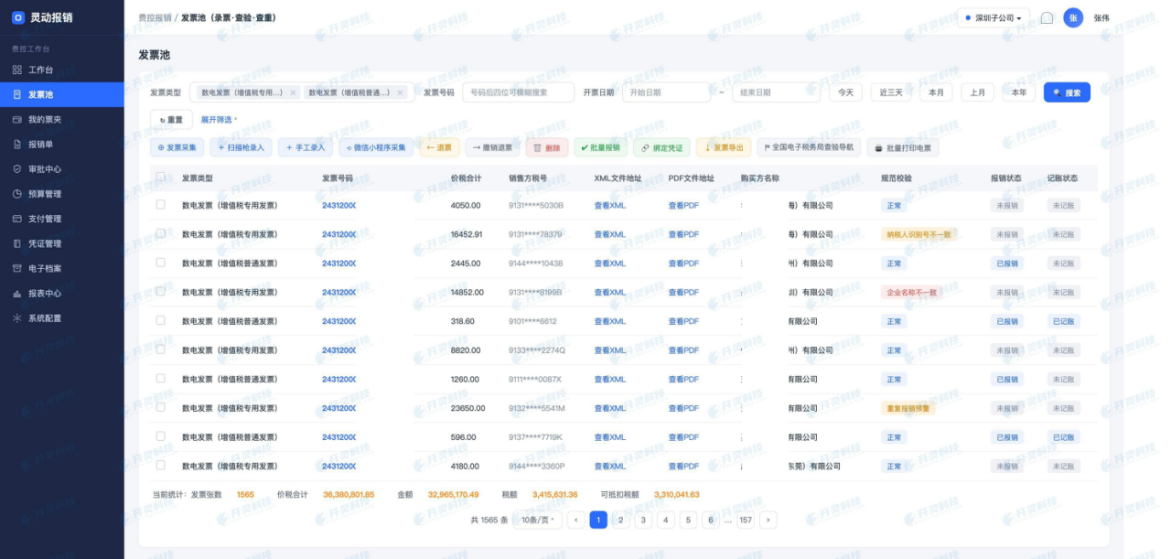
There is also a clever touch here for passenger transport industry invoices: the system synchronizes the enterprise invoice pool twice a day and, based on passenger names, directly collects travel invoices into the corresponding employee's invoice folder. Employees can select them directly when reimbursing, without having to upload itinerary sheets or train tickets themselves. Collected invoices uniformly enter Invoice pool management, forming a full-volume invoice ledger for the enterprise.
III. Step 2: Multi-Dimensional Risk Verification—Move Compliance Ahead of Reimbursement
An invoice entering the pool does not mean it can be reimbursed. Under China Golden Tax Phase IV, "pre-event interception" is far more important than "post-event explanation." Kailing Technology embeds multi-dimensional risk validation at the collection step, directly blocking non-compliant invoices at the door:
- Header information verification: Check whether the title, tax ID, address and phone, and bank account are accurate; wrong numbers caused by mistyped taxpayer identification numbers or enterprise names, or misplaced invoices, will all be caught
- Paper-electronic consistency verification: Whether the paper invoice number is consistent with the Electronic Tax Bureau data
- Invoice tamper prevention: Check whether the electronic invoice signature has been modified, preventing tampering with the original information
- Duplicate Reimbursement Interception: When the same invoice is collected multiple times, a prompt appears, and real-time interception is triggered upon hitting "already entered/already reimbursed", eliminating multiple reimbursement of one invoice from the source
- Blacklist verification: Automatic identification of blacklisted goods and sellers such as tobacco, mooncakes, gift cards, entertainment, bathing, KTV, and foot massage
- Passenger transport own-company employee verification: Transport invoices for non-employees of the company cannot be used for tax deduction
- Validation of taxi tickets with the same license plate: Taxi tickets with the same license plate number are not allowed to be reimbursed repeatedly
Fixed-amount invoices are also covered—supporting fixed-amount invoice recognition across all provinces and cities nationwide, supporting consecutive number recognition, with the system embedding local tax bureau verification websites for manual authenticity checks. In one sentence, compliance is not something you remember at month-end audit, but an action completed the moment an invoice enters the system.
IV. Step 3: Initiate reimbursement — one-click order creation from the invoice folder, automatically locked for tax accounting
Invoices that pass verification sit in the personal invoice folder, and initiating reimbursement becomes as simple as "checking" them. Employees check invoices in the invoice folder, and the system Automatically generate reimbursement forms, with header, amount, and details automatically populated, and reimbursement forms and invoices bidirectionally linked and one-to-one corresponding, traceable at any time. Conversely, you can also create a reimbursement form first and then link invoices; both paths are supported.
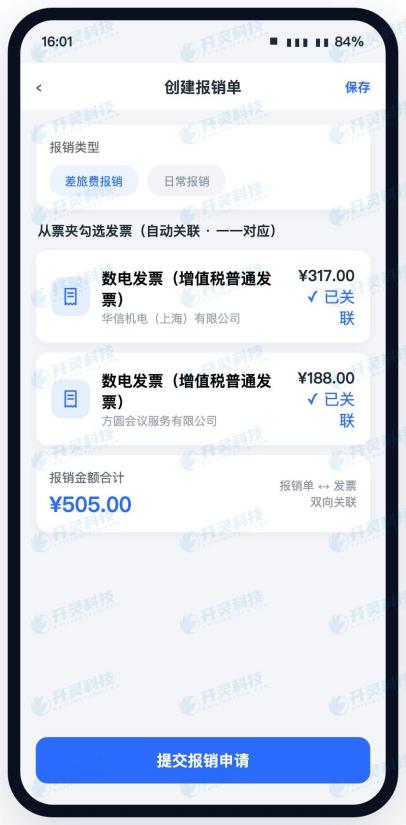
There are two fields in the reimbursement form worth noting:
- Invoice reimbursement content: Automatically generated based on invoice content, and also supports business modification. For example, for Zhang San's travel reimbursement form, the voucher summary linked to U8 is automatically generated as "Travel reimbursement form, Zhang San, accommodation + meals + transportation"
- Actual business occurrence: Manually fill in according to actual business conditions; in special scenarios this field supports information hiding or deletion
An action that is easily overlooked but particularly critical for China Golden Tax Phase IV:After an invoice initiates reimbursement, the tax posting status is automatically locked. According to the latest requirements of the tax digital account, invoices recorded by finance need to be marked with "booking operation" to lock the invoice status and prevent the issuer from maliciously reversing the red-letter invoice. The system will automatically mark "booked - corporate income tax pre-tax deduction/non-deduction," and also supports canceling the booking.
V. Step 4: Multi-level approval — multi-terminal circulation, AI digital employees automatically process orders
After a reimbursement form is submitted, it enters approval. The core requirement here is "don't let approval block the entire chain." The approval function of Kailing Technology's expense control and reimbursement system supports custom workflows on both Web and mobile. Approval messages reach approvers directly via WeCom and DingTalk, and approvers can process them by clicking a link. Approvers can handle them on any device—PC, App, mini program, DingTalk, Feishu, or WeCom—and the approval page shows the attached invoices directly. For rejections, it supports rejecting back to the initiator or the previous level, according to actual configuration.
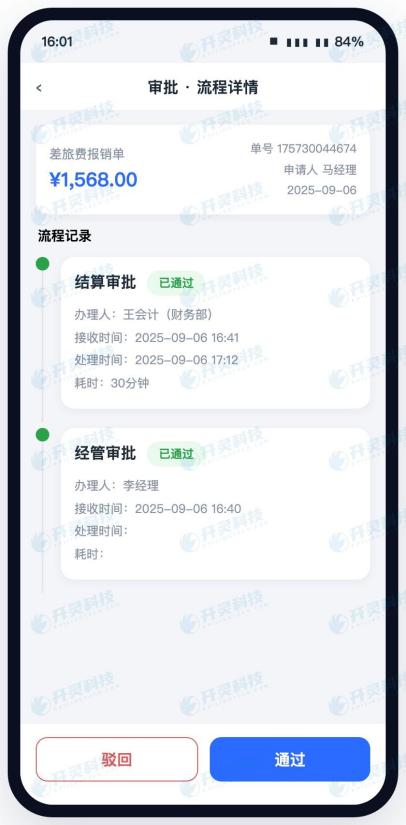
What goes further is AI digital employee intelligent approval: Large models intelligently compare internal control rules with invoice business information, automatically approving compliant documents in seconds, and only transferring abnormal documents to manual key sampling. Approval efficiency and compliance both improve.
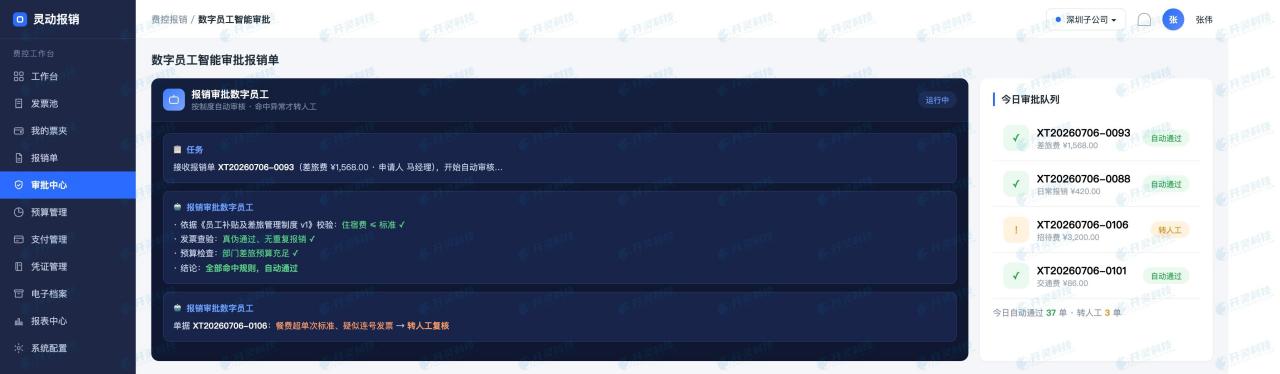
VI. Step 5: Payment Management — Bank-Enterprise Direct Connection for Automatic Payment, Automatic Return of Receipts
After approval, it enters the payment stage. This step is the key to whether the "four flows in one" (contract flow, invoice flow, fund flow, goods flow) can be closed loop. The system supports two methods: it can export online banking payment files in the payment import formats of major mainstream banks for batch payment, and can also connect with banks Bank-enterprise direct connection Once connected and approved, payments are automatically initiated, so cashiers no longer need to transfer funds manually or log into online banking for each transaction.
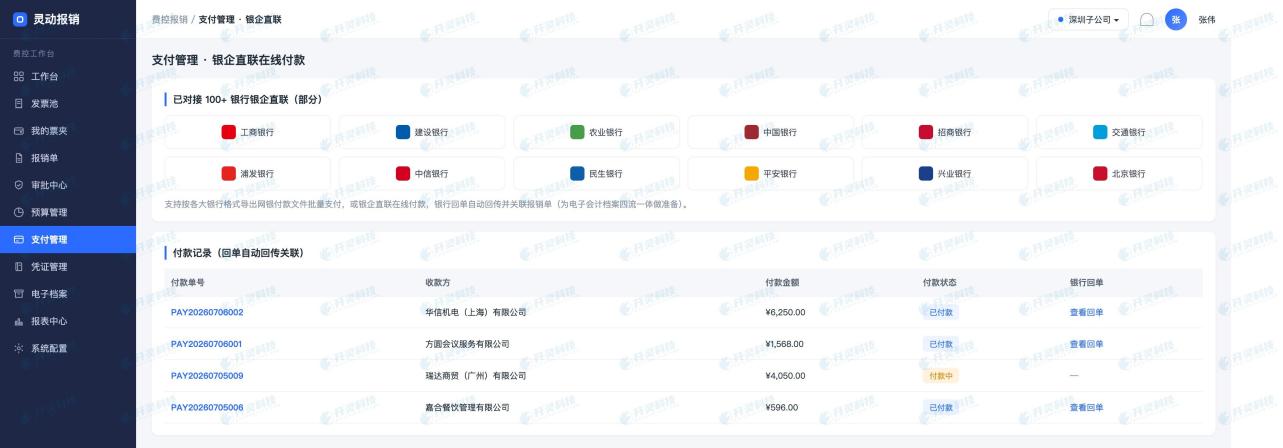
After payment,Real-time return of bank receipts And automatically linking to the reimbursement form, searchable and downloadable online, automatically reconciling with reimbursement forms and vouchers. This step aligns the fund flow with the document flow, laying a solid foundation for the later "four flows in one" of electronic accounting archives. The solution also gives a pragmatic suggestion: China Merchants Bank's external bank-enterprise direct connection interface is currently free, and enterprises can prioritize opening a general account at China Merchants Bank specifically for employee reimbursement payments.
VII. Step 6: One-click conversion to vouchers — replacing manual financial bookkeeping
At this step, the true "value" of paperless reimbursement is revealed. The most time-consuming and error-prone manual bookkeeping step in the traditional process is replaced by the voucher conversion middleware.Voucher conversion middleware Automatically map the fields of reimbursement documents to the ERP system and generate corresponding accounting vouchers, replacing manual bookkeeping by finance staff. It standardly connects with mainstream financial software on the market without custom development and supports modification of voucher information. For example, after mapping reimbursement form information, accounting vouchers are generated directly in Yonyou U8.
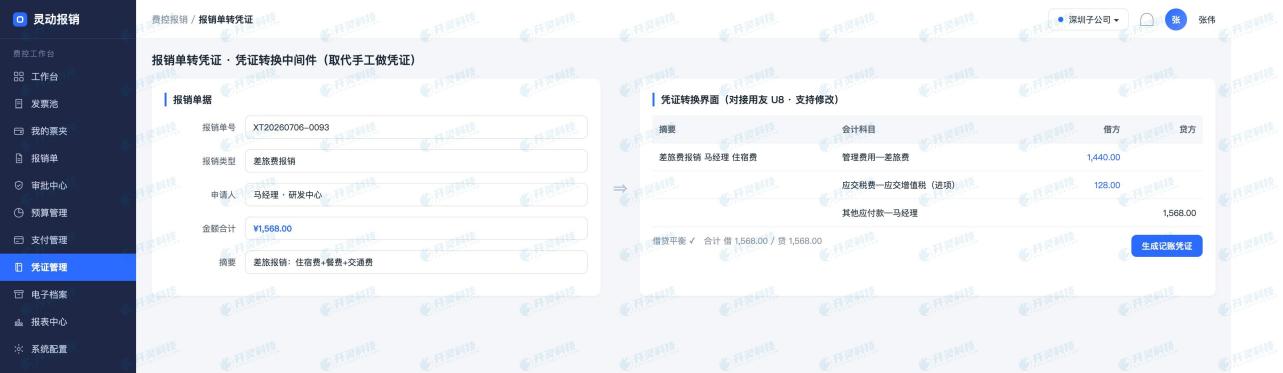
Connection capabilities cover mainstream financial systems — SAP, Oracle, D365, Yonyou NC/U8, Kingdee, Inspur, Digiwin, Chanjet, Newgrand, etc. can all write back vouchers and ledgers.
Eight, deduction and archiving: paving the last two kilometers as well
Once vouchers are generated, two things unavoidable under China Golden Tax Phase IV remain: input VAT deduction and source file archiving.
One-click certification and deduction for special VAT invoices: Filter out invoices already reimbursed/recorded, click "one-click select," and the system automatically links to the Electronic Tax Bureau's "Tax Digital Account" to complete input VAT invoice selection, saving finance the trouble of frequently logging into the Electronic Tax Bureau.
Automatically generate deduction statistics table for passenger transport invoices, automatically applying deduction formulas by different invoice types:
- Air ticket itinerary: input tax amount = (fare + fuel surcharge) ÷ (1+9%) × 9%
- Railway ticket: face amount ÷ (1+9%) × 9%
- Road, waterway, and other passenger tickets: face amount ÷ (1+3%) × 3%
- Bridge and gate tolls: invoice amount ÷ (1+5%) × 5%
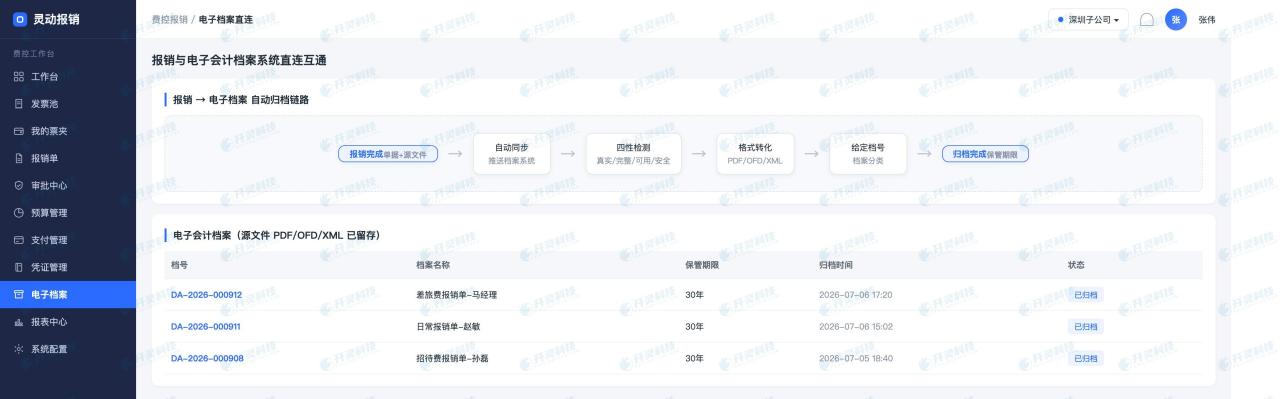
Electronic archiving · Four-property testing: According to Document No. 6 requirements, when e-invoices are recorded, PDF, OFD, and XML source files must also be saved. Original materials such as reimbursement forms, invoices, vouchers, and receipts automatically flow to the electronic accounting archives system, where the "four properties" tests of authenticity, completeness, usability, and security are performed, complying with the Measures for the Management of Accounting Archives and allowing retrieval at any time.
IX. Frequently Asked Questions (FAQ)
Q: Under China Golden Tax Phase IV, why must enterprises adopt paperless reimbursement?
A: Because China Golden Tax Phase IV governs taxation by data, fully digitalized e-invoices are fully promoted, the input VAT invoice pool is queryable in real time, and invoice source files must be archived. Purely manual paper reimbursement makes it difficult to complete invoice verification and duplicate checking, tax posting locking, and source file archiving, creating high compliance risk. Launching an expense control and reimbursement system can move compliance checks forward into every step and avoid risks at the source.
Q: Must PDF, OFD, and XML source files all be uploaded for fully digitalized e-invoice reimbursement?
A: According to the requirements of Ministry of Finance Document No. 6, three types of source files must be retained when electronic invoices are booked. The Kailing Technology expense control and reimbursement system lets employees simply scan the invoice QR code or enter the last 4 digits of the number, and the system automatically associates and archives the full set of source files from the Electronic Tax Bureau, without employees manually uploading three formats.
Q: Can an expense control and reimbursement system replace manual financial bookkeeping?
A: Yes. Through the voucher conversion middleware, reimbursement document fields are automatically mapped to the ERP system to generate accounting vouchers, replacing manual bookkeeping. Standard integration covers mainstream financial software such as UFIDA U8/NC, Kingdee, SAP, and Oracle, with no custom development required.
Q: How much benefit can paperless reimbursement bring after launch?
A: Based on an estimate of 3,000 reimbursement forms per year, document processing time drops from about 65 minutes to about 9 minutes, saving about RMB 124,000 in labor costs annually, with all-employee reimbursement time and finance bookkeeping time reduced by about 90%.
Q: Which systems can the Kailing Technology expense control and reimbursement system integrate with?
A: It supports direct connection to four types of systems: tax invoice systems, collaborative OA, treasury systems, and financial systems.
Paperless reimbursement under China Golden Tax Phase IV is essentially what Kailing Technology practices—embedding compliance verification, tax booking, and archiving into every step of the process, so that enterprises no longer rely on manual fallback but achieve true implementation through a self-consistent system closed loop: https://www.kailingteck.com/feikong/ .
As a comprehensive business-finance-tax digitalization solution service provider, Kailing Technology provides business-finance-tax management digital transformation products and operational services for various government agencies, institutions, and large, medium, and small enterprises. The product line includes:
Solutions for businesses including sales contract management system, procurement contract management system, fully digitalized Leqi interface project, output automatic invoicing system, reverse invoicing system, invoice issuance for individuals system, employee expense control and reimbursement system, input VAT invoice management system, supply chain collaborative reconciliation system, image OCR recognition system, automatic financial bookkeeping system, and electronic accounting archives system, comprehensively driving the digitalization process across various fields.
If you have any business-finance-tax digital transformation needs, welcome to contact us. Beijing Kailing Technology will serve you wholeheartedly.
Keywords: China Golden Tax Phase IV,paperless reimbursement,expense control reimbursement system,Kailing Technology,fully digitalized e-invoice,electronic accounting archives,one-click conversion to voucher,bank-enterprise direct connection,invoice verification and duplicate checking,input VAT deduction
As a comprehensive business-finance-tax digitalization solution service provider, Kailing Technology provides business-finance-tax management digital transformation products and operational services for various government agencies, institutions, and large, medium, and small enterprises. The product line includes: solutions for sales contract management system, procurement contract management system, fully digitalized Leqi interface project, automatic output invoicing system, reverse invoicing system, invoice issuance for individuals system, employee expense control and reimbursement system, input VAT invoice management system, supply chain collaborative reconciliation system, image AI OCR recognition system, automatic financial bookkeeping system, electronic accounting archives system, etc., comprehensively driving the digitalization process across various fields.
Consultation Hotline: 18513895936 / 010-60974119 Location: Beijing