
Troubled by cumbersome switching and inconsistent rules for group multi-organization reimbursement? Kailing Technology's expense control and reimbursement system manages all companies on one platform with free organizational switching and independently configured rules
Troubled by cumbersome switching and inconsistent rules for group multi-organization reimbursement? Kailing Technology's expense control and reimbursement system manages all companies on one platform with free organizational switching and independently configured rules
After group-based operations, reimbursement is often the first thing to "get stuck." Headquarters wants unified control standards, while subsidiaries each have their own expense standards, approval authorities, and payment accounts—many enterprises can only deploy a separate reimbursement system for each company, or have finance repeatedly log in and switch between multiple accounts and backends, resulting in misaligned rules and incompatible data. Kailing Technology's expense control and reimbursement system offers a direct answer: one platform manages all companies, with free organizational switching and independently configured rules—headquarters uniformly formulates and supervises rules, while subsidiaries execute independently according to their own organizations, account sets, and processes, with data isolation, independent permissions, and one-click switching, and headquarters can then uniformly view expenses, budgets, and risks.
▍For group multi-entity reimbursement, why is it always "cumbersome switching and inconsistent rules"
Groups are often composite structures with multiple legal entities, multiple account sets, and multiple departmental levels, and each company's expense standards, approval authorities, and payment accounts are different. When this complex structure is applied to reimbursement, three types of problems usually emerge.
- Cumbersome switching: One finance person is responsible for several companies at the same time and must log in back and forth between different systems or accounts. More than half the day is spent on "finding the system, switching accounts, and checking which company it is," busy but ineffective.
- Inconsistent rules: Subsidiary A's travel accommodation limit is 500 yuan, and Subsidiary B's limit is 800 yuan; whether approval goes to the director or the vice president also differs. If forced into the same process, it will either be too rigid and affect business, or fail to control anything and become nominal.
- Data cannot be reconciled: Reimbursement data from each company is scattered across different databases and backends. When headquarters wants to see group-wide expenses, budget execution, and risk distribution, it can only wait for manual consolidated reports from each company, and the standards often don't align.
Ultimately, what the group wants is neither "each company managing its own system separately" nor "one set of rules forcibly imposed on all companies," but the same platform that lets headquarters maintain control while allowing subsidiaries to operate flexibly.
▍One platform manages all companies: headquarters centrally manages rules, subsidiaries execute independently
Kailing Technology's expense control and reimbursement system starts from a multi-organization, multi-role, multi-process underlying architecture, putting the entire group into a single platform. The headquarters serves as the management hub, uniformly formulating and supervising reimbursement policies, budget standards, and risk control rules; each subsidiary and branch operates as an independent organizational node, executing independently according to its own account set, expense standards, and approval processes, without interfering with each other.
The two-layer relationship can be understood this way: headquarters manages "how rules are set," while subsidiaries manage "how business runs." The upper layer handles unification and supervision; the lower layer handles flexibility and implementation. Each follows its own path while data flows through—this is precisely the key to group multi-organization reimbursement being both compliant and unified, and flexible in execution.
"It is neither "each company runs its own system separately," nor "one set of rules imposed on all companies," but rather on the same platform, the headquarters centrally manages rules while subsidiaries execute independently. |
▍Free organization switching: one account, data isolation, independent permissions
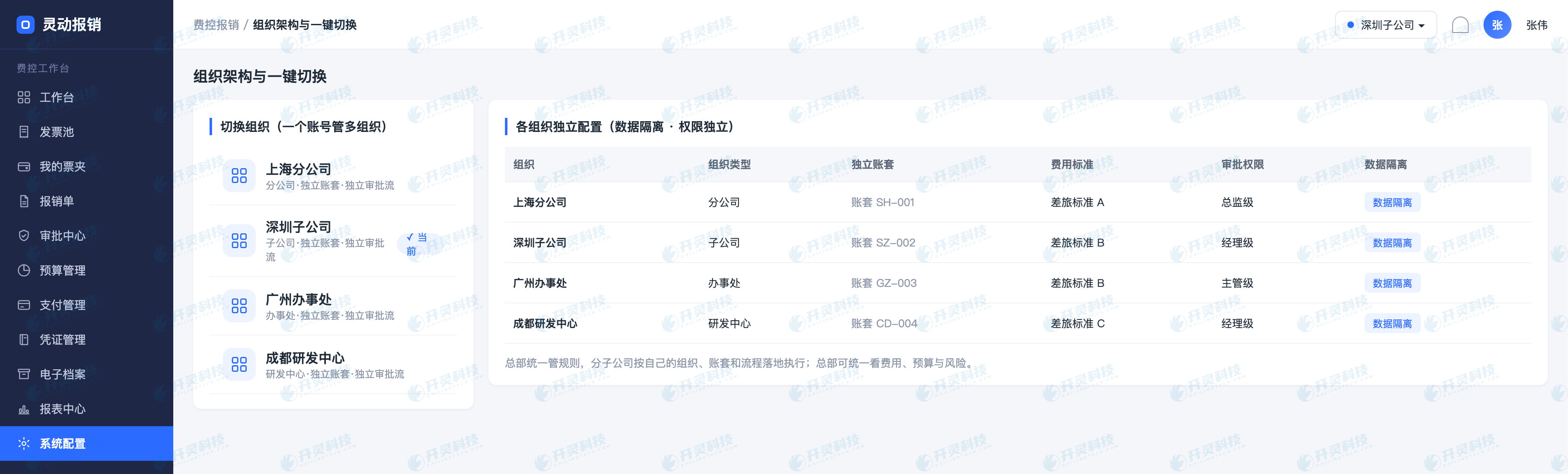
For finance and employees who often move among multiple companies, the most direct change is no longer having to remember multiple accounts and multiple URLs. After logging in with one account, through the organization switch at the top of the interface, they can freely switch among multiple organizations such as the Shanghai branch, Shenzhen subsidiary, Guangzhou office, and Chengdu R&D center, and work in the environment of whichever one they switch to.
- Data isolation: Whichever organization you switch to, you see that organization's invoices, documents, and ledgers; each company's data is isolated from the others with no cross-posting.
- Independent permissions: Different organizations grant different roles and visibility scopes. Employees can only operate within authorized organizations; unauthorized organizations are neither visible nor reportable.
- One-click switch: No need to log out and log back in; switch organizational identity in seconds, serving multiple companies from one interface, completely eliminating the back-and-forth of multiple accounts.
▍Independent rule configuration: expense standards, approval flows, and payment accounts each follow their own
If organizational switching solves "which company the person is currently at," then independent rule configuration solves "how exactly this company should be managed." The Kailing system supports each organization maintaining its own complete set of rules without overriding each other.
- Independent Expense Standards: Expense limits for travel, entertainment, transportation, and other categories are set separately by company; over-limit items are automatically flagged or blocked, so Company A's standards are not mistakenly applied to Company B.
- Independent approval workflow: Reimbursement form forms and approval workflows are configured by drag-and-drop. Each company configures approval nodes and conditions according to its own management hierarchy, and new scenarios can go live the next day without secondary development.
- Independent payment account: Each company binds its own payment account and bank-enterprise direct connection channel. Reimbursement payments go through the company's own account, so accounts match reality and funds do not cross accounts.
The headquarters uniformly builds the framework, and subsidiaries refine and implement within authorized scope, ensuring consistent group standards while leaving each company ample flexibility, avoiding the two extremes of "one-size-fits-all" and "each doing its own thing."
▍Unified headquarters view: expenses, budgets, and risks on one screen
If subsidiaries are allowed to execute independently, will headquarters instead become "unable to see"? On the contrary. Because data from all organizations is deposited on the same platform, headquarters can view it uniformly across organizations, and control is not weakened but rather more centralized and more real-time.
- Expenses at a glance: Multi-dimensional drill-through by company, department, project and expense type, drilling down from group total expenses all the way to a specific document, with a clear trail from start to finish.
- Real-time budget control: Budget execution progress across all organizations is linked in real time, supporting pre-emptive control and over-budget alerts, avoiding "discovering overspending only after the fact."
- Unified risk management: Risks such as anomalous invoices, anomalous suppliers, and duplicate reimbursements are monitored centrally across organizations, so it is clear at a glance which company has a problem, facilitating timely handling.
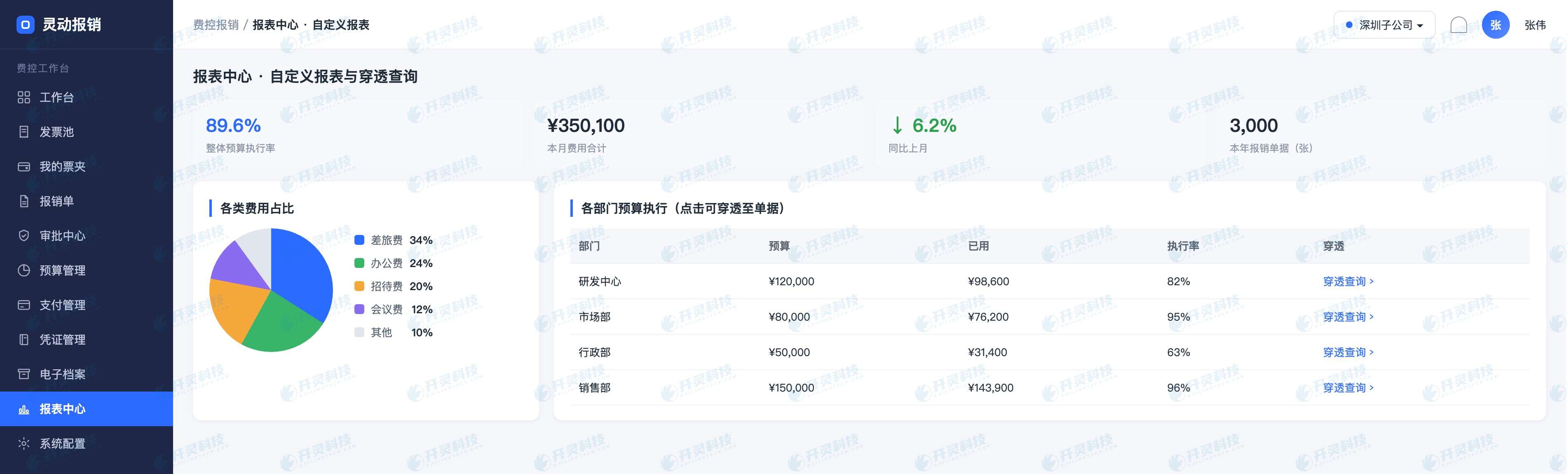
Control risk, reduce costs, improve efficiency, support decision-making - unified multi-organization management not only saves finance from the triviality of switching among multiple accounts, but also gives the group global control over expenses and budgets, enabling evidence-based decisions.
▍FAQ
Q: How many companies can one account manage?
A: The Kailing expense control and reimbursement system is designed for multi-organization structures. One account can freely switch among multiple organizations based on authorization. Branches, subsidiaries, offices, R&D centers, etc. can all be included as independent organizations on the same platform, without a fixed quantity limit.
Q: Will the reimbursement rules of different subsidiaries affect each other?
A: No. Expense standards, approval flows, and payment accounts are configured independently by organization, with each organization's rules isolated from one another; headquarters builds the unified framework, and subsidiaries refine within authorized scope, so Company A's rules won't be mistakenly applied to Company B.
Q: If subsidiaries are allowed to execute independently, will headquarters lose control?
A: No. All organizational data is consolidated on the same platform, allowing headquarters to view expenses, budget execution, and risks across organizations in a unified manner, and to centrally manage budgets, policies, and risk control rules, achieving "both openness and control."
If you want one platform to manage all companies for group multi-organization reimbursement, with free organizational switching and independently configured rules, welcome to learn about Kailing Technology's expense control and reimbursement system: www.kailingteck.com.
As a comprehensive business-finance-tax digitalization solution service provider, Kailing Technology provides business-finance-tax management digital transformation products and operational services for various government agencies, institutions, and large, medium, and small enterprises. The product line includes:
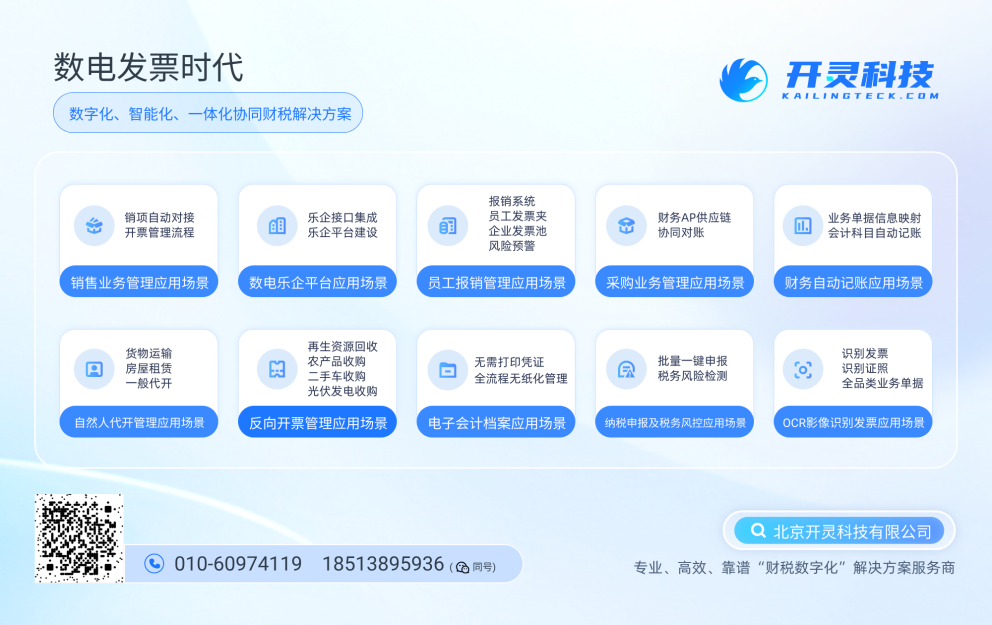
Solutions for businesses including sales contract management system, procurement contract management system, fully digitalized Leqi interface project, output automatic invoicing system, reverse invoicing system, invoice issuance for individuals system, employee expense control and reimbursement system, input VAT invoice management system, supply chain collaborative reconciliation system, image OCR recognition system, automatic financial bookkeeping system, and electronic accounting archives system, comprehensively driving the digitalization process across various fields.
If you have any business-finance-tax digital transformation needs, welcome to contact us. Beijing Kailing Technology will serve you wholeheartedly.
Keywords: Group multi-organization reimbursement, expense control and reimbursement system, free organizational switching, independently configured rules, multi-organization multi-account set, Kailing Technology, unified headquarters control
As a comprehensive business-finance-tax digitalization solution service provider, Kailing Technology provides business-finance-tax management digital transformation products and operational services for various government agencies, institutions, and large, medium, and small enterprises. The product line includes: solutions for sales contract management system, procurement contract management system, fully digitalized Leqi interface project, automatic output invoicing system, reverse invoicing system, invoice issuance for individuals system, employee expense control and reimbursement system, input VAT invoice management system, supply chain collaborative reconciliation system, image AI OCR recognition system, automatic financial bookkeeping system, electronic accounting archives system, etc., comprehensively driving the digitalization process across various fields.
Consultation Hotline: 18513895936 / 010-60974119 Location: Beijing