
How do delivery notes, purchase orders, and goods receipt notes get automatically matched? Kailing Technology AI OCR integrates with ERP for automatic reconciliation
One of the most time-consuming tasks in procurement finance is matching supplier invoices line by line against purchase orders and goods receipt notes: a single invoice can have dozens of line items, with partial deliveries, returns, discounts, and rounding differences all mixed together, and one person can barely reconcile a few invoices a day. Many companies ask, "Can delivery notes, purchase orders, and goods receipt notes be matched automatically?" The direct answer: yes, but they must be linked in business sequence—the delivery note confirms receipt at the receiving step and forms the goods receipt note, which is then matched against the purchase order and invoice in a three-way match; invoices that pass the match automatically generate accounts payable vouchers into the ERP, and payment suggestions are automatically calculated for amounts due. Kailing Technology's AI OCR and supply chain collaboration platform connect this chain, so more than 90% of material invoices require no manual review. This article explains it in the order of "delivery—goods receipt—matching—booking—payment."

▍First clarify the relationships: what delivery notes, goods receipt notes, and three-way matching each handle
Delivery notes, goods receipt notes, purchase orders, and invoices each have their own role in the payable chain. The delivery note is brought by the supplier with the goods, proving the goods were delivered and signed for by the receiving party; the goods receipt note is generated by the enterprise warehouse after acceptance, recording the actual received quantity; the purchase order records the agreed materials, quantities, and unit prices; and the invoice is the supplier's settlement document.
The commonly called three-way match is to match invoices line by line against purchase orders and goods receipt notes; delivery notes do not directly participate in three-way matching but serve as the prerequisite document for goods receipt notes: delivery note signing confirms arrival, the warehouse receives goods accordingly, and only then does the received quantity enter matching. Clarifying this relationship is important; otherwise it is easy to confuse signed quantities, received quantities, and invoiced quantities, making reconciliation increasingly chaotic.
The table below lists the position and role of the four types of documents in the chain.

Division of labor among the four types of documents in the payable chain
As can be seen from the table, the delivery note resolves whether the goods arrived, while three-way matching resolves whether the accounts are correct. The two are linked on the same platform, so the signed original, goods receipt record, and invoice can be strung together under one business number.
▍Step 1: Delivery note signing and goods receipt, turning paper into data
The starting point of the chain is turning paper delivery notes into data in the system. Kailing Technology's AI OCR supports batch scanning or mobile phone photos of delivery notes, recognizing the document number with QR code priority and OCR plus AI vision as a fallback; after recognition, it automatically signs back into the ERP, and the signed original is archived and searchable; handwritten remarks such as shortages or damage are recognized and flagged for manual confirmation.
For documents requiring more fields to be extracted, enterprises can customize extraction rules: define fields, formats, and standards, with rules shared within the organization and configured in the test environment then moved directly to production. Recognition results are returned to ERP as structured JSON via open API as the basis for goods receipt. In this way, quantities on goods receipt notes are supported by signed originals, and quantity discrepancies in subsequent matching can be traced back to the delivery site.
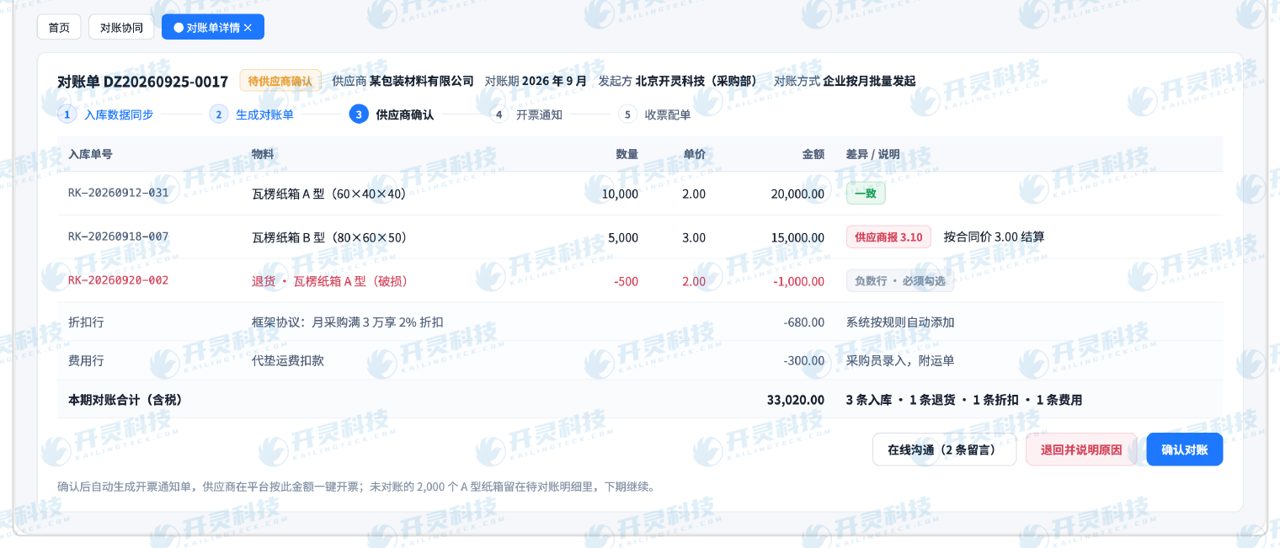
Kailing Technology reconciliation statement: discrepancy lines automatically marked in red (information desensitized)
▍Step 2: Reconciliation collaboration and three-way matching, with over 90% requiring no human review
Once goods receipt data is available, supplier reconciliation and three-way matching can proceed automatically. The Kailing Technology supply chain collaboration platform automatically generates reconciliation statements based on goods receipt data; suppliers confirm on the platform, discrepancy lines are automatically marked in red, return negative lines must be checked, and accounts will not be overpaid. Reconciled statements directly become pre-made invoices, with products, tax codes, splitting and merging, and remarks filled in according to enterprise rules, and suppliers issue invoices with one click.
When an invoice arrives, the system automatically matches it against purchase orders and goods receipt notes by material, quantity, unit price, and amount. There are two matching methods: exact matching for line-by-line correspondence, i.e., material plus quantity plus unit price; and fuzzy matching for cases where only the total needs to match. For many-to-many cases such as one goods receipt split into several invoices or several goods receipts combined into one invoice line, materials are pre-merged and then matched one-to-one; when invoicing in parts at month-end, invoice quantities are deducted line by line against goods receipt lines, with the remaining quantity left for the next period; rounding differences of a few cents caused by invoicing software back-calculating unit prices are automatically corrected by tolerance. Unmatched items go to pending confirmation for manual handling.
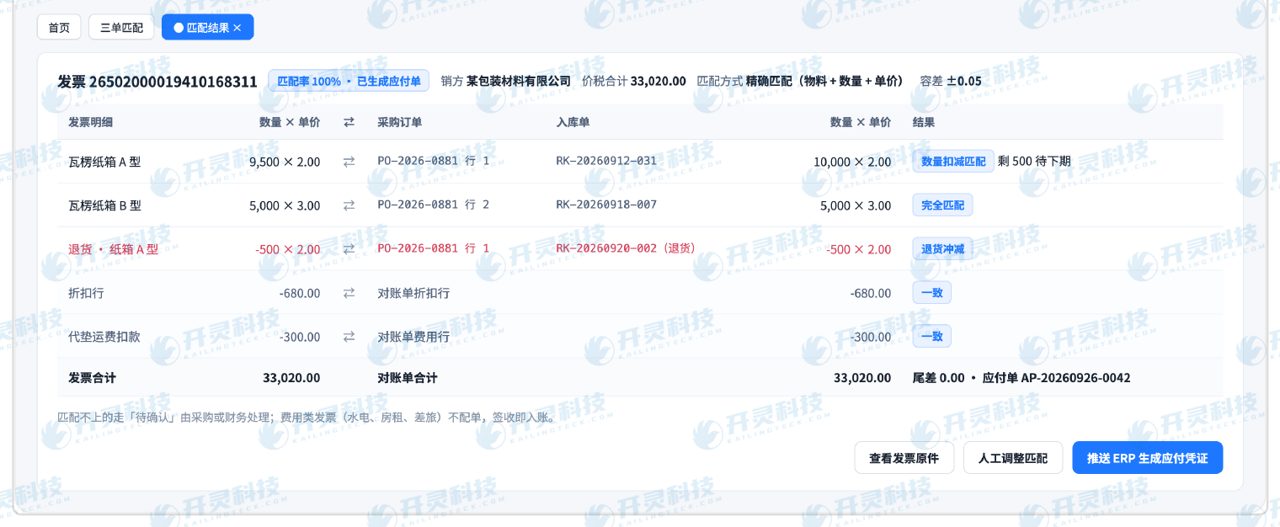
Kailing Technology three-way matching: zero rounding difference generates a payable order (information desensitized)
These rules come from business scenarios refined one by one in production environments, covering one-to-one, one-to-many, many-to-one, many-to-many, partial invoicing, returns and exchanges, quality deductions and weighing differences, freight and service fees, discounts and rebates, prepayments, provisional booking, rounding differences, and similar cases.
▍Step 3: Automatic booking and payment suggestions, with reconciliation results going directly into ERP
Matched invoices automatically generate payable vouchers pushed to ERP, and the voucher number is written back to each invoice; red-letter invoices are automatically booked and automatically matched to red-letter notification vouchers. SAP, Yonyou, Kingdee, and Inspur have all been integrated. For amounts due, the system calculates payment suggestions according to contract payment terms: the current payable equals the amount due minus returns not yet booked, claims, and allowances, with each of the four deductions carrying its source document number.
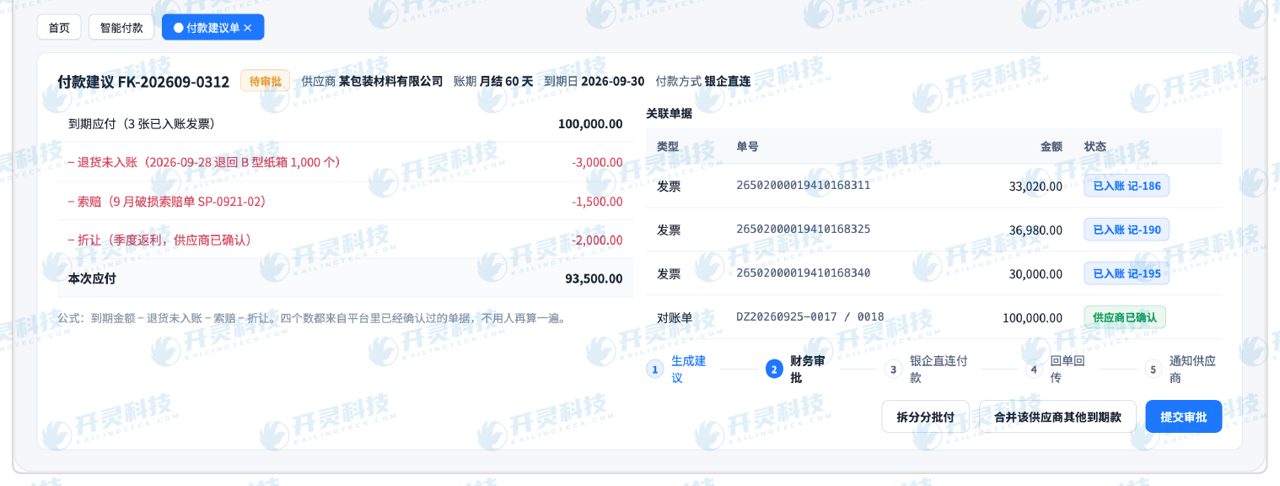
Kailing Technology payment suggestion: deductions traceable to source documents (information desensitized)
Payment instructions are sent to the bank via bank-enterprise direct connection, receipts are automatically retrieved and attached to the payment order, and the supplier simultaneously receives an arrival notification. The purchase order, goods receipt or acceptance note, reconciliation statement, invoice, accounting voucher, payment, and receipt are all attached under the same business number, so inspections or audits can trace to the bottom from any end.
▍Returns and red-letter reversals: the most fragile link in the matching chain
Returns and rebates are the places most likely to break in reconciliation. Under fully digitalized e-invoices, returns and rebates both require red-letter invoices, and the difficulty lies in first finding the original blue invoice. The Kailing Technology supply chain collaboration platform automatically matches the original blue invoice by supplier, product, tax rate, and unit price; the red-letter confirmation form is initiated by the enterprise and confirmed online by the supplier, and after the red invoice is issued it is automatically booked and the payment suggestion updated.
To prevent arbitrary red-letter reversals after the fact, the platform sets a lock upon invoice receipt: invoices already booked cannot be arbitrarily reversed and must go through a red-letter confirmation form, which the enterprise side must approve first. Inconsistent product descriptions, rebates without a corresponding order, and one order corresponding to multiple blue invoices all have corresponding matching rules. In this way, return quantities are offset on the goods receipt note, reversed on the invoice, and deducted in the payment suggestion, keeping the data consistent across all three places.
▍Applicable scenarios and go-live recommendations
This chain is best suited to manufacturing and retail enterprises with large procurement volumes, many suppliers, and many detail lines on material invoices, as well as packaging and fast-moving consumer goods enterprises with large volumes of signed delivery note returns. For procurement without goods receipt notes, such as engineering, services, equipment, and leasing, the platform performs contract-type matching based on contracts, acceptance notes, and invoices; expense invoices such as utilities and rent are not matched and are booked upon receipt.
At go-live, it is recommended to start with top suppliers: typically the top 20% of suppliers cover 80% of invoice volume, so have this group of suppliers use the platform for reconciliation and invoicing first; suppliers not on the platform use automatic email reconciliation and write the reconciliation statement number in the invoice remarks, with automatic parsing and matching after invoice receipt. Delivery note recognition and signed return can go live together with three-way matching, or signed return can go live first and matching be connected later.
▍FAQ
Q: Can delivery notes directly participate in three-way matching?
A: The usual three-way match is invoice, purchase order, and goods receipt note; the delivery note serves as the prerequisite document for goods receipt, proving the goods were delivered and signed for. The two are linked on the same platform, and the signed original can be traced along with the goods receipt note.
Q: How much automation can three-way matching achieve?
A: More than 90% of material invoices on the Kailing Technology supply chain collaboration platform can be automatically matched; many-to-many, partial invoicing, rounding differences, and similar cases are handled by rules, and unmatched items go to pending confirmation for manual handling.
Q: Can matching results automatically enter ERP?
A: Yes. Matched invoices automatically generate payable vouchers pushed to ERP, and the voucher number is written back to the invoice; SAP, Yonyou, Kingdee, and Inspur have all been integrated.
Q: What if suppliers are unwilling to use the platform?
A: Automatic email reconciliation can be used, and suppliers are required to write the reconciliation statement number in the invoice remarks; after the invoice is received, the system automatically parses and matches it.
To automatically match and book deliveries, goods receipts, and invoices, welcome to learn about Kailing Technology AI OCR and the supply chain collaboration platform: https://www.kailingteck.com/ai-ocr/ .
As a national high-tech enterprise, Kailing Technology focuses on the digital and intelligent transformation of enterprise business-finance-tax and operations management, providing software products, system integration, implementation and delivery, and operational services for various government agencies, institutions, group enterprises, and SMEs.
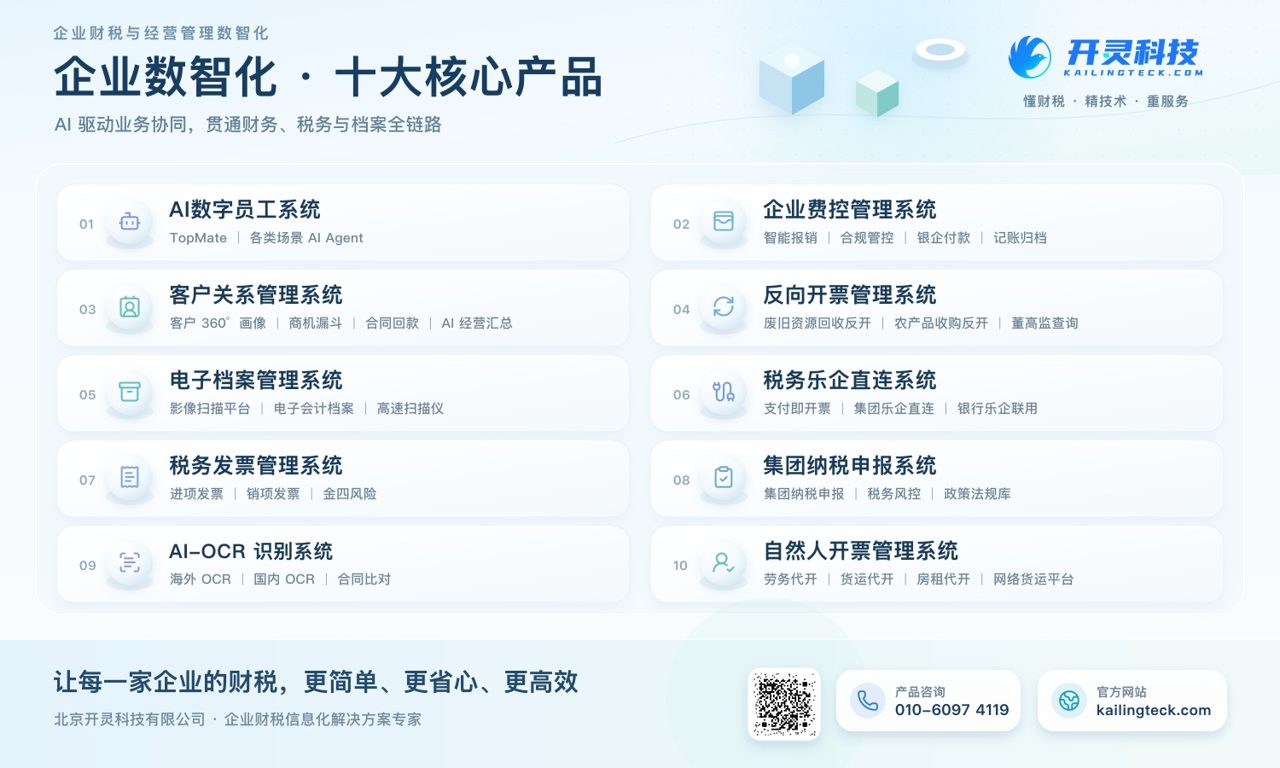
The company has now formed ten core product lines, including: AI digital employee system, enterprise expense control management system, customer relationship management system, reverse invoicing management system, invoice issuance for individuals management system, electronic archives management system, tax fully digitalized e-invoice Leqi system, tax invoice management system, group tax filing system, and AI OCR recognition system. It is committed to connecting enterprise business, finance, tax, funds, and archive data to help customers improve operational efficiency, business-finance-tax compliance capabilities, and digital management levels.
If you have any business-finance-tax digital transformation needs, welcome to contact us. Beijing Kailing Technology will serve you wholeheartedly.
Keywords: delivery note matching, three-way matching, purchase order goods receipt note invoice matching, supplier reconciliation, automatic reconciliation, Kailing Technology AI OCR, ERP automatic booking
As a comprehensive business-finance-tax digitalization solution service provider, Kailing Technology provides business-finance-tax management digital transformation products and operational services for various government agencies, institutions, and large, medium, and small enterprises. The product line includes: solutions for sales contract management system, procurement contract management system, fully digitalized Leqi interface project, automatic output invoicing system, reverse invoicing system, invoice issuance for individuals system, employee expense control and reimbursement system, input VAT invoice management system, supply chain collaborative reconciliation system, image AI OCR recognition system, automatic financial bookkeeping system, electronic accounting archives system, etc., comprehensively driving the digitalization process across various fields.
Consultation Hotline: 18513895936 / 010-60974119 Location: Beijing