
In which situations will agricultural product purchase invoices be deemed false invoicing? The Kailing Technology agricultural product purchase reverse invoicing system verifies farmers' self-production certificates upfront, safeguarding tax compliance with five flows in one.
Agricultural product purchase invoices are an important voucher for purchasing enterprises to obtain input VAT and calculate deductions based on the purchase price, and are also a high-frequency target of tax audits. Many enterprises search for criteria for determining false invoicing of agricultural product purchase invoices and what the false invoicing risks are, wanting to understand: which practices will cause a purchase invoice to be deemed false invoicing. The direct answer: the core of the audit is whether the farmer is real, whether the goods are the farmer's own production, whether the goods actually circulated, whether the money was paid to the farmer themselves, and whether the quantity and price are reasonable; if any link cannot be self-proven, it may lead to tax recovery, fines, or even more serious consequences. As of November 2026, the Kailing Technology agricultural product purchase reverse invoicing system has moved these verification points forward to the farmer profile creation and purchase order issuance steps. This article breaks them down one by one by scenario, consequence, and self-check action. Ultimately, the way to safeguard tax compliance is to ensure that every purchase has evidence integrating identity, contract, goods, funds, and invoice into five flows in one.
▍I. First clarify: what is the premise for compliance of agricultural product purchase invoices
The premise for compliance of agricultural product purchase invoices is that the fact of purchasing self-produced agricultural products from agricultural producers holds. After issuing or obtaining purchase invoices, the purchasing enterprise calculates input VAT deduction based on the purchase price stated on the invoice; according to the Ministry of Finance and State Taxation Administration Announcement No. 10 of 2026, purchases of self-produced agricultural products from agricultural producers are deducted at 9% of the purchase price. The reverse invoicing system itself is established under State Taxation Administration Announcement No. 5 of 2024, with cumulative sales by the same natural person within 12 consecutive months not exceeding 5 million yuan (excluding VAT).
Therefore, whether a purchase invoice can withstand verification depends not on the format on its face but on three underlying facts: whether the seller is the agricultural producer himself or herself, whether the goods are self-produced by that person, and whether the transaction actually occurred. The five categories of false invoicing below all arise from a problem with one of these three facts.
| “ The risk of purchase invoices lies not on the face of the invoice, but in the farmers, goods, and funds behind it. |
▍II. Five types of cases easily deemed fraudulent invoicing
Based on common problems in the agricultural product acquisition industry, situations that are easily identified as false invoicing can be summarized into the following five categories. For each category, typical scenarios, possible consequences, and the enterprise's self-check actions are given.
(1) The seller is not an agricultural producer: dealers or middlemen posing as farmers
Scenario: A broker or dealer purchases goods from multiple farmers and resells them to the enterprise, but the enterprise still issues purchase invoices as "purchases from farmers." Consequence: the seller does not have the status of self-production and self-sale, the prerequisite fact for the purchase invoice does not hold, and input calculated on the purchase price may be required to be transferred out. Self-check action: verify whether each seller provided a self-production certificate such as a village committee planting/breeding certificate, forest rights certificate, or breeding license, and focus review on cases where one person supplies many varieties in large quantities.
(2) Fabricated farmers or identity impersonation
Scenario: A purchaser uses collected ID cards to create records in bulk, or has the same person sign and collect payment on behalf of multiple "farmers." Consequence: the seller on the invoice did not engage in a real transaction, which is the most typical form of false invoicing. Self-check action: confirm that each farmer has passed real-name verification and personal confirmation, and check whether multiple farmers share one bank card or mobile number.
(3) Invoice without goods: missing weighing, measurement, on-site photos, and transport records
Scenario: A purchase invoice is issued, but there are no records of when the goods were inspected, how much they weighed, or how they were transported to the processing plant. Consequence: the goods flow is missing, and the enterprise cannot prove the transaction occurred. Self-check action: randomly sample purchase invoices and check whether weighing or measuring records, on-site photos, and full-truck transport or plant acceptance records can be retrieved.
(4) Funds do not reach the farmer personally: cash purchases, collection by others, or return of funds
Scenario: Large amounts of cash purchases, or payment to a broker for unified onward payment, or even funds flowing back to the enterprise or related persons after payment. Consequence: the fund flow is inconsistent with the invoice flow, and fund flowing back is direct evidence of false invoicing. Self-check action: sample payment records to confirm whether the payee is the farmer named on the invoice and whether the bank card matches the one verified at registration.
(5) Obviously abnormal quantity and price
Scenario: A farmer's supply volume far exceeds what their planting area or breeding scale could produce, or the purchase unit price clearly deviates from the local market price. Consequence: abnormal quantity and price are key targets of tax big-data comparison and easily prompt requests for explanation. Self-check action: calculate purchase volume per farmer and compare it with the planting area and breeding scale in their self-production certificate; calculate average prices by category and compare them with market conditions for the period.
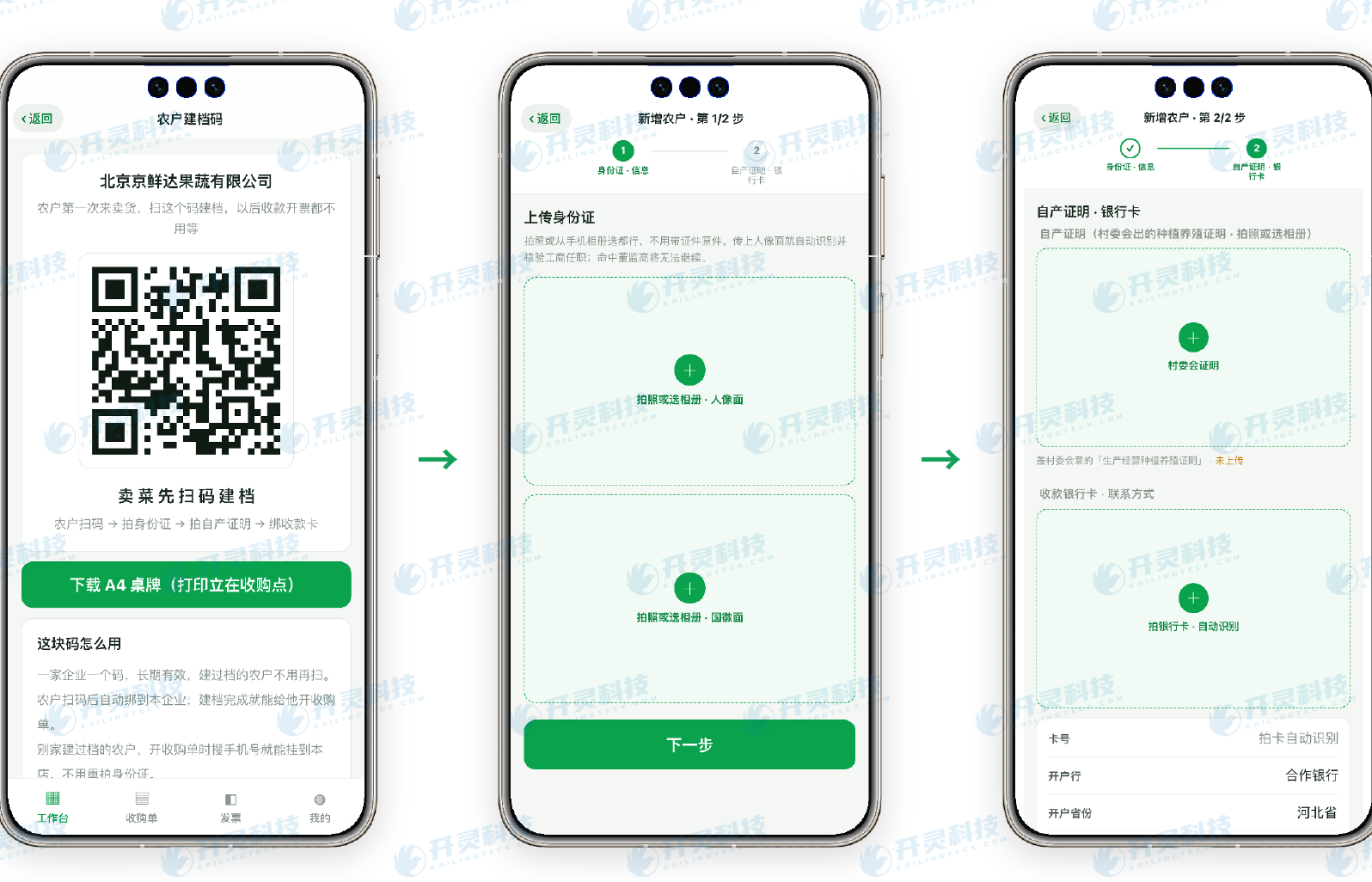
Kailing Technology farmer filing: upload the village committee's self-production certificate (information desensitized)
▍III. See at a glance in one table: which piece of evidence is missing in each of the five cases
The five types of false invoicing essentially correspond to the absence or distortion of one of the five evidence flows. The table below puts the scenario, the missing evidence flow, the materials to be retained, and the system control point together.

Comparison of five types of false invoicing in agricultural product purchase invoices and evidence
The conclusion in the table is: among the five categories, the first four can be resolved when the business occurs through the three actions of "verify the person when creating the file, retain the goods on site, and pay the person directly," while the fifth category requires continuous monitoring through statistical analysis by farmer and category.
▍IV. How Kailing Technology's agricultural product purchase reverse invoicing system pre-verifies
The approach of the Kailing Technology agricultural product acquisition reverse invoicing system is: before invoicing, first verify the three flows of identity, contract, and goods, and if any one is missing, invoicing is not allowed; at payment and invoicing, the fund flow and invoice flow are generated synchronously, with five flows integrated and one archive per invoice.
- Farmer profile creation: Farmers can create a profile by scanning the QR code with WeChat without installing an app; ID cards and bank cards are photographed and automatically recognized, and the key is to upload the village committee-stamped production and farming certificate; the system simultaneously performs real-name verification, 5 million yuan quota verification, and blacklist comparison.
- Acquisition order creation: Purchasing staff select product names from the product library, which has preset tax classification codes; purchasing staff only select and do not fill in. After weight and unit price are entered, the amount is calculated automatically, and photos and videos can be taken to prove the acquisition genuinely occurred.
- Farmer confirmation: The acquisition order generates a confirmation code; farmers scan the code with their own mobile phones to verify the weight and amount, and confirm with a verification code or face recognition plus their own checked declaration; orders not confirmed by farmers cannot enter the payment stage.
- Payment-triggered invoicing: The payment is made directly to the farmer's own bank card, and at the same time as payment succeeds, a reverse invoice is issued through the Leqi fully digitalized e-invoice channel; the farmer's sales are issued tax-free, and the acquisition enterprise calculates input VAT at 9% of the purchase price based on the invoice.
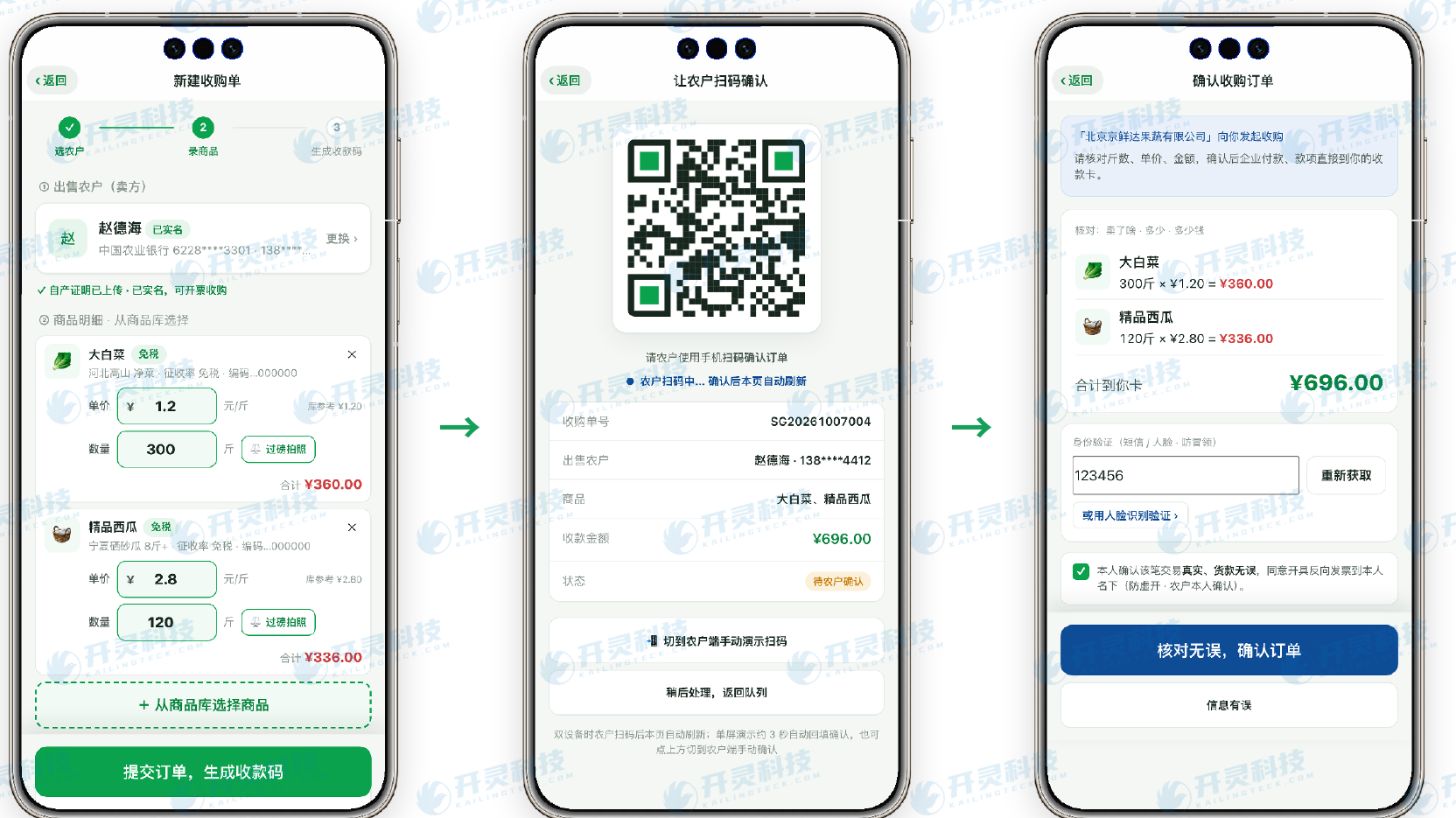
Kailing Technology acquisition order confirmation: farmer scans code to verify (information desensitized)
Among these, farmer self-confirmation is the key step for preventing fictitious farmers and fraudulent collection of payments. In the past, paper purchase orders were filled out single-handedly by purchasers and farmers merely signed; now farmers confirm the transaction content on their own mobile phones, and transaction authenticity is endorsed by the farmer themselves.
▍V. How five-flow evidence is automatically collected: transaction evidence preservation and reconciliation
After each acquisition is completed, the Kailing Technology agricultural product acquisition reverse invoicing system automatically reconciles the order flow, fund flow, and invoice flow in the transaction evidence: the acquisition order number, online banking payment transaction, and reverse invoice number correspond one to one; when all three are complete, it is marked as "three flows complete," and if any one is missing, it is directly marked in red. The identity flow is retained at filing, and the goods flow is retained in the acquisition order; together they form a complete five-flow evidence chain.
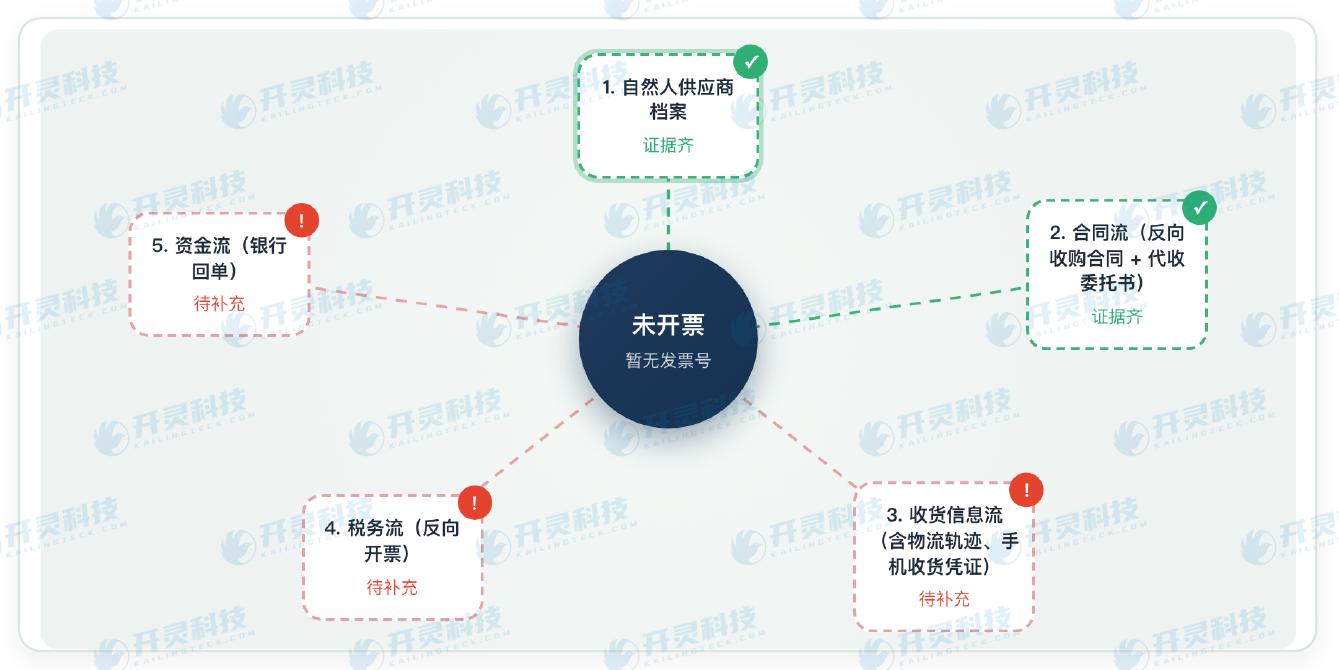
Kailing Technology five-flow star-chain diagram: strong validation of three flows before invoicing (information desensitized)
During a tax inspection, the enterprise can retrieve the full set of evidence by invoice number: farmer files and self-production certificates, acquisition orders and on-site photos, farmer confirmation records, payment receipts, and invoice layout files. Invoicing amounts are summarized monthly, each invoice is marked as reconciled, reconciliation statements can be exported as spreadsheets, and month-end closing no longer requires manual item-by-item matching.
▍VI. Regulatory dashboard: using data to detect quantity and price anomalies
The fifth type of false invoicing situation, "quantity and price anomalies," is difficult to identify in a single acquisition and needs to be discovered by relying on aggregated data. Kailing Technology's agricultural product acquisition reverse invoicing system's risk engine continuously monitors five types of rules: same card, high frequency, abnormal volume, price deviation, and different location: the same bank card is shared by multiple farmers, the same farmer has short-term high-frequency large transactions, a single vehicle's tonnage or number of tickets exceeds a reasonable range, the transaction unit price clearly deviates from the market range, and the file creation location and transaction location do not match for a long time.
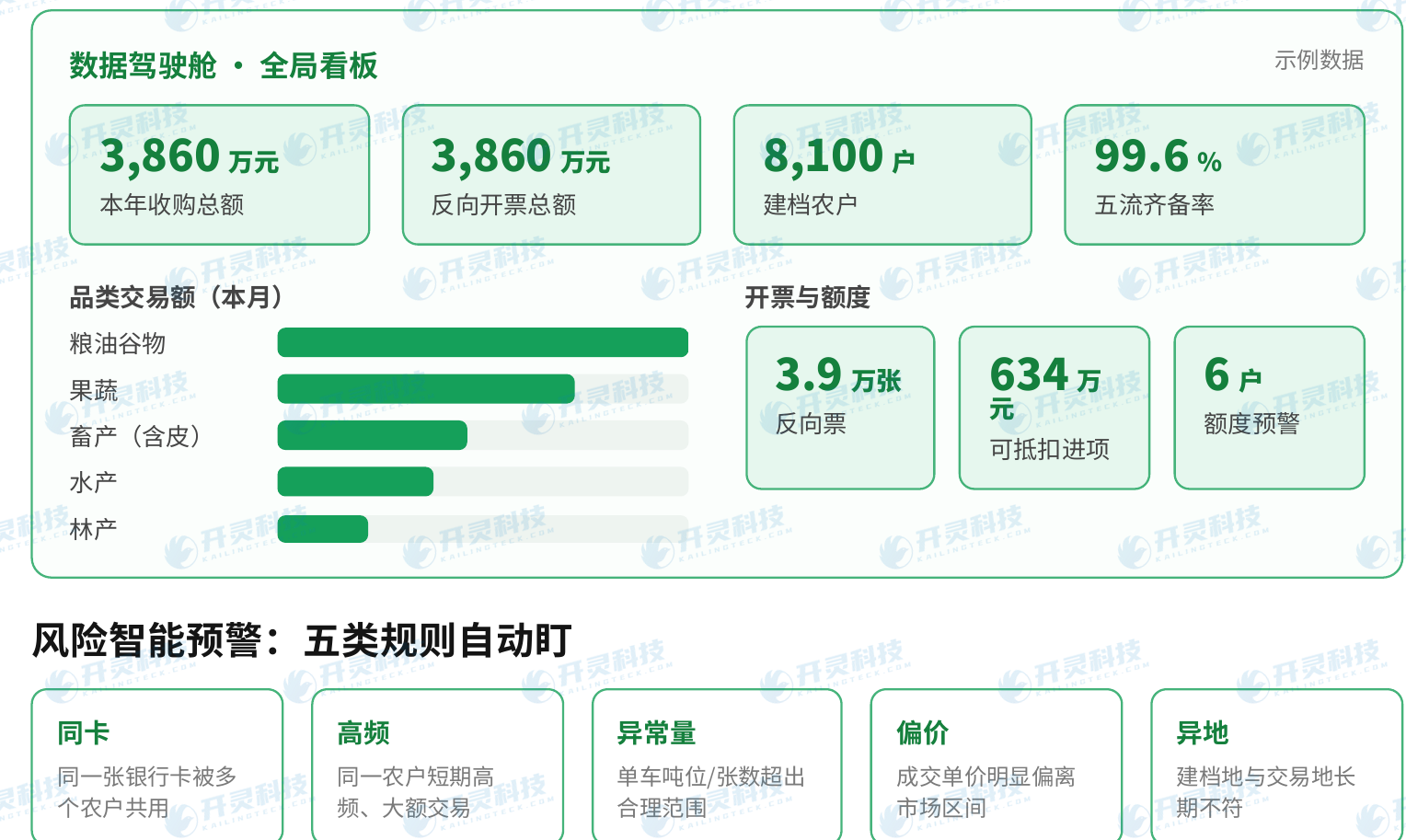
Kailing Technology acquisition data cockpit (sample data)
For purchasing enterprises, the dashboard is used to view their own operations and risks; for agricultural parks and local regulators, the dashboard can show the five-flow completeness rate, invoicing statistics, and risk alerts of enterprises within their jurisdiction, with continuous comparison of self-production/self-sale status and director/supervisor/senior manager identities.
▍VII. What to note for cross-county and cross-province purchases
Many enterprises ask whether purchase invoices can be issued across counties or provinces. Local tax authorities have their own requirements on the scope of use and management of purchase invoices, and enterprises should follow the interpretation of their competent tax authority. From a risk-prevention perspective, cross-regional purchasing does not necessarily constitute a problem in itself; the key is whether it can be proven that the goods genuinely came from local farmers' own production and were actually delivered to the enterprise.
Therefore, cross-regional purchases require retaining three types of materials: first, a self-production certificate issued by the village committee where the farmer is located; second, photos and records of on-site weighing or measuring; third, the transport trajectory from the place of origin to the processing plant. Kailing Technology's agricultural product purchase reverse invoicing system supports trajectory retention for both full-truck and remote direct-shipment transport modes, and if off-site transactions deviate from the registered location for a long time, an off-site rule alert is triggered.
▍VIII. Four frequencies for enterprises' routine self-inspection
Acquisition enterprises can arrange self-checks at four frequencies—"daily, weekly, monthly, quarterly"—to integrate risk control into daily work.
- Daily: Purchasing staff confirm that all acquisition orders of the day have been confirmed by farmers and photographed; unconfirmed orders are not paid.
- Weekly: Finance checks the completeness rate of the five flows and fills in missing evidence; checks the risk warning list and verifies same-card and high-frequency transactions one by one.
- Monthly: Statistics are made by farmer on the match between acquisition volume and planting/breeding scale, and by category on the deviation of average price from market conditions.
- Quarterly: Fully check farmers approaching the 5 million yuan quota, guide larger-scale farmers to register as business entities, and review whether self-production certificates are expired or need updating.
Self-check results should be kept on file as proof that the enterprise's internal controls are operating effectively.
If a problem is found in any self-check item, payment and invoicing for the relevant farmers should be suspended first, and resumed only after materials are completed or the situation is verified, rather than issuing invoices first and supplementing materials later.
The self-checks at four frequencies together cover all risk points of the five categories of false invoicing. Enterprises do not need to assign dedicated staff; they only need to fix these actions into the daily work of purchasers, finance, and management.
▍IX. Applicable conditions and qualification issues
Agricultural product reverse invoicing applies to enterprises purchasing self-produced agricultural products from natural-person farmers, covering all categories of agriculture, forestry, animal husbandry, and fishery, such as grain and oil crops, vegetables and fruits, live livestock and raw hides, timber and bamboo, dried fruits and edible fungi, and fish, shrimp, crabs, and shellfish. If the upstream party is a registered business entity such as a cooperative or family farm, that party should issue the invoice itself; if the seller is a dealer, it is not self-production and self-sale and should not be treated as a purchase from an agricultural producer.
Acquisition enterprises without reverse invoicing qualifications can have Kailing Technology assist in obtaining the required qualifications; during the processing period, the invoice issuance for individuals tax channel can be used as a transition so that business is not interrupted. The system can be deployed privately in the acquisition enterprise's or agricultural park's own data center, or the SaaS service can be used, with strict isolation between multi-organization tenants.
▍X. Taking the agricultural wholesale market as an example: how one stall, one code is implemented
Agricultural product wholesale markets are one of the places where purchase invoice problems are most concentrated: many stalls, highly mobile farmers, and high transaction frequency, with heavy past reliance on handwritten purchase orders and cash settlement. Implementing a one-stall-one-code approach makes the purchases of each stall verifiable.
The specific approach is: the purchasing enterprise sets up a profile QR code at each purchasing point in the market; when a farmer comes to sell goods for the first time, they scan the code with WeChat to create a profile and upload the village committee's self-production certificate; on later visits, the purchaser can retrieve the profile by searching the mobile phone number. After the goods are weighed and the price agreed, the purchaser issues a purchase order and generates a confirmation code, the farmer scans to confirm, and the invoice is issued synchronously when finance pays. For farmers already profiled by another merchant, searching the mobile phone number links them to this store without re-photographing the ID card.
In this mode, purchasers do not need to enter a large amount of additional information; farmers only need to scan a code and confirm, and finance no longer needs to reconcile each transaction at month-end. For agricultural wholesale markets or agricultural parks that concentrate many purchasing merchants, the platform can also serve as a unified entry point, allowing the park to view the five-flow completeness rate and risk alerts of merchants within its jurisdiction.
▍XI. When an inspection comes, in what order should enterprises present materials
When tax authorities require an enterprise to explain a certain acquisition invoice, it is recommended to present materials in the order of "person—goods—money—invoice," which is the clearest logic.
First present the farmer profile: ID verification records, verification that the bank card matches the person, the village committee's self-production certificate, and the quota verification result. Then present the goods evidence: purchase order, weighing or measuring photos, transport trajectory, and factory acceptance records. Then present the fund evidence: payment receipt, explaining that the payee is the farmer themselves and the amount matches the purchase order. Finally present the invoice: the reverse invoice format file and the farmer's confirmation record on the mobile phone.
If the verification concerns overall purchases over a period, the enterprise can also export purchase summaries by farmer and compare them with the farmers' planting area or breeding scale to respond to the question of whether quantities are reasonable.
In this order, inspectors can see the ins and outs of the entire transaction within minutes. The Kailing Technology agricultural product acquisition reverse invoicing system supports retrieving all the above materials at once by invoice number, so enterprises do not need to temporarily collect them from various positions.
▍FAQ
Q: What are the common cases in which agricultural product purchase invoices are deemed fraudulent?
A: Common cases include the seller not being a self-producing farmer, fictitious farmers or identity impersonation, invoices without goods, payment not made to the farmer personally or funds flowing back, and obviously abnormal purchase quantity or price. The core is whether the farmer, the goods, and the funds can each be self-proven.
Q: How can a purchasing enterprise prove that agricultural products are self-produced by farmers?
A: Usually a production, planting, or breeding certificate issued by the village committee where the farmer is located is required; for forest products, a forest right certificate or contract can be provided; for aquatic products, an aquaculture certificate or fishing license can be provided. Kailing Technology's agricultural product purchase reverse invoicing system requires uploading them at the time of profile creation.
Q: Can purchase invoices be issued for agricultural products bought from brokers?
A: Brokers or dealers are not agricultural producers; their resale is not self-production and self-sale, so purchase invoices should not be issued as purchases from farmers, and they should issue invoices themselves as business entities.
Q: How much can agricultural product purchase invoices be deducted for?
A: According to Announcement No. 10 of 2026 of the Ministry of Finance and the State Taxation Administration, for self-produced agricultural products purchased from agricultural producers, input VAT is calculated and deducted at 9% of the purchase price stated on the invoice.
Q: Can the purchase payment be paid to a broker for unified transfer?
A: Not recommended. The payment should be made directly to the farmer's own bank card. Kailing Technology's agricultural product purchase reverse invoicing system pays only to the person's own card verified at the time of profile creation, and issues the invoice at the same time as successful payment.
To issue agricultural product purchase invoices compliantly and clearly for audits, welcome to learn about the Kailing Technology agricultural product purchase reverse invoicing system: https://www.kailingteck.com/fxncp/ .
As a national high-tech enterprise, Kailing Technology focuses on the digital and intelligent transformation of enterprise business-finance-tax and operations management, providing software products, system integration, implementation and delivery, and operational services for various government agencies, institutions, group enterprises, and SMEs.
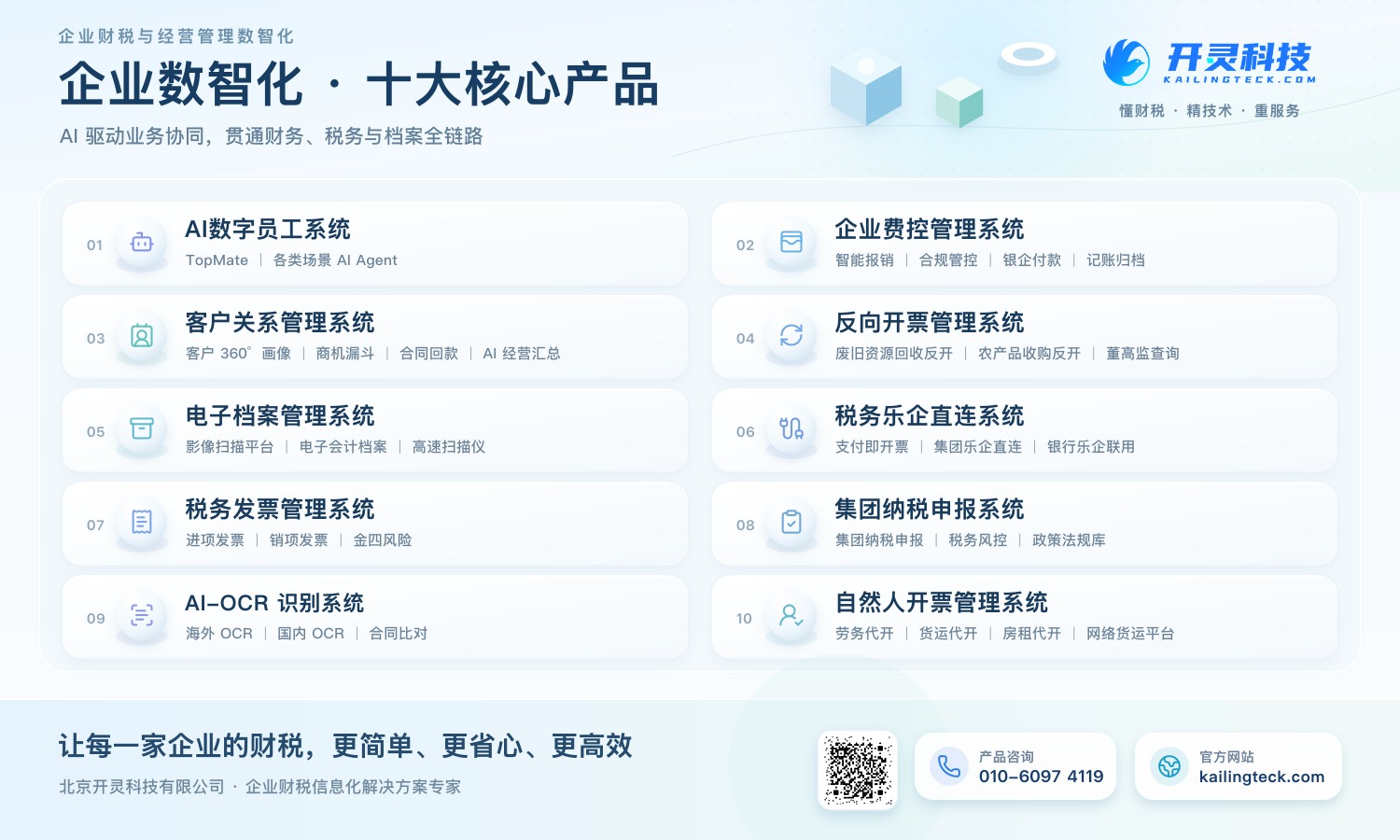
The company has now formed ten core product lines, including: AI digital employee system, enterprise expense control management system, customer relationship management system, reverse invoicing management system, invoice issuance for individuals management system, electronic archives management system, tax fully digitalized e-invoice Leqi system, tax invoice management system, group tax filing system, and AI OCR recognition system. It is committed to connecting enterprise business, finance, tax, funds, and archive data to help customers improve operational efficiency, business-finance-tax compliance capabilities, and digital management levels.
If you have any business-finance-tax digital transformation needs, welcome to contact us. Beijing Kailing Technology will serve you wholeheartedly.
Keywords: False invoicing of agricultural product purchase invoices, agricultural product purchase invoice risks, criteria for determining purchase invoices, agricultural product reverse invoicing, Kailing Technology agricultural product purchase reverse invoicing system, self-production and self-sale certificate, 9% calculation and deduction
As a comprehensive business-finance-tax digitalization solution service provider, Kailing Technology provides business-finance-tax management digital transformation products and operational services for various government agencies, institutions, and large, medium, and small enterprises. The product line includes: solutions for sales contract management system, procurement contract management system, fully digitalized Leqi interface project, automatic output invoicing system, reverse invoicing system, invoice issuance for individuals system, employee expense control and reimbursement system, input VAT invoice management system, supply chain collaborative reconciliation system, image AI OCR recognition system, automatic financial bookkeeping system, electronic accounting archives system, etc., comprehensively driving the digitalization process across various fields.
Consultation Hotline: 18513895936 / 010-60974119 Location: Beijing