
Paid the purchase amount but did not get the invoice? Kailing Technology's Leqi integrated payment-and-invoicing solution tracks payment and invoicing status for resource recycling and agricultural product purchases
What purchasing enterprises fear most is that "the money has arrived, but the invoice cannot be found for a long time." The payment system shows success, while the invoicing platform may still be processing, so business staff mistakenly think a transaction is complete. Kailing Technology's Leqi integrated payment-and-invoicing solution tracks payment and invoicing as two statuses and writes both back to the original purchase order.

▍First make the purchase order a common number
Both resource recycling and agricultural product acquisition require clarifying the actual seller, goods, acceptance, settlement amount, and applicable invoices, but the subject qualifications and invoicing basis of the two types of business cannot be mixed. The enterprise first forms a confirmed purchase order on the business side, then generates payment tasks by order number.
When one payment covers multiple purchase orders, the payment batch should expand the amount of each order; when the same person delivers multiple times, the invoicing scope cannot be inferred solely from the name and total payment amount. The order number is the common anchor for reconciliation between the financial channel and the invoice platform.
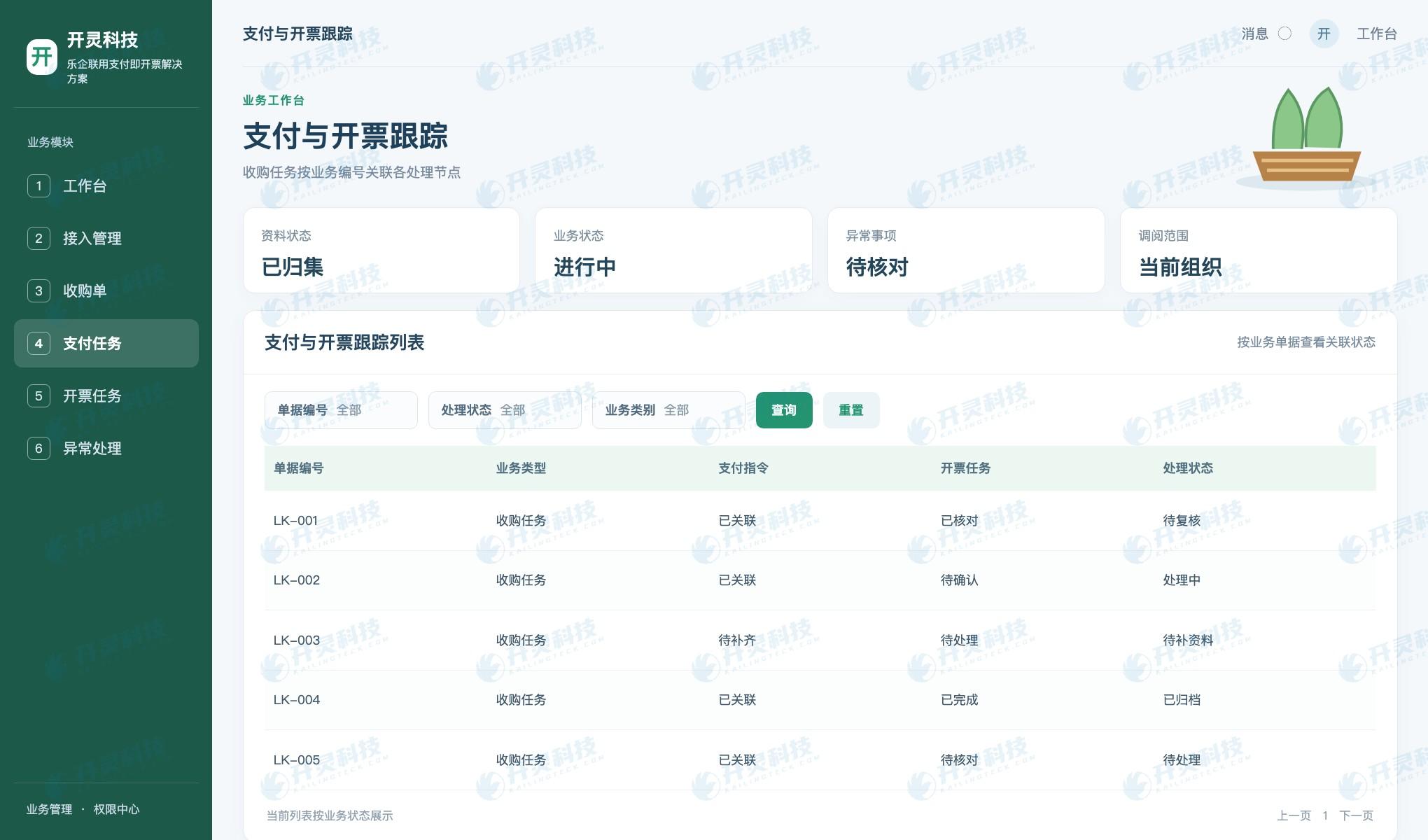
Payment and invoicing tracking business list
▍Payment acceptance is not the same as payment success
After the channel returns an acceptance number, the system continues to wait for the actual payment result. Account information mismatch, bank returns, and network timeouts may all occur. Kailing Technology's solution separately saves payment instructions, channel transaction records, success or failure receipts, and processing times, preventing business staff from mistaking "submitted" for "paid."
Cross-day callbacks and duplicate callbacks must be identified as the same event by transaction number to prevent duplicate triggering. If the payment result is delayed, the exception list reminds for reconciliation and does not automatically archive the purchase order as complete while the status is unclear.
▍Invoicing tasks have their own results
Under applicable business and integration conditions, a successful payment can drive the invoicing process. Before invoicing, seller eligibility, goods, amount, and acquisition materials are still verified. The invoice platform may return processing, success, or failure, and the system saves the invoice number, time, and failure reason item by item.
When payment succeeds but invoicing fails, it should clearly show "paid but not invoiced", and finance should retry or take corresponding action after review; a payment receipt cannot replace an invoice. Invoice red-flushing, reissuance or amount adjustments should also continue to be linked to the original purchase order.
▍View both status lines from the purchase order
Business staff entering the purchase order can see whether payment has arrived, whether the invoice has been issued and the respective times; finance entering from the invoice can find the purchase, acceptance and payment records. The five-flow archives for resource recycling and the household-based purchase evidence for agricultural products are retained separately and are not compressed into the same set of rules just because they share a technical channel.
The value of Leqi integrated use is to uniformly connect the financial channel and the invoicing process, so that normal orders advance automatically and abnormal orders are clearly visible. The final status is still subject to the actual results returned by the bank and the invoice platform.
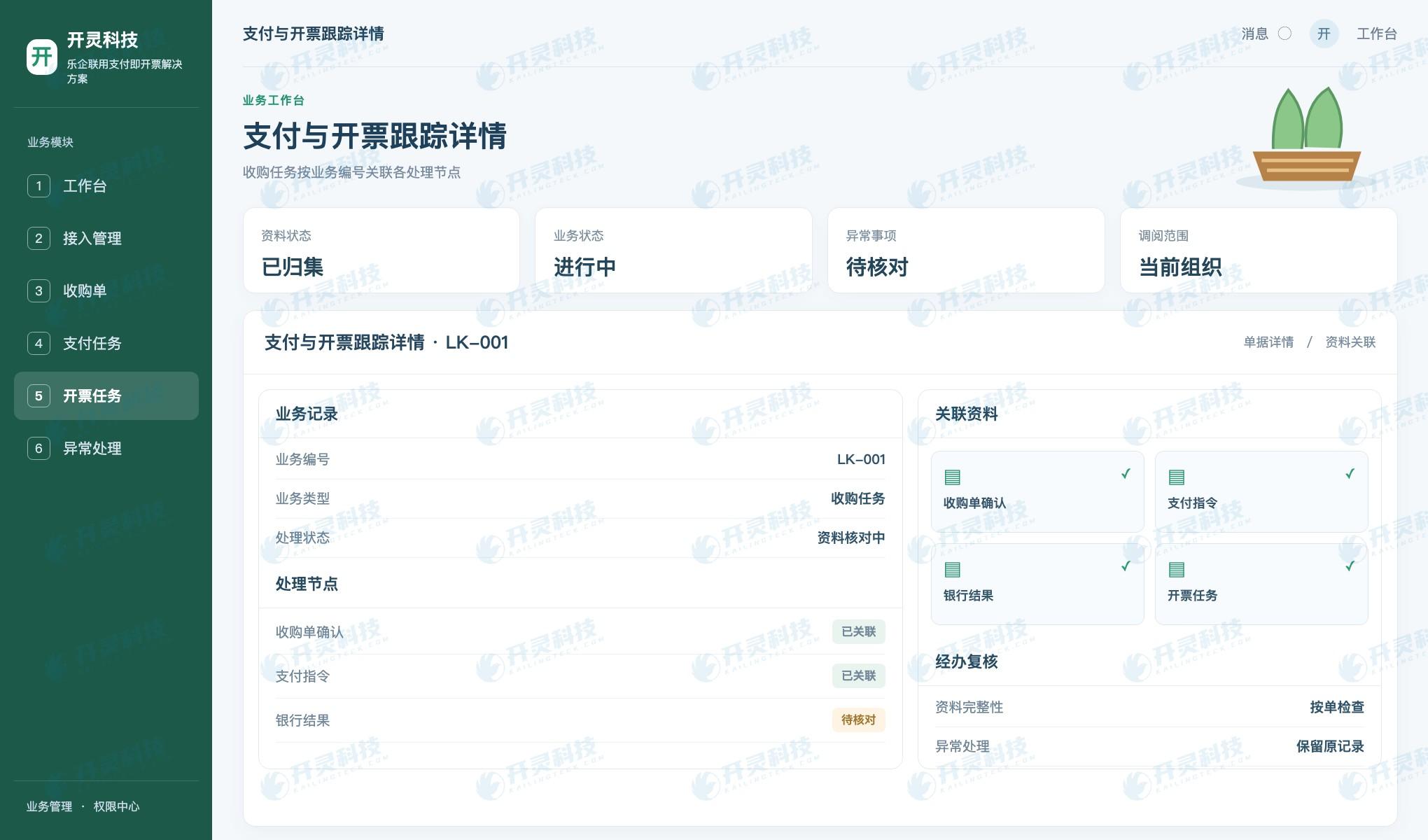
Payment and invoicing tracking document and data association
▍Dispatching "paid but not invoiced" by cause
Finance can classify exceptions into invoice information pending verification, invoicing platform failure, interface timeout, incomplete original transaction materials, and invoice processing in progress. Each category is assigned an owner and a handling time limit, and the handling process is logged. For cases where "the invoice was issued but not written back," first verify the platform's actual result before adding the association, to avoid duplicate issuance.
Also retain reverse differences such as "invoiced but unpaid" or returned payments to facilitate item-by-item settlement at month-end. Reconciling only by the total of a payment batch cannot reveal a missing invoice for a single acquisition.
▍Use failure samples in integration testing
During implementation, select samples for normal payment invoicing, payment returns, successful payment but failed invoicing, duplicate callbacks, and successful invoicing but write-back timeout. Verify the same order number and final status in the business, banking, and invoice systems respectively, then check whether a complete history remains after exception recovery.
The Kailing Technology pay-and-invoice solution defines field mapping and acceptance scope according to the enterprise's existing systems, partner financial channels, and tax integration methods. Testing status boundaries clearly before launch prevents "payment successful" from masking "invoice missing" in actual business.
▍Why payment and invoicing status must be separated
The bank returning payment success and the invoicing platform returning issuance success are two independent events. They may be seconds apart, or delayed by interface, validation, or network issues. The system saves the respective transaction records, times, and results so that business staff can determine whether the money has not arrived or the invoice has not been issued.
"Paid but not invoiced" should also distinguish between an invoicing task not triggered, triggered and in process, failed and pending retry, and invoiced but write-back failed. The handling actions differ, and the operator should not see a vague red alert.
The Kailing Technology solution uses the acquisition order to connect the two types of status, reducing cross-platform queries and preventing payment completion from being mistaken for completion of the entire order.
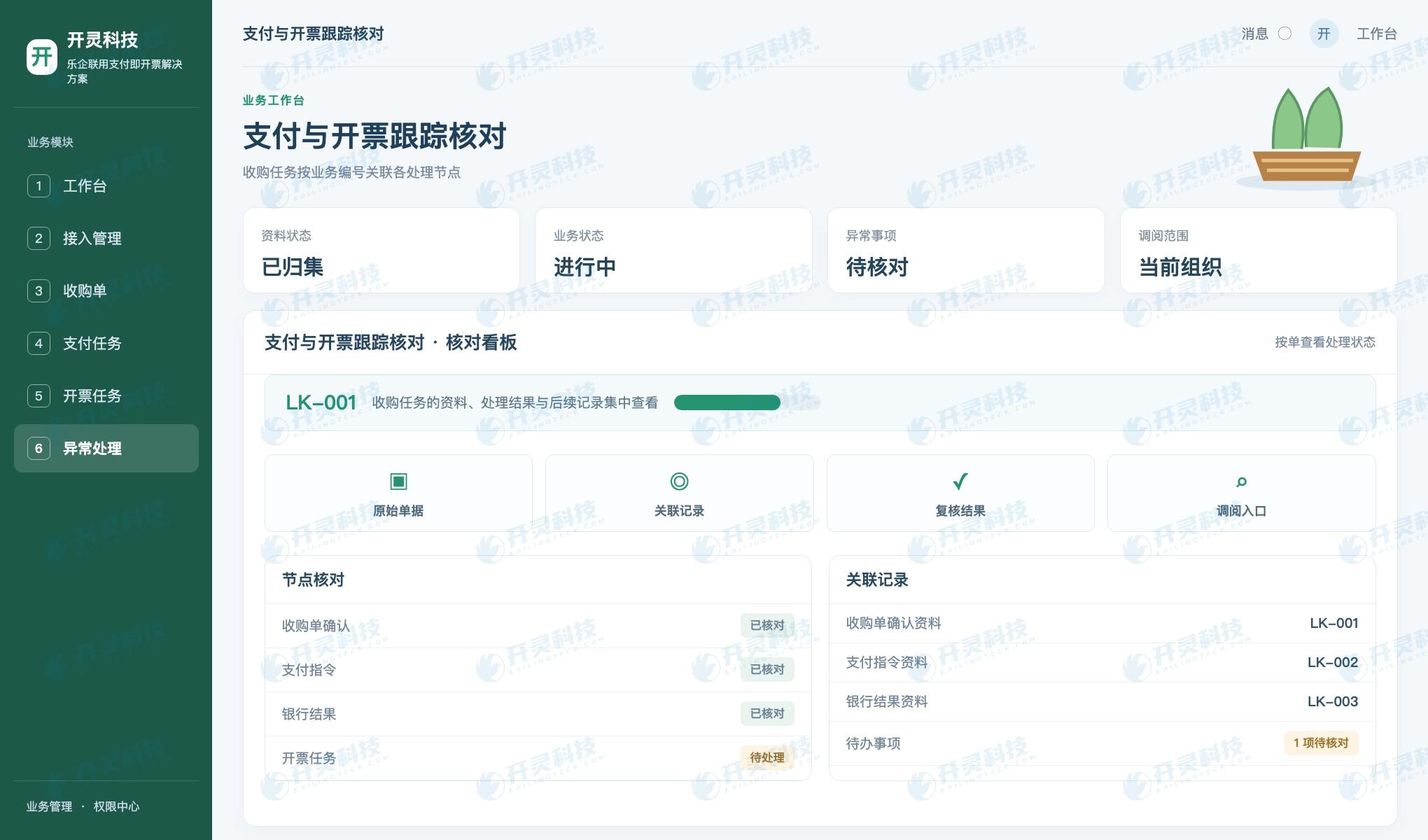
Payment and invoicing tracking node verification
▍Check the original result before retrying exceptions
When a payment callback is lost, first verify the original transaction flow with the financial channel; when an invoicing response times out, first query the actual result on the invoice platform. Only retry as designed after confirming it was unsuccessful. Otherwise, the risk of duplicate payment or duplicate invoicing is harder to handle than a temporary hold.
Both payment tasks and invoicing tasks retain idempotency numbers, original requests, and callback logs. At month-end, finance can compare channel transactions, invoice numbers, and purchase orders one by one to find documents that are not closed-loop.
The qualification determination for reverse invoicing for individuals in resource recycling and for agricultural product acquisition invoices is configured separately; the integrated channel does not change the business rules.
▍Focus acceptance testing on recovery capability
Normal process tests often succeed. More importantly, interface timeouts, duplicate callbacks, bank returns, and invoice platform rejections should occur during testing to confirm whether the system can display the real status, assign responsible persons, and recover processing.
Complex transactions such as multiple deliveries under one payment, multiple households in one vehicle and installment payments should also be tested to see whether purchase order details correspond to payment and receipt results. Looking only at the total payment amount cannot reveal individual missing invoices.
If the scope of the partner channel or upstream system changes, review the field mapping and status rules first, then launch the new business. Kailing Technology's Leqi integrated payment-and-invoicing solution thereby supports daily reconciliation in high-frequency acquisition scenarios.
▍Start daily closing from the paid-but-not-invoiced list
Each day, finance first filters out records with successful payment but no invoice result by purchase order, then distinguishes pending trigger, processing, failed, and missing write-back. Each order in a payment batch is displayed independently and is not marked complete just because other orders in the same batch succeeded.
If the invoice platform already has an invoice but the business side has not received the callback, first query the original platform number, then supplement the write-back association; if issuance indeed failed, correct the materials or retry according to the failure reason. This order can reduce duplicate invoicing.
For payments returned by the bank, the cashier verifies the account and amount before processing, and the invoicing task maintains the corresponding status according to the applicable process. All departments operate on the original business order, and the process is retained after exception recovery.
The Kailing Technology Leqi integrated pay-and-invoice solution can summarize unclosed transactions by site, period, and business category. Management sees the specific documents to be handled, and finance can also reconcile channel statements with invoice numbers item by item.
Daily closing reports should list unpaid, paying, paid but not invoiced, invoice processing, and invoiced but not written back at the same time, avoiding mixing different causes into one "incomplete." Responsible persons handle by original order number, and after recovery they can still view the times and results returned by the bank and the invoice platform respectively.
▍FAQ
Q: Does successful payment guarantee an invoice?
A: The two have independent results; when invoicing fails, it should show paid-but-not-invoiced and be handled.
Q: Can another invoice be issued directly after an interface timeout?
A: First check the actual result on the invoice platform against the original request to avoid duplicate invoicing.
Q: Can resource recycling and agricultural products share receipt rules?
A: Channel linkage can be unified, but the entity and the applicable conditions for receipts still need to be configured separately.
Visit Kailing Technology to learn about related products and implementation plans: www.kailingteck.com .
As a national high-tech enterprise, Kailing Technology focuses on the digital and intelligent transformation of enterprise business-finance-tax and operations management, providing software products, system integration, implementation and delivery, and operational services for various government agencies, institutions, group enterprises, and SMEs.
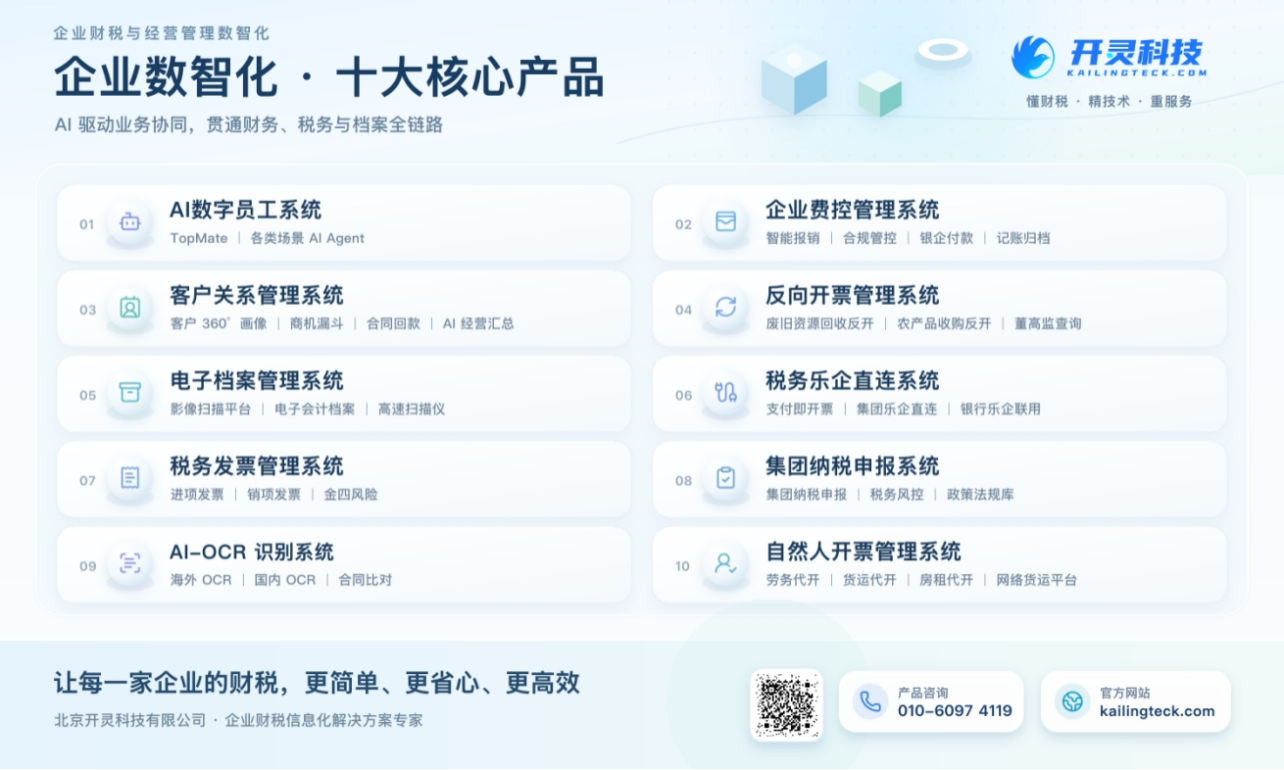
The company has now formed ten core product lines, including: AI digital employee system, enterprise expense control management system, customer relationship management system, reverse invoicing management system, invoice issuance for individuals management system, electronic archives management system, tax fully digitalized e-invoice Leqi system, tax invoice management system, group tax filing system, and AI OCR recognition system. It is committed to connecting enterprise business, finance, tax, funds, and archive data to help customers improve operational efficiency, business-finance-tax compliance capabilities, and digital management levels.
If you have any business-finance-tax digital transformation needs, welcome to contact us. Beijing Kailing Technology will serve you wholeheartedly.
Keywords: Leqi integrated use, payment-and-invoicing, paid but not invoiced, purchase order status, Kailing Technology
As a comprehensive business-finance-tax digitalization solution service provider, Kailing Technology provides business-finance-tax management digital transformation products and operational services for various government agencies, institutions, and large, medium, and small enterprises. The product line includes: solutions for sales contract management system, procurement contract management system, fully digitalized Leqi interface project, automatic output invoicing system, reverse invoicing system, invoice issuance for individuals system, employee expense control and reimbursement system, input VAT invoice management system, supply chain collaborative reconciliation system, image AI OCR recognition system, automatic financial bookkeeping system, electronic accounting archives system, etc., comprehensively driving the digitalization process across various fields.
Consultation Hotline: 18513895936 / 010-60974119 Location: Beijing