
Deployed a bunch of AI but no one manages it, it can't be audited, and responsibility can't be traced? Kailing Technology AI digital employees control audits like managing positions
In the past two years, almost every enterprise has adopted AI: customer service has integrated a large model, finance has installed a review assistant, and business departments have each purchased several sets of intelligent agents. There are more tools, but managers quickly discover a new problem—AI is scattered across various systems, and almost no one can clearly explain who created it, who is using it, what data it has accessed, what it has done, or whom to contact when something goes wrong.Deployed a bunch of AI, yet fell into the "three-no" state of "no one manages it, it can't be audited, and responsibility can't be traced". What Kailing Technology's AI digital employee aims to solve is precisely this governance issue that most enterprises overlook: making AI no longer an unbridled tool, but something managed in a regulated way like a formal employee in a position.
▍The more AI is adopted, why does it become more chaotic the more it is used
The root of the chaos is treating AI as a "tool" rather than a "position." Tools are bought and used, with no identity, no boundaries, and no ledger. This manifests as four types of loss of control:Scattered——AI is distributed across multiple systems such as OA, ERP, finance, and business, each operating independently with inconsistent standards;No one manages it— Accounts are opened at will, anyone can access them, and permission boundaries are vague;Cannot be audited——Which table it read, which interface it called, which data record it changed—there is no traceable record;Cannot be held accountable——Once an error occurs, responsibility cannot be traced to a person, and losses cannot be quickly stopped. When AI is merely scattered feature points, the larger the scale, the greater the risk exposure.
▍A different approach: manage AI like you manage an employee
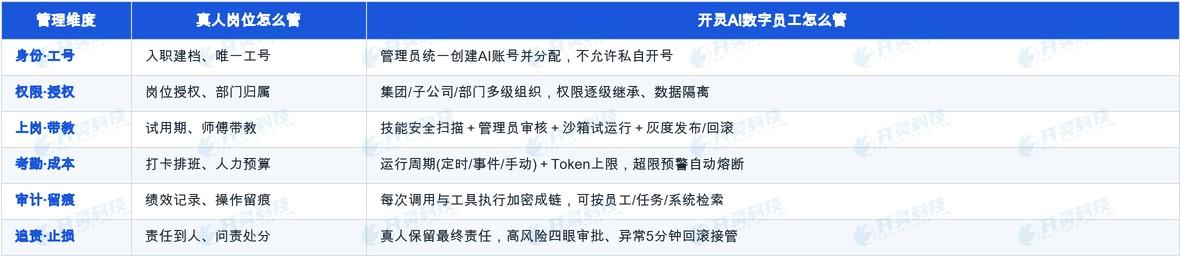
The governance logic of Kailing Technology's AI digital employee is simple: since it assumes position responsibilities, it should be managed by position. Real employees have employee IDs, authorizations, shift attendance, and performance records; digital employees should likewise have a unique AI account, clear permission boundaries, controllable operation attendance, and traceable execution audits. What managers want is not another black-box tool, but a team Monitorable, manageable, and clearly auditable's digital employee team. Around this goal, Kailing has implemented governance in six dimensions: three-terminal architecture, full lifecycle, organizational isolation, skill review, log auditing, and Token control.
▍Three-tier architecture: capabilities, usage, and governance each in their place
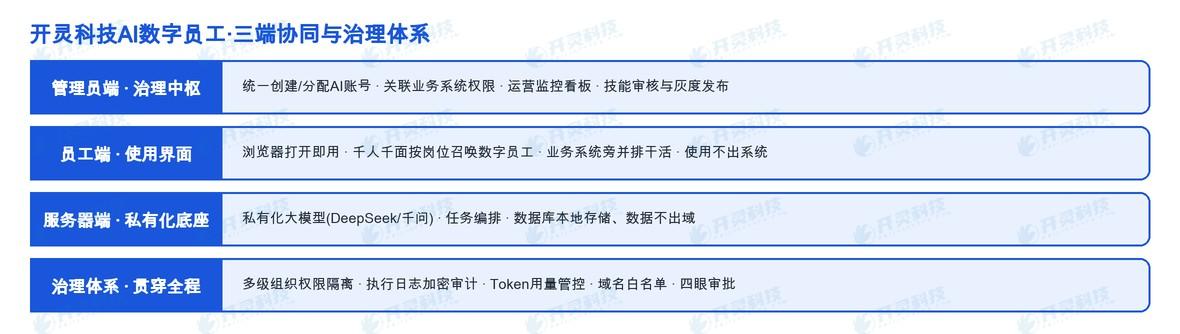
To govern it well, you must first distinguish it clearly. Kailing splits the system into three collaborative ends: the server end is the private deployment foundation, running local large models, task orchestration, and databases, with data never leaving the domain; the employee end is the user interface, ready to use when opened in a browser, personalized for each person, with different digital employees visible to different roles, and always working alongside business systems; the administrator end is the governance hub, responsible for creating accounts, assigning permissions, monitoring operations, and reviewing skills. Above the three ends, there is also a governance mainline running through the entire process—organizational isolation, log auditing, Token control, domain whitelisting, and four-eyes approval. With the three ends each performing their own duties, managers have a unified handle rather than facing a bunch of isolated tools each speaking its own language. In other words, capabilities are concentrated in the foundation, usage returns to the role, and governance is consolidated in the hub, so that every action of AI has a traceable source, a basis of authority, and a person to ask.
▍Full lifecycle: from registration to monitoring, managed end-to-end on one line
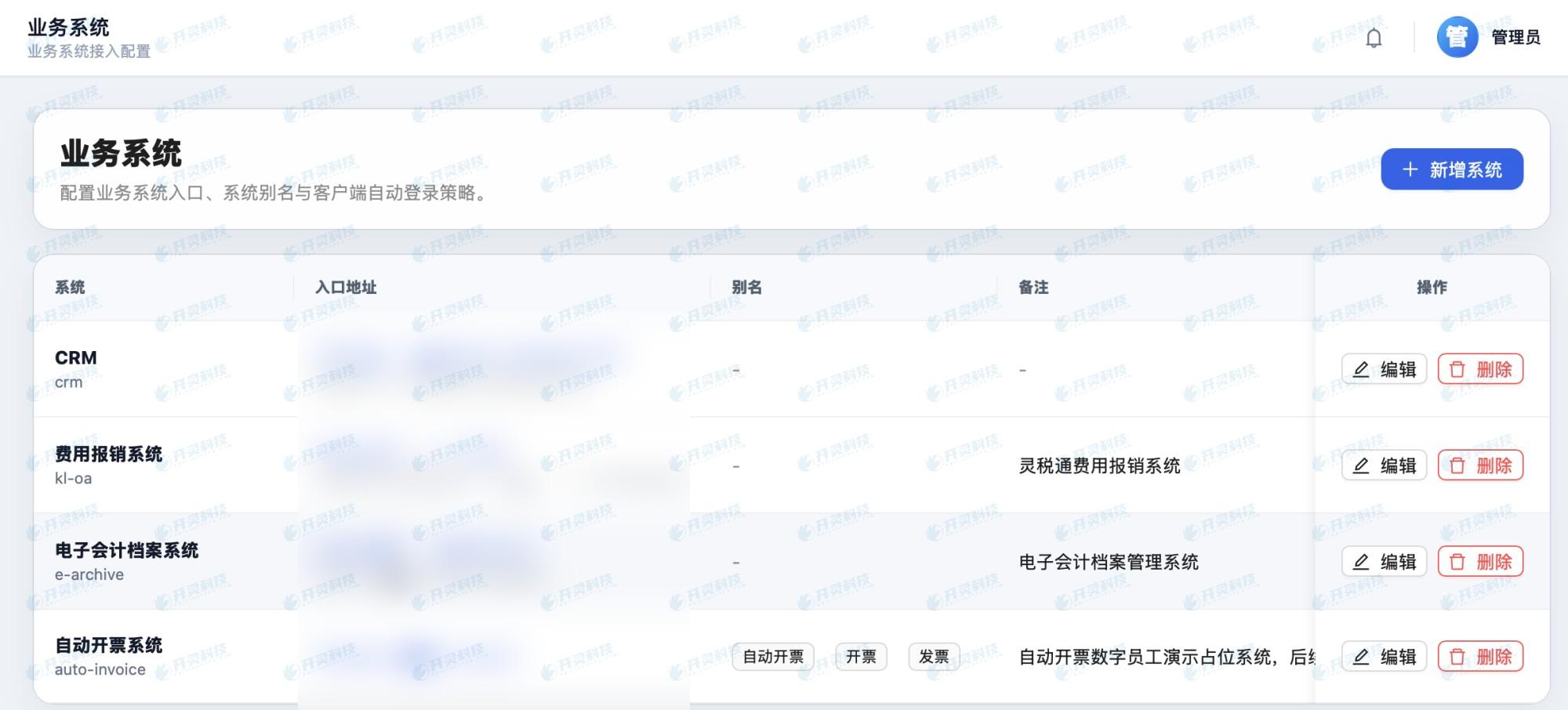
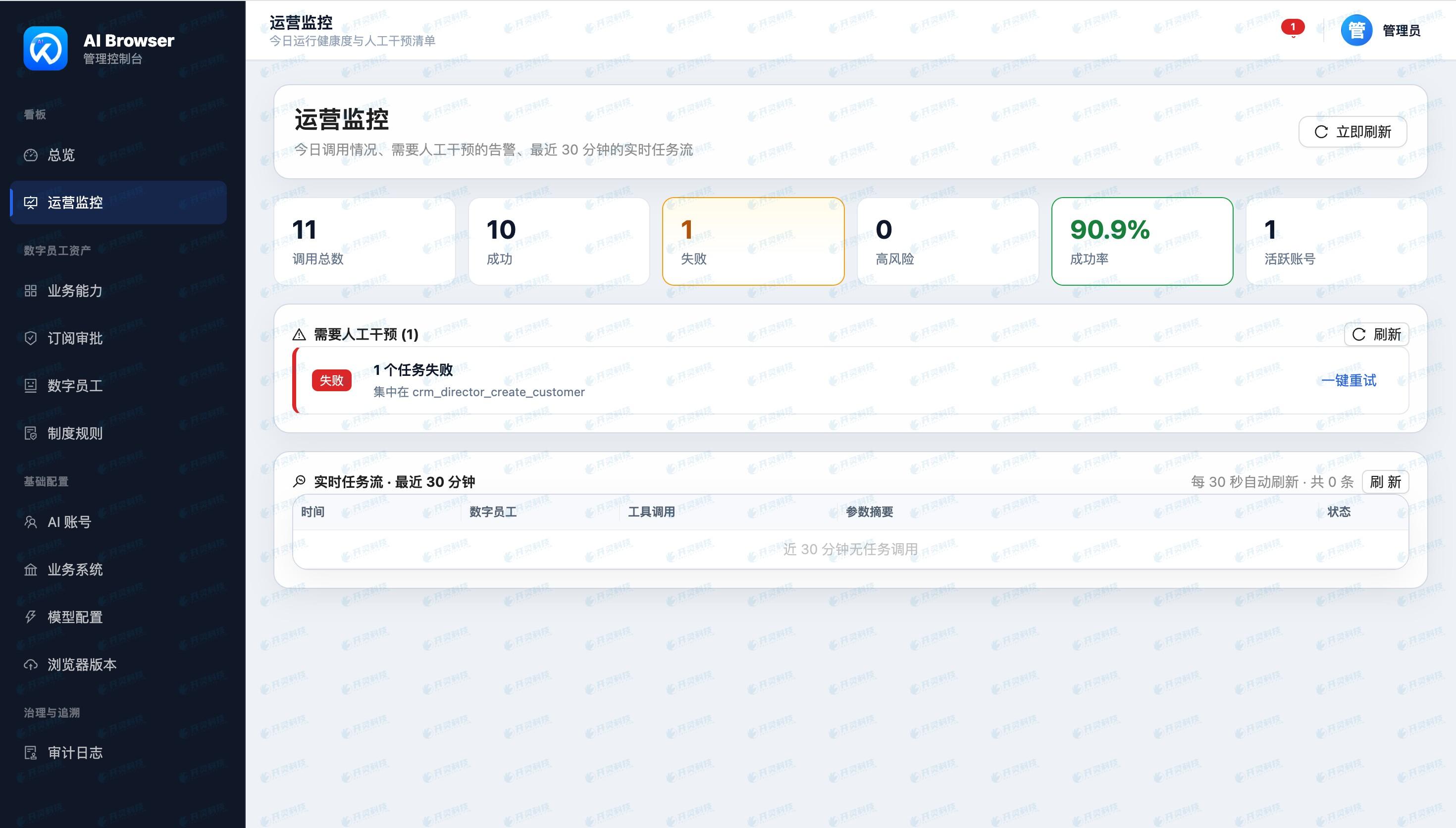
Managing a position means managing its entire career cycle; the same applies to managing digital employees. Kailing breaks it into a four-step closed loop: first, business system registration, connecting existing OA/ERP/financial systems uniformly to the platform; second, AI account creation, with administrators uniformly opening accounts to eliminate unauthorized activation; third, permission association, binding the systems and operation boundaries this AI account can access; fourth, operations monitoring, using dashboards to monitor health, task success rates, exception alerts, and business value in real time. Each step has a clear responsible person and records, and AI remains within managers' sight from "onboarding" to "taking the job."
▍Locking risk in a cage: isolation, review, audit, and control
Governance is not about slogans; it must be implemented through concrete mechanisms.Organizational isolation In addition, Kailing builds tenants by multi-level organization such as group/subsidiary/department/account, with strict data isolation and permissions inherited level by level — however much permission an employee has in the business system, the AI digital employee executes only within that boundary and never exceeds authority.Skill review In addition, any new skill launch must go through security scanning, administrator review, sandbox trial operation, and then gray release; if problems occur, one-click version rollback is available.Log audit In addition, every model call and tool execution is encrypted into a chain and can be searched by employee, task, and system dimensions, so who did what and when can be traced to the end.Token Control In addition, usage limits can be set by tenant/department/account/single AI digital employee, with automatic alerts and circuit breaking when exceeded, so costs no longer spiral out of control. There is also a domain whitelist that restricts external addresses accessible to AI digital employees, blocking data exfiltration and intranet scanning at the source. High-risk actions also have four-eyes approval and 5-minute exception rollback, with real people always retaining final responsibility. By stacking these mechanisms, what AI can do, cannot do, and has done all have clear boundaries and records, and risk is naturally locked in a cage.
▍Four-step delivery: AI starts work on day one, manageable and controllable
At the implementation level, Kailing uses a standardized delivery rhythm to reduce management costs: official activation, with permissions and run cycles configured (scheduled/event/manual); go-live monitoring, with dashboards continuously tracking health; feedback collection, with 48-hour response for fine-tuning within one week of trial use; experience consolidation, forming a "Role × Employee User Manual" that similar roles can inherit with one click. Customers only need to provide account permissions and policy documents; everything else is turnkey. In this way, AI is no longer a tool bought and then left alone, but a digital employee with someone responsible, evidence to check, and continuous optimization—what Kailing Technology's AI digital employee aims for is exactly to have every AI managed as a formal position.
▍FAQ
Q: We have already deployed several AI systems; can they still be brought under unified management?
A: Yes. Kailing uses non-intrusive access to encapsulate existing system interfaces, forms, and processes into AI-callable tools with low code. Without modifying the original systems, it can uniformly manage dispersed AI capabilities and protect the enterprise's existing IT investment.
Q: Will AI digital employees access data beyond their authority?
A: No. Permissions follow the organization and are inherited level by level; whatever business permissions an employee has, the digital employee executes within the same boundaries; sensitive fields are masked and encrypted, and high-risk actions require secondary human approval.
Q: When problems arise, how is accountability assigned and how are losses stopped?
A: Every call and tool execution is encrypted and traced, searchable by employee/task/system; real people retain final responsibility, and exceptions can be rolled back within 5 minutes and transferred to manual takeover, so both responsibility and handling can be assigned to a person.
Q: Will too many calls cause costs to spiral out of control?
A: No. The platform supports setting Token limits by tenant/department/account/individual digital employee, with automatic alerts and circuit breaking upon exceeding limits, keeping usage and costs always under management control.
Want AI in your enterprise to go from "no one manages it" to "manageable"? Welcome to visit the Kailing Technology official website and book a demo of the Kailing Technology AI digital employee governance solution: www.kailingteck.com 。
As a comprehensive business-finance-tax digitalization solution service provider, Kailing Technology provides business-finance-tax management digital transformation products and operational services for various government agencies, institutions, and large, medium, and small enterprises. The product line includes:
Solutions for businesses including sales contract management system, procurement contract management system, fully digitalized Leqi interface project, output automatic invoicing system, reverse invoicing system, invoice issuance for individuals system, employee expense control and reimbursement system, input VAT invoice management system, supply chain collaborative reconciliation system, image OCR recognition system, automatic financial bookkeeping system, and electronic accounting archives system, comprehensively driving the digitalization process across various fields.
If you have any business-finance-tax digital transformation needs, welcome to contact us. Beijing Kailing Technology will serve you wholeheartedly.
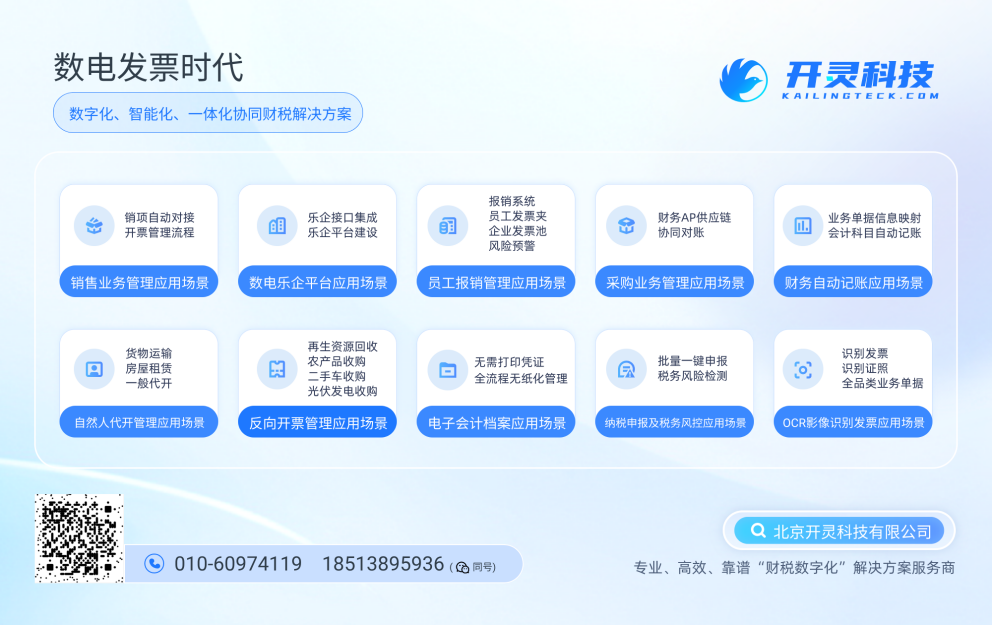
As a comprehensive business-finance-tax digitalization solution service provider, Kailing Technology provides business-finance-tax management digital transformation products and operational services for various government agencies, institutions, and large, medium, and small enterprises. The product line includes: solutions for sales contract management system, procurement contract management system, fully digitalized Leqi interface project, automatic output invoicing system, reverse invoicing system, invoice issuance for individuals system, employee expense control and reimbursement system, input VAT invoice management system, supply chain collaborative reconciliation system, image AI OCR recognition system, automatic financial bookkeeping system, electronic accounting archives system, etc., comprehensively driving the digitalization process across various fields.
Consultation Hotline: 18513895936 / 010-60974119 Location: Beijing