
AI applications in central and state-owned enterprises are stuck at the Q&A stage and slow to produce business value? Kailing Technology's AI digital employees let large models truly run complete business processes for people
AI applications in central and state-owned enterprises are stuck at the Q&A stage and slow to produce business value? Kailing Technology's AI digital employees let large models truly run complete business processes for people
Many central and state-owned enterprises have already built large model platforms and launched agent repositories, but employees still use them in daily work as "ask one question, get one answer"—they cannot produce reports, cannot complete processes, and cannot cross systems. AI applications remain at the "chat tool" stage and produce no business value for a long time. What Kailing Technology's AI digital employee aims to solve is exactly this leap: connecting the already-built large model foundation, the enterprise's internal agents, and business systems, so that AI is not just "able to talk," but like a real colleague can drive progress across systems autonomously, finish a day's work, and produce complete deliverables. It has already been deployed at large scale in central state-owned enterprises, proving a mature path of "business processes unchanged / systems not switched / processes unbroken."
▍1. The large model foundation is built, but AI is still just a "chat tool"?
Over the past two years, central state-owned enterprises have invested considerably in AI infrastructure: private deployment of large models has been completed, MaaS platforms and agent repositories have been built, and scenario requirements keep emerging. But back on the business front line, the actual use of AI is often awkward:
- Implementation form stops at Q&A: Employees treat AI as "a slightly smarter search box," asking one question and getting one answer, unable to produce finished reports or complete processes.
- Agents operating in silos: One for compliance Q&A, one for invoice recognition, one for translation summaries—each is usable, but they cannot be assembled into a complete job role.
- Cross-system still relies on people: Financial reconciliation requires logging into SAP + BPC + bank online banking, and invoicing requires logging into 4 systems. AI cannot help, and employees still have to manually transfer data.
- Value difficult to quantify: Money was invested, meetings were held, and reports were written, but how many people and work hours were saved cannot be explained clearly, making it hard to account upward.
Fundamentally, AI platforms are already ready, business systems are also complete, and demand is urgent—but what is missing is the "AI entry layer" that connects these three. Enabling AI to leap from "point to surface" to "complete position" is the most real next step for AI applications in central state-owned enterprises today.
▍II. What is the Kailing AI digital employee? From 1.0 agent to 2.0 digital employee
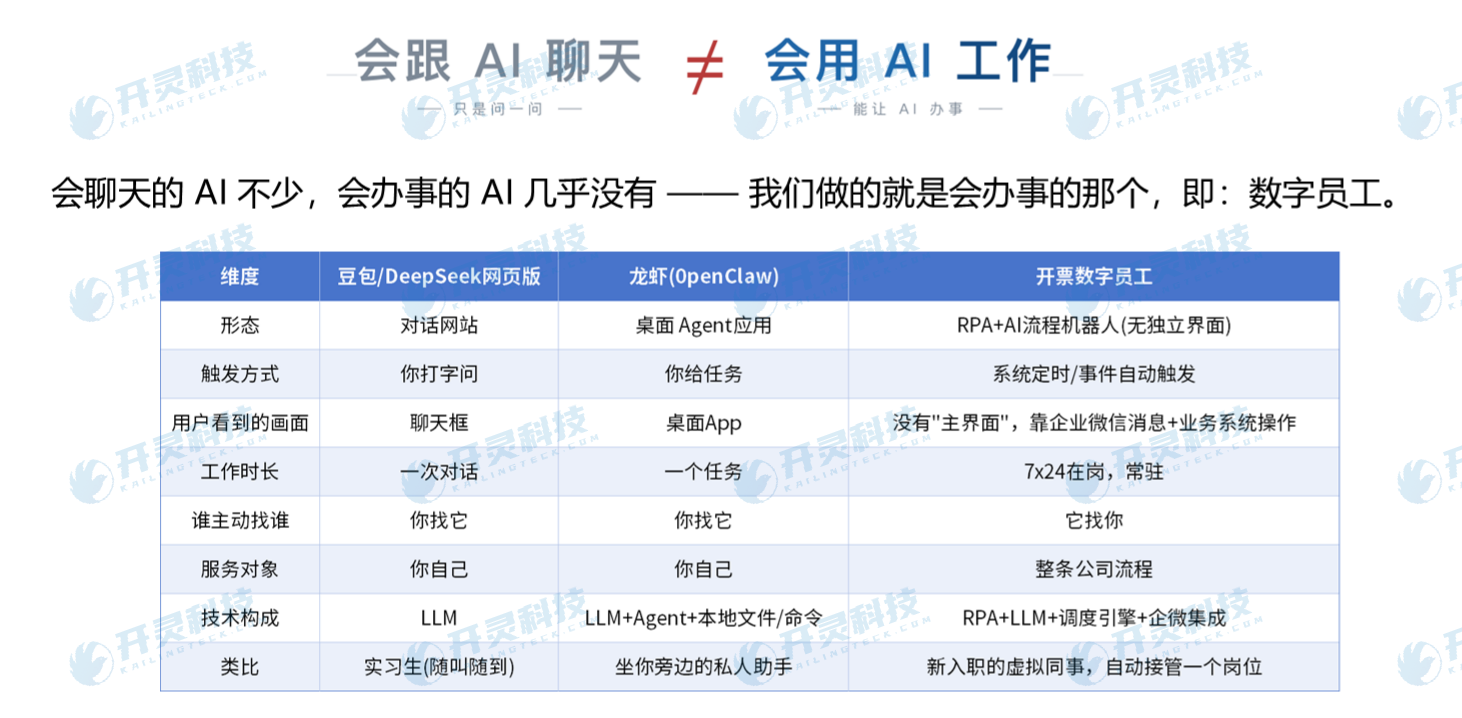
Kailing Technology's definition of a digital employee is very direct: there are many AIs that can chat, but almost no AI that can get things done - what we build is the one that can get things done, namely: a digital employee.
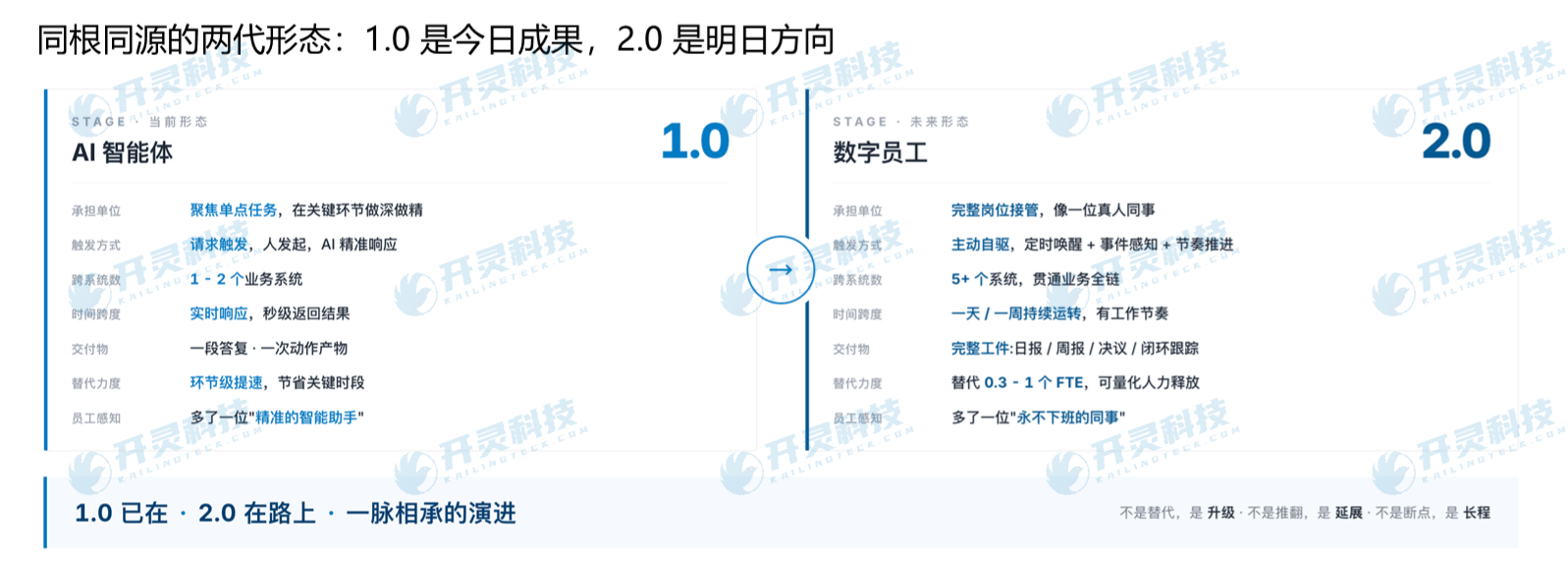
In Kailing's generational path, AI agents and digital employees are "two generations of forms with the same root and origin":
- 1.0 stage · AI agent: Solve single-point problems, such as contract risk clause identification, invoice OCR extraction, policy Q&A, etc., verifying AI's value in key links—most enterprises that have deployed large models have already done this step.
- 2.0 Stage · AI digital employee: Based on a proven capability foundation, it extends toward a "complete job role," enabling each AI digital employee to complete a full day's work like a real colleague—spanning multiple systems, driving progress autonomously, and producing complete deliverables.
In other words, 1.0 is a "capability point," while 2.0 is a "role surface." The large model platforms and agents that enterprises have already built are reused as the capability foundation in the 2.0 stage—not starting over, but running roles through on top of them.
▍III. Applicable scenarios for digital employees: high-frequency / repetitive / cross-system / requiring judgment
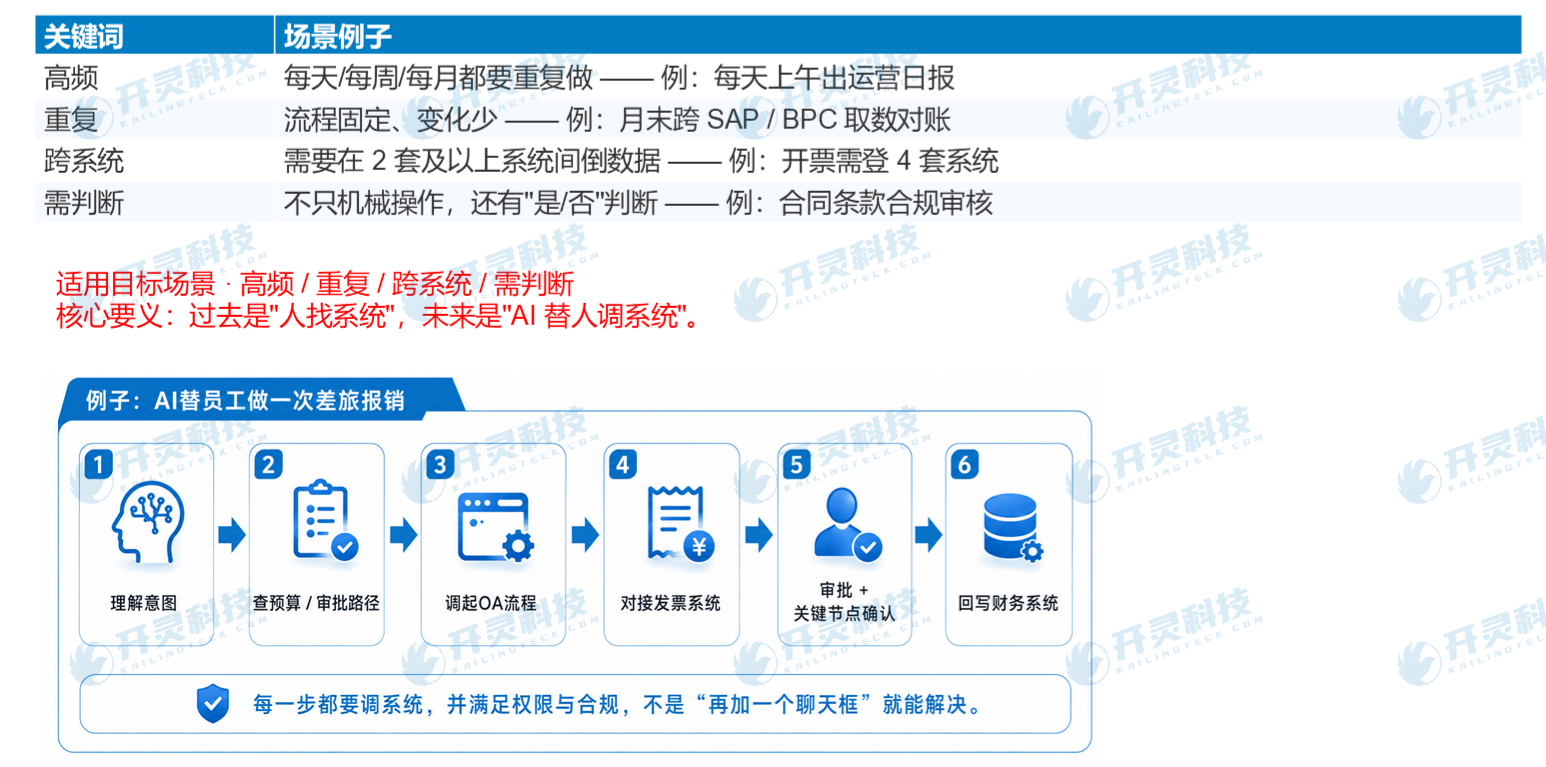
Not all work is worth handing over to AI digital employees. Kailing's four judgment criteria can help enterprises quickly identify the positions that "should be done first":
- High frequency: Must be repeated daily/weekly/monthly—for example: produce the operations daily report every morning.
- Duplicate: Fixed process, few changes—e.g., month-end cross-SAP/BPC data extraction and reconciliation.
- Cross-system: Need to transfer data between 2 or more systems—for example: invoicing requires logging into 4 systems.
- It is necessary to determine: Not just mechanical operations, but also "yes/no" judgments—e.g., contract clause compliance review.
The core essence is one sentence: in the past it was "people finding systems"; in the future it is "AI adjusting systems for people." The more a position matches among the four criteria, the more it is a golden landing point for AI digital employees.
▍IV. Five types of digital employee capability matrix, covering almost all enterprise positions
From an implementation perspective, Kailing divides AI digital employees into five major categories. Any specific AI digital employee must fall into one of them—a combination of five categories of capabilities that can cover all scenarios for all enterprise employees:
- ① General category: Daily Q&A / knowledge queries / meeting booking. Example: policy inquiry AI digital employee; an employee asks "What is the travel reimbursement limit?" and the AI automatically finds the answer from the policy library.
- ② Review category: Contract comparison / reimbursement verification / compliance review. Example: contract risk review employee; after uploading a contract, AI automatically compares it with templates and the regulation library, highlights risks in red, 40 minutes → 5 minutes.
- ③ Monitoring category: Equipment status alarms / environmental indicator monitoring. Example: a "fan operation monitoring employee" watches equipment 24×7, and anomalies automatically trigger SMS/phone calls to the duty officer.
- ④ Report category: Automatic data retrieval / daily and weekly report generation. Example: the production daily report employee automatically generates reports before 9:00 every day, and managers receive them directly in DingTalk/WeCom/Feishu.
- ⑤ Data link category: Cross-system data synchronization / master data validation. Example: ERP-finance bridge employee, automatically synchronizes to finance/procurement/contract after ERP master data changes.
The five categories are not independent, but "capability Lego"—a complex position often uses multiple categories at the same time. For example, a "monthly business analysis AI digital employee" needs to retrieve data across BPC / contract systems (data linkage category), automatically calculate indicators and produce reports (report category), and also provide warning suggestions based on thresholds (review category).
▍V. Make AI a unified business entry point, not yet another new system
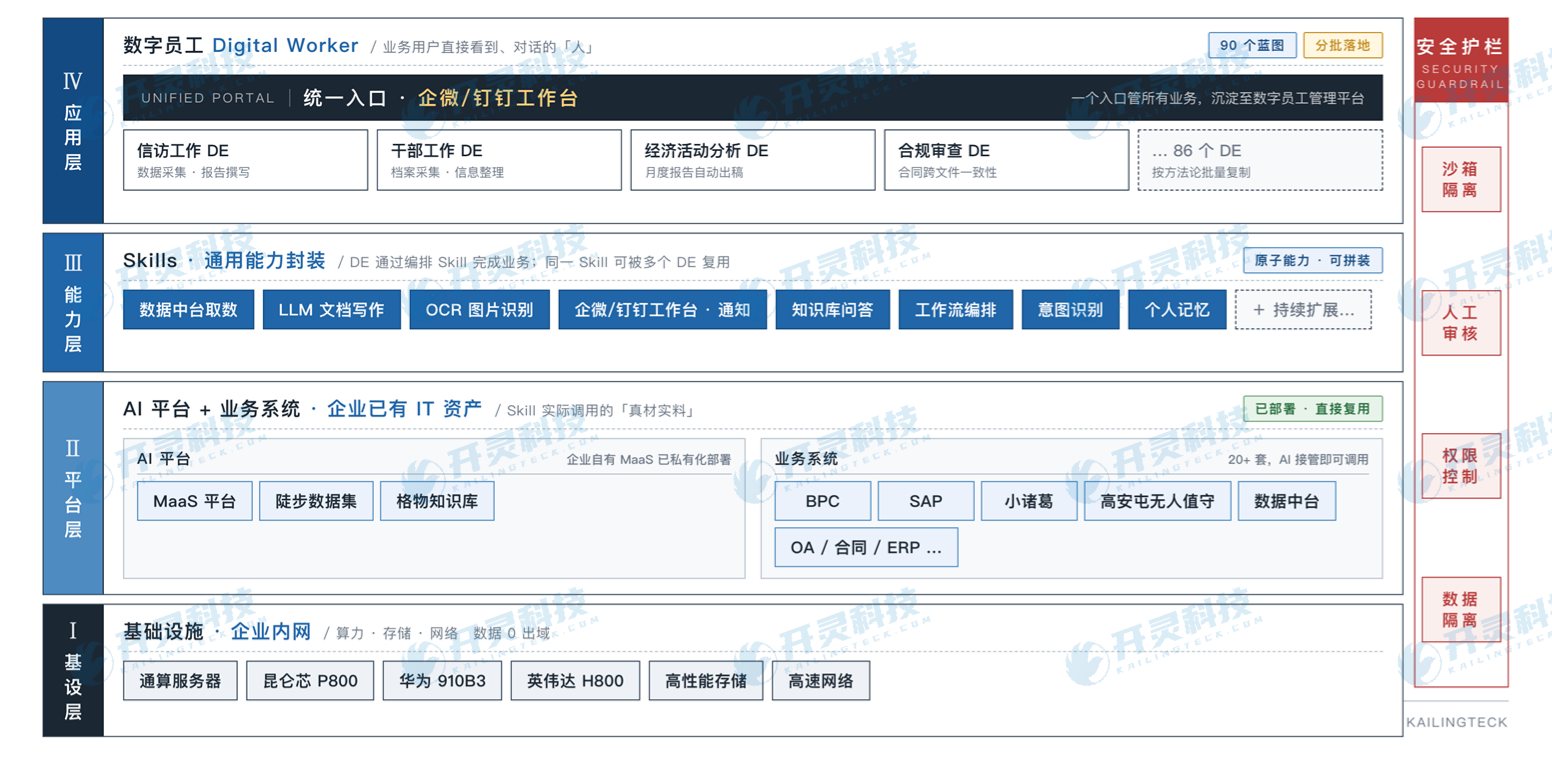
Kailing digital employees have only one architectural goal: to reconstruct how enterprises interact, making AI a unified business entry point. Employees no longer "open SAP to check, then go back to OA for approval," but instead assign cross-system work with one sentence or one subscription in the enterprise's unified AI workbench.
The overall architecture behind this does several things:
- Reuse the enterprise's existing large model foundation: Do not duplicate investment models; directly call the enterprise's MaaS / agent repository to maximize the use of already-built AI assets.
- Connect to various enterprise business systems: SAP / BPC / OA / finance / contracts / procurement / online banking—AI digital employees connect directly via API or RPA channels and run processes across systems.
- Human-in-the-Loop · Mandatory review at key nodes: For high-risk actions such as approval, disbursement, and external sending, mark "human-in-the-loop" nodes to be confirmed by a real person—digital employees assist and do not replace human decision-making.
- Localized deployment · Data stays within domain: Private deployment, sensitive data and business data do not leave the enterprise intranet, meeting the data security and compliance requirements of central state-owned enterprises.
▍VI. A four-stage implementation methodology that turns the "AI platform" into "business value"
Having an architecture is not enough; implementation depends more on a mature methodology. Kailing breaks an AI digital employee from 0 to onboarding into four stages:
Phase 1 · Business scenario communication
Business experts state the scenario, our side sorts out and breaks it down, and outputs the four-piece Scenario Definition Document set: scenario description (business background / goals / current time consumption), process breakdown (input / processing / output / exceptions), system list (which systems / accounts / permissions are involved), acceptance criteria (quantified indicators / exception rate / fallback person). The business department signs to confirm, avoiding "not acknowledging after completion."
Phase 2 · Development execution
Four things advance in parallel: let AI understand the business process (business staff screen recording + large model parsing each step); let AI know whom to ask (connect to the enterprise's existing large models and agents, reusing AI assets); let AI know where to stop (mark "human-in-the-loop" nodes); let AI test itself (run 100 times in a sandbox, go live only at a 99% pass rate, with the error rate written into the SLA).
Phase 3 · Application listing
Strictly follow the group's integrated five-node process: script submission → group review → functional assessment → security assessment → listing monitoring. After listing, it automatically enters the enterprise app store / personalized workbench; business employees can subscribe and use it immediately, permissions are automatically bound, and the backend monitors operational health with real-time alerts for anomalies.
Phase 4 · Operations monitoring
Designate users, configure permissions, set run cycles (scheduled / event / manual); the monitoring dashboard presents health, task success rate, abnormal alerts and business value indicators in real time; collect business employee feedback within 1 week of trial and respond with fine-tuning and launch within 48 hours; consolidate the "Position × Employee User Manual" for one-click inheritance by similar positions later. Delivery is not just "go-live," but "go-live + operate"—this employee is an enterprise asset.
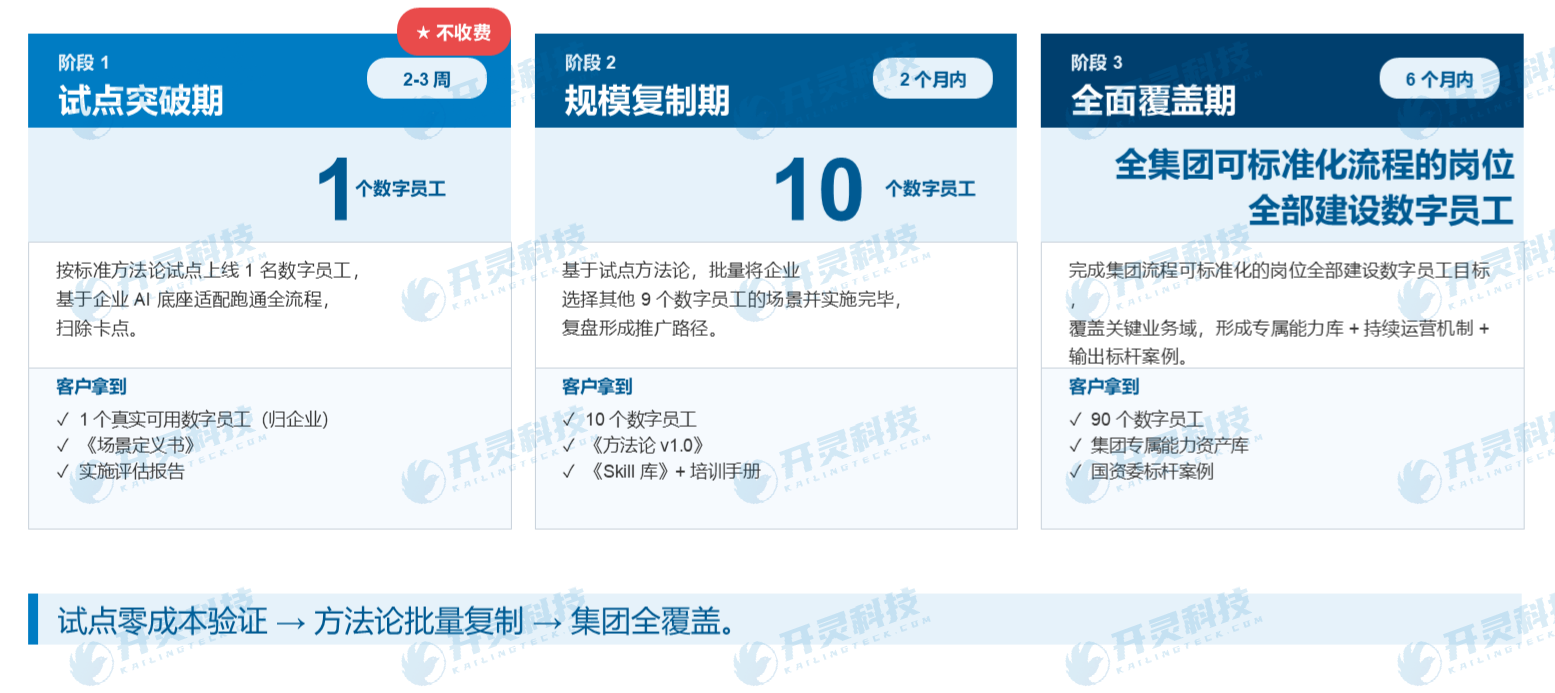
▍7. 9 months, 90 employees, zero-cost pilot validation before scaling replication
Facing central and state-owned enterprises' concern of "wanting to do it but not daring to roll it out all at once," Kailing provides a three-phase construction path:
- Phase 1 · Pilot breakthrough period (2-3 weeks):★ No charge. Following the standard methodology, pilot the launch of 1 digital employee, adapt and run through the entire process based on the enterprise AI foundation, and remove bottlenecks. Deliverables: 1 genuinely usable digital employee (owned by the enterprise) + Scenario Definition Document + Implementation Assessment Report.
- Phase 2 · Scale replication period (within 2 months): Complete the implementation of 9 AI digital employee scenarios in batches, reaching a cumulative total of 10 AI digital employees, and form a promotion path through review. Deliverables: 10 AI digital employees + Methodology v1.0 + Skill Library + training manual.
- Phase 3 · Full coverage period (within 6 months): Complete the goal of building digital employees for all positions in group processes that can be standardized, covering key business domains, forming a dedicated capability library + continuous operation mechanism + benchmark case output. Deliverables: 90 digital employees + group-exclusive capability asset library + SASAC benchmark case.
Zero-cost pilot validation → methodology-based batch replication → full group coverage. This is a steady approach tailored for central and state-owned enterprises: first get one running, then replicate ten, then cover the entire group.
AI applications in central and state-owned enterprises are stuck at the Q&A stage and slow to produce business value? Welcome to Kailing Technology to learn about AI digital employee construction solutions: www.kailingteck.com.
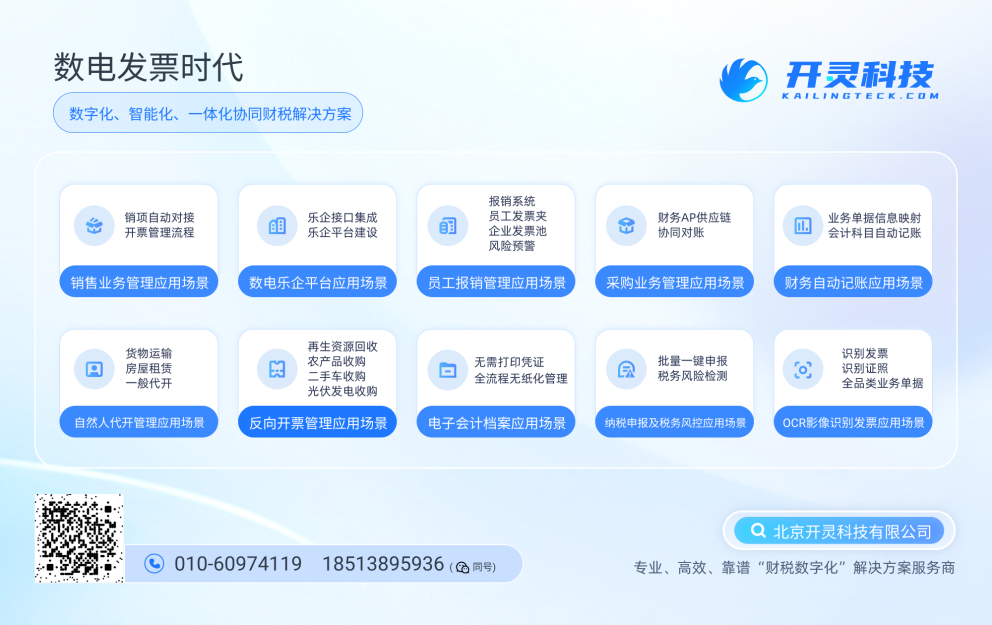
As a comprehensive business-finance-tax digitalization solution service provider, Kailing Technology provides business-finance-tax management digital transformation products and operational services for various government agencies, institutions, and large, medium, and small enterprises. The product line includes:
Solutions for businesses including sales contract management system, procurement contract management system, fully digitalized Leqi interface project, output automatic invoicing system, reverse invoicing system, invoice issuance for individuals system, employee expense control and reimbursement system, input VAT invoice management system, supply chain collaborative reconciliation system, image OCR recognition system, automatic financial bookkeeping system, and electronic accounting archives system, comprehensively driving the digitalization process across various fields.
If you have any business-finance-tax digital transformation needs, welcome to contact us. Beijing Kailing Technology will serve you wholeheartedly.
Keywords: AI digital employee, central state-owned enterprise AI applications, large model implementation, enterprise intelligent agents, AI entry layer, digital employee methodology, cross-system automation, Kailing Technology
As a comprehensive business-finance-tax digitalization solution service provider, Kailing Technology provides business-finance-tax management digital transformation products and operational services for various government agencies, institutions, and large, medium, and small enterprises. The product line includes: solutions for sales contract management system, procurement contract management system, fully digitalized Leqi interface project, automatic output invoicing system, reverse invoicing system, invoice issuance for individuals system, employee expense control and reimbursement system, input VAT invoice management system, supply chain collaborative reconciliation system, image AI OCR recognition system, automatic financial bookkeeping system, electronic accounting archives system, etc., comprehensively driving the digitalization process across various fields.
Consultation Hotline: 18513895936 / 010-60974119 Location: Beijing