
A truck of bamboo material comes from multiple bamboo farmers; how are purchase invoices issued per household? Kailing Technology's agricultural product purchase reverse invoicing system creates orders per household and collects five-flow compliance evidence
Bamboo is loaded centrally at the mountain site, and one vehicle often carries goods from multiple bamboo farmers. At the plant, looking only at the full-vehicle weight and driver information makes it impossible to determine each household's quantity, settlement amount and invoice. The Kailing Technology agricultural product purchase reverse invoicing system first creates orders by household, then connects full-vehicle transport using loading and arrival materials.

▍First confirm the bamboo farmers and the fact of self-production
Purchasers create files household by household at the mountain site, verifying bamboo farmers' identity, self-produced materials and willingness to sell. Cutting, measuring or counting by piece can be recorded on household-level purchase orders, with photos and tally sheets indicating the farmer, batch and collection time. Drivers are responsible for transport and do not automatically become sellers or payees merely because they deliver on behalf of others.
If bamboo and logs use different measurement methods, the purchase order should clearly state the unit and conversion basis. When bamboo is priced by piece, ton, or agreed specification, on-site records must support final settlement; each household on the same vehicle still has independent quantity and price.
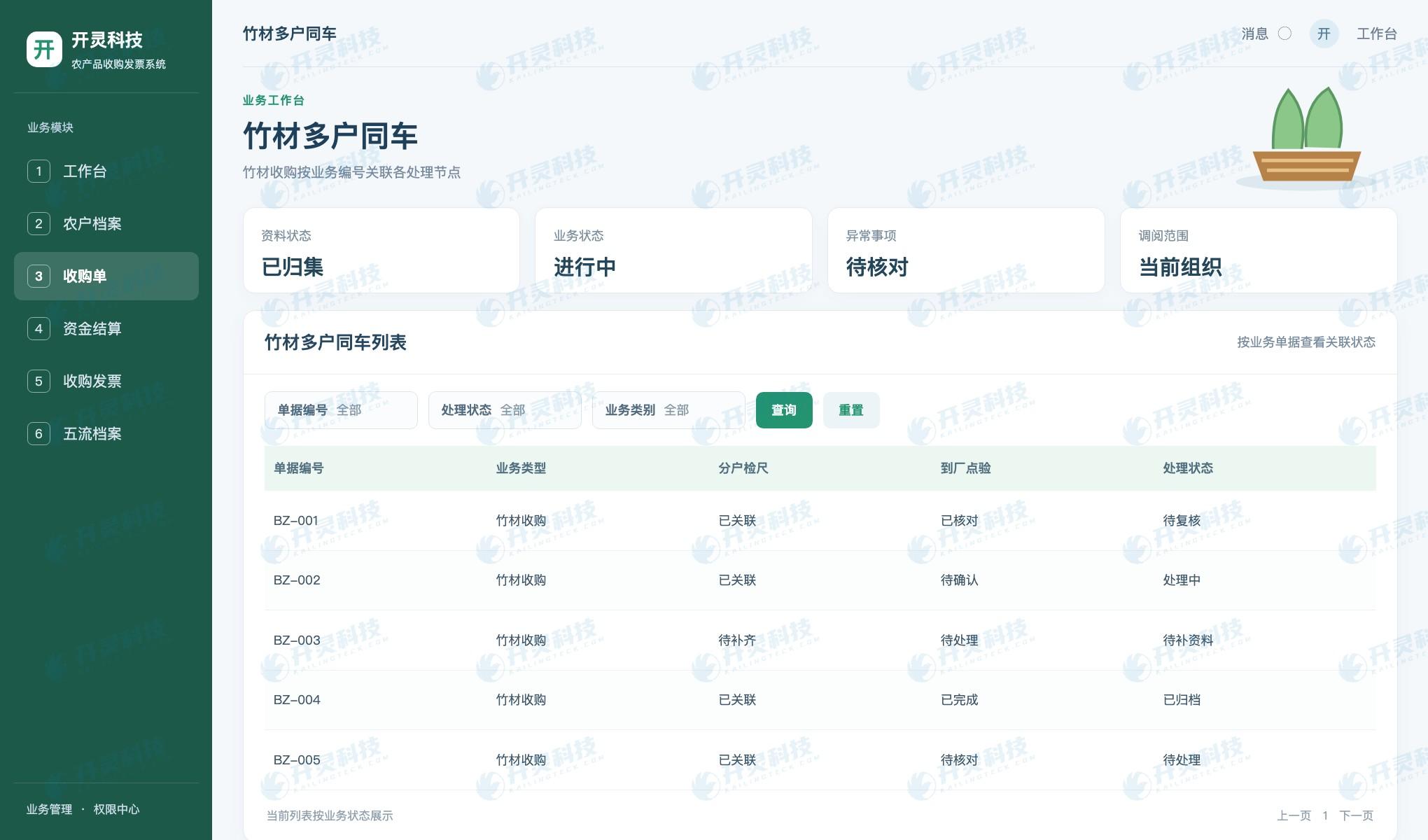
Bamboo household-based purchase business list
▍Loading list combines multiple households into one truck
A unified loading sheet records the vehicle, driver, departure time, and each household's purchase order and loaded quantity. After weighing or inspection at the plant, actual warehousing results are confirmed by household. When the total vehicle quantity differs from the sum by household, losses, misloading, or on-site re-verification should be registered; the difference must not be evenly allocated to all bamboo farmers.
Once bamboo is mixed, it is difficult to identify households by appearance again, so batch labels and photos before loading are especially critical. The system associates household-level purchase orders with vehicle-level transport orders, enabling finance to see both the destination of the full vehicle and trace back the goods facts corresponding to each bamboo farmer.
▍Each household independently confirms the settlement amount
The invoiced amount is formed based on each household's actual accepted quantity, applicable grade and agreed unit price. If some bamboo specifications are found to be non-compliant upon arrival at the plant, the discrepancy should be fed back to the corresponding farmer and a confirmation record kept; for transactions already paid according to the quantity confirmed at the mountain site, the difference must also be handled according to the agreement between both parties, and the original invoice must not be altered without authorization.
Payment operations for one truck of bamboo can be arranged in combination, but the fund details must be split by household, and the receiving account must be verified against the actual bamboo farmer. After successful payment, the receipt returns to each household's document, avoiding the situation where the whole truck is paid but a certain household has not actually received the funds.
▍Agricultural product purchase invoices are attributed per household
Before an enterprise issues a purchase invoice, it should check each household's self-production status, purchase scope, goods, and amount. Invoices point to the corresponding farmer and purchase order respectively; the five-flow archive stores the relationships among identity, confirmation, goods, funds, and documents. Whole-truck transport vouchers can be referenced jointly by multiple households' documents, but cannot replace household-level confirmation.
From an invoice entering the Kailing Technology system, you can see that household's bamboo quantity, loading sheet, factory arrival inspection, and payment result; from a vehicle entry, you can expand all bamboo farmers associated with that vehicle. The statistical basis of both entry points should be consistent.
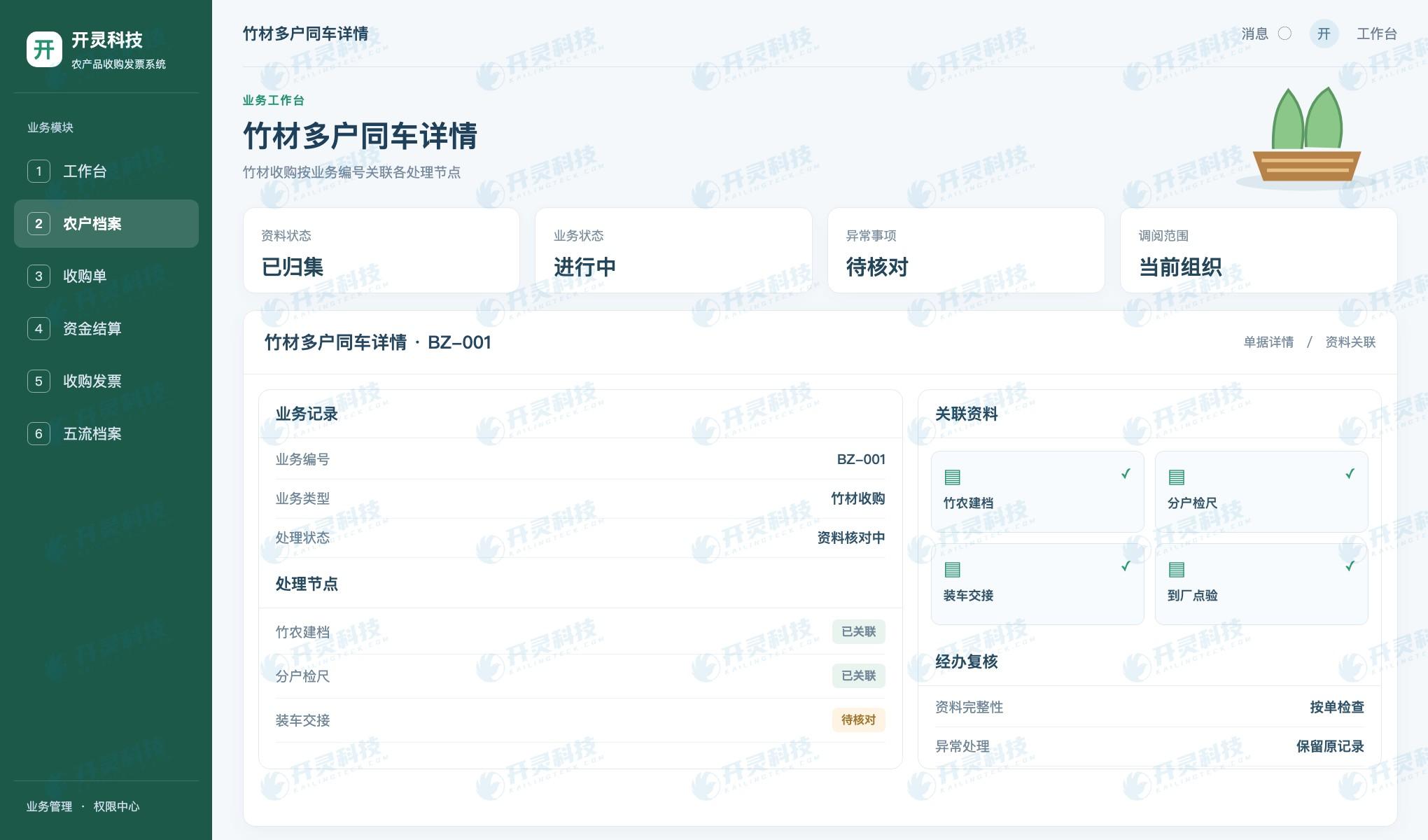
Bamboo household-based purchase document and material association
▍Reconciliation first compares three layers of quantities
Household-level measurement at the mountain site, household subtotals on the loading list, and whole-truck or household-level acceptance at the factory are three different layers of quantity. Finance and procurement should separately verify whether differences have a genuine basis. If the loading sheet is missing one household, that household's invoice cannot be left standing alone; if more goods arrive at the factory, they cannot be directly split evenly among confirmed farmers.
You can first test with samples of two households in the same truck, one bundle short at the factory, and one household changing its receiving account. Household-level tracking reduces disputes and gives each invoice's quantity and payment a clear seller.
▍For multiple households in one truck, first fix the per-household facts
When receiving goods at the mountain site, set an independent document number and goods identifier for each household, and the whole-truck loading sheet lists each household's quantity. If bamboo is settled by piece, bundle, or weight, the purchaser should write the unit on the document; quantities in different units cannot be directly added into one whole-truck piece count.
When bamboo is re-inspected upon arrival at the plant, the warehouse records the actual batch received for each household. If labels fall off, first review through loading photos, tally sheets and driver handover; do not allocate to bamboo farmers based on rough proportions.
Purchase invoices correspond to real bamboo farmers. Full-vehicle transport is only a logistics arrangement and does not change the transaction subject or settlement amount of each household.
▍How to reconcile loading and factory-arrival differences
When the loading list total does not match the total received at the plant, first check measurement units, in-transit losses, loading/unloading mismatches, and returns. Differences belonging to a specific household should be recorded on that household's order; differences that cannot be immediately attributed should remain pending, and all farmers' invoice amounts should not be adjusted directly.
If the bamboo farmer has confirmed the quantity at the mountain site and payment is complete, handling of plant-arrival discrepancies must still be based on the contract and actual responsibility of both parties. Kailing Technology's system records the two stages of facts side by side, helping enterprises distinguish original purchase settlement from subsequent warehousing losses.
During financial reconciliation, check five-flow materials by household on one hand, and check whether all household orders are complete by vehicle on the other. The two dimensions corroborate each other.
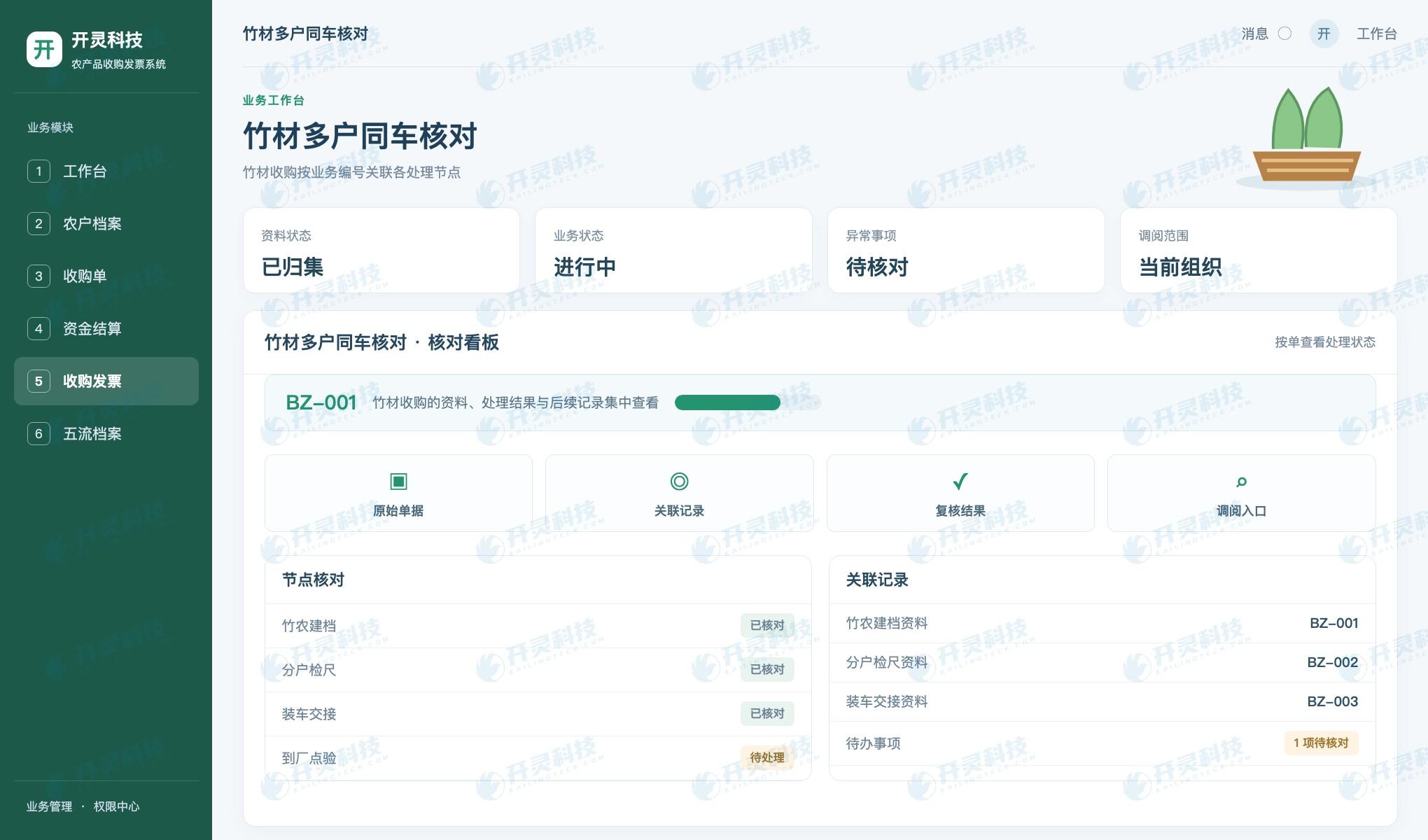
Bamboo household-based purchase node verification
▍Trace back each document using the purchase order
From a bamboo farmer's invoice, you should be able to open the corresponding purchase order, self-produced materials, measurement or piece count, loading sheet, factory acceptance, and bank receipt. Vehicle materials shared by multiple households can reference the same file, but each household's goods quantity and payment remain separate.
If the same bamboo farmer delivers a second truckload the same day, the system should retain a second purchase order, avoiding cross-vehicle mismatches between loading sheets and invoices. Household records summarize identity and historical transactions; order records preserve each delivery.
During implementation, you can test with a sample of one truck, three households, with one household short on goods. Finance can explain the amounts of the three purchase invoices without looking at offline Excel, showing that household-level document creation is truly implemented.
▍On-site material checklist for the bamboo business
Each household should retain identity and self-production materials, measurement or counting results, goods photos, purchase confirmation and payment account. Each vehicle should retain the loading list, vehicle information, and departure and arrival handover. The two layers of materials jointly explain the real structure of one vehicle carrying multiple households.
If the tally sheet contains bamboo length, specifications or volume, the measurer and measurement unit should be noted. When corrections arise from sampling, record the data before and after correction; only the final total must not be left. When verifying invoice amounts, finance can recalculate from specifications and quantities to household-level settlement.
If goods from one household are found mixed into another household's labels at the factory, on-site inventory, photos, and the original loading sheet should first be used for review to form an adjustment opinion, which then affects the relevant purchase orders. Any even allocation requires a genuine business basis.
The Kailing Technology platform provides two-way views by household and by vehicle, facilitating procurement management of transport efficiency and enabling finance to verify invoices household by household. If the totals from the two perspectives are inconsistent, the anomaly list should point directly to the missing household or trip.
▍How to use bamboo batch identifiers
The mountain site can set labels or take numbered photos for each household's loading batch, and after factory arrival inspection confirm that the labels match the purchase orders. If labels are lost, review against the original tally sheets and loading materials.
If one household's bamboo is loaded in two trips, the household-level purchase order can expand into two transport details; if two households share one vehicle, the vehicle information can be referenced by both.
This many-to-many relationship is more complex than a single vehicle summary table, but it is exactly the key that household-by-household invoicing can explain.
During financial review, export household-level purchase orders, loading totals, and plant-arrival inspections separately for comparison. If one household's materials in a vehicle are still pending confirmation, only that household's settlement and invoice processing are paused, while other confirmed transactions can proceed. This sacrifices neither peak-season efficiency nor allocates pending differences to unrelated bamboo farmers.
▍FAQ
Q: Can a driver collect payment and issue invoices on behalf of multiple bamboo farmers?
A: It should be verified based on the actual seller and payment arrangement; the driver's identity cannot directly replace the bamboo farmer.
Q: Is a whole-truck weighbridge ticket enough for per-household invoicing?
A: Household-by-household loading, measurement and acceptance details are also needed to determine each household's settlement amount.
Q: What if there is a difference in quantity at the factory?
A: Record the attribution of differences and the confirmation process, then handle invoices and payments according to the transaction agreement.
Visit Kailing Technology to learn about related products and implementation plans: https://www.kailingteck.com/fxncp/ .
As a national high-tech enterprise, Kailing Technology focuses on the digital and intelligent transformation of enterprise business-finance-tax and operations management, providing software products, system integration, implementation and delivery, and operational services for various government agencies, institutions, group enterprises, and SMEs.
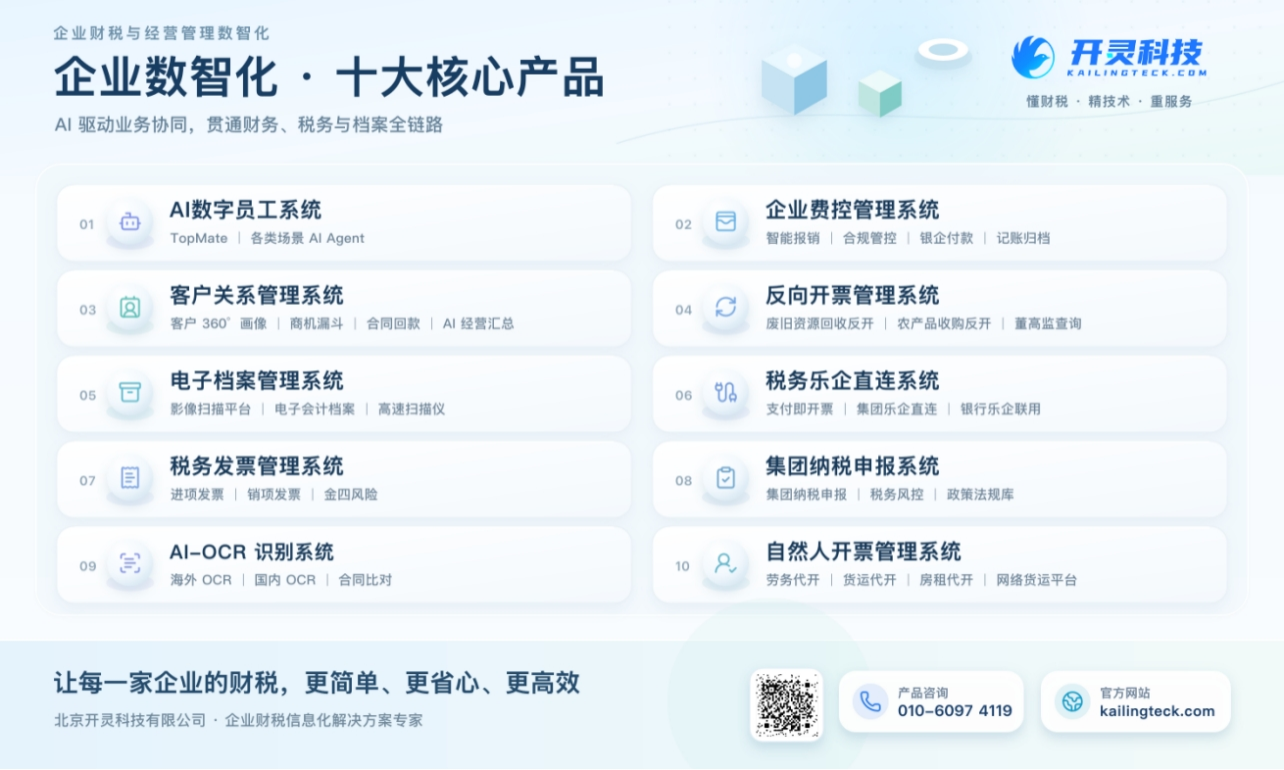
The company has now formed ten core product lines, including: AI digital employee system, enterprise expense control management system, customer relationship management system, reverse invoicing management system, invoice issuance for individuals management system, electronic archives management system, tax fully digitalized e-invoice Leqi system, tax invoice management system, group tax filing system, and AI OCR recognition system. It is committed to connecting enterprise business, finance, tax, funds, and archive data to help customers improve operational efficiency, business-finance-tax compliance capabilities, and digital management levels.
If you have any business-finance-tax digital transformation needs, welcome to contact us. Beijing Kailing Technology will serve you wholeheartedly.
Keywords: Bamboo purchase invoices, multiple households in one vehicle, bamboo farmer self-production, five-flow integration, Kailing Technology
As a comprehensive business-finance-tax digitalization solution service provider, Kailing Technology provides business-finance-tax management digital transformation products and operational services for various government agencies, institutions, and large, medium, and small enterprises. The product line includes: solutions for sales contract management system, procurement contract management system, fully digitalized Leqi interface project, automatic output invoicing system, reverse invoicing system, invoice issuance for individuals system, employee expense control and reimbursement system, input VAT invoice management system, supply chain collaborative reconciliation system, image AI OCR recognition system, automatic financial bookkeeping system, electronic accounting archives system, etc., comprehensively driving the digitalization process across various fields.
Consultation Hotline: 18513895936 / 010-60974119 Location: Beijing