
Afraid AI use puts data outside the domain and afraid to modify legacy systems? Kailing Technology AI digital employee private deployment keeps data in-domain with zero-modification access
First put the two most practical concerns on the table: one is "if AI takes company data to run, will it leave the domain, will it leak secrets," and the other is "does adopting AI mean tearing down and heavily modifying an old system used for more than ten years, causing major disruption." Almost every enterprise that wants to adopt AI gets stuck on these two points first. The answer given by Kailing Technology AI digital employee is very direct: data does not leave the domain, and systems do not need to be modified. Large models and data all run on the enterprise intranet, and not a single line of code in legacy systems needs to be changed. AI is connected in a "non-invasive" way to handle work for you. This article breaks down these two major concerns one by one and explains clearly how Kailing Technology AI digital employee achieves "using AI without paying the price for it."
▍I. Two major concerns, ultimately the same kind of worry
Why do enterprises first get stuck on these two points when adopting AI? Because behind them is actually the same concern—fear of losing control. Worrying about data leaving the domain means fearing that the company's most core assets will flow from the intranet to places that cannot be seen; worrying about transforming old systems means fearing that a business that has finally been running stably will be torn down and rebuilt, which is slow, expensive, and prone to chaos. In other words, enterprises do not not want to use AI; they just do not want to pay the two costs of "data loss of control" and "system rebuild" for using AI. Kailing's approach is to press both costs to zero: data does not leave the premises, systems are not cut open, and the remaining work is left to digital employees.
▍II. Concern one: will data "leave the domain"? — Private deployment, zero data egress
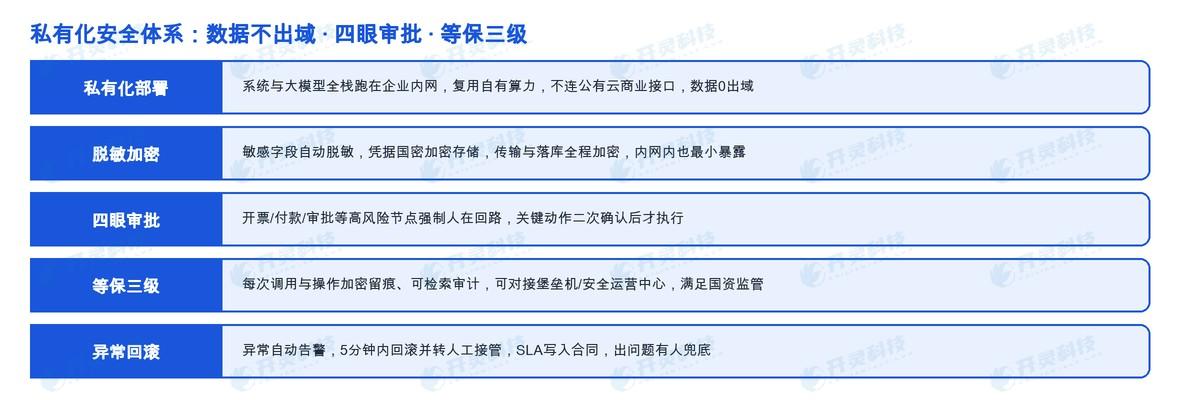
The first concern is the most direct: AI needs to read data and handle tasks — will it transmit company data to external clouds or third parties? Kailing's answer is no; data never leaves the domain throughout the process. This is not a slogan, but is backed layer by layer by five lines of defense:
Private deployment, model runs locally. The entire system, along with the full large model stack, is deployed on the enterprise's internal network, reusing the enterprise's own computing power without relying on networked public cloud commercial interfaces. Data never leaves the enterprise from start to finish.
Sensitive data masking, national cryptographic encryption. Sensitive fields are automatically masked, account credentials are stored with national cryptographic encryption, and transmission and database storage are encrypted throughout, achieving minimal exposure even on the intranet.
Four-eyes approval, human in the loop. High-risk actions such as invoicing, payment, and approval enforce "human-in-the-loop" with secondary confirmation at key nodes; AI only goes as far as "before you nod," and the final decision is made by humans.
Full-process traceability, Level 3 classified protection. Every call and every operation is encrypted, traceable, and searchable for audit, and can connect to bastion hosts and security operations centers, overall meeting Level 3 of the Multi-Level Protection Scheme and state-owned asset regulatory requirements.
Anomaly rolled back within 5 minutes. Once an anomaly is detected, it automatically alerts and rolls back within 5 minutes, transferring to manual takeover. The SLA is written into the contract, so when problems arise, someone is accountable and there is evidence to check.
Connecting these five lines of defense comes down to one sentence: AI can use the data, but the data always stays in the enterprise's own yard. Kailing Technology's AI digital employee does not "send data out to compute," but "invites AI in to compute"—computing power, models, and data are all on the intranet, and who comes in, what they touch, and how far they go is visible and traceable throughout.
▍III. Concern two: will it require a disruptive overhaul of legacy systems? — Non-invasive, zero-modification integration
The second major concern is equally real: does adopting AI mean overhauling the OA, ERP, and financial systems that have been running for over a decade? Many enterprises back off at the mere thought of touching the underlying systems, halting business, and re-testing. Kailing's approach is the exact opposite — not a single line of code in the old systems needs to be changed.
The key lies in "non-intrusive access": Instead of transforming existing systems, it encapsulates the interfaces, forms, processes, and pages of OA, ERP, finance, and other systems into "tools" that AI can understand and invoke using a low-code approach. The digital employee understands what you want to accomplish, then invokes these tools to operate the original systems on your behalf, without touching the underlying code or changing the database structure throughout the process.
Zero modification of the original system. Only "external encapsulation" is performed, without touching a single line of code in the old system; business runs as usual, the data structure remains unchanged, and the go-live process does not interrupt daily operations.
Protect more than a decade of IT investment. The money enterprises previously spent on OA/ERP/finance and the processes they accumulated are not wasted at all. AI is "added" on top of existing systems, rather than "replacing" them.
Reuse existing MaaS. If an enterprise has already deployed its own large model platform, it can directly reuse it without repeated procurement or repeated construction, so the money already spent will not be wasted.
From months compressed to weeks. It eliminates the heaviest and most uncontrollable engineering work of transforming legacy systems. An integration cycle originally measured in months can be compressed to weeks or even shorter.
In this way, “adopting AI” no longer equals “replacing systems.” The Kailing Technology AI digital employee is more like hiring a new colleague—it will use your existing systems to get things done, without requiring you to reinstall an office environment for it. The old systems remain the same old systems, except there is now an AI beside them that can operate them for you.

▍IV. See it in one table: two major concerns vs Kailing's solutions
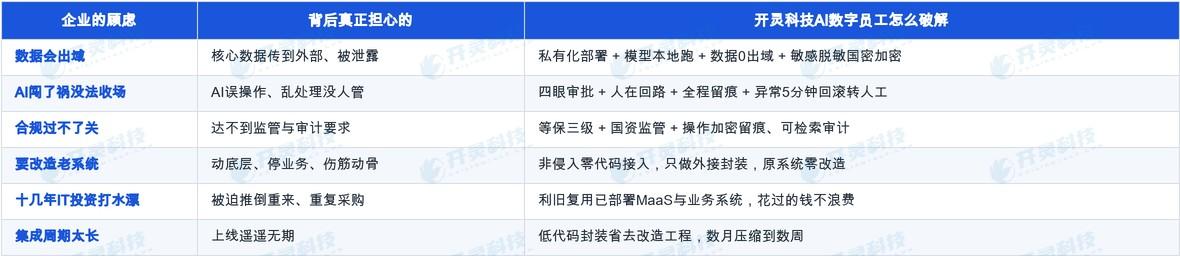
Condense the previous two sections into a comparison table; every item enterprises worry about most can find a corresponding solution in Kailing Technology's AI digital employees:
▍V. Why the "two don't move" can hold true at the same time
Some will ask further: if data does not leave the domain, how can AI read the data? If the system is not modified, how can AI operate the system? This seems contradictory, but in fact it is resolved together by the same design—Because AI does not "remotely call your data and systems," but is "invited into the intranet and stands beside your existing systems" to do work. Data is processed locally by models within the intranet, so it does not leave the domain; the system is invoked through tool encapsulation, so no modification is required. The two are not a trade-off, but two sides of the same design: privatization plus non-intrusiveness.
This also directly answers the most fundamental concern: does adopting AI really require "paying a price"? Kailing Technology's AI digital employee presses the price down to "two no-moves"—data does not leave the premises, and systems are not cut into. What enterprises really need to do is simply hand over account permissions and policy documents to the digital employee; the rest, let it finish steadily in your own yard, using your own systems.
▍FAQ
Q: For private deployment, do you need to buy additional tokens and another large model?
A: No need. Kailing uses privately deployed open-source large models running on the enterprise intranet, with no per-token external payment; if the enterprise has already deployed its own large model platform (MaaS), it can be directly reused without duplicate procurement or duplicate setup.
Q: Is it really true that not a single line of code in the old system needs to be changed?
A: Yes. Kailing uses non-intrusive access, only encapsulating the interfaces, forms, and processes of systems such as OA/ERP/finance into AI-callable tools with low code, without touching the underlying original systems or changing database structures. Business runs as usual, data structures remain unchanged, and go-live does not interrupt daily operations.
Q: What if AI makes an operational error and causes trouble?
A: High-risk actions all have four-eyes approval and human-in-the-loop, and key nodes must be confirmed by a person before execution; once an anomaly occurs, the system automatically alerts and rolls back within 5 minutes, switching to manual takeover. The SLA is written into the contract, so there is someone accountable when problems arise, and the whole process is traceable.
Q: If data does not leave the domain, how are regulatory and audit requirements met?
A: The entire operation process is encrypted and traceable, supporting multi-dimensional audit retrieval by employee, task, and system. It can connect to bastion hosts and security operations centers, and overall meets Level 3 classified protection and SASAC regulatory requirements. It achieves both zero data leaving the domain and manageability, controllability, and auditability.
Q: How long does it roughly take from signing to go-live?
A: Because it eliminates the heaviest engineering work of transforming legacy systems. Standard positions can usually enter trial operation in 1-2 weeks, and overall integration is compressed from months to weeks; feedback is collected within one week of trial use, with fine-tuning responses within 48 hours.
Want to adopt AI but don't want data to leave your domain or to overhaul legacy systems? Learn about Kailing Technology's AI digital employee private deployment solution with data staying in-domain and zero-modification access: www.kailingteck.com.
As a comprehensive business-finance-tax digitalization solution service provider, Kailing Technology provides business-finance-tax management digital transformation products and operational services for various government agencies, institutions, and large, medium, and small enterprises. The product line includes:
Solutions for businesses including sales contract management system, procurement contract management system, fully digitalized Leqi interface project, output automatic invoicing system, reverse invoicing system, invoice issuance for individuals system, employee expense control and reimbursement system, input VAT invoice management system, supply chain collaborative reconciliation system, image OCR recognition system, automatic financial bookkeeping system, and electronic accounting archives system, comprehensively driving the digitalization process across various fields.
If you have any business-finance-tax digital transformation needs, welcome to contact us. Beijing Kailing Technology will serve you wholeheartedly.
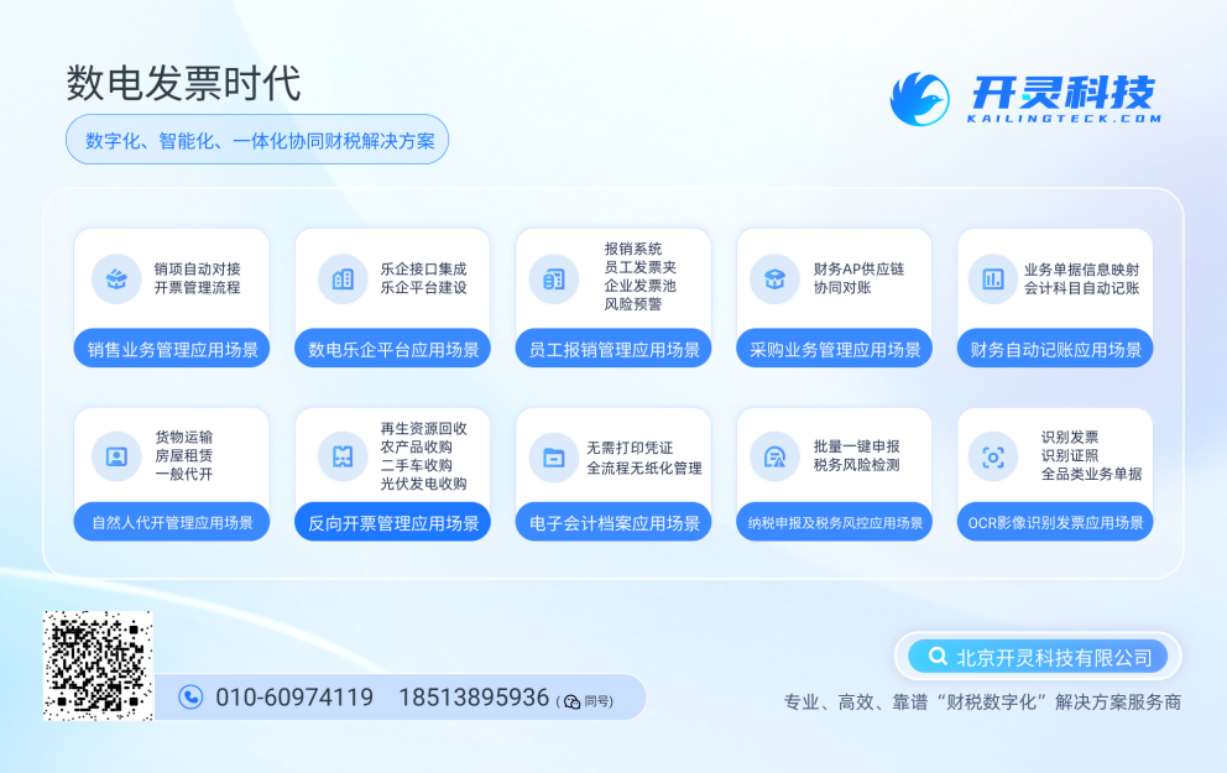
As a comprehensive business-finance-tax digitalization solution service provider, Kailing Technology provides business-finance-tax management digital transformation products and operational services for various government agencies, institutions, and large, medium, and small enterprises. The product line includes: solutions for sales contract management system, procurement contract management system, fully digitalized Leqi interface project, automatic output invoicing system, reverse invoicing system, invoice issuance for individuals system, employee expense control and reimbursement system, input VAT invoice management system, supply chain collaborative reconciliation system, image AI OCR recognition system, automatic financial bookkeeping system, electronic accounting archives system, etc., comprehensively driving the digitalization process across various fields.
Consultation Hotline: 18513895936 / 010-60974119 Location: Beijing