Customer opportunities, contracts, and payments each recorded separately and never matching up? Kailing Technology AI-CRM provides a full online closed loop from customer to payment across the entire sales process
Many sales teams have encountered this scenario: customer information is recorded in each person's Excel and WeChat, how far an opportunity has progressed is remembered only in the salesperson's head, contracts are thrown into folders once signed, and whether payment has arrived requires logging into online banking and checking transaction by transaction. By month-end, when doing performance and receivables, four sets of data are placed together and none match—customers, opportunities, contracts, and payments are each recorded separately. This is the typical "sales business line breakpoint."Kailing TechnologyAI-CRM What needs to be solved is precisely reconnecting this business line that has been cut into several segments, so that customers, opportunities, contracts, and collections are linked online from start to finish, forming a sales closed loop that no one can break.
▍1. Customers in spreadsheets, opportunities in heads, contracts in folders, payments in online banking
To understand the value of the closed loop, you must first see clearly how the breakpoints arise. A breakpoint is not a single step failing; rather, each step is placed in a different "box," and there is no channel between the boxes.
· Customers are in spreadsheets: Each salesperson maintains their own customer list in a variety of formats, and once a person leaves, the customer follow-up records disappear with them.
· Opportunities are in your head: How far this customer has progressed and what should be done next are often known only to the salesperson handling the order; if the supervisor wants to see progress, they can only ask one by one.
· Contracts are in folders: Contract amount, installment milestones, and when the next payment should be collected are all buried in scanned copies and Word documents, with no proactive reminders.
· Payments are in online banking: Whether the money has arrived requires finance to log in to online banking and check item by item, then go back to find which contract and which sales order it belongs to.
The four boxes each record separately and do not communicate with one another, resulting in mismatched accounts, lost deals during follow-up, and no one managing near-expiry renewals. The more breakpoints there are, the more time the sales team spends on "finding information and reconciling data", and the less time is actually spent with customers.
▍II. Breakpoint vs closed loop: two ways of living on the same sales line
Putting breakpoints and closed loops side by side makes the difference more intuitive. On the same "customer to payment collection" line, in breakpoint mode every step requires manual data transfer, while in closed-loop mode one record links everywhere.
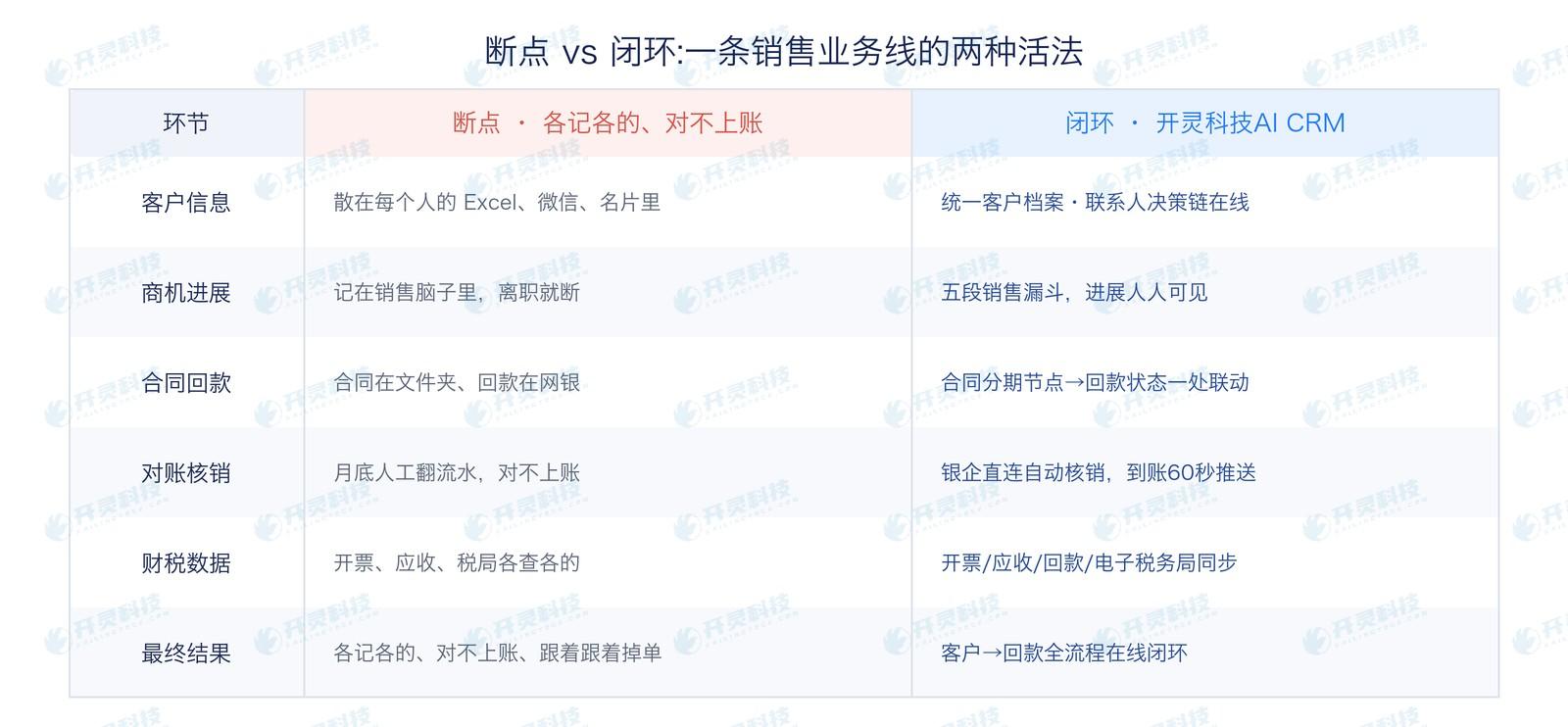
As can be seen from the above figure, a closed loop is not placing four systems together, but having them share the same data: once a customer file is established, subsequent opportunities, contracts, and payments are all attached to this customer; once a contract is signed, installment payment nodes and receivable amounts are automatically generated; once a payment arrives, it is automatically written off and backfilled to the corresponding contract and salesperson.Kailing TechnologyAI-CRM This "record once" approach fundamentally eliminates duplicate entry and reconciliation errors.
▍III. The closed loop of Kailing Technology AI-CRM: from customer file creation to renewal and repeat purchase
Kailing AI-CRM's sales closed loop can be broken into six end-to-end connected stages: customer profiling → opportunity → contract → payment → reminder → renewal repurchase.
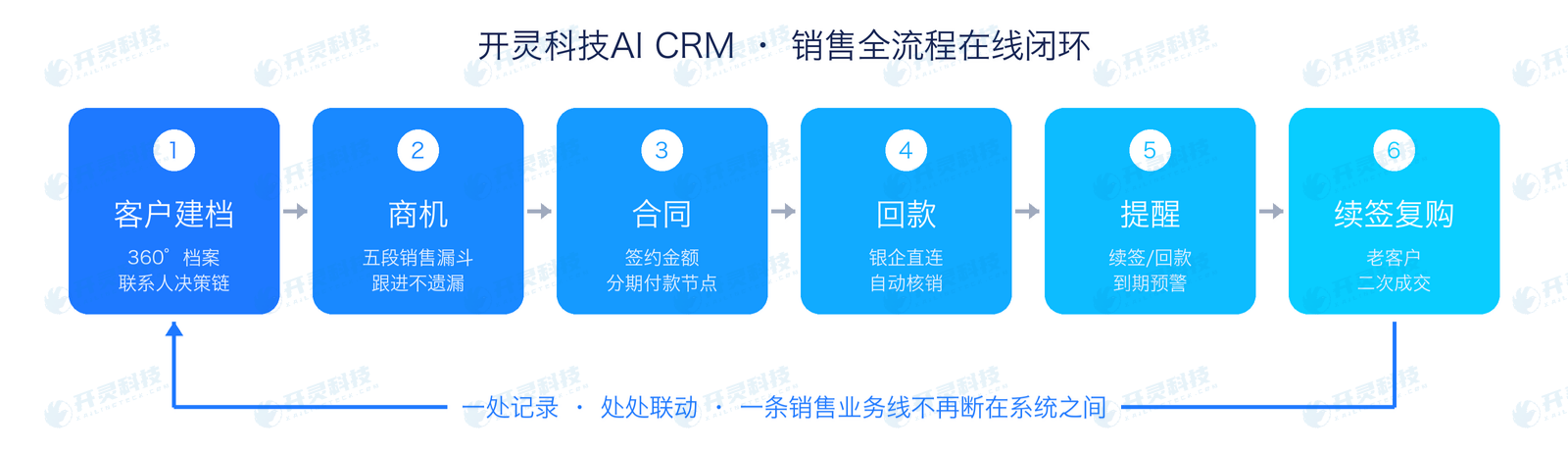
Customer record creation is the starting point. The system creates a 360° profile for each customer, recording industry, scale, person in charge, contacts, and decision chain, so you no longer need to worry about salespeople leaving and taking customers with them.
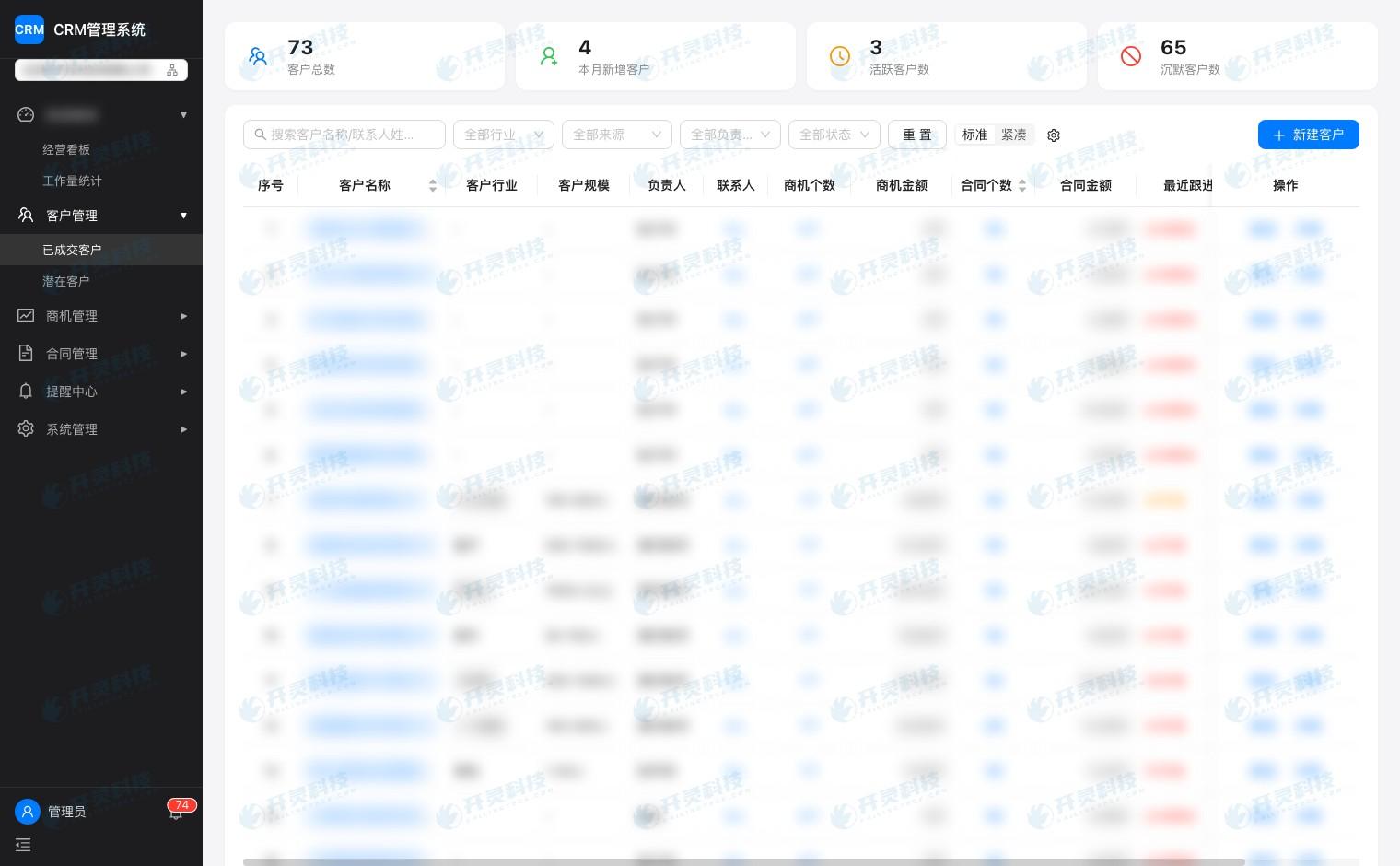
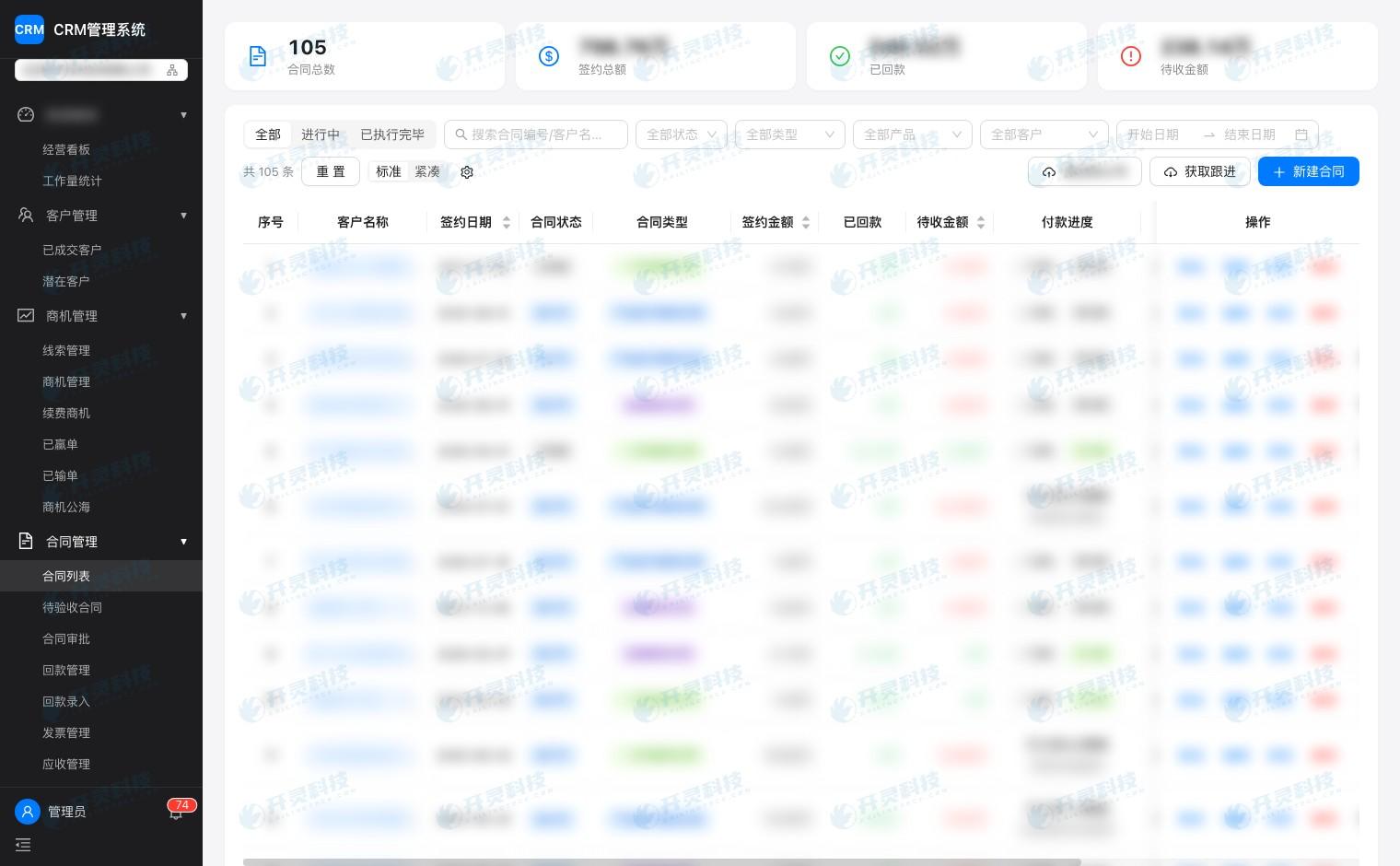
Entering the opportunity stage, leads flow through a five-stage sales funnel. From lead creation to win or loss, every step of progress is visible online, and supervisors can see at a glance where opportunities are stuck. At the contract stage, the signed amount, amount already collected, amount pending collection, and installment payment nodes are clear at a glance. The system automatically prompts the next receivable according to the node, no longer relying on people to remember.
The three stages of payment collection, reminders, and renewal and repeat purchases truly close this line into a "loop": payment collection is automatically written off, upcoming renewals and overdue payments are proactively warned, old customers are pushed to sales before expiration, and repeat purchases and renewals become new business opportunities, returning to the starting point. This is the complete closed loop of "customer → payment collection → back to customer."
▍IV. Business-finance-tax integration: invoicing, receivables, collections, and Electronic Tax Bureau data sync
If only the sales actions are connected, it is still only half a closed loop. What truly makes Kailing TechnologyAI-CRM What sets it apart from ordinary sales management tools is that it also connects "business-finance-tax" into this line.
In many enterprises, the sales system and the business-finance-tax system are two different teams with two different sets of accounts: sales looks at contracts and payments received, finance looks at invoicing and receivables, and tax data must be separately checked on the electronic tax bureau. Once data is separated, disputes arise such as "the contract shows payment received, but finance cannot find the invoice."
Kailing AI-CRM connects and syncs invoicing information, receivables, payments and electronic tax bureau data: applying for invoicing, syncing invoice status and reconciling accounts receivable are all completed on the same business line. Sales can see the invoicing and payment progress of their own orders, finance can see the contract and invoice corresponding to each payment, and management can see the complete receivables structure of invoiced-unpaid, uninvoiced-unpaid, long-term uninvoiced and total accounts receivable on the business dashboard. Business-finance-tax integration keeps 'what sales says' and 'what the books record' always the same thing.
▍V. Bank-enterprise direct connection auto-write-off: notify sales within 60 seconds of funds arrival
The link most likely to fail in the closed loop is payment collection and offset. The traditional approach is for finance to export bank statements at month-end and compare them one by one with a pile of contracts, which is not only slow but often mismatched.
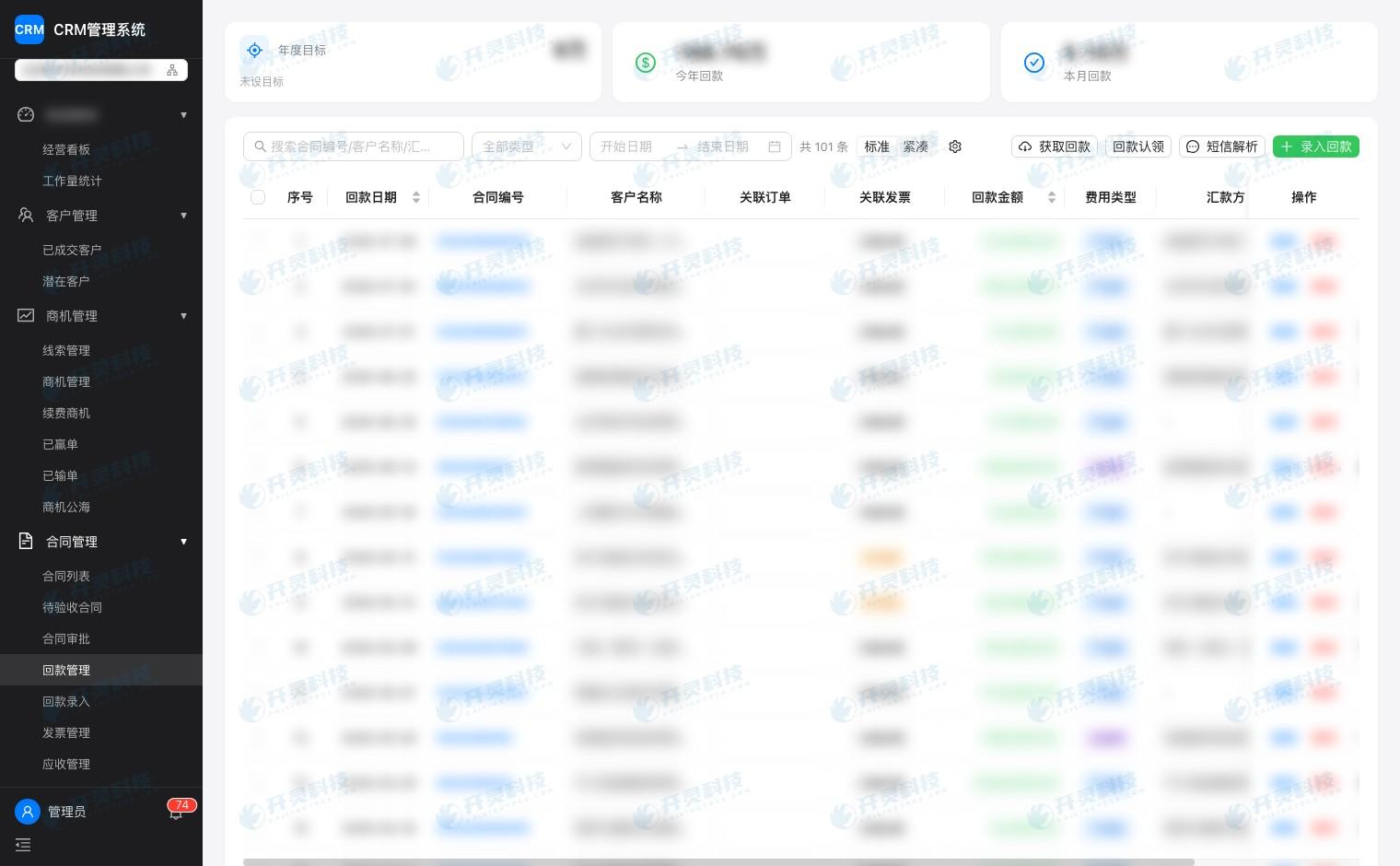
Kailing AI-CRM connects to bank statements via bank-enterprise direct connection. Once money arrives, the system pushes this payment to the corresponding salesperson within 60 seconds and automatically completes reconciliation — no manual order matching, no manual registration. Payment status is backfilled in real time to contracts and the business dashboard, and performance completion, payment trends and receivables overview update accordingly.
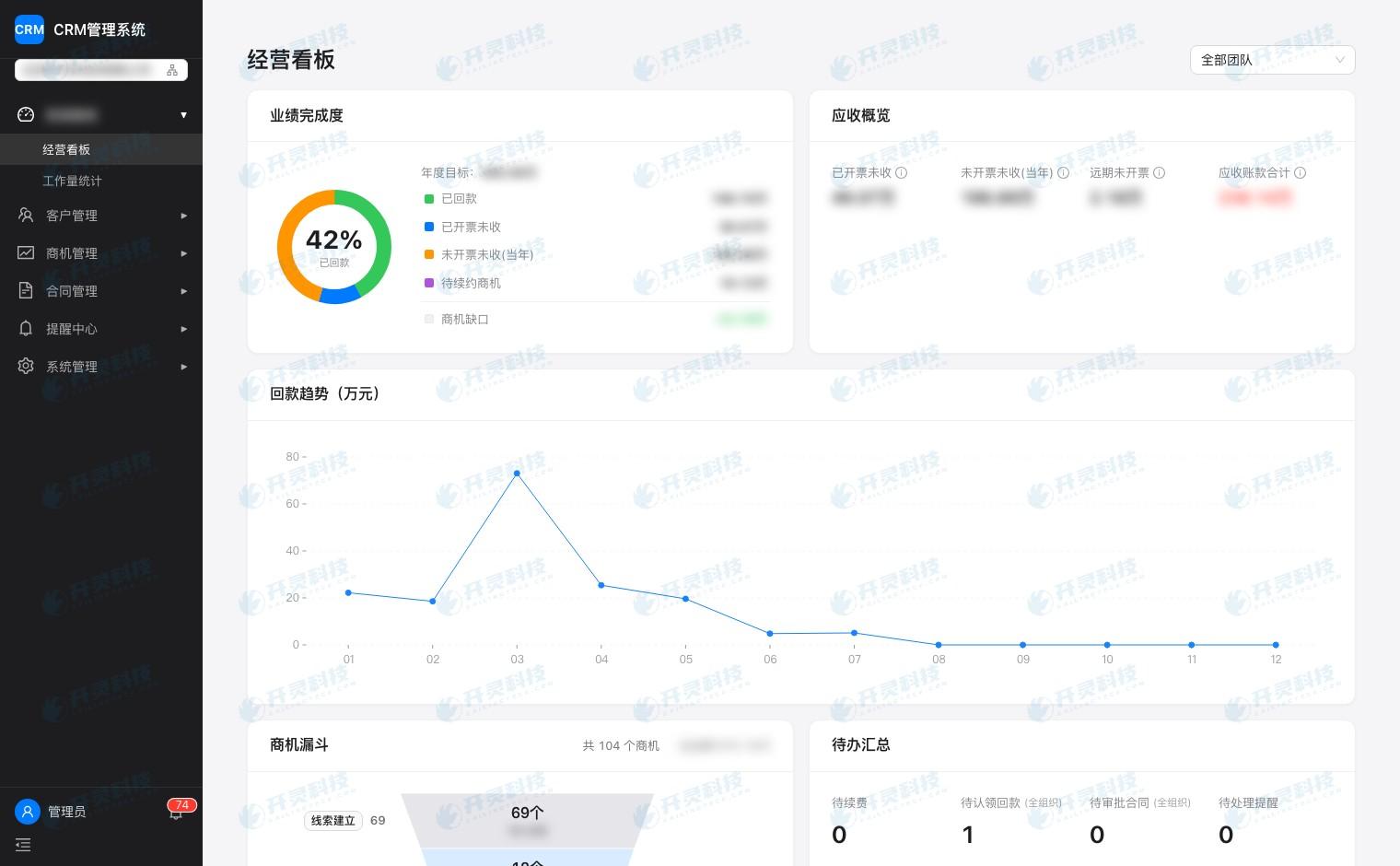
Thus, from the arrival of funds to the salesperson receiving notification, the contract being updated, and the dashboard refreshing, the entire process no longer requires people to move back and forth between systems. This is the most tangible value of a closed loop compared with breakpoints.
▍FAQ
Q: Kailing TechnologyAI-CRM What is the difference from ordinary sales management software?
A: Ordinary sales software mostly only manages customers and opportunities, while invoicing, collections, and receivables often require separate systems. Kailing Technology AI-CRM integrates customers, opportunities, contracts, collections, and business-finance-tax into the same line, and with bank-enterprise direct connection for automatic write-off, it delivers a full-process closed loop from customer to collection, rather than a single-point tool.
Q: Is bank-enterprise direct connection automatic reconciliation safe? Does it require changing the existing online banking process?
A: Bank-enterprise direct connection reads incoming transaction records based on the connection method provided by the bank, and is used to automatically match contracts and collections and generate write-off records, without changing the enterprise's original fund approval and online banking operation processes; after funds arrive, the system automatically compares and pushes them, and staff only need to confirm exceptions.
Q: We already use OA or WeCom. Can it integrate?
A: Yes. The system supports seamless integration with mainstream systems such as Weaver OA, WeCom, DingTalk, and Feishu, and to-dos and reminders can be pushed to the office tools commonly used by sales; it also supports private independent deployment and white-label OEM delivery, keeping data in the enterprise's own hands.
Q: After launch, will the way sales and finance work need major changes?
A: There is no need to start over. Sales continue to work with customers as usual, only moving records from their own spreadsheets into a unified archive; finance no longer needs to go through transaction records at month-end for reconciliation, as the system automatically writes off and only handles exceptions. Most actions are 'doing less repetitive work', not 'learning another system'.
Want customers, opportunities, contracts, and collections to no longer be recorded separately? Book Kailing TechnologyAI-CRM Demo, connecting the entire sales process into one closed loop: www.kailingteck.com 。
As a comprehensive business-finance-tax digitalization solution service provider, Kailing Technology provides business-finance-tax management digital transformation products and operational services for various government agencies, institutions, and large, medium, and small enterprises. The product line includes:
Solutions for businesses including sales contract management system, procurement contract management system, fully digitalized Leqi interface project, output automatic invoicing system, reverse invoicing system, invoice issuance for individuals system, employee expense control and reimbursement system, input VAT invoice management system, supply chain collaborative reconciliation system, image OCR recognition system, automatic financial bookkeeping system, and electronic accounting archives system, comprehensively driving the digitalization process across various fields.
If you have any business-finance-tax digital transformation needs, welcome to contact us. Beijing Kailing Technology will serve you wholeheartedly.
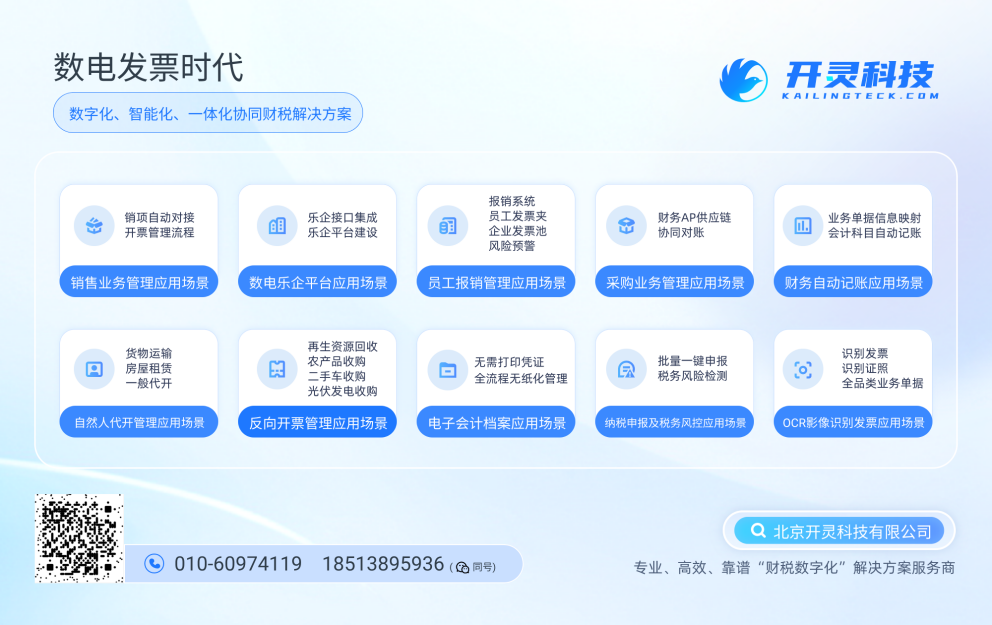
As a comprehensive business-finance-tax digitalization solution service provider, Kailing Technology provides business-finance-tax management digital transformation products and operational services for various government agencies, institutions, and large, medium, and small enterprises. The product line includes: solutions for sales contract management system, procurement contract management system, fully digitalized Leqi interface project, automatic output invoicing system, reverse invoicing system, invoice issuance for individuals system, employee expense control and reimbursement system, input VAT invoice management system, supply chain collaborative reconciliation system, image AI OCR recognition system, automatic financial bookkeeping system, electronic accounting archives system, etc., comprehensively driving the digitalization process across various fields.
Consultation Hotline: 18513895936 / 010-60974119 Location: Beijing