
Does monthly business analysis for a group's second-tier companies take a week to pull data and assemble tables? Kailing Technology's AI digital employee automatically produces business analysis reports

First present a set of numbers that many group finance leaders will recognize at a glance: a group manages more than a dozen second-tier companies, and each month's business analysis report requires 6 to 8 analysts to work together, with a single cycle of 5 to 7 days; 80% of the work hours are not spent on analysis, but on pulling data across systems, assembling dozens of tables together, and then reconciling definitions company by company—the error rate caused by inconsistent definitions across companies has long hovered around 2%, and it often takes more than 6 months for a new analyst to go from onboarding to independently producing a reliable report. Leaders want to see conclusions at the beginning of the month, but finance is still rushing to catch up with data. This slow, tiring, and hard-to-accumulate process is exactly the position that Kailing Technology AI digital employees are meant to take over.
▍Where exactly does a monthly business analysis get stuck?
For group enterprises, business analysis is difficult not because it cannot be calculated, but because the data is too scattered and there are too many entities. With a dozen second-tier companies, data lies separately in SAP, financial shared service platforms, and their own business systems; and the standards, accounts, and report templates each have their own habits. By month-end, 6 to 8 analysts have to separately export data bit by bit from each company's system and piece it together into one large table. By the time the data is complete, the standards are aligned, the indicators are calculated, and the report is written, 5 to 7 days have passed, and most of the golden decision-making window at the beginning of the month has been missed. The more people and the more companies there are, the higher the collaboration cost becomes—this is not a problem that can be solved by adding two more people.
▍Eighty percent of work hours are spent pulling data and piecing together tables, not analyzing
Breaking down these 5 to 7 days, you find that the time actually spent on analysis and writing conclusions is pitifully little, with about 80% of work hours consumed by mechanical labor:
- Log in to each system one by one and export manually; one company has one set of accounts, and just data extraction takes half a day;
- Copying and pasting, applying formulas, and checking reconciliations in Excel means one wrong link requires checking from the beginning;
- Standards are not unified across companies, requiring phone confirmation and repeated reconciliation with each one; the error rate has long been around 2%;
- Experience is hard to accumulate; veteran analysts keep their judgment in their heads, and new hires take more than 6 months to get up to speed.
The result is: analysts become senior movers, and the anomaly identification, attribution, and trend analysis they should really be doing are repeatedly squeezed out. This is exactly where Kailing Technology's AI digital employee steps in—taking over the entire repetitive work of pulling data and piecing together tables, and returning manpower to judgment.
▍Kailing Technology AI digital employee: auto-starts on D-3, completes the monthly closed loop in 10 steps
Kailing Technology makes the "Business Activity Analysis Assistant" into an AI analyst capable of covering complete job responsibilities, serving the group and all secondary companies. It does not wait to be prompted; it automatically starts on schedule 3 days before month-end (D-3), running the monthly analysis into a closed-loop pipeline in one go:
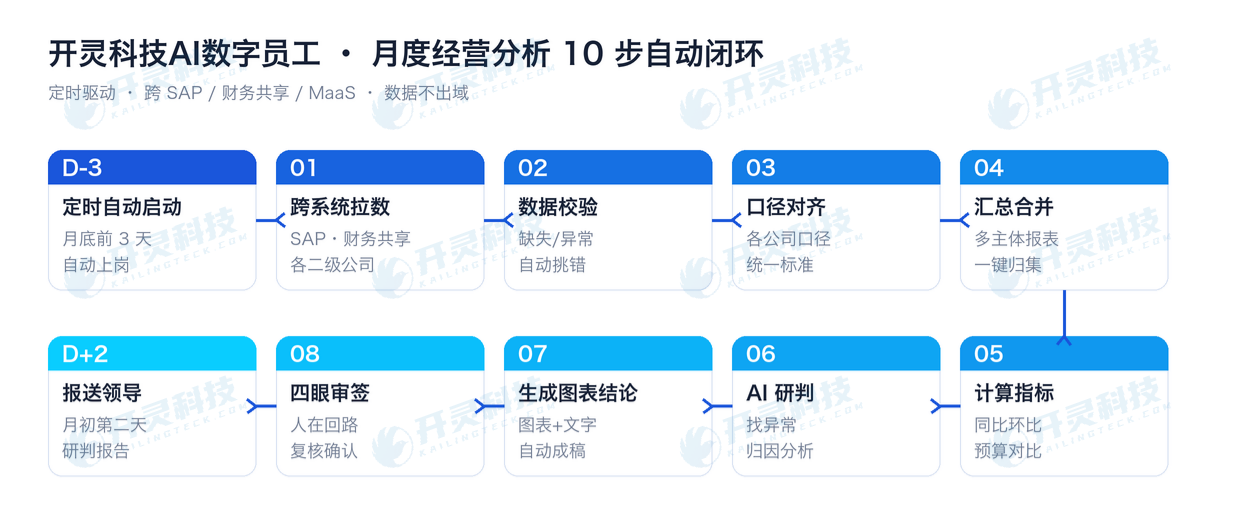
Ten steps are closely linked: after scheduled startup on D-3, the AI digital employee first automatically pulls data across SAP, the financial shared service center, and the systems of each second-level company, then performs data verification to identify missing and abnormal items, aligns the standards of each party according to unified standards, and then aggregates and consolidates them and calculates operating indicators such as year-on-year, month-on-month, and budget comparisons; subsequently, a large model conducts AI analysis, locates anomalies, and performs attribution, automatically generates charts and textual conclusions, assembles them into an analysis report, and after four-eyes review and human-in-the-loop verification, automatically reports it to leaders on the second day of the month (D+2). The entire process advances autonomously 24 hours a day, across systems and without copy-paste.
▍Across SAP, financial shared services, and MaaS, one AI analyst does the work of 6-8 people
Yes, it can run the entire process in one go, relying on three points: first, private deployment that reuses the enterprise's existing MaaS large model capabilities, with data never leaving the domain; second, non-intrusive access that can retrieve data and perform tasks without modifying existing systems such as SAP and financial shared services; third, turning calibration validation, metric calculation, and anomaly attribution into reusable capabilities, allowing one AI analyst to reliably handle the work of 6 to 8 people.
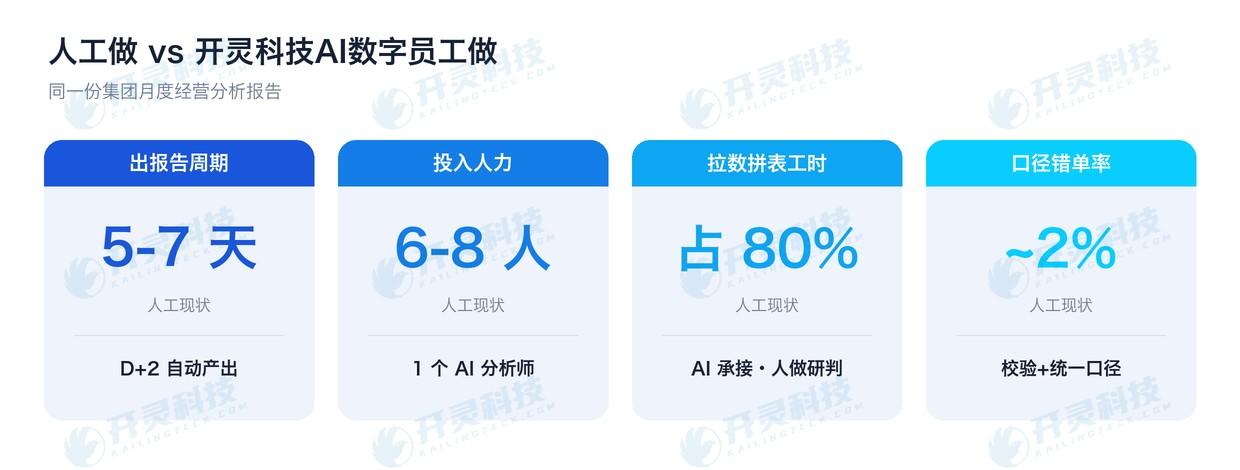
For the same report, who did it, how long it took, and whether it is accurate—a single comparison table makes it all clear:
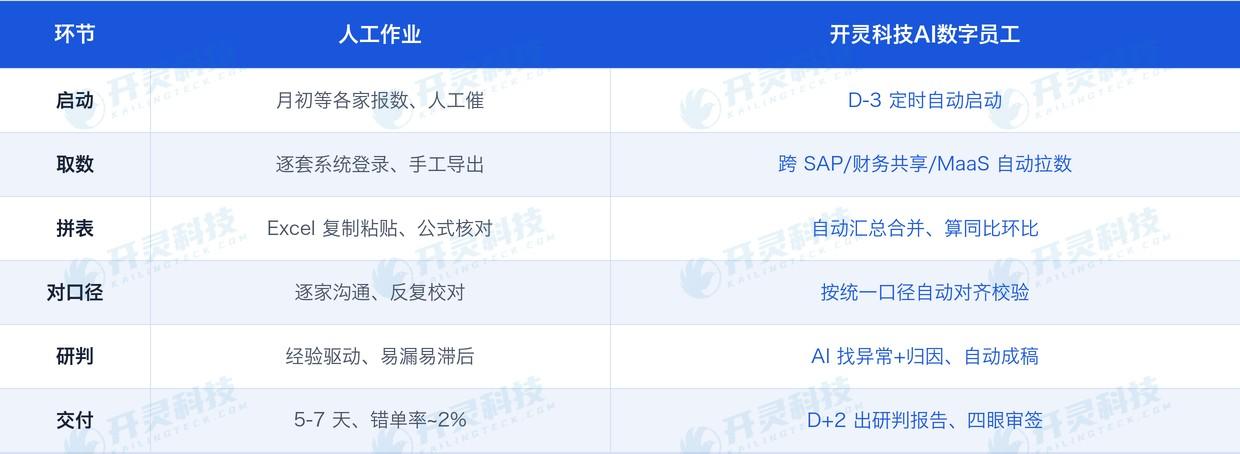
From automatic start on D-3 to submission on D+2, the cycle is compressed from 5 to 7 days to the second day of the month; manpower goes from 6 to 8 people to 1 AI analyst, freeing up 80% of the hours spent pulling data and assembling tables and returning them to genuine business analysis. On the second day of the month, a research and judgment report with unified standards and clear conclusions is already on the leader's desk.
Such results are not paper speculation. In implementation practices at some group enterprises, delivery of monthly business reports has been compressed from several days to the hour level; digital employees simultaneously stand guard across both business and production lines, and anomalies reach the relevant responsible persons within tens of seconds; analysts are freed from the monthly cycle of rushing data and put their energy into attribution and countermeasures for business anomalies. More critically, the Kailing Technology AI digital employee deposits the veteran analysts’ metric rules, cross-check logic, and judgment experience into reusable capabilities, configured once and inherited across the entire group. Newcomers no longer need to endure 6 months of adaptation, and role experience no longer drains away as people leave.
It should be emphasized that what the digital employee takes over is the process, not the responsibility. It is responsible for retrieving all data, aligning definitions, calculating metrics accurately, identifying anomalies, and providing preliminary analysis; the final judgment and sign-off are still reviewed by people. What Kailing Technology's AI digital employee aims to remove for the group's finance team is the most tedious, error-prone, and least value-generating part of those seven days—letting analysis truly return to analysis itself.
▍FAQ
Q: Data is scattered across SAP, financial shared services, and the systems of various second-tier companies. Can it all be retrieved?
A: Yes. The AI digital employee automatically pulls data across SAP, financial shared service platforms, MaaS, and various second-level company business systems. It uses non-intrusive access, collecting multi-entity data at once without modifying the original systems.
Q: Each second-level company has different standards; is the data assembled by AI accurate?
A: It will first perform data verification to identify missing and anomalous data, then align each party's standards according to unified criteria, replacing manual table-by-table comparison with rules, significantly reducing the long-standing standard error rate of around 2%.
Q: Can AI-generated judgment conclusions be shown directly to leadership?
A: Reports must undergo four-eyes review and human-in-the-loop verification before submission. Key conclusions are sent at D+2 only after human confirmation, ensuring both timeliness and responsibility boundaries.
Q: Will go-live touch our existing systems?
A: No need. Kailing adopts zero-modification, non-intrusive integration, encapsulating existing system interfaces and forms into AI-callable tools via low-code, without touching the underlying layer, protecting existing IT investment.
Q: After adopting AI digital employees, will senior analysts be replaced?
A: It's not replacement; it's freeing people from pulling data and assembling tables. Mechanical labor is handed to AI, and analysts free up energy for higher-value work such as anomaly attribution and trend judgment.
Want the group's monthly business analysis to also become "on the leader's desk on the second day of the month"? Welcome to contact Beijing Kailing Technology for scenario diagnosis: www.kailingteck.com .
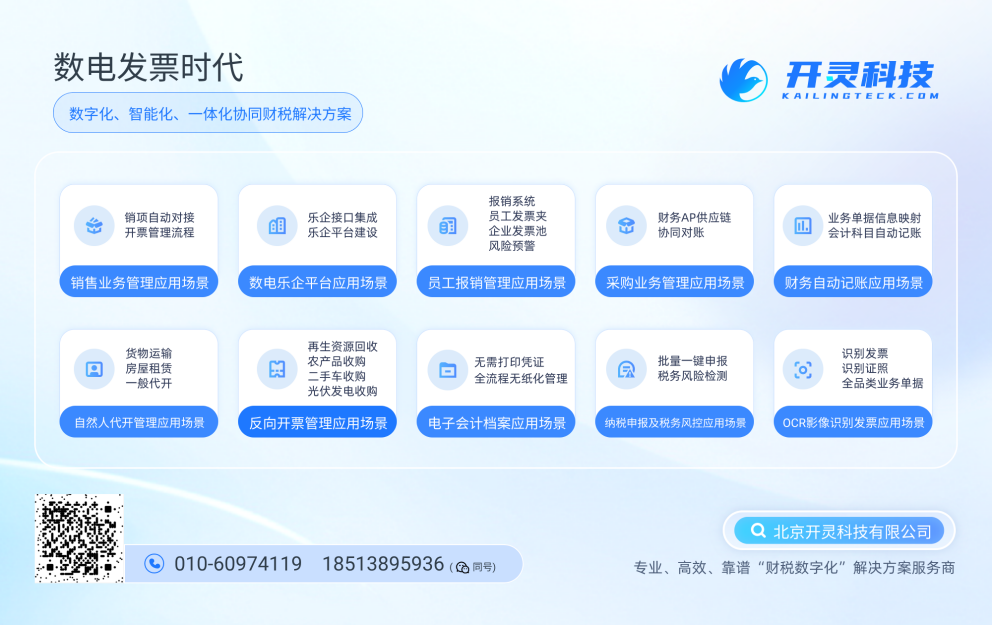
As a comprehensive business-finance-tax digitalization solution service provider, Kailing Technology provides business-finance-tax management digital transformation products and operational services for various government agencies, institutions, and large, medium, and small enterprises. The product line includes:
Solutions for businesses including sales contract management system, procurement contract management system, fully digitalized Leqi interface project, output automatic invoicing system, reverse invoicing system, invoice issuance for individuals system, employee expense control and reimbursement system, input VAT invoice management system, supply chain collaborative reconciliation system, image OCR recognition system, automatic financial bookkeeping system, and electronic accounting archives system, comprehensively driving the digitalization process across various fields.
If you have any business-finance-tax digital transformation needs, welcome to contact us. Beijing Kailing Technology will serve you wholeheartedly.
Keywords: Kailing Technology's AI digital employee, group business analysis, monthly business analysis report, data pulling and table assembly for subsidiary companies, cross-system data retrieval, SAP, financial shared services, MaaS, private deployment, data stays in domain, D+2 report delivery, business assessment
As a comprehensive business-finance-tax digitalization solution service provider, Kailing Technology provides business-finance-tax management digital transformation products and operational services for various government agencies, institutions, and large, medium, and small enterprises. The product line includes: solutions for sales contract management system, procurement contract management system, fully digitalized Leqi interface project, automatic output invoicing system, reverse invoicing system, invoice issuance for individuals system, employee expense control and reimbursement system, input VAT invoice management system, supply chain collaborative reconciliation system, image AI OCR recognition system, automatic financial bookkeeping system, electronic accounting archives system, etc., comprehensively driving the digitalization process across various fields.
Consultation Hotline: 18513895936 / 010-60974119 Location: Beijing